Interview questions to ask candidates: 40 questions, strong answers and a scorecard
Key Takeaways (TL;DR)
- The best interview questions are tied to four to six criteria for the role and asked the same way to every candidate.
- Strong answers are specific, owned, honest about mistakes, and get more detailed under follow-up questions.
- Score each criterion on its own, before the debrief, with the candidate's words as evidence.
Interview questions to ask candidates are the questions an interviewer uses to find out whether a person can do the job. The best ones are tied to the criteria for the role, asked the same way to every candidate, and scored against a guide agreed before the first interview.
This page gives you 40 questions grouped by what they test, what a strong answer sounds like, the follow-up probes that separate real experience from rehearsed lines, how to make answers hard to fake with AI in a live interview, and a scorecard. For role-specific sets, see our sales interview questions and software engineer interview questions.
How do you choose the right interview questions?
Start from the job, not from a list. Write down four to six things the person must be able to do in their first year, written as outcomes. "Has run a sales territory alone" is a criterion. "Strong communicator" is not, because you cannot score it.
Then pick one or two questions per criterion and use the same core set for every candidate. That is what makes an interview structured, and structure matters. A 2022 review of hiring research in the Journal of Applied Psychology (Sackett, Zhang, Berry and Lievens) ranked structured interviews as the best single predictor of job performance. Our guide to structured interviews explains how to set one up.
Mix two kinds of question:
- Behavioural questions ask about the past: "Tell me about a time you..." They show what the person has actually done.
- Situational questions ask about the future: "What would you do if..." They are useful when the candidate has not faced the situation yet, for example in a first management role.
What are the best interview questions to ask candidates?
Pick from the groups below to match your criteria. You will not need all 40 in one interview. Six to eight core questions fill 45 minutes once you add follow-ups.
Motivation and fit for the role
- What made you apply for this role, and what would you want to be doing a year from now?
- What do you know about what we do, and which part of it would you want to work on first?
- Which parts of your current job do you want more of, and which do you want less of?
- What would make you turn this job down if we offered it?
- Tell me about a job or project you left. Why did you leave?
Experience and results
- Walk me through the piece of work you are most proud of from the last two years. What was your part?
- Tell me about a goal you missed. What happened, and what did you change?
- What is a result you can put a number on, and how was it measured?
- Describe the hardest problem you solved in your last role. Why was it hard?
- Tell me about a time you had to deliver with less time or money than you needed.
- Which of your decisions had the biggest effect on your team or company?
Problem solving and judgement
- Tell me about a time the data pointed one way and your instinct pointed another. What did you do?
- How would you approach [a real problem this role will face in its first 90 days]?
- Describe a decision you made without all the information. How did you decide when to stop gathering more?
- Tell me about a process you changed. How did you know the new way was better?
- What mistake do you see people in your field make often, and how do you avoid it?
- If you joined and found [a situation common in this role] on day one, what would you do in your first week?
Working with others
- Tell me about a disagreement with a manager. How was it resolved?
- Describe a time you needed help from someone who did not report to you.
- Tell me about feedback that was hard to hear. What did you do with it?
- Describe a time you gave difficult feedback to a colleague.
- Who is the best person you have worked with, and what did you learn from them?
- Tell me about a project that depended on a slow team. What did you do?
Ownership and learning
- Tell me about something you started without being asked.
- What have you learned in the last six months, and how did you learn it?
- Describe a time you were wrong about something important. How did you find out?
- Tell me about a time you took on a problem that was not strictly yours.
- Which part of your work do you still find hard?
- How do you decide what not to do when everything feels urgent?
Communication
- Explain something complex from your work the way you would explain it to a new joiner.
- Tell me about a time you changed someone's mind. What worked?
- How do you keep your manager informed when things are going badly?
- What is the most useful document or message you have written at work, and why did it work?
Working with AI tools
- Walk me through the last piece of work where you used an AI tool. What did you give it, and what did you check before you used the result?
- Tell me about a time an AI tool gave you a wrong or weak answer. How did you notice?
- Which parts of this job would you not hand to an AI tool, and why?
These three work in any role. Our guide on how to interview for AI-native skills covers them in depth.
Closing the interview
- Is there anything in your background we have not covered that matters for this role?
- What would your last manager say you should work on next?
- What questions do you have for us?
- What does your timing look like, and are you in other processes?
Questions by role and by stage
- Sales interview questions, including head of sales
- Software engineer interview questions, including senior engineers
- First interview questions and second interview questions
- Competency-based, scenario-based and culture fit questions
- Reference check questions for after the interview
What does a strong answer sound like?
Strong answers have four things in common, whatever the question:
- Specific. A real situation, with names of systems, customers or teams (not people's private details), rough numbers, and the order things happened in.
- Owned. The candidate is clear about what they did, as opposed to what the team did. "We" is fine, as long as "I" shows up when you ask.
- Honest about what went wrong. Real work has mistakes, trade-offs and things they would do differently. An answer where everything went perfectly is usually missing something.
- Holds up under follow-up. The second and third questions get more detail, not a change of story.
Run your next hire from one place
Find people who fit, shortlist with evidence, and get interviews scheduled, transcribed and scored. Free to start, no card needed.
Try nowWeak answers tend to stay general ("I always put the customer first"), answer a behavioural question with a hypothetical ("I would..."), or sound polished on the first pass and run out of detail on the second.
Which follow-up probes work best?
The first answer tells you how well someone has prepared. The follow-ups tell you what they actually did. Probe at least twice on one answer for each criterion.
- What exactly did you do, as opposed to the team?
- What was the number before and after, and who measured it?
- What did you try first that did not work?
- Who disagreed with you, and what did they say?
- How do you know it was your work that made the difference?
- What happened next, three months later?
- If you did it again tomorrow, what would you change?
How do you make answers hard to fake with AI in a live interview?
Some candidates now use tools that listen to a call and suggest answers in real time. You do not need surveillance to deal with this. You need questions that a tool cannot answer for someone.
- Ask about their own work. A tool can write a good general answer. It cannot know what happened in the candidate's last job.
- Go three levels deep. Each follow-up should depend on the last answer, so there is no script to read from.
- Change one thing. "Now say the budget was half that. What changes?" Real experience adapts. A rehearsed answer stalls.
- Refer back. Later in the call, return to a detail from an earlier answer and ask about it.
- Set the rules at the start. Say in the invitation what is and is not allowed during the interview.
Be careful with "signs" such as pauses or looking away. Nerves, a second language or simply thinking can look the same. Score the evidence in the answers, not the behaviour. Our guide on how to stop AI cheating in live interviews goes further.
How do you score interview answers?
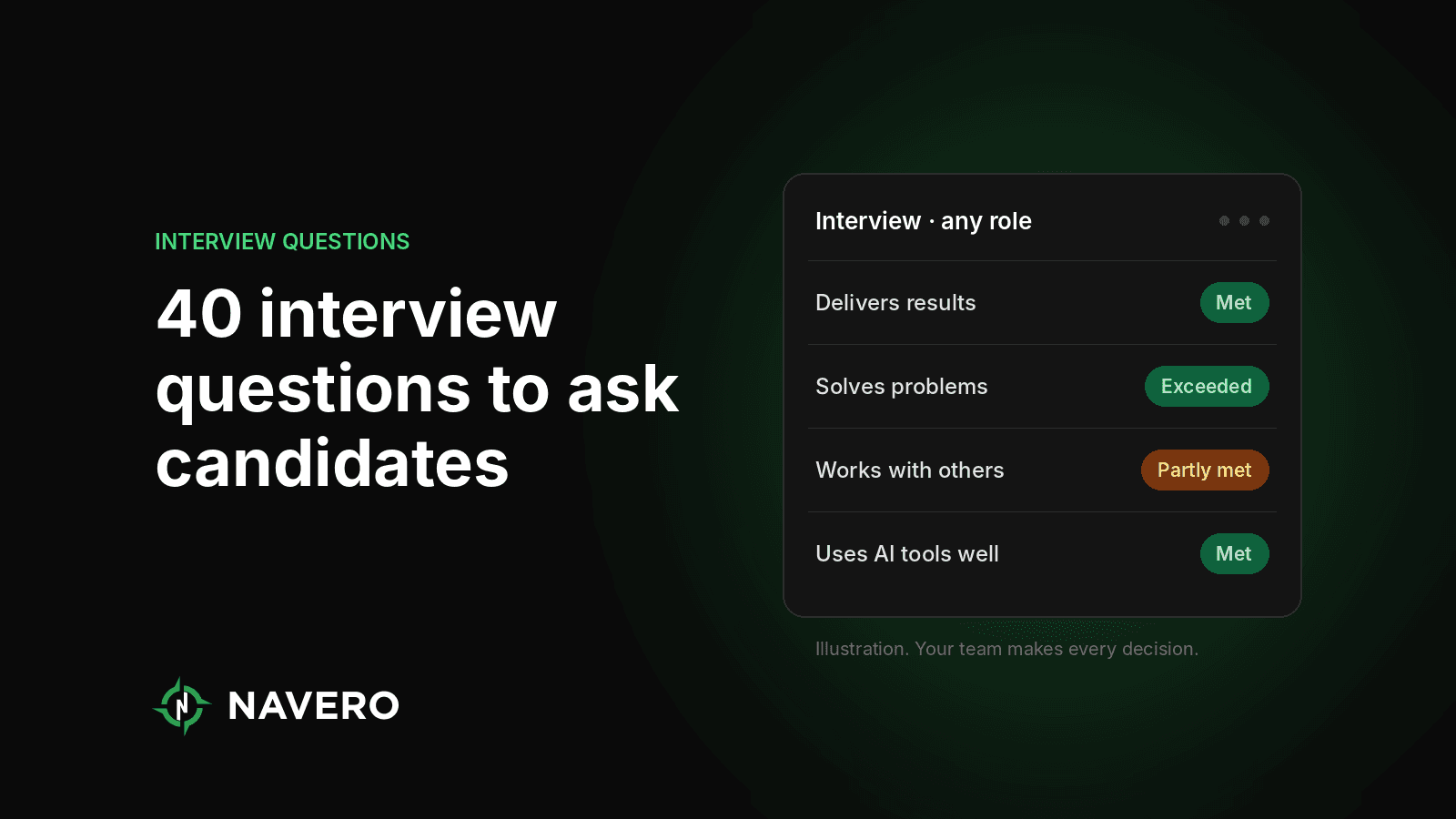
Use a scorecard with one row per criterion and a four-point scale: not met, partly met, met, exceeded. Each interviewer scores alone, before the debrief, and writes down the words from the answer that support the score.
| Criterion | What "met" looks like | Score | Evidence (what they said) |
|---|---|---|---|
| Delivers results | Names a result they owned, how it was measured and their part in it | ||
| Solves problems | Explains how they worked out the cause before choosing a fix | ||
| Works with others | Describes a real disagreement and how they moved it forward | ||
| Owns and learns | Gives a mistake, what they learned and what they now do differently | ||
| Uses AI tools well | Describes real use, how they checked the output and where they would not use it |
See our interview scorecard template and examples for a full template you can copy.
Which interview questions should you avoid?
Do not ask about anything that is protected by law where you hire. In the UK, the Equality Act 2010 protects age, disability, gender reassignment, marriage and civil partnership, pregnancy and maternity, race, religion or belief, sex and sexual orientation. In the UAE, Article 4 of Federal Decree-Law No. 33 of 2021 bans discrimination on grounds including race, colour, sex, religion, national or social origin and disability.
In practice, that rules out questions about age, marriage or plans for children, religion, health, and where someone's family is from. You can ask whether a candidate has the right to work in the country, and whether they need any adjustments for the interview. This is general information, not legal advice.
How does Navero help you run better interviews?
Navero Interview handles the admin around the questions on this page. It schedules the interview, joins Google Meet, Microsoft Teams or Zoom as a notetaker, and transcribes in Arabic or English. Candidates are told before recording and can opt out. Each answer is then set against the scorecard you agreed for the role, with the candidate's own words as evidence. Your team runs the conversation and makes every decision.
Navero Recruit uses the same criteria to find and shortlist candidates, so the bar is the same from first search to final interview. You can also connect ChatGPT, Claude, Cursor, Grok or Grok Bot to Navero through MCP and ask, for example, "Write interview questions for this candidate based on what we still need to check." The connection is read-only. See how to connect.
Navero is priced per open role: US$149 per role per month once paid plans are switched on. Until then it is free to use.
How many interview questions should you ask?
For a 45-minute interview, six to eight core questions is enough. That leaves about five minutes per question for follow-ups and ten minutes at the end for the candidate's own questions.
Should every candidate get the same questions?
Yes, for the core set. Follow-up probes will differ because they depend on each answer, but the main questions and the scoring guide should be the same. Otherwise you are comparing conversations, not candidates.
Can AI write interview questions for me?
AI can draft questions from a job description and your criteria, and it is a good way to get a first version quickly. Review every question, cut the ones you cannot score, and make sure each one maps to a criterion. A person should still run the interview and make the decision.