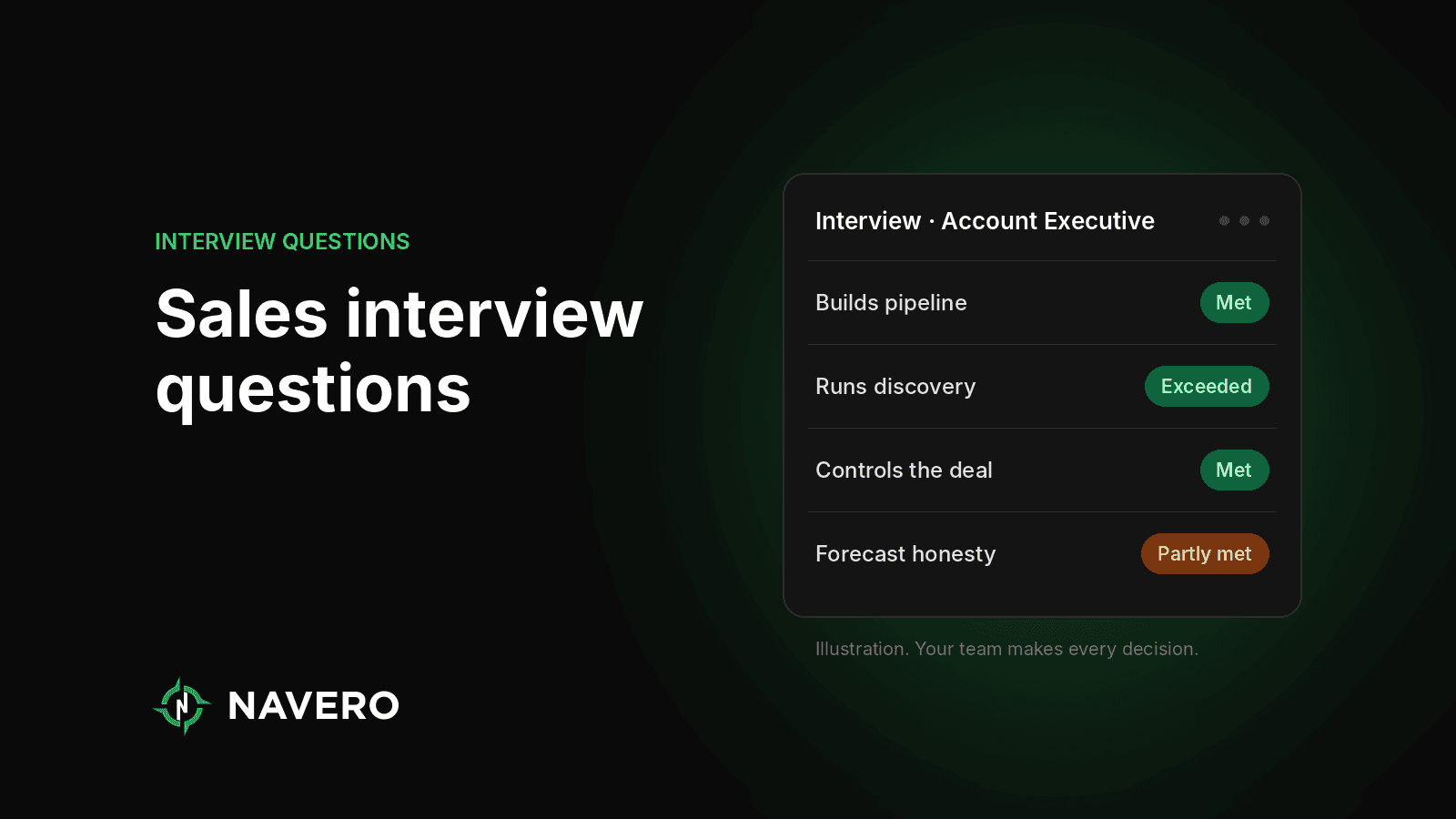
Sales interview questions: 20 questions for reps and a head of sales
Key Takeaways (TL;DR)
- Good sales interview questions ask about real deals, real numbers and what happened when a deal went wrong.
- Stay on one deal across several questions and check the numbers add up. This also makes answers hard to fake with AI.
- For a head of sales, test hiring, coaching, the forecast and process, not personal deals.
Sales interview questions test whether a candidate can find, run and close deals in your market, not whether they are good in a meeting. The best ones ask about real deals, real numbers and what the candidate did when a deal went wrong.
Below are 12 questions for sales reps and account executives, 8 more for a head of sales, what strong answers sound like, the follow-up probes to use, how to make answers hard to fake with AI in a live interview, one AI-native question, and a scorecard. For questions that work in any role, see our hub of interview questions to ask candidates.
What should a sales interview test?
Pick four to six criteria before the first interview. For most sales roles they look like this:
- Builds pipeline. Finds and opens new conversations without waiting for inbound leads.
- Runs discovery. Learns what the buyer needs, who decides and what happens if they do nothing.
- Controls the deal. Keeps next steps agreed, handles the buying group and closes on a date.
- Is honest about the forecast. Knows which deals are real and says so early.
- Takes coaching. Changes how they sell after feedback.
For a head of sales, add: hires and coaches reps, builds a forecast the business can plan on, and designs the sales process.
What are the best sales interview questions?
For sales reps and account executives
- Walk me through the last deal you closed, from first contact to signature. What was your part at each step?
- Tell me about a deal you expected to win and lost. When did you know, and what would you do differently?
- How did you build your own pipeline in your last role? Roughly how much of it came from you rather than inbound?
- Take me through your best discovery call. What did you learn that changed the deal?
- Tell me about a buyer who went quiet after a strong meeting. What did you do?
- How do you decide a deal is not worth chasing?
- What were your quota and your attainment over the last four quarters, and what explains the difference between your best and worst quarter?
- Describe a deal with several decision makers. How did you find out who really decided?
- Tell me about a time a buyer pushed for a discount. How did you protect the price?
- How do you prepare for a first call with someone you know nothing about?
- What feedback from a sales manager changed the way you sell?
- Our buyer is [the role you sell to]. Who would you call first here, and what would you say to get the meeting?
For a head of sales
- How did you build the forecast in your last role, and how close was it each quarter?
- Walk me through a sales hire you got wrong. What did you change in how you hire?
- What would you do in your first 90 days here, and what would you expect to have changed by day 30?
- Tell me about a time you changed the sales process. What happened to win rate or deal length?
- How do you coach a rep who is working hard but behind on quota?
- At our stage, how would you split selling between the founder, yourself and the team?
- Tell me about a pricing or packaging change you pushed for. What did you learn?
- Which numbers do you look at every week, and what would make you act on one?
What does a strong answer sound like?
- Pipeline. Describes a repeatable way they found buyers, with rough volumes (for example, how many conversations a week) and which channel worked best. A weak answer relies on "the leads were good".
- Discovery. Names what the buyer said that changed the deal, such as a hidden deadline or a second decision maker. A weak answer lists the product's features.
- Deal control. Can describe the buying group by role and the agreed next step at each stage. Knows why a deal moved or stalled.
- Forecast honesty. Explains their quota and attainment plainly, including bad quarters, without blaming the territory for everything.
- Coaching. Gives a specific piece of feedback and a specific change in behaviour that followed.
- Head of sales. Talks about systems and people, not just personal deals: how the forecast is built, how reps are hired and ramped, which numbers trigger action.
Run your next hire from one place
Find people who fit, shortlist with evidence, and get interviews scheduled, transcribed and scored. Free to start, no card needed.
Try nowWhich follow-up probes should you use?
- What was the deal size range and how long did it take from first call to signature?
- Who was the economic buyer, and when did you first speak to them?
- What did the competitor offer, and why did the buyer choose you (or them)?
- What was the next step you agreed at the end of that call?
- How many deals like that did you close in the year?
- For a head of sales: what did the forecast say at the start of the quarter, and what came in?
How do you make sales answers hard to fake with AI in a live interview?
A tool can produce a good general answer about discovery or objection handling. It cannot know the candidate's own deals. So keep pulling the conversation back to one real deal and go deep.
- Stay on one deal. Ask about the same deal across several questions: who joined when, what the buyer objected to, what changed the outcome.
- Refer back. "Earlier you said finance joined in week three. What did they ask?" Real memory has these details. Generated answers do not.
- Check that the numbers add up. Quota, attainment, deal size and deal count should agree with each other across the interview.
- Change the situation. In the prospecting question, change the buyer halfway: "They say they already use a competitor. Now what?"
- Say your rules at the start. Tell candidates in the invitation what is allowed during the call.
Our guide on how to stop AI cheating in live interviews covers this in more detail.
What is a good AI-native question for sales?
"Talk me through how you would use an AI assistant to prepare for a first call with one of our target accounts. What would you ask it, what would you check yourself, and what would you never send without rewriting?"
A strong answer gives the assistant real context (the account, the buyer's role, what the candidate already knows), uses it for research and preparation, checks facts against the source before relying on them, rewrites outreach in their own voice, and keeps customer data out of tools the company has not approved. A weak answer is either "I don't use it" with no reason, or "I let it write my emails".
How do you score a sales interview?
Use one row per criterion. Score each one on its own as not met, partly met, met or exceeded, and write down what the candidate said.
| Criterion | What "met" looks like | Red flag |
|---|---|---|
| Builds pipeline | A repeatable way of finding buyers, with rough volumes | All pipeline came from inbound or a manager |
| Runs discovery | Names a buyer insight that changed the deal | Describes features, not the buyer's problem |
| Controls the deal | Knows the buying group and the next step at each stage | Cannot say who decided or why it closed |
| Forecast honesty | States quota and attainment plainly, including bad quarters | Numbers change or do not add up |
| Takes coaching | A specific feedback point and the change that followed | No example, or blames the manager |
| Head of sales: builds the team | A hiring and ramp approach, including a hire that failed and what changed | Only talks about their own deals |
| Head of sales: forecast and process | Explains how the forecast is built and how close it was | Cannot describe the forecast method |
Copy the full template from our interview scorecard guide.
How does Navero help you hire salespeople?
Navero Recruit finds sales candidates against criteria you approve, such as "has sold to finance teams in the GCC", and shows what each person has done against each one. Navero Interview schedules the interviews, transcribes them in Arabic or English with the candidate's consent, and sets every answer against your scorecard with the candidate's words as evidence. Your team runs the interview and makes the decision. If you are hiring your first rep, our guide on how to hire a sales rep covers the full process.
Navero is free to use for now. Once paid plans are switched on, it costs US$149 per open role per month.
How many interviews should a sales hire have?
Most teams use two or three: a first interview on pipeline and results, a second on discovery and deal control (often with a role-play), and a final conversation with the founder or head of sales. More rounds rarely add evidence and they slow down good candidates.
Should a sales interview include a role-play?
It can, if it is structured. Give every candidate the same buyer, the same brief and the same objection, and score it against the same criteria. An unplanned "sell me this pen" tests confidence more than selling.
How is interviewing a head of sales different?
You are hiring someone to build a system, not to close deals personally. Spend most of the time on hiring, coaching, the forecast and process, and ask for evidence from teams they ran. A great individual seller does not always make a great head of sales.