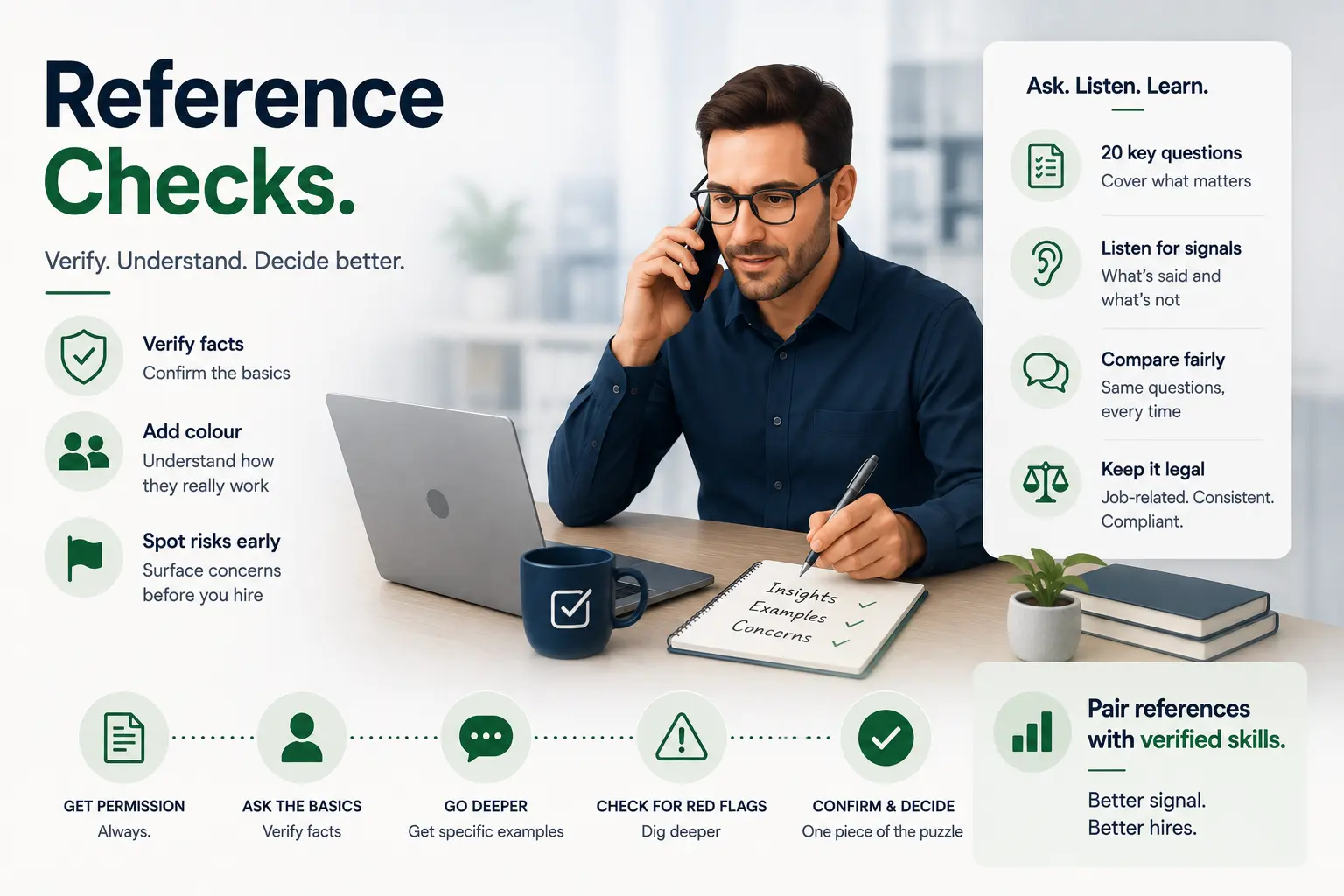
20 Reference Check Questions to Ask in 2026 (and How to Read the Answers)
Key Takeaways (TL;DR)
- Reference check questions help you confirm what a candidate told you and spot anything a resume and interview missed. Used well, they add a useful final signal. Used alone, they are one of the weaker ways to predict who will actually perform.
- References are a limited signal. In decades of selection research, reference checks rank well below work samples, structured interviews, and ability tests as predictors of job performance.
- They are still worth doing, because they confirm facts, reveal working style, and occasionally surface a real red flag.
- The key is structure: ask every referee the same questions, listen for what is not said, and treat vague answers as data.
- Below are 20 questions to ask, grouped by what you are trying to learn, plus how to make references reliable and where verified skills do the job better.
What is a reference check, and what is it good for?
A reference check is a conversation with someone who has worked with your candidate, usually a former manager or colleague, to confirm what you have learned and fill in gaps. Done well, it does three things: it verifies facts like role and dates, it adds colour on how the person actually works, and it occasionally surfaces a serious concern before you make an offer.
What it is not is a strong predictor of performance on its own. That is worth saying up front, because many teams lean on references as if they settle the decision, and they do not.
The honest truth: references are a weak predictor
Here is the part most guides skip. In the landmark Schmidt and Hunter research, which pooled 85 years of studies on selection methods, reference checks land among the weaker predictors of job performance, well below work sample tests, structured interviews, and general mental ability (Schmidt and Oh, validity and utility of selection methods).
There are good reasons for that.
The candidate picks the referees. People choose references who will speak well of them, so the sample is biased from the start.
Referees are cautious. Many former employers now confirm only job title and dates to avoid legal risk, which strips out the useful detail.
Praise is cheap. "They were great" tells you almost nothing. Without structure, you get warm words and little signal.
None of this means skip references. It means treat them as a confirming signal, not a deciding one, and pair them with something that measures ability directly. We explain the wider case in why most teams skip reference checks and what to do instead.
20 reference check questions by goal
Ask every referee the same core set so you can compare answers across candidates. Group your questions by what you are trying to learn.
Confirm the basics
Can you confirm the candidate's job title, main responsibilities, and dates of employment?
What was your working relationship, and how closely did you work together?
Would you describe their role as junior, mid, or senior compared to how they presented it?
Why: this catches inflated titles or exaggerated scope before anything else.
Understand real performance
What were the candidate's main strengths in the role?
What kind of work did they do best, and where did they need the most support?
How did their performance compare to others in similar roles on your team?
Can you give a specific example of strong work they produced?
Why: specifics separate genuine praise from polite filler. Push gently for examples.
Working style and collaboration
How did they work within a team? Were they easy to collaborate with?
How did they respond to feedback or direction they disagreed with?
How did they handle pressure, deadlines, or setbacks?
Why: most new hires who struggle do so on working style and attitude, not raw skill, so this is high-value ground.
Reliability and conduct
Were there any issues with reliability, attendance, or meeting commitments?
Is there anything about their conduct or professionalism I should be aware of?
Why did they leave, or why are they looking to leave?
Why: asked neutrally, these give a referee room to raise a real concern without being led.
Growth and development
What is one area where you would have liked to see them grow?
If they joined a new team, what would help them succeed fastest?
How coachable were they, and did they act on feedback over time?
Why: a thoughtful development answer is far more honest and useful than "no weaknesses."
The questions that reveal the most
Would you hire or work with this person again, given the chance?
What kind of role and environment do you think they would thrive in, and which would they not?
Is there anything I have not asked that you think I should know?
On a scale of one to ten, how would you rate them, and what would make it a ten?
Why: question 17 is the classic tell. A slow or qualified "yes" says a lot. Questions 19 and 20 open space for candid detail that scripted questions miss.
How to make reference checks actually useful
The questions only work if the process around them is disciplined. A few habits do most of the work.
Get permission first. Always confirm the candidate agrees before you contact anyone, and follow data-protection rules on what you collect and store.
Ask everyone the same questions. Structure is what turns anecdotes into comparable evidence, the same principle behind standardising interview scoring.
Listen for what is not said. A long pause, a topic the referee steers around, or praise that stays vague is itself a signal. Follow up gently.
Prefer managers to peers. A former manager usually gives a more useful picture of performance than a hand-picked friendly colleague.
Keep it lawful and consistent. Focus on job-related behaviour, ask the same things of every candidate, and steer clear of protected personal characteristics.
Handle references this way and they become a genuine final check. Handle them loosely and they are just a formality that confirms what you already hoped.
Red flags to listen for
No single answer should sink a candidate, but a cluster of these is a reason to dig deeper before you make an offer.
Vague praise that never gets specific. If a referee cannot give one concrete example of good work, the warm words may be politeness, not evidence.
A hesitant "would you rehire them?" A long pause or a qualified answer to question 17 often says more than the words that follow.
Dates or titles that do not match. Any gap between what the candidate told you and what the referee confirms is worth resolving directly.
Steering around a topic. If a referee avoids a straightforward question about conduct or reliability, note it and follow up gently.
Only peer references, no managers. A candidate who cannot offer a single former manager as a reference is worth a careful, respectful conversation about why.
Treat each of these as a prompt to ask one more question, not as an automatic no. The point is to understand, not to catch someone out.
A simple reference request template
Reaching out to a referee is easier with a clear, low-pressure note. Copy and adjust this:
Subject: Quick reference for [Candidate name]
Hi [Referee name],
[Candidate name] has applied for the [Role] position with us and gave your name as a reference, with their permission. Would you have 15 minutes for a short, confidential call this week?
I will ask a few straightforward questions about your experience working together. If a call is tricky, I am happy to send the questions by email instead.
Thank you for your time, [Your name], [Company]
Keeping the ask short and flexible gets you more responses, and a live call almost always gives you more useful detail than a written reply.
Where verified skills do the job better
Because references are a weak and biased signal, the strongest move is not to lean on them harder. It is to put a stronger signal earlier in the process, so the reference check is confirming a decision you already have good evidence for.
That stronger signal is tested ability. Navero screens and ranks candidates on verified skills before you ever pick up the phone to a referee, so you already know the candidate can do the work. AI screening filters out roughly 60% of unqualified applications and cuts time-to-hire by up to 75% (based on customer data), which means references become a light final check rather than the thing your whole decision rests on.
Two principles keep it fair. First, Navero surfaces and scores candidates on evidence and shows its reasoning, while a human makes the final decision. Second, that human-in-the-loop design supports alignment with the EU AI Act, NYC Local Law 144, EEOC guidance, and data-protection rules as they tighten around hiring. For the broader verification picture, see our guide to what a background check is and how it fits and evaluating candidates in your screening process.
Frequently Asked Questions
What questions should you ask in a reference check? Confirm the basics like title and dates, then ask about strengths, working style, how they handled feedback and pressure, why they left, and the classic "would you hire them again?" Ask every referee the same core set so answers are comparable.
Are reference checks worth doing? Yes, as a confirming signal. They verify facts and can surface a real red flag. But they are a weak predictor of performance on their own, so pair them with evidence of skill rather than relying on them to make the decision.
How many references should you check? Two or three is typical, ideally including at least one former manager. More important than the number is asking each the same structured questions and pushing gently for specific examples.
Why are reference checks considered unreliable? Candidates choose their own referees, many employers only confirm title and dates to avoid legal risk, and unstructured praise carries little signal. That is why references rank low as a standalone predictor of performance.
When in the process should you do a reference check? Usually near the end, after interviews and any skills assessment, once a candidate is a serious contender or you are close to an offer. Running references earlier wastes everyone's time, and running them on candidates whose ability you have already verified turns them into a light final check rather than the decision itself.
What can you not ask in a reference check? Avoid questions about protected characteristics such as age, health, religion, or family status. Keep to job-related behaviour and performance, ask every candidate the same questions, and follow data-protection rules. This is general guidance, not legal advice.