First Interview Questions to Ask in 2026 (and What to Listen For)
Key Takeaways (TL;DR)
- The first interview is your first real conversation with a candidate, and its job is to decide who is worth a deeper look. Ask the right questions and you filter well early. Ask lazy ones and you waste later rounds on the wrong people.
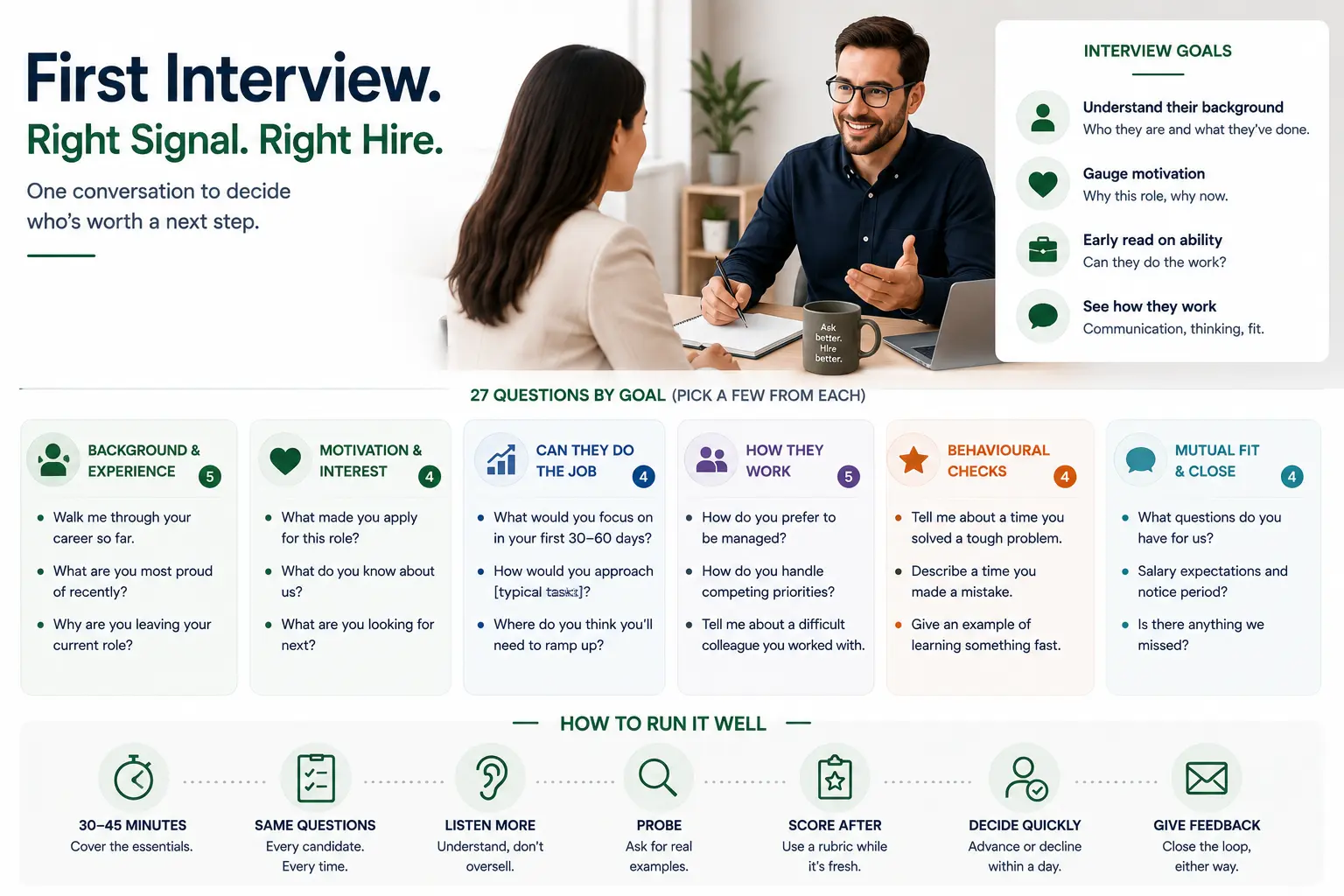
- A good first interview covers four things: background, motivation, whether they can do the job, and how they work.
- Structure beats a casual chat. Structured interviews predict performance far better than unstructured ones, so ask every candidate the same core questions.
- Listen for specifics and real examples. Vague, all-theory answers are the clearest early warning sign.
- Below are 27 questions grouped by goal, with what a strong answer looks like, plus how to run the interview. Pair it with skills screening, and keep a human deciding.
What is a first interview for?
The first interview, usually the first proper conversation after any recruiter screen, has one job: decide whether this candidate is worth investing more time in. It is not the place to make the final call. It is the place to confirm the basics, test genuine interest, get an early read on ability, and see how someone actually communicates.
Think of it as a filter with four goals. You want to understand their background, gauge how motivated they really are, get a first signal on whether they can do the work, and see how they think and interact. Everything you ask should serve one of those four. If a question does not, it is small talk, and small talk is not what a first interview is for.
Why structure matters from the very first interview
It is tempting to keep the first interview loose and friendly. Friendly is good. Loose is not. Research pooling decades of studies found that structured interviews, where every candidate gets the same questions and the same scoring, predict job performance far better than unstructured ones (Schmidt and Oh, validity and utility of selection methods).
The reason is simple. When you ask everyone different questions, you compare apples to oranges and let gut feel decide. When you ask the same core set, you can actually compare answers, and you strip out the bias that creeps in when an interview is just a nice chat. Keep it warm, but keep it structured.
27 first interview questions by goal
Choose a handful from each group so the interview covers all four goals, and ask every candidate for the role the same core set.
Background and experience
Walk me through your career so far, and what led you here.
Tell me about your current or most recent role. What do you actually spend your time on?
What have you done that is most relevant to this position?
What is an accomplishment from the last year or two that you are proud of?
Why are you looking to leave your current role, or why did you leave your last one?
What a strong answer shows: a clear, honest narrative with specifics and real ownership, not a vague recital of the resume.
Motivation and interest
What made you apply for this role specifically?
What do you know about us, and what interests you about what we do?
What are you looking for in your next role that you do not have now?
Where do you hope to grow over the next couple of years?
What a strong answer shows: genuine, specific interest in this role and company, not a generic "I want a challenge" that could apply anywhere.
Can they do the job
What would you focus on in your first 30 to 60 days in this role?
Talk me through how you would approach [a real, typical task for the role].
What part of this job do you think you would be strongest at, and where would you need to ramp up?
Tell me about a time you did work very similar to what this role needs.
What a strong answer shows: a practical grasp of the actual work, honest self-awareness about gaps, and a sensible plan rather than buzzwords.
How they work
Describe your ideal working environment and the kind of team you do your best work in.
How do you prefer to be managed?
Tell me about a time you worked with a difficult colleague or stakeholder.
How do you organise your work when you have competing priorities?
How do you like to receive feedback, and can you give an example of acting on some?
What a strong answer shows: self-awareness, flexibility, and a working style that fits how your team actually operates.
A few early behavioural checks
Tell me about a time you solved a difficult problem at work.
Describe a time you made a mistake. What did you do about it?
Give an example of a time you had to learn something quickly.
Tell me about a time you disagreed with a decision. How did you handle it?
What a strong answer shows: concrete, real examples with a clear personal action and outcome, rather than a hypothetical or a "we" with no "I".
Mutual fit and close
What questions do you have about the role or the team?
Is there anything about the job description that concerns you or is unclear?
What are your salary expectations and notice period?
What would you need from us to do your best work here?
Is there anything we have not covered that you think we should know?
What a strong answer shows: thoughtful questions that reveal they have engaged with the role, and honesty about practicalities like pay and timing.
How to run a strong first interview
The questions are only half of it. How you run the conversation decides how much signal you get.
Keep it to 30 to 45 minutes. Enough to cover the four goals, short enough to respect everyone's time.
Ask the same core set of every candidate. That is what makes answers comparable and keeps the process fair.
Listen more than you talk. Sell the role briefly, but spend most of the time hearing them. You learn nothing while you are talking.
Probe for specifics. When an answer stays abstract, follow up with "can you give me a real example?" The follow-up is often where the truth is.
Score right after, against a rubric. Rate each candidate on the same scale while it is fresh, as covered in standardising interview scoring. Running these inside a structured process keeps scores comparable.
Red flags to watch for in a first interview
No single answer is disqualifying, but a cluster of these is a reason to think twice before advancing someone.
All theory, no examples. A candidate who never gives a concrete "time when" is either unprepared or embellishing.
No real interest in you. If they know nothing about the company and ask nothing, the motivation is thin.
Everything is "we", never "I". You are hiring one person. If they cannot describe their own contribution, dig deeper.
Blaming others for every setback. A pattern of "it was always someone else's fault" tends to continue on your team.
Vague on the basics. Evasiveness about why they left a role, or about pay and notice, is worth a gentle but direct follow-up.
After the first interview: deciding who advances
The interview is only useful if it leads to a clean decision. As soon as it ends, score the candidate against your rubric while the conversation is fresh, before the next meeting blurs your memory. Waiting until the end of the day, or the end of the week, is how strong impressions fade and gut feel takes over.
Then decide quickly. The first interview exists to filter, so be willing to act on it: advance the people who cleared the bar, and close the loop kindly with those who did not. Sitting on decisions is exactly what drags a process out and loses your best candidates to faster offers. A good rule is to know, within a day of the interview, whether each person moves forward, and to tell them promptly either way. Speed here is not just courtesy, it is how you keep the candidates you actually want.
How Navero makes your first interview count
A first interview is far more useful when the people reaching it are already qualified. If you are using the first round to filter out candidates who simply cannot do the work, you are spending expensive interview time on a job software should do first.
That is where Navero helps. By screening and ranking candidates on verified skills before the first interview, it makes sure your conversations are with people who can already do the job, so the interview is about depth and fit rather than basic filtering. AI screening filters out roughly 60% of unqualified applications and cuts time-to-hire by up to 75% (based on customer data).
Two principles keep it fair. First, Navero surfaces and scores candidates on evidence and shows its reasoning, while a human interviewer makes the decision. Second, that human-in-the-loop design keeps you aligned with the EU AI Act, NYC Local Law 144, and EEOC guidance as they tighten around automated hiring. When candidates advance, our guides to scenario-based interview questions and second interview questions help you go deeper in later rounds.
Frequently Asked Questions
What questions should you ask in a first interview? Cover four goals: background and experience, motivation for this specific role, an early read on whether they can do the job, and how they work. Ask every candidate the same core set so answers are comparable, and probe for concrete examples.
How long should a first interview be? About 30 to 45 minutes. That is enough to cover the essentials and get a genuine read on the candidate, while respecting everyone's time and keeping your process fast enough that strong candidates do not drift to other offers.
What is the difference between a first and second interview? A first interview filters for the basics: background, motivation, early ability, and working style. A second interview goes deeper on skills, judgment, and fit with the people they will work with, usually for a shorter shortlist.
How do you assess a candidate in a first interview? Ask structured questions tied to the four goals, listen for specific real examples rather than theory, and score against a consistent rubric right after. Pairing the interview with a skills assessment gives you evidence of ability alongside the conversation.
What are red flags in a first interview? Answers that stay abstract with no real examples, no genuine interest in the company, describing only "we" and never their own contribution, blaming others for every setback, and evasiveness about basics like why they left a role.