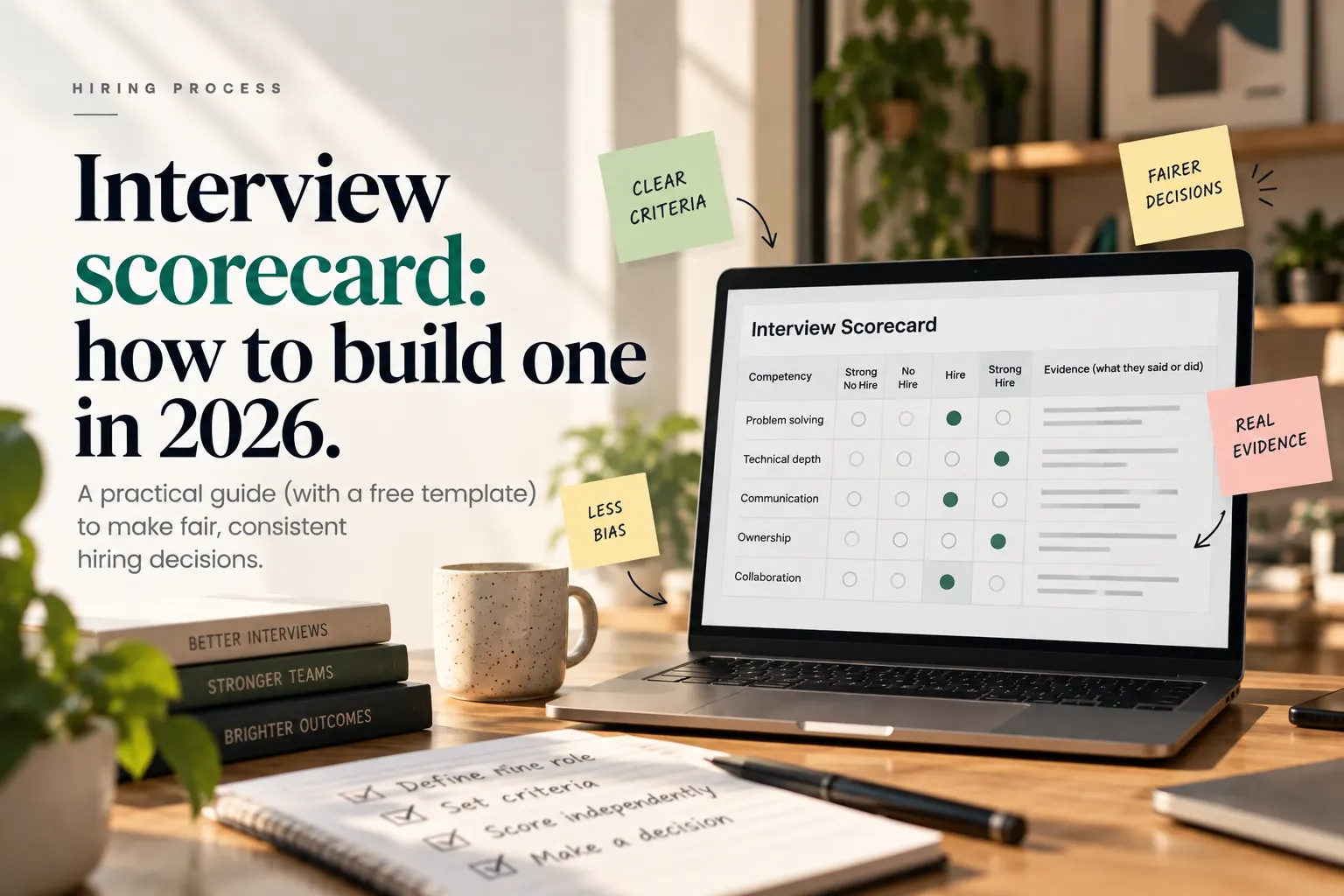
Interview Scorecard: How to Build One in 2026 (With a Free Template)
Key Takeaways (TL;DR)
- An interview scorecard turns a vague "I liked them" into a fair, evidence-based decision. It is the single simplest upgrade most teams can make to their hiring, and it costs nothing but a little planning.
- Score 4 to 6 job-specific skills plus 1 or 2 company-wide attributes. More than that muddies the signal.
- Use a 4-point scale with labels like Strong Hire to Strong No Hire, so interviewers take a clear position instead of hiding at the midpoint.
- Define the criteria and the anchors before you meet the first candidate, and have interviewers score independently before any group debrief.
- A scorecard makes structured interviews work, and structured interviews predict performance about twice as well as unstructured chats.
What an interview scorecard is, and why it matters
An interview scorecard is a simple, shared form that lists the specific things you are assessing for a role, gives each a rating scale with clear definitions, and asks the interviewer to record evidence and a recommendation. Instead of everyone forming a gut impression and arguing about it later, each interviewer scores the same criteria the same way, backed by what the candidate actually said or did.
This matters because unstructured interviews are weak predictors of performance and are wide open to bias. Structured interviews, where every candidate faces the same questions and is scored on the same scale, predict job performance far better, by many estimates roughly twice as well (VidCruiter, on structured scorecards). The scorecard is the tool that makes structure real. Without it, "structured interview" is just a good intention. Our guide to structured versus unstructured interviews covers the evidence in more depth.
Step 1: Define what you are actually scoring
Before you write a single question, decide what a great hire for this role really needs. Pull the true must-haves from the job, not a wish-list, and turn them into clear competencies. Aim for 4 to 6 role-specific skills plus 1 or 2 company-wide attributes that every hire should share. Resist the urge to add more. When a scorecard tries to measure a dozen things, interviewers spread themselves thin, the signal gets muddy, and the form becomes admin rather than a decision tool. Our guide to competency-based interview questions helps you turn each competency into questions.
Step 2: Choose a rating scale that forces a decision
The scale is where most scorecards quietly fail. A 5-point scale sounds precise, but in practice interviewers cluster around the safe middle, and a pile of 3s tells you nothing. A 4-point scale removes the neutral option and forces a directional call. Better still, use labels rather than bare numbers. A scale of Strong Hire, Hire, No Hire, Strong No Hire makes each interviewer commit to a clear position on every competency, which is exactly what you need when you compare notes later.
Step 3: Write behavioral anchors for each level
A rating is only consistent if everyone means the same thing by it. So for each competency, write a short description of what each level actually looks like. For a "problem-solving" competency, a Strong Hire might be "broke down an unfamiliar problem clearly and reasoned to a sound solution," while a No Hire might be "struggled to structure the problem and jumped to an answer without reasoning." These behavioral anchors are what turn a subjective score into a shared standard, and they dramatically cut the gap between a generous interviewer and a harsh one.
Step 4: Require evidence, not just a score
Every score should come with a line of evidence: what the candidate said or did that justifies it. This does two things. It forces the interviewer to base the rating on the interview rather than a vibe, and it gives the hiring team something concrete to discuss in the debrief. A scorecard full of numbers with no notes is nearly worthless. A scorecard where every score points to a real moment in the interview is a genuine decision record, and it is also your best protection if a hiring decision is ever questioned.
A simple interview scorecard template
Here is a clean template you can copy. Adapt the competencies to your role.
Candidate: | Role: | Interviewer: | Date: |
|---|
Competency | Rating (Strong No Hire / No Hire / Hire / Strong Hire) | Evidence (what they said or did) |
|---|---|---|
Role skill 1 (e.g. problem-solving) | ||
Role skill 2 (e.g. technical depth) | ||
Role skill 3 (e.g. communication) | ||
Role skill 4 (e.g. ownership) | ||
Company attribute (e.g. collaboration) |
Overall recommendation: Strong Hire / Hire / No Hire / Strong No Hire
One thing that would change my mind:
Keep it to a single page. If it does not fit on one screen, it is too long to fill in honestly after a busy interview.
Step 5: Score independently, then debrief
The order of operations matters as much as the form. Have each interviewer complete and submit their scorecard before the group talks. If people debrief first, the most senior or most confident voice anchors everyone else, and the scores just converge on their opinion. Independent scoring preserves genuinely different reads, which is the whole point of having several interviewers. Then bring the scorecards together and focus the discussion on the disagreements, where the real signal usually lives. Our guide to giving interview feedback helps you run that conversation well.
Step 6: Calibrate your interviewers
Even with anchors, people rate differently. A quick calibration step fixes most of this. Before a hiring loop, have your interviewers score one or two sample answers together, then compare and talk through the gaps. You will surface different assumptions fast, "I thought that answer was weak, you thought it was strong, why?", and align on a shared bar. A calibrated panel using the same scorecard produces scores you can actually trust and compare across candidates.
Adapt the scorecard to the role and stage
One scorecard rarely fits every interview. Keep the company-wide attributes consistent across the whole loop, so every candidate is judged on the same core values, but vary the role-specific competencies by stage. A first-round screen might score communication and motivation, while a later technical round scores depth and problem-solving. Give each interviewer only the competencies they are genuinely placed to judge, rather than asking everyone to rate everything. This keeps each scorecard short and honest, avoids weak guesses on skills an interviewer never really probed, and means the combined picture across the loop covers everything that matters without stretching any single interviewer too thin.
Common mistakes when building a scorecard
Too many competencies. Scoring a dozen things spreads interviewers thin and muddies the signal. Stick to 4 to 6 core skills plus a couple of attributes.
A 5-point scale. It invites fence-sitting at the midpoint. Use a 4-point scale that forces a directional call.
Vague labels with no anchors. If "3 out of 5" is undefined, everyone means something different. Write what each level looks like.
Scores without evidence. A rating with no supporting note is a vibe, not data. Require a line of evidence for each.
Debriefing before scoring. Talking first lets one strong voice anchor the room. Score independently, then discuss.
Writing it after you meet candidates. Define the criteria upfront, or you will bend them to fit whoever you already like.
How Navero fits with scorecards
A scorecard makes your interviews fair and consistent, but it only helps with the candidates who reach an interview. The earlier problem is deciding who gets there in the first place, and that is where most bias and wasted time live. Navero screens candidates on verified skills with realistic, job-relevant tasks, so the shortlist that reaches your scorecard stage is already evidence-based rather than resume-based.
Navero filters out roughly 60% of unqualified applications and cuts time-to-hire by up to 75% (based on customer data), scores every candidate on the same criteria, and shows the reasoning behind each result, with a human making the final decision. That consistent, evidence-first approach is the same principle as a good scorecard, applied to the whole funnel, and it supports alignment with the EU AI Act, NYC Local Law 144, and EEOC guidance. Our guide to evaluating candidates in your screening process ties the two together.
Want the scorecard discipline across your whole pipeline? See how Navero's structured, skills-based screening builds an evidence-based shortlist before the interview even starts.
The bottom line
An interview scorecard is the cheapest, fastest upgrade most hiring teams can make. It replaces "I have a good feeling about this one" with a fair, evidence-based comparison, and it is what makes a structured interview actually structured. Keep it to 4 to 6 role skills and a couple of company attributes, use a 4-point scale with clear labels and behavioral anchors, require a line of evidence for every score, and have interviewers rate independently before they debrief. Add a quick calibration step, and your panel will produce scores you can trust and compare. Do this, and you will make better hires, defend your decisions with evidence, and spend far less time arguing about gut feelings.
Frequently Asked Questions
What is an interview scorecard? It is a shared form that lists the specific competencies you are assessing for a role, gives each a rating scale with defined levels, and asks the interviewer to record evidence and an overall recommendation. It replaces gut-feel impressions with a consistent, evidence-based way to compare candidates, which makes hiring fairer and more predictive.
How many criteria should an interview scorecard have? Around 4 to 6 role-specific competencies plus 1 or 2 company-wide attributes. That is enough to capture what matters without overwhelming interviewers. When a scorecard tries to measure too many things, ratings spread thin, the signal gets muddy, and the form becomes busywork instead of a genuine decision tool.
What rating scale is best for an interview scorecard? A 4-point scale, ideally with labels like Strong Hire, Hire, No Hire, and Strong No Hire. A 5-point scale invites interviewers to cluster around the neutral midpoint, which weakens the signal. A 4-point scale removes the safe middle and forces each interviewer to take a clear, directional position on every competency.
Do interview scorecards reduce bias? They help, especially when combined with three habits: define the criteria and anchors before meeting candidates, require evidence for every score, and have interviewers rate independently before the group debrief. These structural steps reduce the influence of gut feeling and stop one confident voice from anchoring the whole panel, which is where much interview bias creeps in.
When should interviewers fill in the scorecard? Right after the interview, while it is fresh, and before any group discussion. Independent scoring preserves genuinely different reads from each interviewer. If the team debriefs first, scores tend to converge on the most senior or confident opinion, and you lose the diverse signal that made multiple interviewers worthwhile in the first place.