30 Competency-Based Interview Questions for 2026 (and How to Score Them)
Key Takeaways (TL;DR)
- A competency-based interview asks candidates to describe real past situations, so you judge them on evidence of what they have actually done rather than how they say they would behave in theory.
- Structured, competency-based interviews predict job performance far better than unstructured chats, at an operational validity of about .51 in the landmark Schmidt and Hunter research.
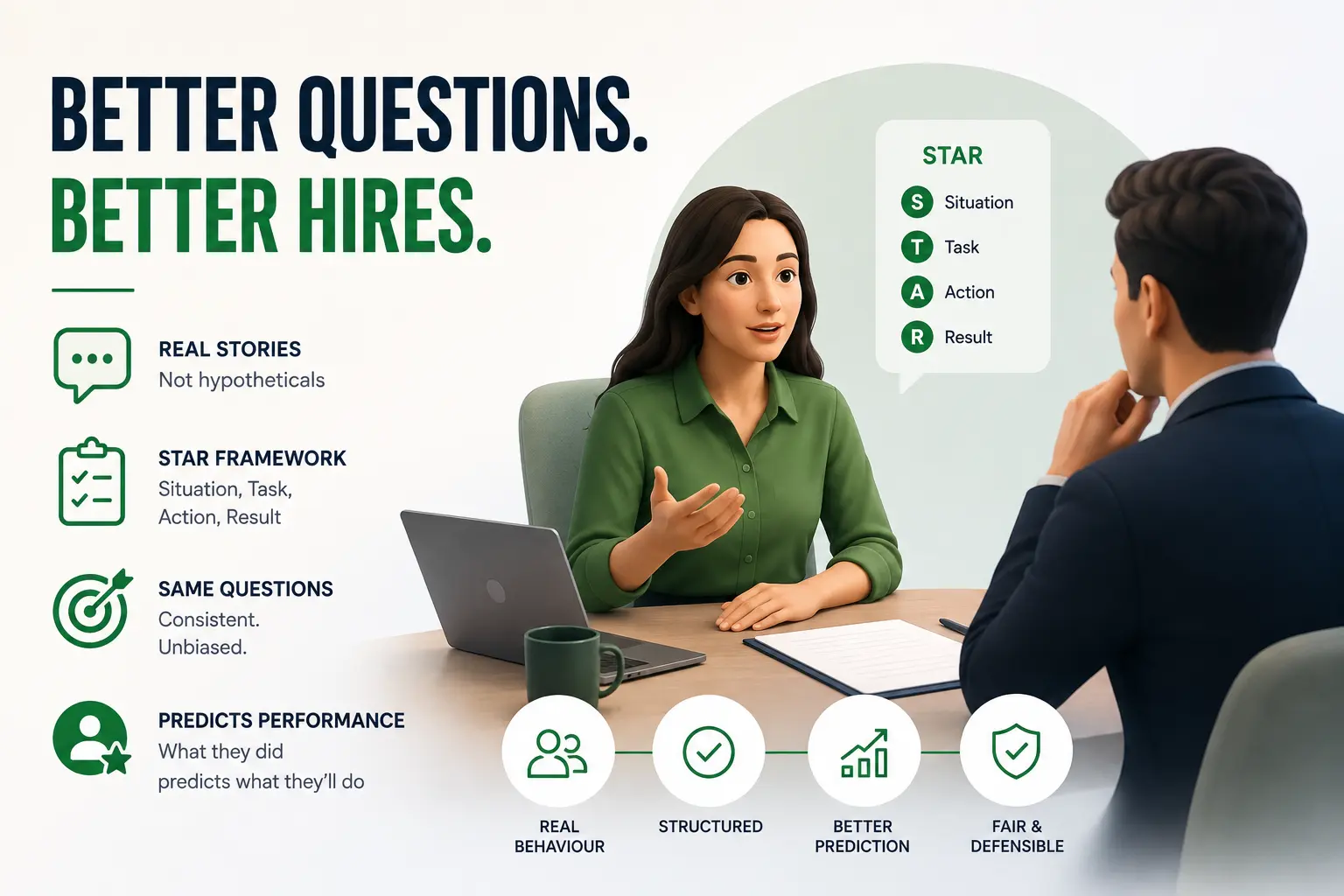
- The method works because past behaviour is the most reliable guide to future behaviour, and because every candidate answers the same questions and is scored the same way.
- Use the STAR framework (Situation, Task, Action, Result) to read answers, and a simple rubric to score them consistently.
- Below are 30 questions across 8 core competencies, with what a strong answer looks like for each. Pair them with skills-based screening, and a human still makes the final call.
What is a competency-based interview?
A competency-based interview, sometimes called a structured or behavioural interview, is built around specific skills the role needs, such as communication, problem-solving, or leadership. Instead of asking how a candidate would handle a hypothetical, you ask them to describe a real time they did handle something, then you probe the detail.
The logic is simple. What someone actually did in a real situation is a far better guide to how they will perform than what they claim they would do. A candidate can say they are a great team player. A competency question makes them prove it with a real example, which is much harder to fake.
This is different from your scenario-based interview questions, which test judgment on a hypothetical situation. Competency questions look backwards at real behaviour. Both are useful, and many strong interviews use a mix.
Why competency-based interviews work
This is not just good practice, it is one of the best-evidenced findings in hiring research. The landmark Schmidt and Hunter meta-analysis, which pooled 85 years of research, found that structured interviews predict job performance at an operational validity of about .51, while unstructured interviews sit far lower (Schmidt and Oh, validity and utility of selection methods).
Two things drive that gap.
Past behaviour predicts future behaviour. A concrete example of how someone solved a problem tells you more than a polished opinion about problems in general.
Structure removes noise. When every candidate gets the same questions and the same scoring, you compare like with like, and you strip out the gut-feel bias that makes unstructured interviews unreliable.
So the value is not just the questions. It is asking the same questions of everyone and scoring them the same way. That is what turns an interview from a chat into a measurement.
How to read answers: the STAR method
Before the questions, learn the framework for judging the answers. Strong candidates naturally structure their examples as STAR, and you can prompt for any part they skip.
Situation. What was the context? A real, specific setting, not a vague generalisation.
Task. What was their responsibility in it? What were they actually on the hook for?
Action. What did they personally do? Listen for "I", not just "we". This is the heart of the answer.
Result. What happened, ideally with a number or a clear outcome? And what did they learn?
A weak answer stays abstract, talks only in "we", or never reaches a result. A strong answer is specific, owns a personal action, and closes with a concrete outcome. If a candidate gives you the situation but skips the action, ask "what did you personally do?" and see if the detail holds up.
30 competency-based interview questions by skill
Pick three or four competencies that matter most for the role, then choose a couple of questions from each. Asking every candidate the same set is what makes the scores comparable.
Communication
Tell me about a time you had to explain something complex to someone without your background. What did you do?
Describe a situation where you had to deliver difficult news to a colleague or customer.
Give an example of a time your first attempt to communicate something did not land. How did you fix it?
What a strong answer shows: they adjust to the audience, check for understanding, and stay clear under pressure rather than blaming the listener.
Teamwork and collaboration
Tell me about a time you worked with someone whose style was very different from yours.
Describe a situation where you had to rely on others to hit a deadline.
Give an example of a time you supported a teammate who was struggling.
What a strong answer shows: they take responsibility for their part, credit others honestly, and focus on the shared outcome rather than personal glory.
Problem-solving
Walk me through a difficult problem you solved recently. How did you approach it?
Tell me about a time you had to make a decision without all the information you wanted.
Describe a time your first solution did not work. What did you do next?
What a strong answer shows: a clear method, comfort with ambiguity, and a willingness to change course when the evidence says to.
Leadership and influence
Tell me about a time you led a project or a group, formally or informally.
Describe a situation where you had to get buy-in from people who did not report to you.
Give an example of a time you had to motivate a team through a setback.
What a strong answer shows: they set direction, bring people with them without relying on authority, and own the result, good or bad.
Adaptability and resilience
Tell me about a time priorities changed suddenly. How did you handle it?
Describe a significant setback at work and how you responded.
Give an example of a time you had to learn something new quickly to do your job.
What a strong answer shows: they stay effective under change, recover from failure without dwelling, and treat learning as part of the job.
Time management and prioritisation
Tell me about a time you had more work than time. How did you decide what to do?
Describe a situation where you missed a deadline. What happened, and what did you change?
Give an example of how you handle competing requests from different people.
What a strong answer shows: they prioritise deliberately, communicate trade-offs early, and learn from the times it went wrong.
Conflict resolution
Tell me about a disagreement you had with a colleague. How was it resolved?
Describe a time you received criticism you did not agree with.
Give an example of a time you had to push back on a manager or senior stakeholder.
What a strong answer shows: they address conflict directly and respectfully, separate the issue from the person, and can disagree without damaging the relationship.
Initiative and ownership
Tell me about a time you spotted a problem nobody had asked you to fix, and fixed it.
Describe a time you went beyond your job description to get a result.
Give an example of a time you took responsibility for a mistake.
What a strong answer shows: they act without being told, take ownership of outcomes, and treat mistakes as theirs to fix rather than to hide.
Customer or stakeholder focus
Tell me about a time you turned around an unhappy customer or stakeholder.
Describe a situation where you had to balance what someone wanted against what was possible.
Give an example of a time you advocated for a user or customer internally.
What a strong answer shows: they genuinely understand the other side's needs, manage expectations honestly, and follow through.
Two strong closers for any role
What is the achievement you are most proud of, and what was your specific role in it?
Tell me about a time you failed. What did you learn, and what would you do differently?
If we spoke to your last team, what would they say you should work on?
What a strong answer shows: self-awareness, honesty about weakness, and evidence that they reflect and improve.
How to score competency-based interviews fairly
The questions only work if you score them consistently. Gut feel is exactly what competency interviews are meant to remove.
Use a simple, shared rubric. For each competency, rate the answer on a fixed scale:
Score | What it means |
|---|---|
1 | No real example, or a vague, all-theory answer |
2 | A relevant example but thin on the candidate's own action or the result |
3 | A clear STAR answer with personal action and a concrete outcome |
4 | A strong STAR answer that also shows reflection, learning, or impact beyond the task |
Have every interviewer score independently before discussing, so the loudest voice does not set the tone. When several people interview, aligning on the rubric first is what keeps scores comparable, as we cover in how to standardise interview scoring across hiring managers. If you are running these without a big team or budget, our guide to structured interviews on a small budget shows how to keep it simple.
Common mistakes to avoid
Accepting hypothetical answers. If a candidate says "I would probably...", steer them back to a real example. The evidence is in what they actually did.
Letting "we" hide the individual. Teams succeed together, but you are hiring one person. Always find out what they personally did.
Asking everyone different questions. That breaks the comparison and lets bias back in. Use the same core set for every candidate for a role.
Scoring on charisma. A confident storyteller is not the same as a strong performer. Score the evidence in the answer, not the delivery.
Skipping the rubric. Without a shared scale, you are back to gut feel, which is what makes unstructured interviews unreliable.
How Navero complements competency interviews
A competency interview is strong evidence, but it is still one signal, and it comes late in the process. The best hiring pairs it with proof of skill earlier on, so the people you spend interview time with are already qualified.
Navero screens and ranks candidates on verified skills before the interview stage, so your competency interviews are spent on candidates who can already do the work, not on filtering out those who cannot. That makes every interview slot more valuable. AI screening filters out roughly 60% of unqualified applications and cuts time-to-hire by up to 75% (based on customer data).
Two principles keep it fair. First, Navero scores and surfaces candidates and shows the reasoning behind each score, and a human interviewer makes the final decision, which is exactly where a competency interview belongs. Second, that human-in-the-loop design keeps you aligned with the EU AI Act, NYC Local Law 144, and EEOC guidance as they tighten around automated hiring. For the wider picture, see how to evaluate candidates in your screening process.
Frequently Asked Questions
What is a competency-based interview question? It is a question that asks a candidate to describe a real past situation that demonstrates a specific skill, such as "tell me about a time you resolved a conflict." You judge them on evidence of what they actually did, not on a hypothetical answer.
How is a competency interview different from a scenario-based one? A competency question looks backwards at real past behaviour ("tell me about a time you..."). A scenario-based question looks forward at a hypothetical ("what would you do if..."). Competency questions test track record, scenario questions test judgment, and many good interviews use both.
How many competency questions should I ask? Choose three or four competencies that matter most for the role and ask two or three questions per competency, so the interview stays focused. Ask the same core set of every candidate so their scores are comparable.
What is the STAR method? STAR stands for Situation, Task, Action, and Result. It is a framework for structuring and reading answers. A strong answer sets the context, explains the candidate's responsibility and personal action, and ends with a concrete result.
Do competency interviews reduce bias? They help, because every candidate answers the same questions and is scored on the same rubric, which removes much of the gut-feel bias in unstructured interviews. Independent scoring before discussion, and pairing interviews with skills-based screening, reduce it further.