How to stop AI cheating in live interviews
Key Takeaways (TL;DR)
- Most AI cheating works only against generic questions. Ask about the candidate's own work and follow up three levels deep.
- Decide your rules on AI use before the interview and tell every candidate the same thing.
- Do not judge on signs such as pauses or eye movement. Score the evidence in the answers.
AI cheating in a live interview means a candidate uses a tool during the call to hear your questions and feed them answers, or reads answers someone or something else wrote. You stop most of it with interview design, not surveillance: ask about the candidate's own work, follow up deeply, and set clear rules before the call.
This guide covers what it looks like, when using AI is and is not cheating, the questions that are hardest to fake, why warning signs need care, and what to do if you suspect it. For question sets built this way, see our hub of interview questions to ask candidates.
What does AI cheating in a live interview look like?
- Real-time answer tools. Apps that listen to the call, transcribe the question and show a suggested answer on screen.
- A second device. A phone or laptop off camera running an AI assistant.
- Scripted answers. Answers to likely questions written in advance by an AI tool and read out.
- Someone else helping. A person off camera, which is not new, but is now often combined with AI.
All of these work best against generic questions. "What is your greatest strength?" is easy to answer with a tool. "What did your manager say when the launch slipped?" is not.
Is using AI in an interview always cheating?
No. Preparing with an AI assistant, practising answers or researching your company with one is normal, and it is what you want a capable hire to do. Cheating is breaking the rules you set for the interview itself, usually by getting live help while you are trying to hear what the candidate knows.
So the first step is to decide your rules and say them clearly. Some teams allow AI tools for a work discussion and not for questions about past experience. Others ban them for the whole call. Either is fine, as long as every candidate hears the same thing.
How do you set rules for AI use in interviews?
- Write them in the invitation. For example: "Please do not use AI tools or notes while answering during this interview. You are welcome to use them to prepare."
- Repeat them at the start of the call, in one sentence.
- Say what you will record and why, and ask for consent.
- Apply them the same way to everyone.
Which interview questions are hardest to fake with AI?
- Questions about their own past work. "Walk me through the last project you led" needs memory, not general knowledge.
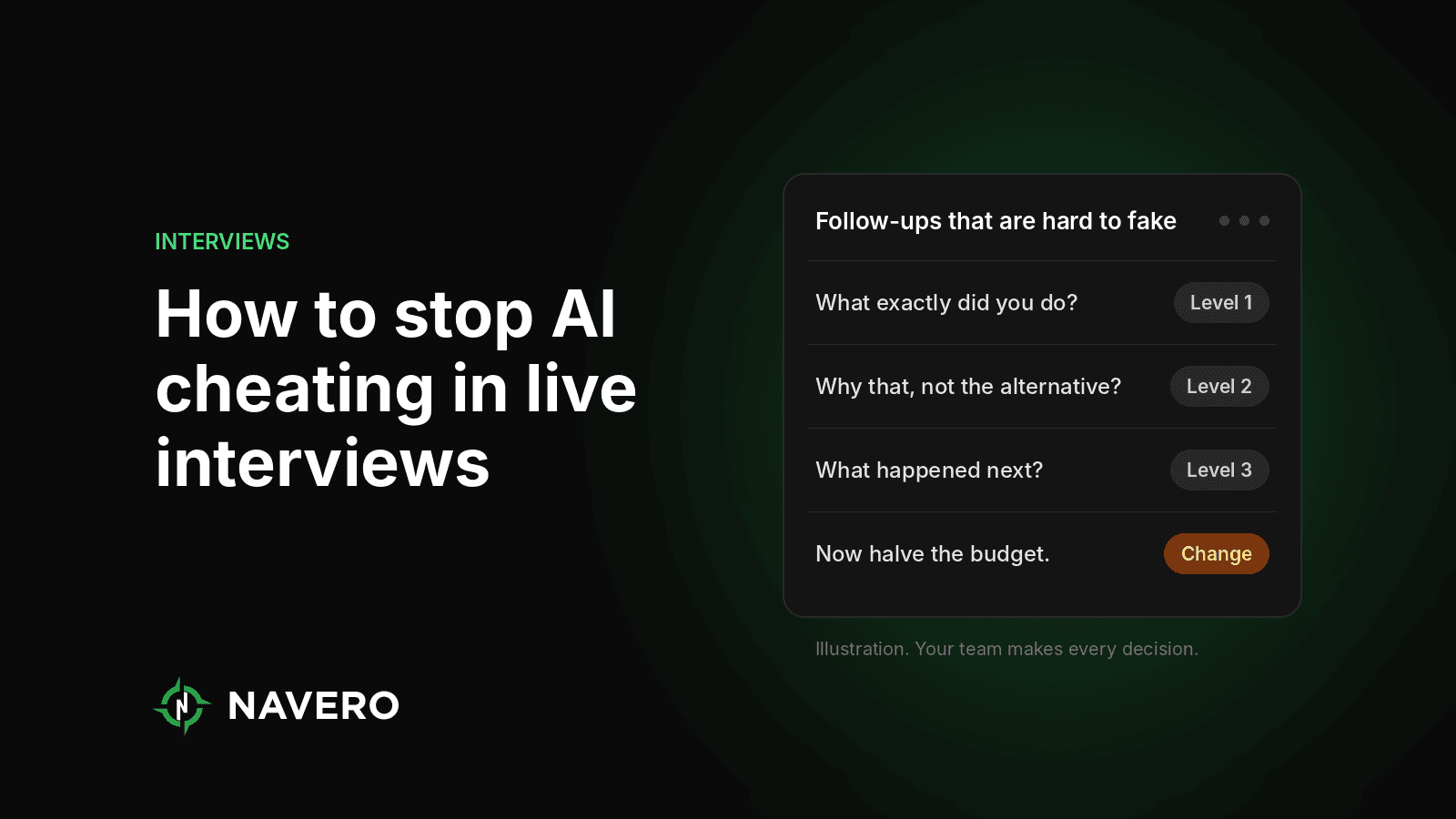
- Layered follow-ups. Each question depends on the previous answer, so there is nothing to prepare. Go three levels deep: what, then why, then what happened next.
- Specific details. Names of systems, the order things happened, who disagreed, roughly how big it was. People who did the work remember these.
- Changed constraints. "Now say you had half the budget." Real experience adapts. A suggested answer has to start again.
- Referring back. Twenty minutes later, return to a detail from an earlier answer.
- Thinking aloud. Ask the candidate to talk you through how they would work something out, not just give the answer.
- Your own real problem. A recent problem from your team, described in your words, is not something a tool has seen before.
See these in practice in our sales and software engineer interview questions, and in structured interview examples.
What are the warning signs, and why should you be careful with them?
People often mention:
- A pause after every question, then a fluent answer.
- Eyes moving as if reading.
- Very polished answers that run out of detail at the first follow-up.
- Answers that repeat the wording of your question back.
- Details that change between the first and second interview.
Run your next hire from one place
Find people who fit, shortlist with evidence, and get interviews scheduled, transcribed and scored. Free to start, no card needed.
Try nowTreat these with care. Nerves, thinking time, speaking in a second language, a different way of processing information, or a camera placed beside the screen can all look the same. None of them proves anything on its own. Never reject someone because of a sign. Score what they said.
What should you do if you suspect AI cheating?
- Ask another follow-up. Go deeper on the same answer. Real experience gets richer. Borrowed answers get thinner.
- Ask them to put it in their own words, or to give a different example.
- Remind them of the rules, politely and without accusing them.
- Score the evidence, not the suspicion. If the follow-ups produced no specifics, the criterion is "not met" or "not shown". That is fair whatever the reason.
- If still unsure, test it again in a second conversation with a different interviewer.
Do cameras on or screen sharing help?
Asking for cameras on is common and reasonable for a video interview, but say so in the invitation and allow for adjustments. Some teams ask candidates to share their screen for one part of the call. If you do, explain why, keep it short, and remember it will not catch a second device. Questions that need real experience do more than any camera rule.
How does a transcript help?
A transcript, recorded with consent, lets you review afterwards which answers had real specifics and which stayed general. You can also compare what a candidate said in the first round with the second. It is evidence for scoring the criteria, not a lie detector.
How does Navero fit in?
Navero does not detect cheating and does not monitor candidates. Navero Interview helps you run the kind of interview that is hard to fake. It keeps the same questions and scorecard for every candidate, joins Google Meet, Microsoft Teams or Zoom as a notetaker, and transcribes in Arabic or English. Candidates are told before recording and can opt out. Each answer is then set against your rubric with the quote that supports it, so it is easy to see where an answer had evidence and where it did not. Your team makes the decision.
Navero is free to use for now, then US$149 per open role per month once paid plans are switched on.
Can you reliably detect AI-generated answers?
Be cautious. Judging from tone, pauses or eye movement produces false alarms, and a false accusation harms an honest candidate. A better test is whether the candidate can go deeper on their own answer when you ask.
Should you ban AI tools in interviews?
For questions about the candidate's own experience, many teams do, because the point is to hear what the person knows. For a discussion of how they would approach a task, some teams allow AI tools and ask the candidate to show how they use them. Decide in advance and tell every candidate. Our guide on how to interview for AI-native skills covers the second approach.
Is AI cheating a reason to go back to in-person interviews?
In-person interviews help for final rounds, but they cost candidates time and limit who you can hire. Good question design works in both formats, so start there.