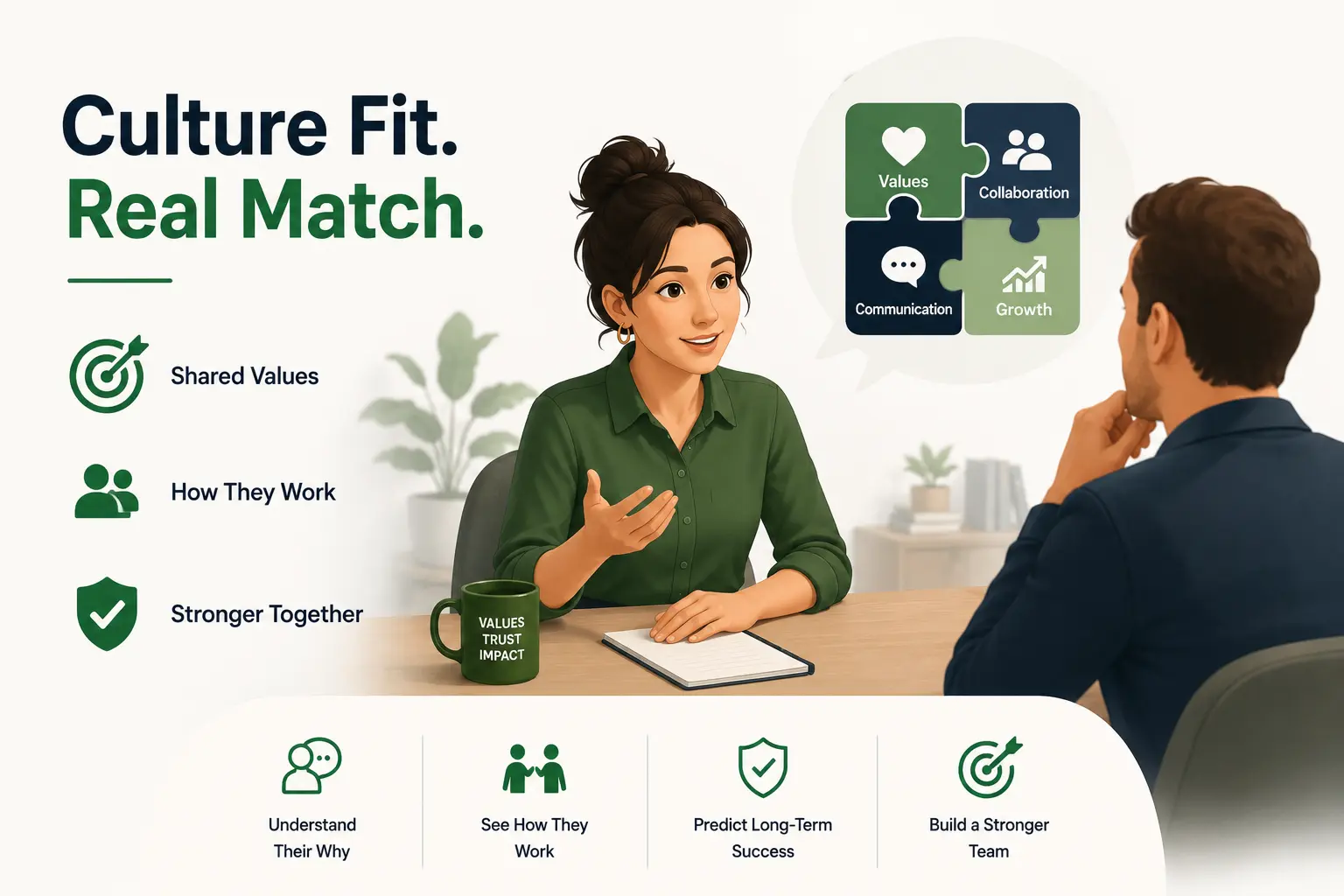
Culture Fit Interview Questions for 2026 (and How to Ask Them Without Bias)
Key Takeaways (TL;DR)
- Culture fit interview questions test whether a candidate's values and working style match how your team actually operates. Done well, they predict who will thrive. Done badly, they become a polite way to hire people who look and think like you.
- Most new hires who fail do so for attitudinal and fit reasons, not a lack of skill, which is why fit is worth assessing deliberately.
- The trap is "culture fit" as a vibe check, which quietly rewards sameness and invites bias. The fix is to assess values and behaviours, not background or likeability.
- Reframe it as "culture add": will this person share your values and bring something the team does not already have?
- Below are 25 questions with what a strong answer looks like, plus how to score them fairly. Pair them with skills-based screening, and keep a human making the call.
What is a culture fit interview question?
A culture fit interview question asks a candidate to show how they work, what they value, and how they behave with other people, so you can judge whether they will do well inside your team specifically. It is not about whether you would grab a drink with them. It is about whether the way they operate matches how your team operates.
That distinction matters more than it sounds. The same candidate can be a great hire for one company and a poor one for another, not because of skill, but because of how each team makes decisions, handles conflict, and communicates. Culture fit questions are how you test that match on purpose instead of leaving it to a gut feeling.
They work alongside your other interviews. Where competency and scenario-based questions test ability and judgment, culture fit questions test values and working style. You want both.
Why culture fit is worth assessing
Skills get someone in the door. Fit often decides whether they stay and do well. Research from Leadership IQ, which tracked thousands of new hires, found that most who failed did so for attitudinal reasons such as poor fit, low motivation, or being uncoachable, rather than a lack of technical skill (Leadership IQ hiring research).
That is the case for taking fit seriously. If most mis-hires fail on fit and attitude, then screening only for skill leaves the biggest risk untested. A structured culture fit interview closes that gap.
But there is a catch, and it is a big one.
The culture fit trap, and how to avoid it
"Culture fit" is one of the most misused ideas in hiring. Used loosely, it becomes shorthand for "someone like us", which is how bias sneaks into a process that feels perfectly reasonable. If an interviewer scores fit on a hunch, they tend to reward candidates who share their background, hobbies, and communication style, none of which predict performance.
So before you ask a single question, fix the framing with three rules.
Define your values first. You cannot assess fit against a culture you have not written down. List the four or five values and behaviours that actually describe how your best people work, then interview against those.
Hire for culture add, not culture sameness. The goal is a candidate who shares your values and brings something the team lacks. A team of identical thinkers is not a strong culture, it is a blind spot.
Ask about behaviour, not vibes. Replace "would they fit in?" with "how have they behaved in situations that reveal our values?" That turns a feeling into evidence.
Get this framing right and culture fit questions become a fairness tool rather than a bias risk. Get it wrong and you are just formalising favouritism. For the wider picture, see our guide to fair recruitment practices and reducing bias.
25 culture fit interview questions by theme
Choose the themes that map to your defined values, then ask every candidate for the role the same set so you can compare fairly.
Values and motivation
What kind of work makes you lose track of time, and why?
Tell me about a company or team you loved working for. What made it work for you?
What would make you leave a job even if the pay was good?
Describe a decision you made at work that reflected something you really care about.
What a strong answer shows: clear, honest motivations that line up with what your role and team can actually offer, rather than generic "I love a challenge" filler.
Working style and collaboration
Do you do your best work independently or as part of a group? Tell me about a time that setup helped you.
How do you prefer to receive feedback? Give me an example of feedback that changed how you work.
Describe your ideal manager. What do they do, and what do they avoid?
Tell me about a time you had to adjust your working style to fit a team.
What a strong answer shows: self-awareness about how they operate, and flexibility, rather than a rigid "this is the only way I work."
Handling conflict and disagreement
Tell me about a time you disagreed with how your team did something. What did you do?
Describe a time you had to work closely with someone you did not get along with.
How do you react when a decision goes against your recommendation?
What a strong answer shows: they can disagree respectfully, stay professional under friction, and commit to a decision even when it is not the one they wanted.
Integrity and accountability
Tell me about a time you made a mistake that affected others. What did you do?
Describe a situation where you saw something being done that you felt was wrong.
Have you ever had to say no to a manager or a customer? How did you handle it?
What a strong answer shows: honesty about failure, a sense of ownership, and the backbone to do the right thing under pressure.
Adaptability and growth
Tell me about a time your role or company changed significantly. How did you handle it?
What is something you have changed your mind about in your career?
How do you keep learning in your field? Give me a recent example.
What a strong answer shows: comfort with change, openness to being wrong, and a genuine habit of growth rather than a rehearsed answer.
Contribution and culture add
What is something you would want to bring to or change about a team you join?
Tell me about a time you improved how your team worked, not just your own output.
What kind of people do you do your best work around?
What a strong answer shows: they think about the team, not just themselves, and they bring a perspective or strength that adds to your culture.
Motivation and long-term fit
What does a good day at work look like for you?
Where do you do your most meaningful work, and why?
What would you need from us to be successful here?
What questions do you have about how we actually work day to day?
A year from now, what would make you say this was a great decision?
What a strong answer shows: their picture of success is one you can realistically provide, which is the truest test of long-term fit.
How to score culture fit fairly
The questions only reduce bias if you score them with structure. A loose "good vibe" rating is exactly the problem you are trying to avoid.
Score each answer against your defined values, not against how much you liked the person. A simple scale works well:
Score | What it means |
|---|---|
1 | Answer conflicts with a core team value, or shows no real reflection |
2 | Neutral, or a generic answer with no concrete example |
3 | A specific example that aligns with a defined value |
4 | A strong example that aligns and adds something the team needs |
Two habits keep it fair. First, have every interviewer score independently before discussing, so one confident opinion does not sway the room, as we cover in standardising interview scoring across hiring managers. Second, separate "fit" from "likeability" out loud, because they feel the same in the moment and are not the same thing. Running these inside a structured interview process is what keeps the scores comparable.
Common mistakes to avoid
Assessing sameness, not values. If your notes are about shared hobbies or background, you are measuring bias, not fit.
No defined culture to test against. Without written values, "fit" means whatever each interviewer feels, which is where bias lives.
Leading questions. "We move fast here, are you okay with that?" tells the candidate the answer. Ask neutral, behavioural questions instead.
Scoring on charm. A likeable candidate is not automatically a good fit. Score the evidence, not the delivery.
Making fit the whole interview. Fit matters, but it does not replace evidence of skill. Use both, and weight them deliberately.
How Navero supports fair, evidence-based hiring
Culture fit is one signal, and it is a human one, best judged by people. What Navero does is make sure that signal is spent on the right candidates and sits inside a fair, consistent process.
Navero screens and ranks candidates on verified skills before the interview stage, so your culture fit conversations happen with people who can already do the job. That keeps the process efficient and stops fit questions from becoming a tiebreaker between unqualified candidates. AI screening filters out roughly 60% of unqualified applications and cuts time-to-hire by up to 75% (based on customer data).
Two principles keep it fair. First, Navero scores and surfaces candidates on evidence and shows its reasoning, while a human makes the final decision, which is exactly where a judgment about culture belongs. Second, that human-in-the-loop design supports alignment with the EU AI Act, NYC Local Law 144, and EEOC guidance as they tighten around automated hiring. For more on removing bias from the process, see our guide to tools that help reduce hiring bias.
Frequently Asked Questions
What is a culture fit interview question? It is a question that reveals how a candidate works, what they value, and how they behave with others, so you can judge whether they will thrive in your specific team. It focuses on values and behaviour, not background or likeability.
Is hiring for culture fit biased? It can be, when "fit" is used loosely to mean "someone like us." You avoid that by defining your values first, asking behavioural questions against those values, hiring for culture add rather than sameness, and scoring every candidate on the same rubric.
What is the difference between culture fit and culture add? Culture fit asks whether a candidate shares your values and working style. Culture add goes further and asks what new strength or perspective they bring. Hiring for culture add keeps your team aligned on values while avoiding a monoculture.
How many culture fit questions should I ask? Pick the two or three themes that map to your core values and ask a few questions from each, so fit is one deliberate part of the interview rather than the whole thing. Ask every candidate for the role the same set.
Should culture fit outweigh skills? No. Skills and fit answer different questions and both matter. Screen for skills first so you know the candidate can do the job, then use culture fit questions to assess how well they will work within your team.