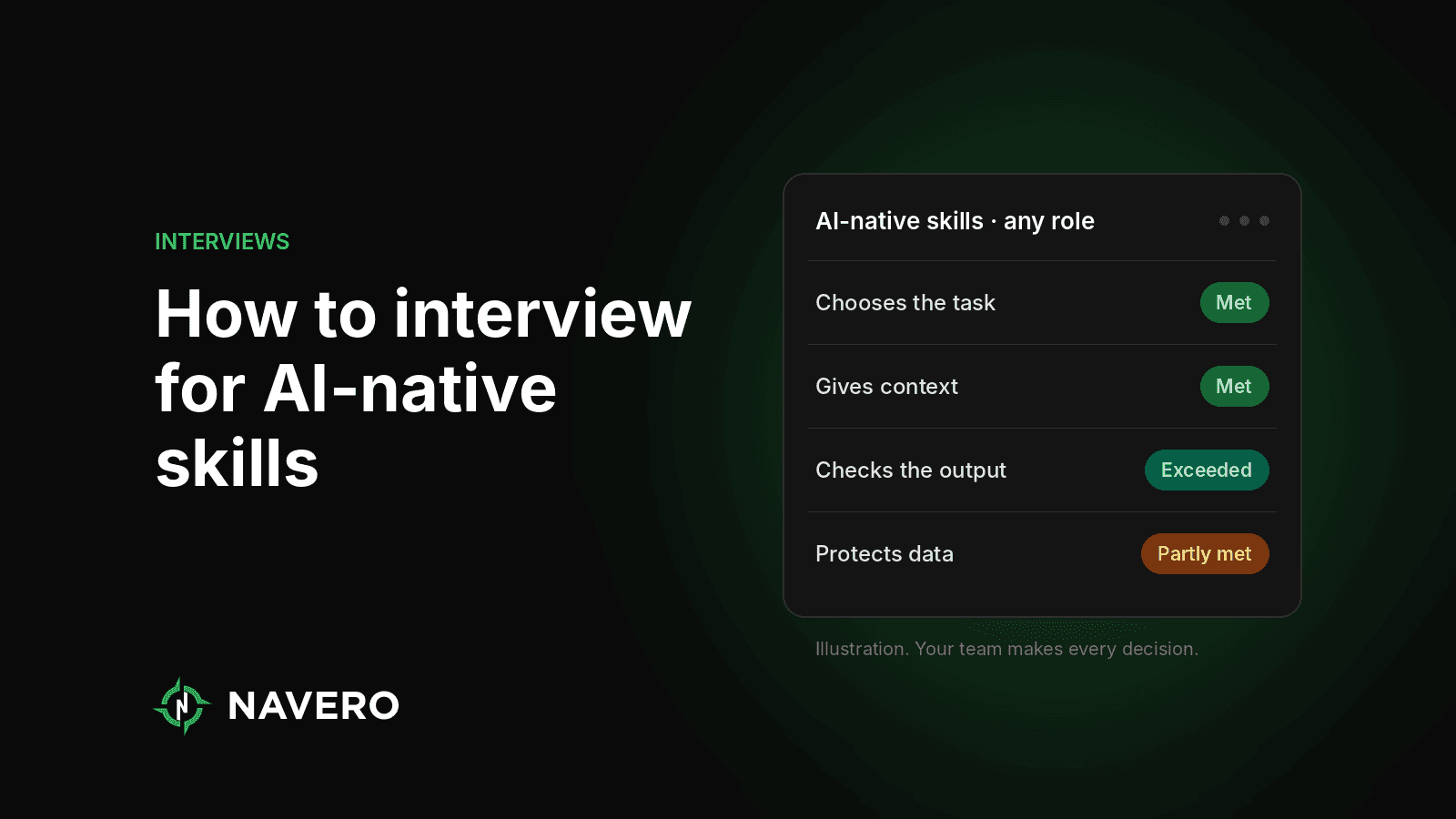
How to interview for AI-native skills in any role
Key Takeaways (TL;DR)
- AI-native skills are choosing the task, giving context, checking output, building it into the work and protecting data.
- Do not ask whether someone uses AI tools. Ask about a real recent piece of work and follow up.
- Choosing not to use AI for a sensitive task is good judgement, not a weak answer.
AI-native skills are the habits of someone who uses AI tools as a normal part of their work: they pick the right tasks for the tool, give it good context, check what comes back, and keep the judgement calls for themselves. You can interview for them in any role with a few questions about real work and the right follow-ups.
This guide defines the five skills, explains why "do you use ChatGPT?" tells you nothing, and gives you core questions, a question for each common role, what strong answers sound like, follow-up probes and a scorecard. It is part of our hub of interview questions to ask candidates.
What are AI-native skills?
- Choosing the task. Knowing which parts of the job an AI tool does well, which it does badly, and which should not go near it.
- Giving context. Explaining the goal, the audience, the constraints and the source material, instead of typing one line and hoping.
- Checking the output. Treating what comes back as a draft from a fast but unreliable colleague: checking facts, numbers and sources before using it.
- Building it into the work. Turning one-off use into a repeatable way of working, such as a saved set of instructions or a connected tool.
- Protecting data and judgement. Keeping customer and company data in approved tools, and owning the decision whatever the tool suggested.
Why interview for AI-native skills in every role?
AI tools now sit inside the software most teams already use, from email to spreadsheets to code editors. Two people with the same job title can get very different results from the same tools. That difference is now part of how well someone does the job, so it belongs in the interview like any other criterion.
It is also a two-way signal. Candidates who work this way want to know your team does too.
Why does "do you use AI tools?" not work?
Almost everyone says yes, and the answer tells you nothing about how well. Self-description is easy to inflate. Ask instead about a specific recent piece of work, what the candidate gave the tool, what came back, and what they changed. Then follow up.
What are the best questions to test AI-native skills?
Core questions for any role
- Walk me through the last piece of work where you used an AI tool. What did you give it, and what did you do with the result?
- Tell me about a time an AI tool gave you a wrong or weak answer. How did you notice?
- Which parts of your current job would you never hand to an AI tool? Why?
- Have you set up a way of using AI that you now repeat, such as saved instructions or a connected tool? How does it work?
- How do you decide what information is safe to put into an AI tool?
- Tell me about a time using AI made a piece of work worse, or slower. What did you learn?
- How has the way you work changed in the last year because of AI tools?
- If you joined us, which part of this role would you try AI on first, and how would you know it was working?
One question for each common role
- Sales: How would you use an AI assistant to prepare for a first call with one of our target accounts, and what would you check yourself? (More in sales interview questions.)
- Software engineering: Tell me about a time an AI coding tool suggested code you rejected. Why? (More in software engineer interview questions.)
- Marketing: How do you use AI for content without it all sounding the same as everyone else's?
- Finance: Where do you use AI tools in reporting or analysis, and how do you check the numbers?
- Operations: Tell me about a manual process you automated or sped up with AI. What broke along the way?
- Customer support: When would you use an AI-drafted reply, and when would you write it yourself?
- People and recruiting: Where should AI help in hiring, and where should a person always decide?
- Managers: How have you helped your team adopt AI tools, and what did you do about people who did not want to?
Run your next hire from one place
Find people who fit, shortlist with evidence, and get interviews scheduled, transcribed and scored. Free to start, no card needed.
Try nowWhat does a strong answer sound like?
- A real, recent example, with the actual task, the tool and roughly what they asked for.
- Context, not magic words. They describe giving the tool the goal, the source material and the constraints. Tricks and "prompt secrets" matter much less.
- A clear checking step. They say how they checked facts and numbers, and give an example of catching a mistake.
- Good reasons for not using AI. They can name tasks they keep for themselves and say why.
- Care with data. They mention company rules or keeping sensitive information out of unapproved tools without being asked.
Weak answers name-drop tools without describing the work, claim the tool does everything, or dismiss AI completely without reasons. A candidate who chooses not to use AI for good, specific reasons is not weak. One who has never thought about it may be.
Which follow-up probes should you use?
- What exactly did you type or give it? Roughly how long was it?
- What did the first answer get wrong?
- How long would that work have taken without the tool?
- How did you check it before you used it or sent it?
- Who else saw the result, and did they know AI was involved?
- What would you do differently next time?
How do you make answers about AI hard to fake?
There is an irony here: a candidate could use AI to answer questions about using AI. The fix is the same as for any question. Stay on one real piece of work, ask for the details (what they gave the tool, what came back, what they changed), and follow up two or three times. Someone who really works this way can describe the messy middle. See how to stop AI cheating in live interviews for more.
How do you score AI-native skills?
Add one row to your scorecard, or split it into the five skills for roles where AI use is central. Score as not met, partly met, met or exceeded.
| Skill | What "met" looks like | Red flag |
|---|---|---|
| Chooses the task | Names good and bad uses in their own work, with reasons | Uses it for everything, or for nothing, without reasons |
| Gives context | Describes giving goal, audience, source material and constraints | One-line requests, then complains about the results |
| Checks output | A clear checking step and an example of a caught mistake | Uses output as it comes |
| Builds it into the work | A repeatable workflow, not just one-off use | Only occasional, unplanned use |
| Protects data and judgement | Mentions data rules and owns the final decision | Pastes sensitive data anywhere, or blames the tool |
The full template is in our interview scorecard guide.
What mistakes do teams make when interviewing for AI skills?
- Rewarding vocabulary. Knowing the latest tool names is not the same as using them well.
- Penalising good judgement. Choosing not to use AI for a sensitive task is a strength.
- Making it the only criterion. AI skills multiply the core skills of the role. They do not replace them.
- Different questions for different people. Ask every candidate the same core question, or the comparison is unfair.
How does Navero help?
Navero is built for teams that already work this way. Navero Recruit finds candidates against criteria you approve, and Navero Interview schedules, transcribes and scores interviews against your scorecard, including an AI-native skills row if you add one. Transcripts are in Arabic or English, with the candidate's consent. Your team runs the interview and decides.
You can also reach Navero from the assistant you use every day. ChatGPT, Claude, Cursor, Grok and Grok Bot can connect through MCP to read your roles, shortlists and the evidence for each candidate. The connection is read-only for now, and Slack is coming soon. See how to connect. Navero is free for now, then US$149 per open role per month once paid plans are switched on.
Should junior candidates have AI-native skills?
Often more than senior ones, because they have grown up with the tools. What juniors may lack is the judgement to check output in a field they are still learning. Test for that. See how to hire junior talent in the AI era.
What if the role does not use AI today?
Ask anyway, at least the core question about checking output. Most roles will touch AI tools within the life of the hire, and how someone thinks about new tools is useful evidence.
Is this a skills test?
No. These are interview questions about real work the candidate has done. They fit into a normal structured interview and are scored like any other criterion.