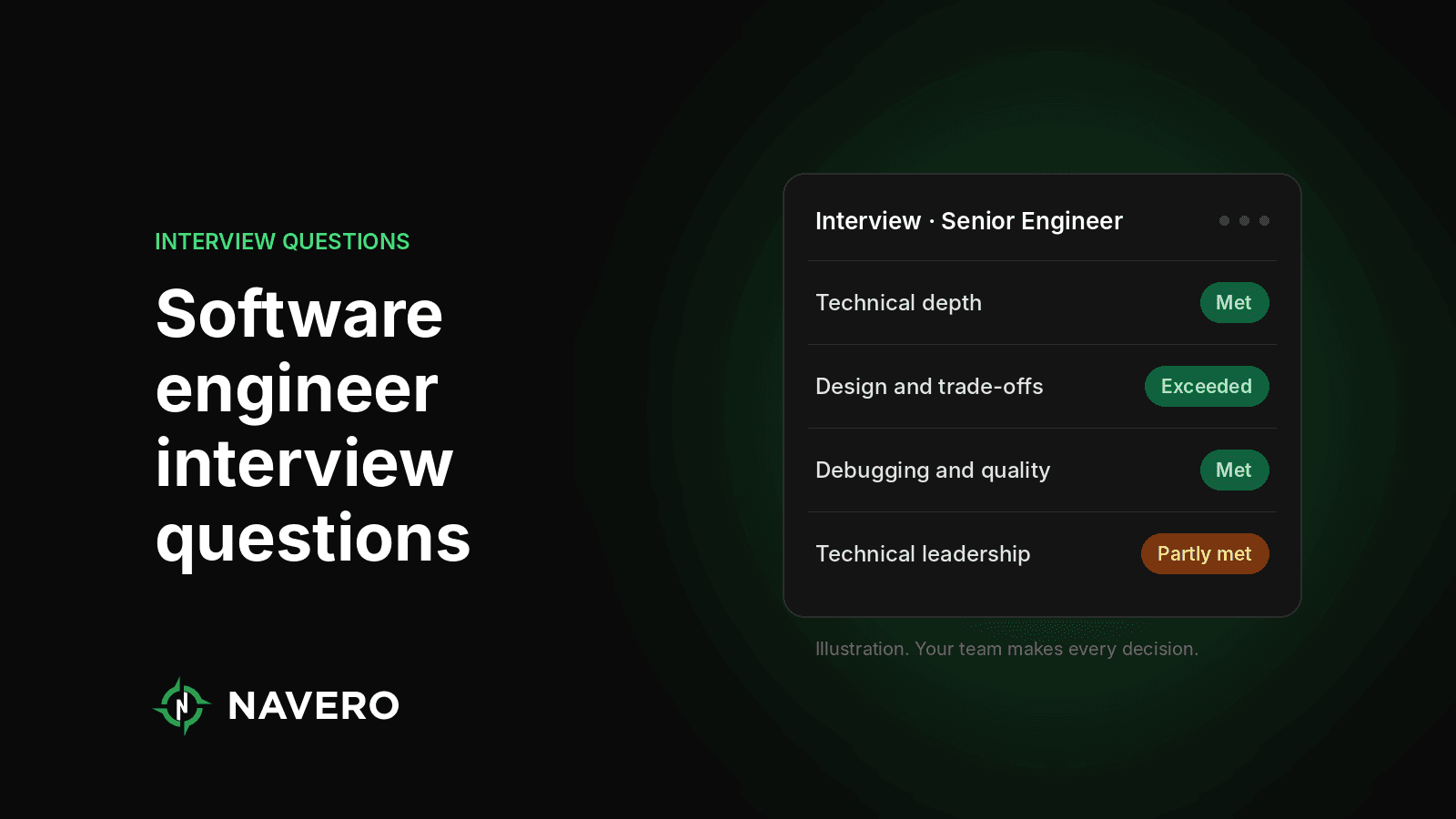
Software engineer interview questions: 20 questions for engineers and senior engineers
Key Takeaways (TL;DR)
- Start from a system the candidate has shipped, so follow-up questions can go deep.
- Ask for rough numbers, rejected options and how they found the cause of a bug. These are hard to fake with AI.
- For senior engineers, look for decisions that affected the team and people they helped grow.
Software engineer interview questions test how a candidate designs, builds and fixes real systems, and how they work with the people around them. The best ones start from code the candidate has actually shipped, so the follow-up questions can go deep.
Below are 12 questions for software engineers, 8 more for senior engineers, what strong answers sound like, follow-up probes, how to make answers hard to fake with AI in a live interview, one AI-native question, and a scorecard. This page covers interview conversations, not coding tests. For questions that work in any role, see our hub of interview questions to ask candidates.
What should a software engineer interview test?
Agree four to six criteria before the first interview. Typical ones:
- Technical depth in the parts of your stack the role will own.
- Design and trade-offs. Can choose between options and explain why.
- Debugging and quality. Finds the cause of problems and leaves systems more reliable.
- Collaboration. Reviews code well, handles disagreement, works with product and design.
- Delivery. Ships in small steps and estimates honestly.
For senior engineers, add technical leadership: decisions the team lives with, raising the level of others, and pushing back on requests when there is a good reason. Our technical interview rubrics by seniority show how the bar changes at each level.
What are the best software engineer interview questions?
For software engineers
- Walk me through a system you built that is running in production. What would you change about it now?
- Tell me about the hardest bug you have fixed. How did you find the cause?
- Describe a time you chose a simpler solution over a cleverer one. Why?
- What does a good code review from you look like? Tell me about a comment you left recently.
- Tell me about a time you broke something in production. What happened next?
- How do you decide what to test and what not to test?
- How would you design [a feature close to one on your roadmap], starting from the requirements?
- Tell me about a time the requirements changed halfway through. What did you do?
- Describe a technical disagreement with a colleague. How was it settled?
- Which part of our stack have you not used, and how would you get up to speed?
- Tell me about a piece of work you estimated badly. What did you learn?
- How do you make sure the next person can maintain your code?
For senior software engineers
- Tell me about a technical decision you made that the team still lives with. Was it right?
- How have you helped a less experienced engineer get better? What changed for them?
- Describe a time you pushed back on a product or business request for technical reasons. What happened?
- How would you split a large migration into steps that can each ship on their own?
- Tell me about an outage you led the response to. What did you change afterwards?
- How do you decide when to pay down technical debt and when to live with it?
- What would you look at in your first month here to decide where to spend your time?
- Tell me about a time you were the most senior engineer in the room and you were wrong.
What does a strong answer sound like?
- Technical depth. Uses the real names of components, explains why they chose them, and gives rough sizes: traffic, data volume, latency. A weak answer stays at the level of the job description.
- Design and trade-offs. Names at least one option they rejected and why. Talks about cost, risk and how long it would take, not only elegance.
- Debugging. Describes how they narrowed the problem down step by step, including dead ends. A weak answer jumps straight to the fix.
- Collaboration. Gives a real review comment or disagreement and explains how it was resolved without winning at all costs.
- Delivery. Talks about shipping in small pieces, saying early when an estimate is wrong, and what they cut to hit a date.
- Senior. The examples involve other people: a decision that affected the team, someone they helped grow, a request they reshaped.
Run your next hire from one place
Find people who fit, shortlist with evidence, and get interviews scheduled, transcribed and scored. Free to start, no card needed.
Try nowWhich follow-up probes should you use?
- What was the load on that system, and how did you measure it?
- Why that database (or queue, or framework) and not another one?
- What did you try first that did not work?
- Who reviewed it, and what did they push back on?
- How did you know the fix worked, and is it still in place?
- What would break first if traffic went up ten times?
- For seniors: who disagreed with the decision, and how did you bring them along?
How do you make engineering answers hard to fake with AI in a live interview?
General technical answers are easy for a tool to produce. What a tool cannot do is remember the candidate's own system. Anchor the interview there.
- Start from their system, not a textbook question. "Walk me through a system you built" beats "explain how caching works".
- Ask for the numbers and how they got them. Real engineers remember rough traffic, data sizes and the dashboard they checked.
- Ask "why not the alternative?" twice. Each answer leads to the next question, so there is no script to read.
- Change a constraint. "Now the data has to stay in the UAE." or "Now it has to handle ten times the traffic." Watch how the design adapts.
- Ask them to sketch it out loud. Talking through the architecture step by step, or drawing it on a shared whiteboard, shows real understanding.
- Set the rules up front. Tell candidates in the invitation whether AI tools are allowed during the interview.
More in our guide on how to stop AI cheating in live interviews.
What is a good AI-native question for software engineers?
"Walk me through how you use AI coding tools in your work. Tell me about a time one suggested code you rejected, and why."
A strong answer describes giving the tool context (the codebase, the constraints, the tests), reviewing every change as if a colleague wrote it, writing or running tests before trusting the result, and being alert to security issues and made-up library calls. Good candidates also know when the tool slows them down. A weak answer is either "I never use them" with no reason, or "it writes most of my code" with no mention of review.
How do you score a software engineer interview?
One row per criterion, scored on its own as not met, partly met, met or exceeded, with what the candidate said as evidence.
| Criterion | What "met" looks like | Red flag |
|---|---|---|
| Technical depth | Explains their own system with real components and rough numbers | Answers only in general terms |
| Design and trade-offs | Names a rejected option and the reason | One "right" answer, no trade-offs |
| Debugging and quality | Step-by-step diagnosis, including dead ends | Jumps to the fix, cannot say how they found it |
| Collaboration | A real review or disagreement resolved well | Blames others, or never disagrees |
| Delivery | Ships in small steps, flags slipping estimates early | Large releases, surprises at the deadline |
| Senior: technical leadership | A decision the team lives with and someone they helped grow | Every example is solo work |
See our interview scorecard template and examples for a full template.
How does Navero help you hire engineers?
Navero Recruit finds engineers against criteria you approve, such as "Go and PostgreSQL in production" or "has led a team of three or more", and shows the evidence for each criterion. Navero Interview schedules the interview, joins Google Meet, Microsoft Teams or Zoom as a notetaker with the candidate's consent, transcribes in English or Arabic, and sets each answer against your scorecard with quotes. Your team runs the interview and decides.
If your team works in Cursor, you can connect it to Navero through MCP and ask about a role or candidate without leaving your editor. ChatGPT, Claude, Grok and Grok Bot work too. The connection is read-only. See how to connect. For the full hiring process, read how to hire a software developer.
Navero is free to use for now, then US$149 per open role per month once paid plans are switched on.
How many questions fit in a 60-minute technical interview?
Five or six core questions, with plenty of time for follow-ups. Deep follow-ups on two of them tell you more than ten questions answered at surface level.
How is a senior engineer interview different?
The bar moves from "can build it" to "can decide what to build and bring others along". Spend more time on past decisions, trade-offs at scale, mentoring and pushing back, and ask for examples that involve other people.
Should engineers be allowed to use AI in the interview?
That is your choice, but decide it before the interview and tell every candidate the same thing. Many teams allow AI tools in the job but not during a conversation about the candidate's own experience, because the point of the conversation is to hear what they know.