How to Hire Junior Talent in the AI Era: A 2026 Skills-Based Playbook
Key Takeaways (TL;DR)
- Entry-level hiring did not disappear in 2026. It changed shape. AI has absorbed a lot of routine junior work, applications have flooded in, and the roles that remain now expect skills that used to appear years into a career.
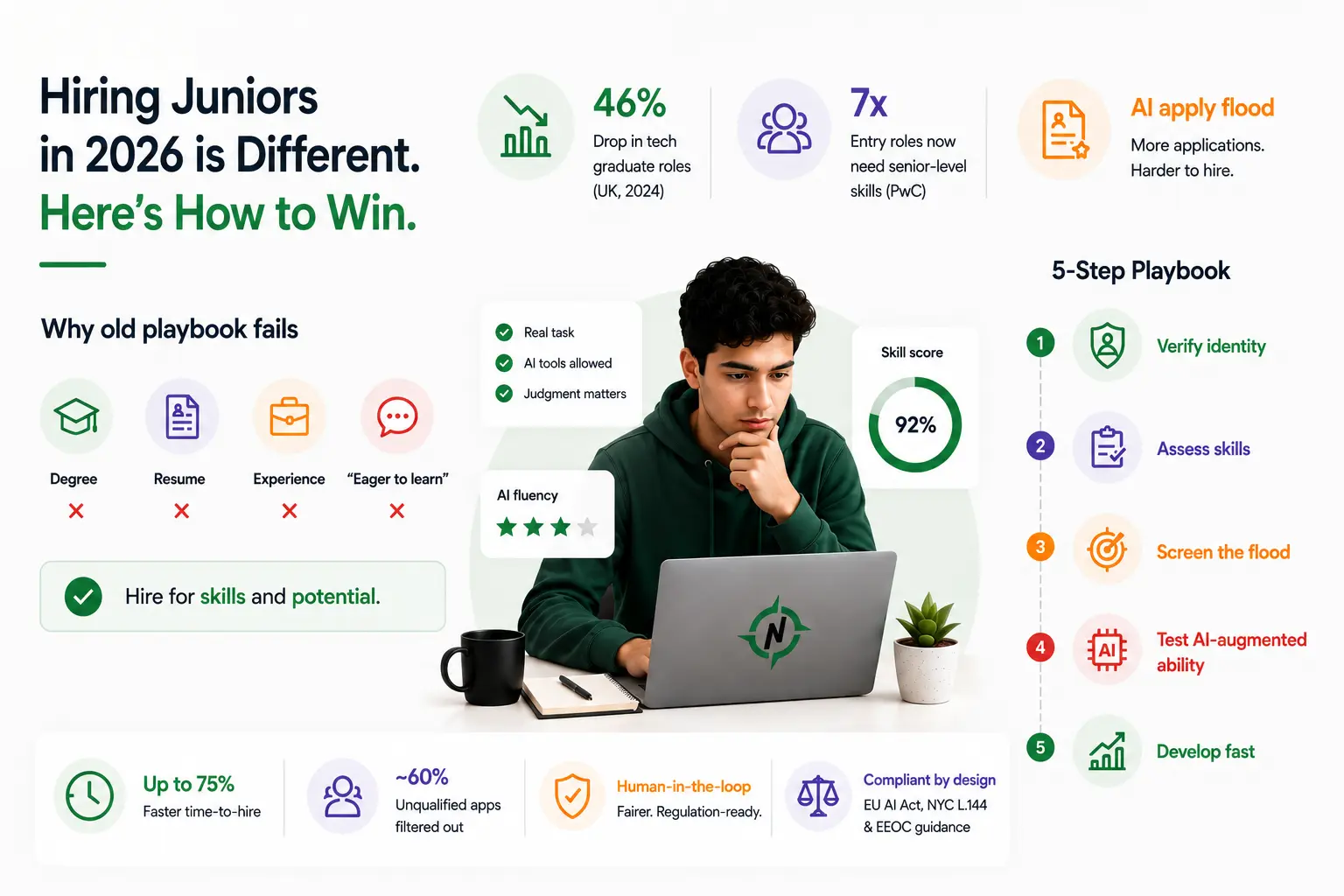
- Junior tech postings have fallen sharply, and big employers have cut new-graduate hiring by more than half since 2019.
- PwC calls this "seniorization": entry-level roles in AI-exposed jobs are far more likely to demand senior skills like judgment and stakeholder management.
- The old signals (degree, years of experience, a polished resume) no longer tell you who can do the work.
- The fix is to hire juniors on skills and potential, tested directly. Navero scores candidates on evidence and surfaces them; your team decides.
What is happening to entry-level hiring in 2026?
The entry-level market has been squeezed from three directions at once, and the result looks like a collapse even though the real story is a reshaping.
The roles are shrinking. In the UK, tech graduate roles fell about 46% in 2024, with further drops projected through 2026, and junior postings in areas like software and data analysis have dropped steeply in the US too (Recruither). The largest tech employers have cut new-graduate hiring by more than half since 2019.
Companies stopped investing in training. The average age of technical hires has been rising as teams choose to buy experience rather than build it. Improving AI output takes minutes. Training a junior takes months. Under cost pressure, many teams chose the shortcut.
The application flood makes it worse. One-click AI apply tools mean every junior opening now draws a huge, hard-to-sort pile of near-identical applications.
So the junior pipeline did not vanish. It got harder to enter, harder to fill well, and much harder to screen.
Why "seniorization" changes how you must hire
Here is the finding that should reshape your junior hiring. According to PwC research covered in 2026, entry-level roles in the most AI-exposed occupations are now roughly 7x more likely to require skills that used to appear later in a career, and in those occupations about 52% of the new skills showing up in entry-level postings were ones traditionally tied to experienced workers (Fortune).
In plain terms: AI took the routine tasks that junior roles used to be built from. What is left is judgment, problem-solving, stakeholder work, and knowing when to trust an AI output and when not to. Those are exactly the skills you cannot read off a resume, and exactly the ones a 22-year-old has never had a chance to list.
That creates a trap. If you screen juniors the old way, on pedigree and experience, you will reject the people who could actually do the redesigned job, because none of them have the experience the posting now implies. You have to assess the underlying skills instead.
Why the old junior-hiring playbook fails now
The traditional way to hire juniors was to filter on proxies: which university, what internships, how polished the resume. Every one of those proxies is now broken.
Old signal (now weak) | Why it fails in 2026 | What to assess instead |
|---|---|---|
Degree and university | Says little about ability; AI flood makes credentials easy to list | Demonstrated skills on a real task |
Years of experience | Redesigned entry roles need senior skills juniors have not had time to build | Judgment and potential, tested directly |
A polished resume | AI now writes a flawless, tailored resume in seconds | Work-sample output the candidate actually produced |
"Eager to learn" | Every applicant claims it; it is unfalsifiable | AI-augmented performance on a scenario task |
The pattern is the same one running through hiring generally in 2026. The signals candidates present are cheap to fake or no longer predictive. The evidence they produce is not.
How to hire junior talent in the AI era: a 5-step playbook
The goal is to find people who can do the redesigned junior job, and to do it without drowning in applications or defaulting to pedigree.
1. Hire for skills and potential, not pedigree
Start from the skills the role actually needs now, then test for them directly. A skills-based hiring approach lets a candidate from a non-traditional background prove they can do the work, and stops a strong resume from carrying someone who cannot. This is the single most important shift, because it is the only way to see the judgment that seniorization now demands.
2. Assess judgment, not just knowledge
The redesigned junior role rewards people who make good calls, not people who memorized facts an AI can retrieve. Design tasks that reveal reasoning: a scenario with a wrong AI output to catch, a decision with incomplete information, a problem with no clean answer. Score how they think, not just what they produce.
3. Screen the flood with work samples
You cannot read thousands of AI-written applications by hand. A short, role-relevant work sample scored automatically filters the pile down to the candidates who can actually perform, before a human spends time on anyone. This turns the application flood from a problem into a filter, because AI screening on real skills does not care how polished the resume is.
4. Test AI-augmented ability, on purpose
Juniors increasingly use AI to perform above their raw experience level. That is not cheating for most roles. It is the job. Let candidates use AI on the task and watch whether they use it well: do they catch its mistakes, add what it cannot know, and know when to override it? A junior who is fluent with AI can deliver like a mid-level hire, which is exactly the value seniorization is asking for.
5. Plan to develop fast
If you hire for potential, you have to build the skills quickly, since the role no longer eases people in gently. Pair new juniors with clear structured feedback and real ownership early. The employers winning junior talent in 2026 are the ones redesigning the role to accelerate development, not the ones waiting for pre-formed seniors who do not exist at entry level.
What high-potential junior candidates look like
Because you are hiring for potential rather than track record, it helps to know the observable signals. These show up clearly in a work-sample or scenario task, and none of them requires prior experience.
Signal | What it looks like in a task |
|---|---|
Judgment | Catches a flawed AI output and fixes it, rather than shipping it |
Learning speed | Applies feedback within the same task, not just the next one |
Structured thinking | Breaks an open problem into steps before reaching for a tool |
AI leverage | Uses AI to move faster, then verifies the result instead of trusting it |
Ownership | Asks the clarifying question a strong hire would ask on the job |
All five predict how quickly a junior becomes productive, which is the real question when the role no longer eases anyone in gently. Score them consistently and you can compare a bootcamp graduate and an Ivy League one on the same evidence, which is the point.
Common mistakes when hiring juniors in 2026
Screening on pedigree. It filters out the capable and keeps the well-branded. It is also the easiest signal to game.
Writing a senior job and labelling it entry-level. Seniorization is real, but if the posting demands five years of experience for a junior salary, you get no applicants who fit and a pile who do not.
Banning AI in the assessment. The job uses AI. The test should too, so you can see who uses it well.
Trying to read the flood manually. Without an automated skills filter, volume forces you back onto shortcuts like pedigree.
Hiring for potential, then offering no development. Potential without support is just an unfilled skills gap.
How Navero helps you hire junior talent
Navero is built for exactly this shift, because it hires on verified skills rather than resume signals. You can define the skills the redesigned junior role needs, test candidates on them with realistic tasks, and let AI screening rank the flood on evidence so your team only spends time on people who can actually do the work. Navero cuts time-to-hire by up to 75% and filters out roughly 60% of unqualified applications (based on customer data), which is what makes a high-volume junior pipeline manageable.
Two principles keep it fair. First, Navero scores and surfaces candidates and shows the reasoning behind each score. A human recruiter or hiring manager makes the final call. Second, that human-in-the-loop design keeps you aligned with the EU AI Act, NYC Local Law 144, and EEOC guidance as they tighten around automated hiring, which matters most in high-volume, early-career screening.
Related reading: Skills first hiring: why mid-market firms are winning and what is skill validation?
Frequently Asked Questions
Are entry-level jobs really disappearing because of AI? Not exactly. Roles have shrunk in number, especially in tech, but the bigger change is "seniorization": AI absorbed routine junior tasks, so the entry-level roles that remain now demand judgment and problem-solving that used to appear later in a career.
How should employers screen junior candidates in 2026? On skills and potential rather than pedigree. Use short, role-relevant work samples scored on evidence, and design tasks that reveal judgment. This filters a flood of AI-written applications and surfaces candidates who can actually do the redesigned role.
Should candidates be allowed to use AI in a junior assessment? For most roles, yes. Using AI well is now part of the job. Let candidates use it and assess whether they catch its errors and apply good judgment, rather than testing raw recall an AI can provide.
Why does a resume no longer predict junior performance? Because AI writes a polished, tailored resume in seconds, and because the traditional signals (degree, experience) no longer map to the skills seniorized entry-level roles require. Demonstrated ability is a far stronger predictor.
How do you hire for potential without hiring badly? Test the underlying skills directly, hire on that evidence, and pair the hire with fast, structured development. Potential plus a real development plan produces strong junior hires; potential alone does not.