Structured interview examples: six worked questions with scoring guides
Key Takeaways (TL;DR)
- A structured interview example has three parts: a criterion, the question that tests it, and a scoring guide.
- Use behavioural questions when the candidate should have done the work before, and situational ones when they have not.
- Run the debrief criterion by criterion, and decide only after every criterion is scored.
A structured interview example shows the three parts working together: one criterion, the question that tests it, and a scoring guide that says what a weak, acceptable and strong answer sounds like. This is part 2 of our structured interviews guide, which explains why structure works and how to set it up.
Below you will find a full 45-minute interview plan, six worked examples across different roles, examples of behavioural and situational questions side by side, and a sample debrief. Copy what fits your role and change the details.
What does a complete structured interview look like?
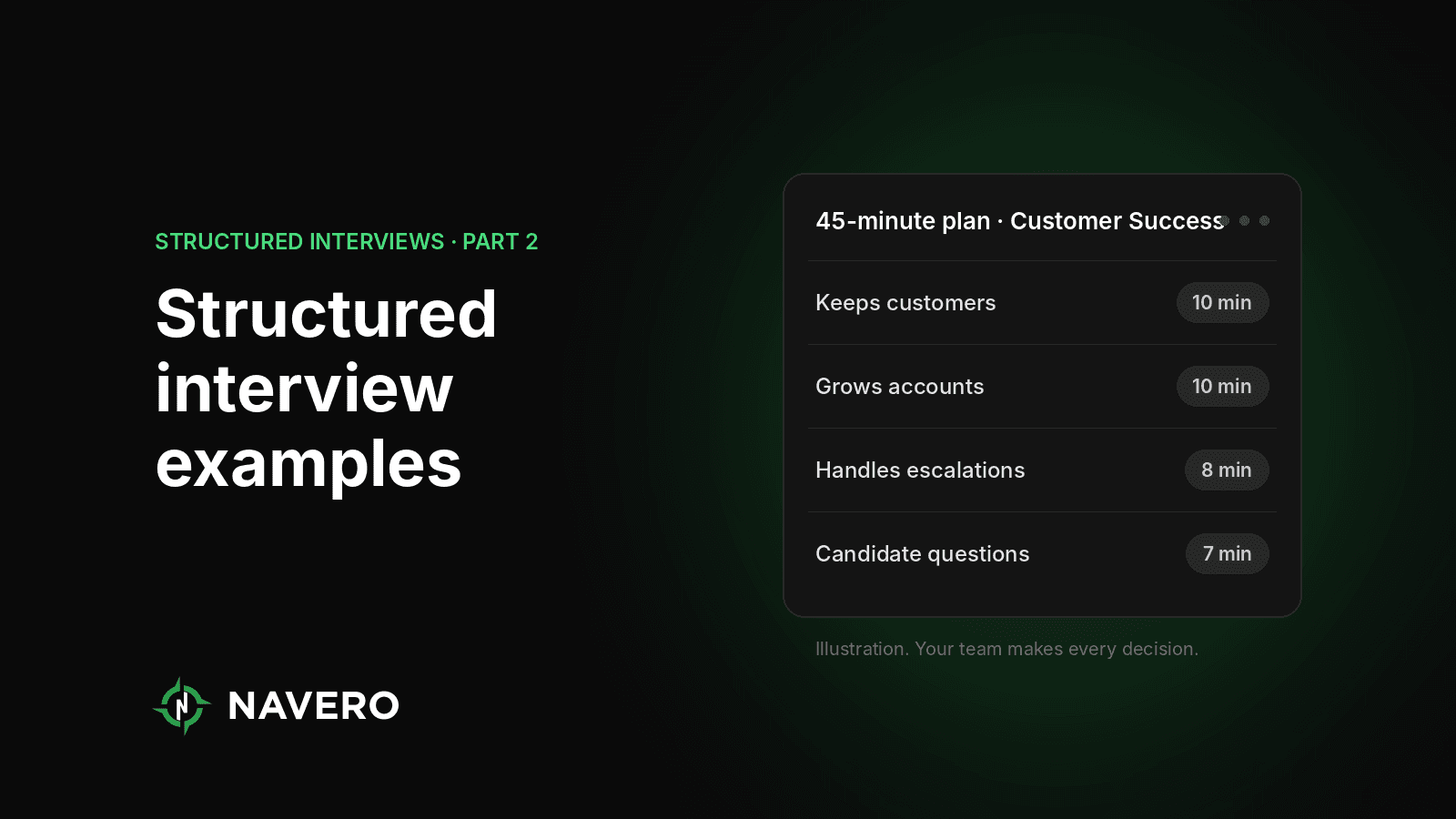
Here is a 45-minute plan for a customer success manager. Every candidate gets the same plan.
| Time | Part | What happens |
|---|---|---|
| 0 to 5 min | Opening | Introductions, how the interview works, the rules on AI tools and recording |
| 5 to 15 min | Criterion 1: keeps customers | One behavioural question, two or three follow-ups |
| 15 to 25 min | Criterion 2: grows accounts | One behavioural question, two or three follow-ups |
| 25 to 33 min | Criterion 3: handles escalations | One situational question about a real scenario |
| 33 to 38 min | Criterion 4: works with product | One behavioural question |
| 38 to 45 min | Candidate's questions | Their questions, then what happens next |
Four criteria, five core questions, plenty of room for follow-ups. That is enough to score each criterion with evidence.
What are some structured interview examples?
Each example uses the same four-point scale as our interview scorecard template: not met, partly met, met, exceeded. "Not met" and "exceeded" are left out of the guides below to keep them short.
Example 1: Customer success manager, keeps customers
Question (behavioural): Tell me about a customer who was about to leave. What did you do?
Follow-ups: How did you find out they were at risk? What did they say was wrong? What happened six months later?
- Partly met: Saved the account with a discount or a favour, but cannot say what caused the risk.
- Met: Found the real cause, agreed a plan with the customer, and the customer stayed.
- Strong sign: Also changed something so the same problem did not hit other customers.
Example 2: Operations manager, improves processes
Question (behavioural): Tell me about a process you changed that people did not want to change.
Follow-ups: How did you measure it before and after? Who pushed back, and how did you bring them along? What would you do differently?
- Partly met: Made the change, but has no measure of whether it worked.
- Met: A clear before and after, and an explanation of how they got people to adopt it.
- Strong sign: Tested the change on a small scale first.
Example 3: Product designer, decides with evidence
Question (behavioural): Tell me about a design decision where user research changed your mind.
Follow-ups: What did you believe before? What exactly did users do or say? How did you convince the team?
- Partly met: Ran research, but the decision was made before it was done.
- Met: Describes the original view, the evidence, and the changed design.
- Strong sign: Checked after launch whether the new design worked.
Example 4: Finance manager, accuracy under pressure
Question (situational): It is the day before the board pack is due and you find a number that does not reconcile. The CFO is travelling. What do you do?
Follow-ups: What would you check first? Who would you tell, and what would you say? What if you cannot find the cause in time?
- Partly met: Would fix the number quietly, or would wait for the CFO before doing anything.
- Met: Checks the source, flags it clearly and early, and proposes what goes in the pack with a note.
- Strong sign: Mentions fixing the process that let the error through.
Example 5: Marketing manager, learns from results
Question (behavioural): Tell me about a campaign that did worse than you expected.
Follow-ups: What did you expect, and what happened? How did you work out why? What did you change in the next campaign?
- Partly met: Describes the result but blames the budget, timing or the product.
- Met: Has a measured result, a reasoned cause and a specific change that followed.
- Strong sign: Stopped the campaign early because the numbers were clear.
Run your next hire from one place
Find people who fit, shortlist with evidence, and get interviews scheduled, transcribed and scored. Free to start, no card needed.
Try nowExample 6: First-time manager, handles poor performance
Question (situational): One of your team has missed two deadlines this month and seems disengaged. You have a one-to-one tomorrow. How do you run it?
Follow-ups: What would you say first? What if they say it is a personal problem? What if nothing changes in two weeks?
- Partly met: Would either avoid the topic or go straight to a warning.
- Met: Asks first, states the facts clearly, agrees specific next steps and a date to review.
- Strong sign: Knows when to bring in HR and how to support someone with a personal problem without dropping the standard.
What is the difference between behavioural and situational examples?
The same criterion can be tested both ways. Use behavioural questions when the candidate should already have done the work, and situational ones when they have not.
| Criterion | Behavioural (past) | Situational (future) |
|---|---|---|
| Prioritises | Tell me about a week when you had more work than time. What did you drop? | You have three urgent requests from three managers. What do you do? |
| Handles conflict | Describe a disagreement with a colleague that got heated. | A peer criticises your work in a team meeting. How do you respond? |
| Uses AI tools well | Tell me about a time an AI tool gave you a wrong answer. How did you notice? | You are asked to use an AI tool on customer data. What do you check first? |
For more question ideas, see our hub of interview questions to ask candidates, plus competency-based and scenario-based questions.
What does a structured debrief look like?
Each interviewer submits scores before the meeting. Then the debrief goes criterion by criterion:
- Read out the scores for one criterion. No discussion yet.
- Where scores agree, move on.
- Where they differ, each person reads the evidence they wrote down. Often one interviewer asked a better follow-up.
- Agree a score or mark the criterion "needs more evidence" for the next round.
- Decide last, after every criterion is done. Check must-haves first.
Thirty minutes is usually enough for one candidate.
What mistakes show up in structured interview examples?
- Leading questions. "You are good at handling pressure, right?" tells the candidate the answer.
- Two criteria in one question. "Tell me how you lead and how you plan" makes it hard to score either.
- Scoring guides that describe the person. "Confident" is not a scoring anchor. "Gave a measured result" is.
- Hypotheticals for experienced hires. If the role needs experience, ask what they did, not what they would do.
- No follow-ups planned. The first answer is the rehearsed one. The follow-ups are where you learn.
How does Navero help you run structured interviews?
Navero Interview keeps the criteria, questions and scorecard with the role, so every interviewer works from the same plan. It schedules the interview, joins Google Meet, Microsoft Teams or Zoom as a notetaker with the candidate's consent, transcribes in Arabic or English, and sets each answer against the scoring guide with the quote that supports it. Interviewers confirm every score, and your team makes the decision. Navero Recruit uses the same criteria when it finds candidates, so the standard does not change between stages.
Navero is free for now, then US$149 per open role per month once paid plans are switched on.
Can you ask follow-up questions in a structured interview?
Yes. The core questions and the scoring guide stay the same for every candidate. Follow-ups depend on each answer, and that is fine. Plan two or three per question so interviewers know where to dig.
How many examples should a candidate give per criterion?
One good example, explored with follow-ups, is usually enough to score. If the first example is weak, ask for a second before scoring "not met".
Do structured interviews work for senior roles?
Yes. The criteria change (strategy, leading leaders, decisions with long consequences) but the method is the same: agreed criteria, the same core questions, a scoring guide and evidence.