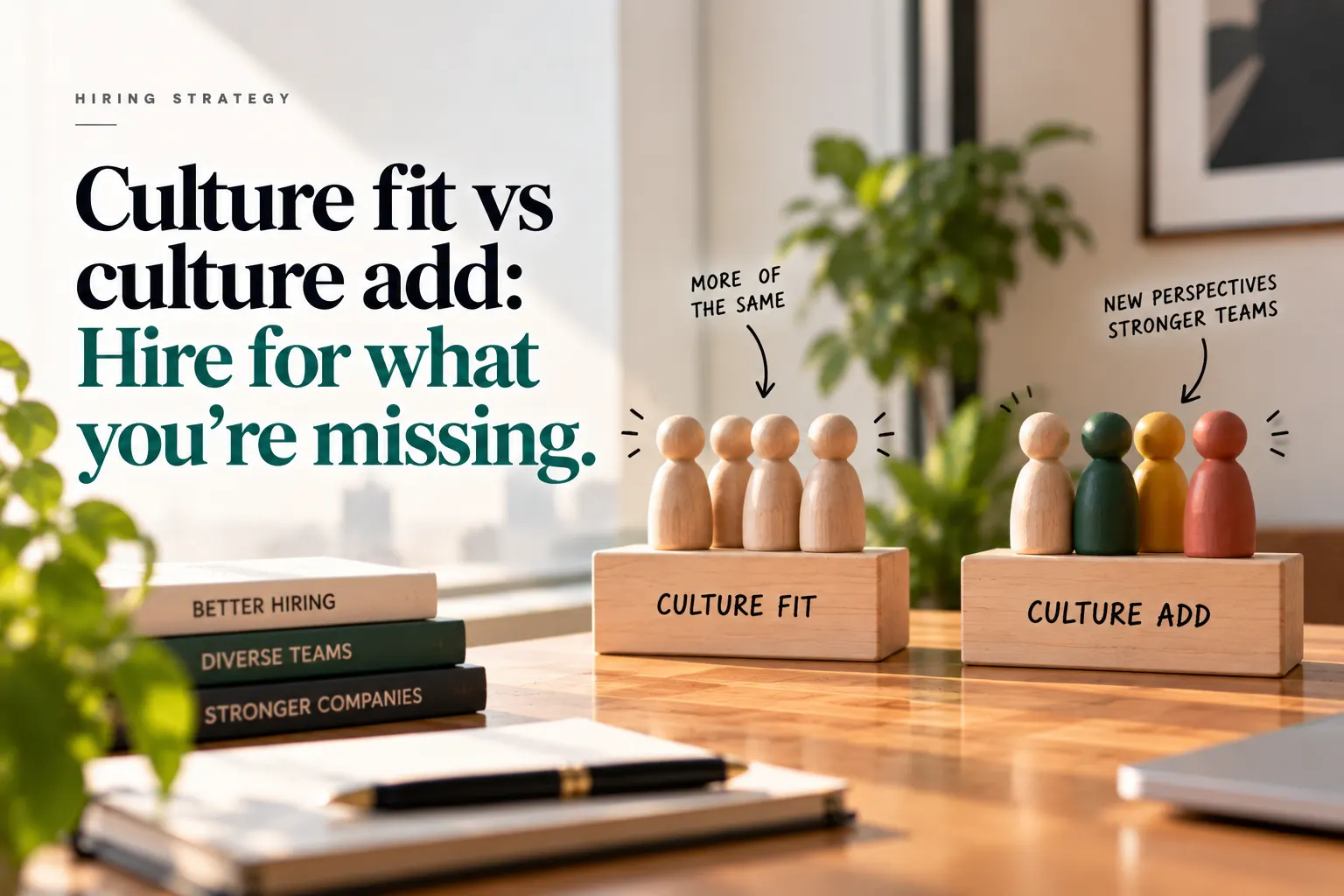
Culture Add vs Culture Fit: Hire for What You're Missing
Key Takeaways (TL;DR)
- "Culture fit" sounds like a virtue and often works like a bias. When hiring on fit means hiring people who feel familiar, you slowly build a team of clones and screen out the different perspectives that make teams better. The fix is to hire for culture add instead.
- Culture fit, as usually practised, rewards sameness: candidates who look, sound, and think like the people already in the room.
- That makes it a common hiding place for unconscious bias, because "they just did not feel right" is rarely about values.
- Culture add keeps your real, shared values as a baseline, then asks what new perspective a candidate brings.
- The way to do it fairly is to define values as concrete behaviours and assess them with structure, not gut feel.
The problem with "culture fit"
Ask a hiring manager why they passed on a strong candidate and you will often hear a version of "they were good, but not quite a culture fit." It sounds responsible. Culture matters, after all. But stop and ask what "fit" actually meant in that moment, and the answer is frequently uncomfortable: the candidate did not remind them of the team.
That is the quiet danger of culture fit as most companies practise it. It starts as a reasonable idea, that people should share the organisation's values, and drifts into something else entirely: a preference for people who feel familiar. The same school, the same humour, the same way of speaking in a meeting, the same background. None of that is a value. It is similarity. And when similarity becomes your hiring filter, two bad things happen at once.
Why fit becomes a bias trap
The first problem is bias. "Fit" is a subjective judgement that is almost impossible to check, which makes it the perfect cover for unconscious bias. When a decision rests on whether someone "felt right," no one can audit whether the real reason was values or just discomfort with difference. Comments like "they are not really one of us" or "I could not picture them on the team" are classic warning signs (Great Place to Work, on culture add). The result, widely argued by practitioners, is that fit-based hiring tends to narrow the diversity of a team over time, because each hire is quietly measured against the people already there. It is worth noting that the hard data here is mostly practitioner commentary rather than peer-reviewed proof, but the logic is sound and the pattern is familiar to anyone who has watched a homogenous team keep hiring more of itself.
The second problem is performance. A team of people who think alike has shared blind spots. It reaches consensus quickly and misses things just as quickly. The differing perspective that feels like friction in the interview is often exactly what the team needs to make better decisions. Filter it out in the name of fit, and you optimise for comfort at the cost of capability.
The cost of a team of clones
It helps to be concrete about what fit hiring costs you, because the damage is easy to miss. A team of people who think alike makes faster decisions and worse ones, because no one in the room sees the blind spot everyone shares. Innovation slows, since new ideas usually come from someone who looks at the problem differently. Your understanding of customers narrows, because a homogenous team struggles to imagine users unlike themselves. And over time the effect compounds: each similar hire makes the next different candidate feel like an even bigger outlier, so the filter tightens on its own. None of this shows up on a dashboard, which is exactly why it is dangerous. You do not notice the great perspectives you never hired, you only feel the slow sameness settling over the team.
What culture add actually means
Culture add is not the opposite of having a culture, and it does not mean hiring people who clash with your values. That is the common misunderstanding. It means separating two things that "fit" bundles together: your genuine, shared values, and mere similarity.
The shared values stay as a real baseline. If your company runs on candour, or on customer obsession, or on moving fast, a new hire does need to share that. But beyond that baseline, culture add flips the question. Instead of asking "will this person fit in with the team we already have?", you ask "does this person share our core values, and what do they bring that we do not already have?" That second half is the point. You are hiring for the perspective, experience, or strength that is missing, not for another copy of what you already own.
How to hire for culture add without the gut-feel trap
The catch is that "culture add" can become just as vague and bias-prone as "fit" if you assess it by feel. The fix is structure. A few principles make it real.
First, define your values as concrete behaviours, not vibes. "Good communicator" is a vibe. "Explains a complex idea clearly to someone outside their field" is a behaviour you can actually observe and score. Our guide to culture fit interview questions shows how to ask about values without defaulting to bias.
Second, assess everyone the same way. Ask every candidate the same value-based questions and score them against the same defined behaviours, as with any structured interview. Structure is what stops "add" from collapsing back into gut feel.
Third, lead with what people can do. The strongest guard against bias is to anchor your decision in demonstrated ability, not impressions. When you judge candidates first on real, job-relevant skills, as in skills-based hiring over resume screening and blind hiring, the "culture" conversation happens on top of evidence rather than in place of it.
To be fair to the idea of fit
There is a real thing buried inside "culture fit," and it is worth keeping. People genuinely do need to share an organisation's core values and ways of working, and a true values mismatch is a legitimate reason not to hire. Someone who cannot work honestly in a culture built on candour is a poor hire, full stop. That is not bias, it is alignment.
The argument here is not that values do not matter. It is that "fit" as commonly used smuggles similarity in alongside values, and the similarity part is the problem. Keep the values. Drop the clone test. There is also a practical reason to be careful: subjective "fit" judgements can edge into legal risk when they become a proxy for protected characteristics, which is exactly what structured, skills-first hiring helps you avoid.
How Navero helps
Navero is built to anchor hiring in evidence rather than impression, which is the foundation culture add needs. It screens candidates on verified skills with realistic, job-relevant tasks, so your shortlist is based on what people can actually do, not on who felt familiar in a conversation.
Navero scores every candidate on the same criteria, shows the reasoning behind each result, and keeps a human making the final decision, which supports alignment with the EU AI Act, NYC Local Law 144, and EEOC guidance. Starting from demonstrated ability removes a whole layer of gut-feel bias, so when you do assess values and what a candidate adds, you are building on evidence rather than replacing it. For more on reducing bias in your process, see our guide to blind hiring.
Want culture decisions built on evidence, not familiarity? See how Navero's skills-based screening anchors your shortlist in real ability first.
The bottom line
Culture fit, as most teams practise it, is a comfortable way to keep hiring people like the ones you already have. It feels like protecting your culture and often works like protecting your comfort, inviting bias and quietly draining the diversity of thought that makes teams strong. Culture add is the better frame: hold your genuine shared values as a firm baseline, then hire for the perspective and strength a candidate brings that you do not already have. Do it with structure, defined behaviours, consistent scoring, and skills-first evidence, so "add" does not become another gut-feel trap. Keep the values, drop the clone test, and you will build a team that is both aligned and genuinely diverse, which is the combination that actually performs.
Frequently Asked Questions
What is the difference between culture fit and culture add? Culture fit asks whether a candidate will blend in with the existing team, which in practice often rewards similarity. Culture add keeps shared company values as a baseline but then asks what new perspective, experience, or strength the person brings that the team does not already have. Fit optimises for sameness, add optimises for shared values plus valuable difference.
Why is hiring for culture fit considered biased? Because "fit" is a subjective judgement that is hard to audit, it easily becomes a cover for unconscious bias. When a decision rests on whether a candidate "felt right," the real driver may be discomfort with difference rather than a genuine values mismatch. Over time, measuring every candidate against the current team tends to narrow a team's diversity, which is the core criticism of fit-based hiring.
Does culture add mean ignoring company values? No, and that is the most common misunderstanding. Culture add keeps your genuine, shared values as a firm baseline that every hire must meet. What it drops is the extra, unspoken requirement that a candidate also resemble the existing team. You hire people who share the values and bring something new, rather than people who simply feel familiar.
How do you assess culture add without introducing bias? With structure. Define your values as concrete, observable behaviours rather than vague vibes, ask every candidate the same value-based questions, and score them against the same criteria. Most importantly, anchor the decision in demonstrated, job-relevant skills first, so the culture conversation happens on top of real evidence rather than replacing it with gut feel.
Is culture fit ever legitimate? Yes, in one specific sense: candidates do need to share an organisation's core values and ways of working, and a true values mismatch is a fair reason not to hire. The problem is that "fit" as commonly used bundles genuine values together with mere similarity. Keep the values requirement, which is alignment, and drop the similarity test, which is where bias and even legal risk creep in.