Blind Hiring: How to Reduce Bias in Your Process in 2026
Key Takeaways (TL;DR)
- Blind hiring means removing details that reveal a candidate's identity, like name, gender, age, and school, so early decisions are made on ability rather than background. The evidence that identity affects hiring is strong, and blind hiring is one way to counter it.
- Research is stark: resumes with white-sounding names get around 50% more callbacks than identical resumes with black-sounding names.
- Anonymising applications can raise callbacks for underrepresented candidates, and famously made women far more likely to advance in orchestra auditions.
- But blind hiring is not a silver bullet. It only protects the early stages, and bias can return at interview if the rest of the process is loose.
- The most robust form of blind hiring is judging candidates on tested skills, not identity. Navero scores candidates on evidence, and a human decides.
What is blind hiring?
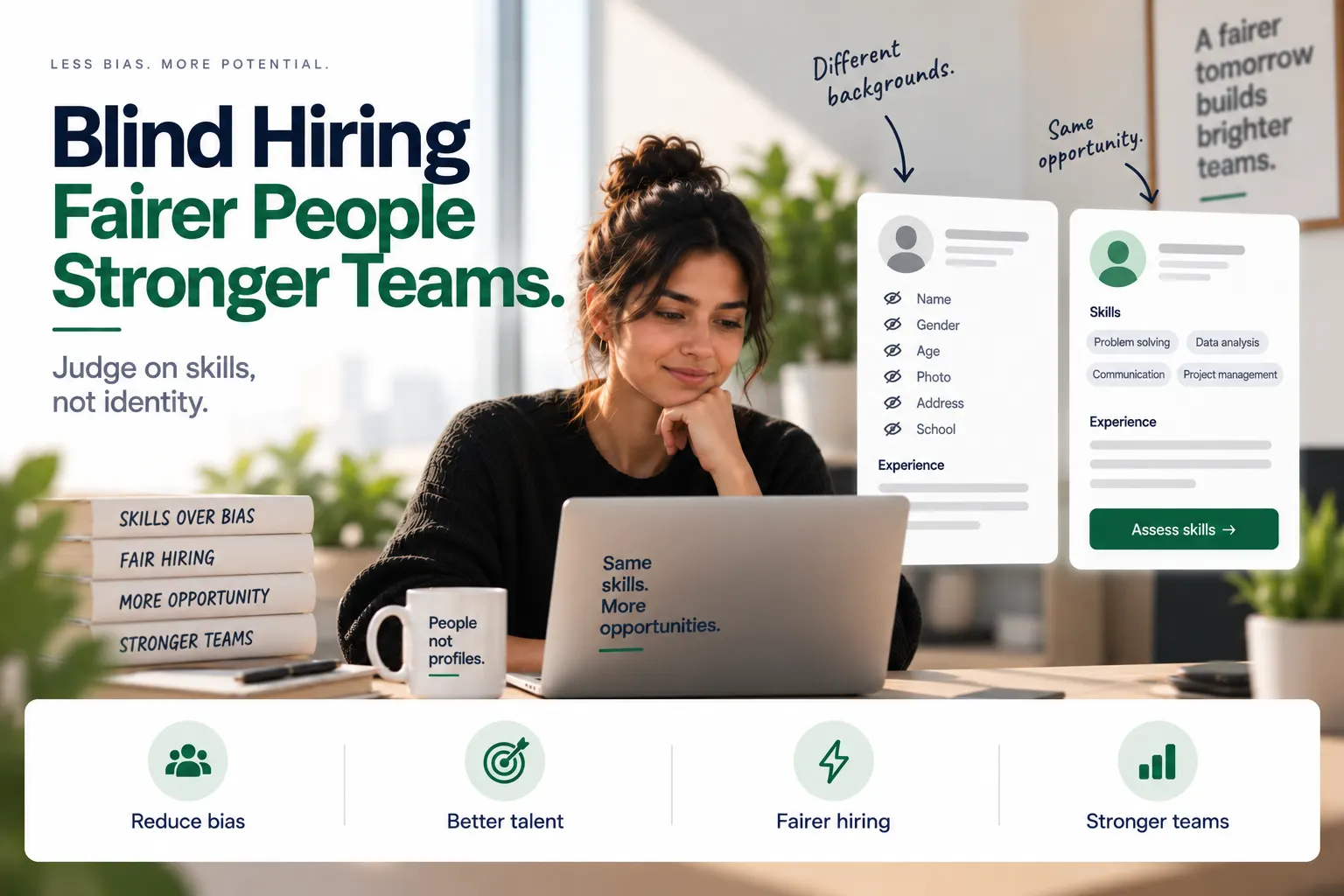
Blind hiring, or blind recruitment, is the practice of hiding details that reveal who a candidate is, so those details cannot sway a decision. Commonly removed are the candidate's name, gender, age, photo, address, and the specific school or university they attended.
The goal is simple: force early hiring decisions to rest on what a candidate can do and has done, rather than on assumptions triggered by their identity. It is a direct response to a well-documented problem, which is that those assumptions change outcomes even when the underlying ability is identical.
The evidence that bias is real
This is not a hypothetical concern. The research is some of the clearest in all of hiring.
Names change callbacks. A landmark study found that resumes with white-sounding names received roughly 50% more callbacks than identical resumes with black-sounding names (TestGorilla, on blind hiring research). Similar gaps appear for other ethnic and religious name signals.
Anonymity can help underrepresented candidates. Blind resumes have been shown to raise callbacks for underrepresented candidates, and the famous orchestra study found that blind auditions made women several times more likely to advance past the first round (SHRM, on blind hiring and diversity).
When identical qualifications produce different outcomes based on a name or a photo, that is bias operating, whether anyone intends it or not. Blind hiring is one tool for interrupting it.
How to implement blind hiring
1. Anonymise applications
At the first screen, remove or hide name, photo, gender, age, address, and the specific institution attended. Focus reviewers on experience, skills, and what the candidate actually did. Many applicant systems can mask these fields automatically.
2. Standardise what you look at
Blinding only works if everyone assesses the same anonymised information the same way. Use a consistent format and a shared rubric, so reviewers compare like with like rather than filling gaps with assumptions.
3. Use skills assessments, the strongest form of blinding
The most powerful way to hire blind is to judge candidates on a work sample or skills assessment. A piece of real work speaks for itself, regardless of the candidate's name, background, or school. This is blind hiring in its most robust form, because it does not just hide identity, it replaces it with evidence of ability.
4. Keep structure through the interview
Anonymity usually ends at the interview, which is exactly where bias can creep back in. Counter it with structured interviews: the same questions, scored on the same rubric, for every candidate. Without this, a blind early stage feeds into a biased later one, and the benefit is lost.
The limits of blind hiring
Here is the honest part most guides skip. Blind hiring helps, but it is not a complete solution, and treating it as one is a mistake.
First, it only protects the stages where you can hide identity. The moment a candidate walks into an interview, the anonymity is gone, so a blind screen followed by an unstructured interview can undo much of the gain. Second, the evidence is not unanimous. Some studies, including a well-known French trial of anonymous CVs, found mixed or even negative effects, partly because of how employers self-selected into the schemes (SHRM). And third, blinding hides signals but does not build capability, so it works best as one part of a broader commitment to fair, structured, evidence-based hiring.
The takeaway is not to abandon blind hiring. It is to see it as one layer, most powerful when paired with skills assessment and structure, not a switch you flip to declare the problem solved.
A quick example
Take two candidates for the same role. On paper, one has a familiar name and a well-known university. The other has a foreign-sounding name and a school you do not recognise. The research says the first candidate is far more likely to get a callback, even if the two are equally qualified. That is bias at work, and most of the time nobody notices it happening.
Now blind the process. Strip the names, the schools, and the photos, and give both candidates the same short work task. The reviewer sees only the work. Suddenly the decision rests on who did the better job, not on whose name felt familiar. That is the whole idea in one picture: remove the trigger for the assumption, and let the evidence speak. It is a small change to the process that can quietly change who gets a fair shot.
Common mistakes with blind hiring
Treating it as the whole solution. Blinding the first screen helps, but if the interview is unstructured, bias walks back in. Pair it with structure.
Blinding, then ignoring the data. If you never check whether your pipeline is more balanced, you cannot tell if it is working. Measure it.
Hiding skills too. The point is to hide identity, not ability. Keep the work, the skills, and the results fully visible.
Stopping at the resume. Anonymising a CV is the weakest form. Judging candidates on a work sample is far more powerful, because it replaces identity with evidence.
Assuming it fixes culture. Blind hiring changes one part of one stage. Real fairness needs a broader, consistent, evidence-based process behind it.
Blind hiring versus skills-based hiring
These two ideas are closely related, and understanding the difference is useful. Blind hiring removes identifying information so bias has less to grab onto. Skills-based hiring replaces those signals with direct evidence of ability. The second is the more robust version of the first, because it does not rely on hiding information that reappears at the interview. When you judge a candidate on verified skills, you are hiring on the one thing that actually predicts performance, and identity simply is not part of the score. That is why moving to skills-based hiring versus resume screening achieves the goal of blind hiring more completely than anonymising a resume alone.
How Navero supports fairer, more evidence-based hiring
Navero delivers the strongest form of blind hiring by design. It screens and ranks candidates on verified skills rather than names, schools, or resume signals, so candidates rise on demonstrated ability, not identity. That is blinding at its most robust, because the score is built from what someone can do.
Navero also shows the reasoning behind each score and keeps a human making the final decision, which is essential: fairness comes from consistent, explainable, job-related evidence, not from a black box. That design supports alignment with the EU AI Act, NYC Local Law 144, and EEOC guidance as they tighten around hiring. For the wider picture, see our guides to fair recruitment practices and tools that reduce hiring bias.
Want to hire on ability, not identity? See how Navero's skills-based screening scores candidates on evidence.
The bottom line
Blind hiring is a genuinely useful tool, but it is a layer, not a cure. The evidence that identity changes outcomes is hard to argue with, and hiding names and photos at the first screen can give overlooked candidates a fairer shot. Its weakness is just as clear: the anonymity ends at the interview, and a blind screen followed by a loose, gut-feel interview loses most of the benefit. So the smart way to use it is to combine it with structure and, above all, with skills assessment. Judging candidates on what they can actually do is blind hiring in its strongest form, because identity is not part of the score in the first place. Hide the name if you like, but the surest way to hire fairly is to hire on evidence.
Frequently Asked Questions
What is blind hiring? Blind hiring removes details that reveal a candidate's identity, such as name, gender, age, photo, and school, from early hiring stages, so decisions rest on ability rather than assumptions about background. The most robust version judges candidates on tested skills.
Does blind hiring actually reduce bias? It can, especially in early screening. Research shows anonymising applications can raise callbacks for underrepresented candidates, and blind auditions notably increased women's advancement. But the evidence is mixed in some settings, and blind hiring only protects stages where identity can be hidden.
What are the limits of blind hiring? It only works where you can hide identity, so bias can return at the interview if the rest of the process is unstructured. Some studies found weak or negative effects. It is best used as one layer alongside skills assessments and structured, consistent evaluation.
What is the difference between blind hiring and skills-based hiring? Blind hiring hides identifying information. Skills-based hiring replaces it with direct evidence of ability. Skills-based hiring is the more robust approach, because it judges candidates on what they can do, so identity is not part of the score even at the interview stage.
What information should you hide in blind hiring? Typically name, gender, age, photo, home address, and the specific school or university attended, since these trigger assumptions unrelated to ability. Keep skills, experience, and work samples fully visible. The goal is to remove identity signals while keeping every signal that actually predicts performance.
Does blind hiring work at the interview stage? Not directly, because the candidate is present and identity is visible again. That is why a blind early screen must be paired with structured interviews, the same questions scored the same way for everyone. Without that structure, bias can return at the interview and undo the earlier gain.
How do I make my hiring process fairer? Anonymise early applications, standardise what reviewers see, judge candidates on skills assessments, keep interviews structured and consistently scored, and measure your pipeline for disparities. Fairness comes from evidence and consistency, not from hiding information alone.