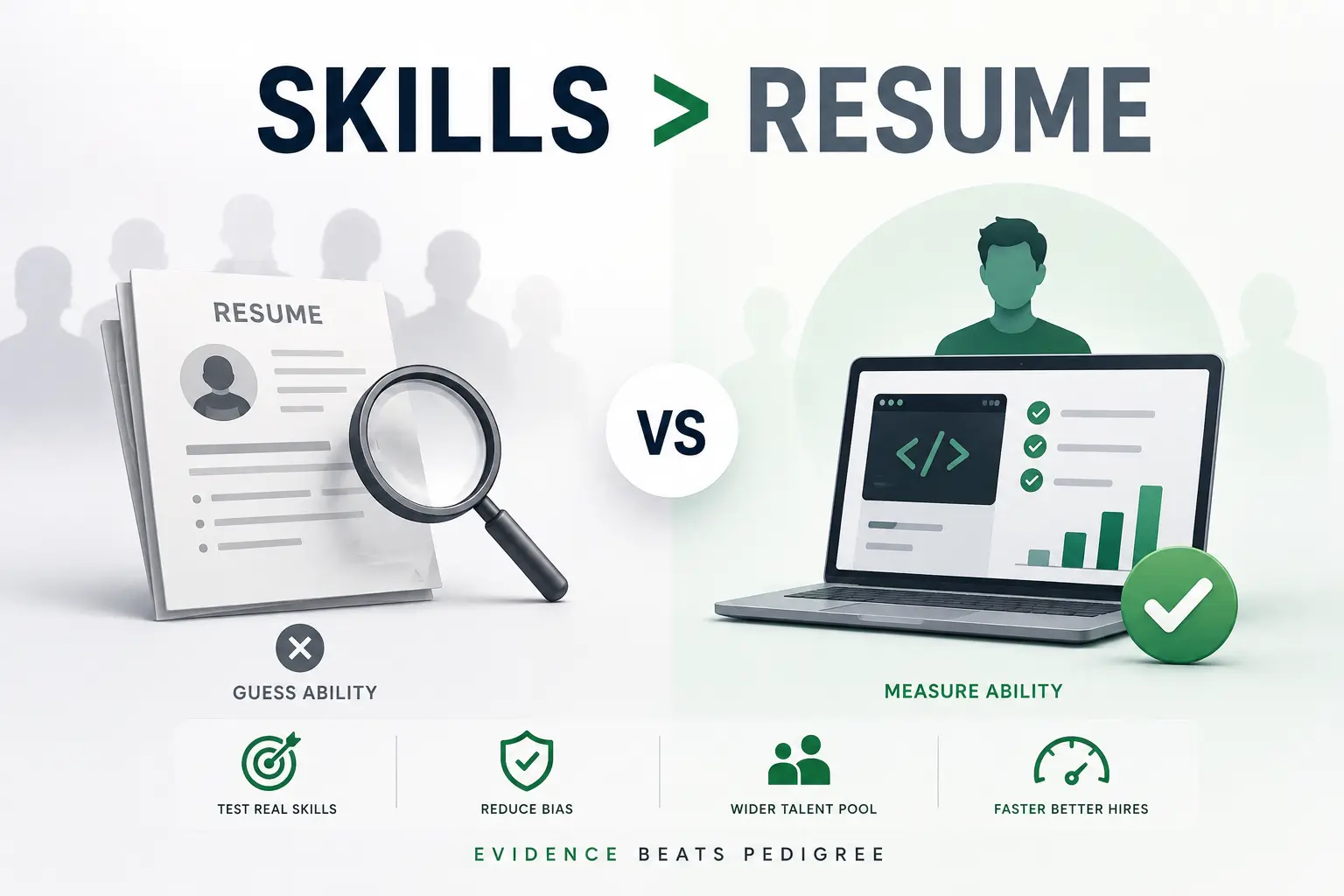
Skills-Based Hiring vs Resume Screening: What Actually Predicts Performance in 2026
Key Takeaways (TL;DR)
- Resume screening judges candidates on what they claim: past titles, years of experience, and where they studied. Skills-based hiring judges them on what they can do, tested directly. Decades of research say the second approach predicts performance far better.
- Work sample tests predict job performance at around r = .54, and structured interviews and general mental ability at about .51, according to the landmark Schmidt and Hunter meta-analysis of 85 years of research.
- Years of experience is one of the weakest predictors, ranking behind more than 20 other selection methods.
- A resume mostly bundles those weak signals together, which is why resume-first screening misses strong candidates and lets weak ones through.
- Skills-based hiring flips the order: test ability first, read the resume second. Navero scores candidates on verified skills and surfaces them; your team decides.
The core difference
Resume screening and skills-based hiring answer the same question in opposite ways. The question is "can this person do the job?"
Resume screening infers the answer from proxies. It looks at job titles, years of experience, employers, and education, and assumes those add up to ability. It is fast and familiar, which is why it became the default.
Skills-based hiring measures the answer directly. It puts the candidate in front of a task or assessment that reflects the real work and scores how they actually perform. Instead of trusting the claim, it checks it.
That is the whole debate in one line: infer ability from a document, or measure it directly. The research on which approach works is not close.
What the research says about predicting performance
This is not opinion. Industrial and organizational psychologists have studied it for decades, and the landmark reference is the Schmidt and Hunter meta-analysis, which aggregated 85 years of research on which selection methods actually predict job performance (Schmidt and Hunter, University of Baltimore archive).
Here is the pattern that matters. The methods that measure ability sit at the top. The proxies a resume is built from sit near the bottom.
Selection method | Approx. predictive validity (r) | What it measures |
|---|---|---|
Work sample tests | .54 | Actual ability on the job's tasks |
General mental ability | .51 | Reasoning and problem-solving |
Structured interviews | .51 | Evidence-based judgment and fit |
Years of experience | low | A proxy, ranked behind 20+ methods |
Unstructured interviews | low | First impressions, weakly predictive |
Education credentials | low | A proxy for ability, not ability itself |
A validity of around .5 is strong for this kind of research, while the proxies a resume leans on cluster near the bottom (Plum, Schmidt and Hunter explained). Combining a structured interview with a general mental ability measure pushes validity to about .63, and adding a work sample raises accuracy further still.
One honest note: a 2022 re-analysis by Sackett and colleagues produced somewhat lower absolute numbers under stricter corrections, but the ranking held. Work samples, structured interviews, and ability tests stayed at the top, and unstructured proxies stayed at the bottom. The direction of the evidence is settled even where the exact figures are debated.
Why the resume is a weak signal
A resume is not one predictor. It is a bundle of the weak ones. It reports years of experience, past titles, and education, which are exactly the proxies the research ranks lowest. So resume-first screening is not slightly worse than testing skills. It is built almost entirely from the signals that predict performance least.
Three forces have made the resume weaker still in 2026.
AI writes them now. A candidate can generate a flawless, keyword-matched resume in seconds. Screening for a polished resume increasingly screens for AI access, not ability. We cover the wider problem in what AI-native hiring actually means.
Keywords are gamed. Because applicant tracking systems filter on keywords, candidates reverse-engineer them. The resume that ranks highest is often the best-optimized, not the best-qualified.
It hides good people. Skills-based hiring widens the pool to strong candidates from non-traditional backgrounds who never had the "right" titles, and resume screening filters exactly those people out.
None of this means a resume is useless. It means it is a weak first filter, and using it as the main gate is the mistake.
Skills-based hiring vs resume screening, side by side
Resume screening | Skills-based hiring | |
|---|---|---|
What it judges | Claims: titles, experience, education | Evidence: tested ability |
Predictive strength | Low, built on weak proxies | High, built on work samples and ability |
Effect of AI-written resumes | Weakened badly | Largely unaffected |
Bias risk | Higher, favors pedigree and keywords | Lower, when scored consistently on skills |
Widens or narrows the pool | Narrows to familiar profiles | Widens to non-traditional talent |
Speed at volume | Fast but often wrong | Fast and evidence-based when automated |
The table is not close, and that is the point. On nearly every axis that decides hire quality, measuring ability beats inferring it.
A quick example
Picture two candidates for the same role. The first has a polished resume: the right degree, a familiar employer, and all the keywords your automated resume screening is set to catch. The second has an uneven resume, a career gap, and a non-traditional path, so the system ranks them low or filters them out.
Now give both a short work sample that mirrors the job. The second candidate produces clearly stronger work. Under resume-first screening, you never see it, because they were cut before anyone looked. Under skills-first screening, they rise to the top, because the test measures what the resume could not.
This is not a rare edge case. It is the predictable result of screening on proxies. The resume rewards the familiar profile, while the work sample rewards the better performer, and those are often two different people. That gap is exactly what skills-based hiring is designed to close.
Does this mean resumes are dead?
No, and it is worth being precise. A resume is still a reasonable way to capture context: a career story, a portfolio link, a rough sense of level. The mistake is using it as the primary screen, the thing that decides who advances.
The better model is to change the order. Test skills first, then read the resume for context on the people who already proved they can do the work. That way the weak signal informs the decision without gating it, and the strong signal, tested ability, does the heavy lifting. This is what a good skills-based hiring process does in practice.
How to move from resume-first to skills-first
You do not need to throw out your process. You need to reverse the order of evidence.
1. Define the skills the role actually needs
Start from the real work, not the old job description. List the handful of skills that separate a strong performer from a weak one, and build your assessment around those.
2. Test ability before you read resumes
Put a short, role-relevant work sample or skills assessment at the front of the funnel. Score candidates on what they produce, then use the resume only for context on those who pass. This is the single change that moves you from proxy to evidence.
3. Score everyone consistently
Use the same evidence and the same rubric for every candidate. Consistency is what turns skills testing into a fair, defensible process, and it is where a structured approach beats gut feel. Our guide to evaluating candidates in your screening process covers how to build that rubric.
4. Keep a human in the decision
Let the process surface and rank candidates on evidence, but keep a person making the final call. That is both better hiring and, as automated-hiring rules tighten, the compliant way to run it.
How Navero does skills-first screening
Navero is built on the model the research supports: measure ability, do not infer it. It screens and ranks candidates on verified skills rather than resume signals, so the people who rise to the top of your shortlist are the ones who demonstrated they can do the work, not the ones with the most optimized resume.
That is why Navero helps teams filter out roughly 60% of unqualified applications and cut time-to-hire by up to 75% (based on customer data). It puts the strong signal, tested skill, at the front of the funnel, where the weak signal used to sit.
Two principles keep it fair. First, Navero scores and surfaces candidates and shows the reasoning behind each score, and a human recruiter or hiring manager makes the final decision. Second, that human-in-the-loop design keeps you aligned with the EU AI Act, NYC Local Law 144, and EEOC guidance as they tighten around automated hiring.
The bottom line
The debate between skills-based hiring and resume screening is not really a debate. Eighty-five years of research says testing ability predicts performance far better than reading a document built from weak proxies, and AI-written resumes have only widened the gap. The fix is not to ban resumes. It is to demote them: test skills first, read the resume second, and let evidence rather than pedigree decide who you hire. Teams that make that switch make better hires, and they make them faster.
Frequently Asked Questions
Is skills-based hiring better than resume screening? For predicting job performance, yes. Work sample tests and structured, skills-based methods predict performance far better than the proxies a resume relies on, such as years of experience and education, according to decades of research.
Does a resume predict job performance? Weakly. A resume mostly reports experience, titles, and education, which rank among the weakest predictors of performance. Tested ability, through work samples or structured assessments, is a much stronger signal.
Should we stop using resumes entirely? No. Resumes are useful for context, like a career story or portfolio. The change that matters is order: test skills first as the primary screen, then read resumes for context on candidates who already proved they can do the work.
Why are resumes weaker signals in 2026? AI can write a polished, keyword-optimized resume in seconds, and candidates reverse-engineer applicant tracking system keywords. Both make the resume easier to game and less connected to real ability than ever.
How do we start hiring on skills? Define the skills the role needs, put a short work sample or assessment at the front of the process, score every candidate consistently on the same rubric, and keep a human making the final decision.