Structured vs Unstructured Interviews: Which Predicts Better Hires in 2026?
Key Takeaways (TL;DR)
- A structured interview asks every candidate the same planned questions and scores them the same way. An unstructured interview is a free-flowing chat that changes with each candidate. The research on which one predicts performance is not close.
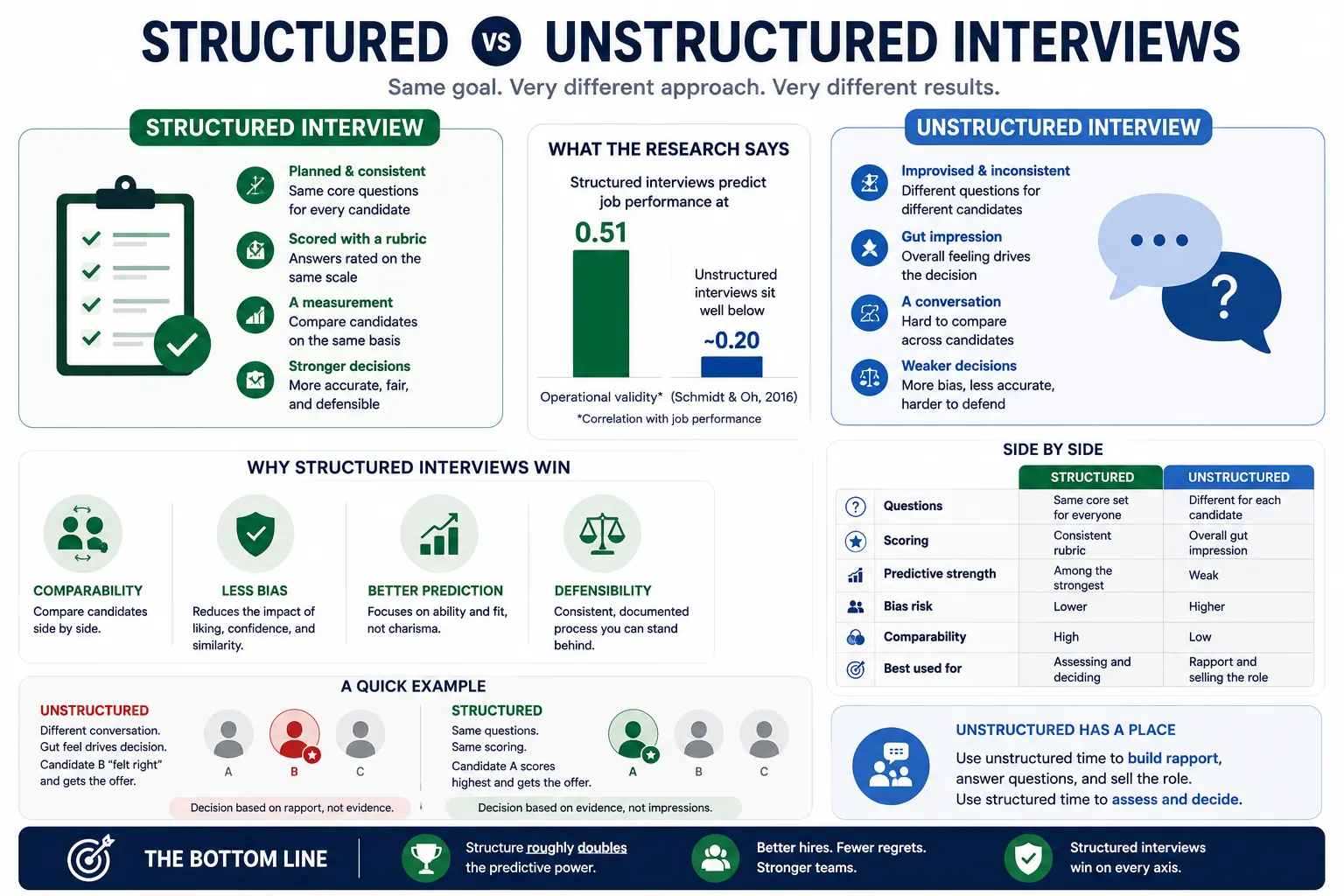
- Structured interviews predict job performance far better than unstructured ones, at an operational validity of about 0.51 in the landmark Schmidt and Hunter research.
- Unstructured interviews feel natural but mostly measure rapport and confidence, and they let bias in through the back door.
- Structure is what makes interviews comparable, fair, and defensible, which matters more as hiring rules tighten.
- The best process is structured interviews on top of skills evidence. Navero screens on verified skills and keeps a human deciding.
What is the difference?
The two approaches sound similar but work in opposite ways.
A structured interview is planned. You decide in advance which skills and traits you are assessing, write a set of questions tied to them, and ask every candidate the same core questions. You then score each answer against a consistent rubric. It is a measurement.
An unstructured interview is improvised. The interviewer follows the conversation wherever it goes, asks different questions of different candidates, and forms an overall impression at the end. It is a chat.
Most hiring still leans unstructured, because it feels natural and easy. That instinct is exactly the problem, because the easy option is also the weaker one.
What the research says
This is one of the most settled findings in hiring research. The landmark Schmidt and Hunter meta-analysis, which pooled 85 years of studies on selection methods, found that structured interviews predict job performance at an operational validity of around 0.51, among the strongest of any method, while unstructured interviews sit well below that (Schmidt and Oh, validity and utility of selection methods).
The gap is large, and the reason is simple. When every candidate answers the same questions and is scored the same way, you are actually comparing them on the same basis. When each interview is different, you are comparing impressions, and impressions are shaped by things that have nothing to do with the job.
So the headline is clear: structure roughly doubles the predictive power of the same conversation. You are not adding more interviews, you are making the interview you already run actually work.
Why structured interviews win
Four things drive the difference.
Comparability. The same questions and scoring let you compare candidates side by side, instead of ranking vague memories of different conversations.
Less bias. Unstructured interviews reward people who are confident, articulate, and similar to the interviewer, none of which predict performance. Structure strips much of that out, which is why it is a core tool for fairer hiring.
Better prediction. Because the questions are tied to the actual job and scored consistently, the signal is about ability and fit, not charisma.
Defensibility. A consistent, documented process is far easier to defend if a hiring decision is ever questioned, which matters as rules around hiring tighten.
None of this makes the interview colder. A structured interview can still be warm and conversational. It just has a backbone underneath the warmth.
Does unstructured have any place?
To be fair, unstructured conversation is not worthless. It just has the wrong job if you use it to evaluate.
A loose, human chat is genuinely useful for building rapport, selling the role, and answering a candidate's questions. Those matter, especially when you are trying to win a strong candidate. The mistake is letting that same freewheeling chat decide who gets hired. Use unstructured time to connect and sell, and structured time to assess. Keep the two jobs separate and you get the benefit of both.
Structured vs unstructured, side by side
Structured | Unstructured | |
|---|---|---|
Questions | Same core set for everyone | Different for each candidate |
Scoring | Consistent rubric | Overall gut impression |
Predictive strength | Among the strongest | Weak |
Bias risk | Lower | Higher |
Comparability | High | Low |
Best used for | Assessing and deciding | Rapport and selling the role |
The table makes the trade-off obvious. On every axis that decides hire quality, structure wins.
A quick example
Picture two hiring managers interviewing the same three candidates for the same role.
The first runs it unstructured. Each conversation goes somewhere different, and at the end she has three overall impressions. Candidate B "just felt right," partly because they share a hometown and an easy rapport. B gets the offer. There is no record of why, and no real way to know if B was actually the strongest.
The second runs it structured. All three answer the same questions, and she scores each answer against a rubric right after. Candidate A scores highest on the competencies that matter, even though B was the smoother talker. She hires A, with a clear, documented reason.
Same three candidates, two different hires. The unstructured version rewarded rapport. The structured version rewarded evidence. Over dozens of hires, that difference is the gap between a team built on gut feel and one built on signal.
Structured interviews do not have to be slow
A common objection is that structure makes interviews rigid or slow. It does not. Writing your questions once and reusing them actually saves time, because you are not improvising a new interview for every candidate. Scoring against a rubric is faster than agonising over a vague overall impression later. And because structured interviews reach a confident decision sooner, they shorten the process rather than lengthen it, which also means fewer strong candidates lost to faster-moving competitors. The rigour pays for itself in both quality and speed.
How to run a structured interview
Moving from a chat to a structured interview is not hard, and you do not need a big team to do it. Five steps cover it.
Define what you are assessing. Pick the handful of skills and traits that matter most for the role, and build the interview around those.
Write the questions in advance. Prepare a core set tied to each thing you are assessing, including behavioural questions that ask for real past examples.
Ask everyone the same core questions. This is the step that makes answers comparable. You can still follow up and probe, but the backbone stays the same.
Score against a rubric. Rate each answer on a fixed scale right after the interview, before impressions blur. Our guide to standardising interview scoring shows how.
Have interviewers score independently. Let each interviewer rate before discussing, so the loudest voice does not set the tone.
Our guide to running structured interviews without a recruiting budget walks through the whole thing, and our scenario-based interview questions give you a ready set to start from.
Common mistakes to avoid
Calling a loose chat "structured" because you had a few questions in mind. Structure means the same core questions and a real rubric, not a rough plan.
Different questions for each candidate. That breaks comparability and lets bias back in. Keep the core set consistent.
Scoring on delivery, not evidence. A confident storyteller is not the same as a strong performer. Score what the answer shows, not how smoothly it was said.
Deciding on a single overall gut feeling. Rate each competency separately, then combine. One blurred impression is where bias hides.
Using the interview to test skills you could measure directly. An interview is good for judgment and fit. For ability, a skills assessment is stronger.
How Navero fits
A structured interview is strong, but it is even stronger when the people you interview are already proven to have the skills. That is the pairing the research supports: measure ability directly, then use a structured interview for judgment and fit.
Navero screens and ranks candidates on verified skills before the interview, so your structured conversations happen with people who can already do the work. AI screening filters out roughly 60% of unqualified applications and cuts time-to-hire by up to 75% (based on customer data), which means every structured interview slot is spent on a candidate worth the time.
Two principles keep it fair. First, Navero surfaces and scores candidates on evidence and shows its reasoning, while a human interviewer makes the final decision. Second, that consistent, documented, human-in-the-loop design keeps you aligned with the EU AI Act, NYC Local Law 144, and EEOC guidance as they tighten around hiring. It is the same logic as choosing evidence over impressions in skills-based hiring versus resume screening.
If you want interviews that actually predict performance, start by screening on evidence. See how Navero's skills-based screening builds a shortlist worth interviewing.
The bottom line
Structured and unstructured interviews are not two equal styles to pick between by taste. One is roughly twice as good at predicting who will actually perform, and it is fairer and more defensible on top of that. Unstructured conversation still has a job, which is building rapport and selling the role, but it should never be the thing that decides who you hire. The practical move is simple: keep the warmth, add a backbone. Ask every candidate the same core questions, score them the same way, and pair the interview with real evidence of skill. Do that and the interview you already run starts producing far better hires, without costing you any more time.
Frequently Asked Questions
Are structured or unstructured interviews better? Structured interviews are clearly better for predicting job performance. In decades of research they predict at around 0.51, far ahead of unstructured interviews. Unstructured chats are useful for rapport and selling the role, but not for making the hiring decision.
Why are structured interviews more effective? Because every candidate answers the same questions and is scored the same way, so you compare like with like and strip out much of the bias that comes from confidence, charisma, or similarity to the interviewer. That makes the signal about the job, not the impression.
Are unstructured interviews ever useful? Yes, for building rapport, answering a candidate's questions, and selling the role, especially when competing for a strong candidate. The mistake is using a freewheeling chat to evaluate and decide, which is exactly where it is weakest.
How do I make my interviews more structured? Define the skills and traits you are assessing, write questions in advance, ask every candidate the same core set, score answers on a consistent rubric right after, and have interviewers score independently before discussing.
Do structured interviews reduce bias? They help significantly, because consistent questions and scoring remove much of the gut-feel bias in unstructured interviews. Pairing structured interviews with skills-based screening and independent scoring reduces it further.