Contract vs Full-Time Employees: Which Should You Hire in 2026?
Key Takeaways (TL;DR)
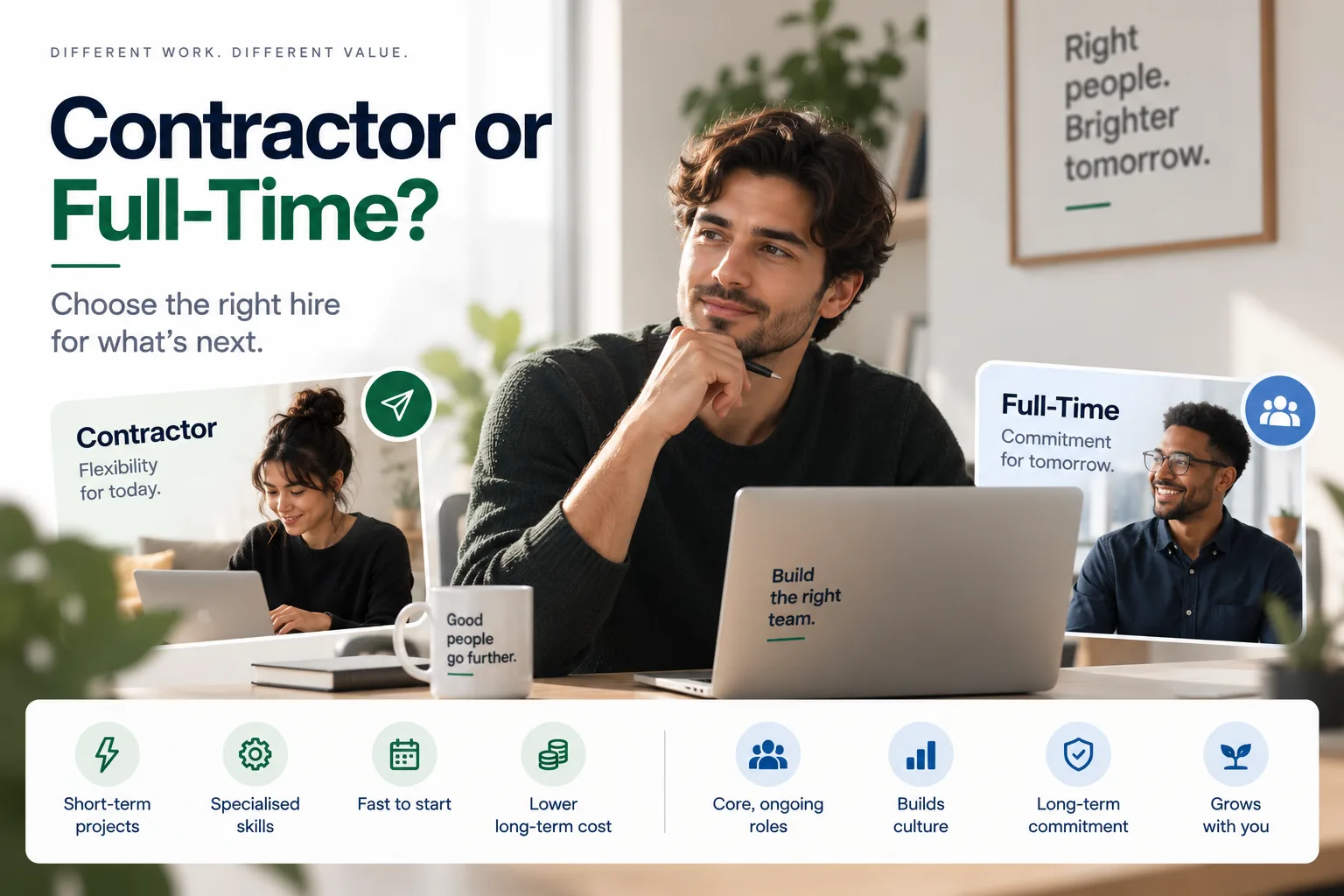
- Hiring a contractor and hiring a full-time employee solve different problems. A contractor gives you speed and flexibility for a defined piece of work. A full-time employee gives you commitment and depth for a core, ongoing role.
- Contractors suit short-term, specialised, or uncertain needs. Full-time employees suit core, long-term roles central to your business and culture.
- The contingent workforce is growing fast, and so is the risk of getting classification wrong.
- Misclassifying an employee as a contractor is expensive, with penalties that can run well into six figures, and in the UK, IR35 has moved hundreds of thousands of contractors onto payroll.
- Whichever you choose, hire on proven skill. Navero screens contractors and employees alike on verified ability, and a human decides.
- This article is general information, not legal or tax advice. Confirm classification rules with a qualified adviser.
The core difference
A full-time employee is a permanent part of your team. You direct their work, they use your tools and processes, and you handle their tax, benefits, and employment rights. They are built to stay and grow with you.
A contractor (or independent contractor) is a separate business you engage for a specific piece of work. They typically control how they deliver it, use their own setup, manage their own tax, and move on when the work is done. They are built for flexibility.
The distinction is not just administrative. It shapes cost, control, commitment, and legal risk, and getting it right starts with being honest about what the role actually is.
When to hire a contractor
A contractor is usually the right call when:
The work is short-term or project-based. A defined deliverable with an end date fits a contract better than a permanent role.
You need a specialised skill briefly. For expertise you need for weeks, not years, a contractor is faster and cheaper than building the role in-house.
The need is uncertain. If you are not sure a role is permanent, a contractor lets you meet the need now without a long-term commitment.
Speed matters. Contractors can often start quickly and require less onboarding for a narrow task.
The trade-off is less control, less loyalty, and less continuity. A contractor is not there to absorb your culture or stay for the long haul, and that is fine, because that is not the job.
When to hire full-time
A full-time employee is usually right when:
The role is core and ongoing. Work central to your business, with no end date, belongs to an employee.
Culture and continuity matter. For roles that shape your team and need long-term relationships, permanence pays off.
You want to develop the person. If you plan to grow someone into more responsibility, that is an employee investment, not a contract.
You need full control and availability. Directing how, when, and where the work happens points clearly to employment.
A genuine first hire, and most core team roles, sit here. If you can describe the role's next two years, it is probably a full-time job.
Contract vs full-time, side by side
Contractor | Full-time employee | |
|---|---|---|
Best for | Short-term, specialised, uncertain work | Core, ongoing, long-term roles |
Cost | Higher day rate, no benefits or long-term cost | Salary plus benefits and overhead |
Control | They decide how the work is done | You direct the work |
Commitment | Flexible, moves on when done | Permanent, invested in the team |
Speed to start | Often fast | Longer to hire and onboard |
You handle tax/benefits | No, they do | Yes |
Compliance risk | Misclassification risk | Standard employment obligations |
The classification risk you must not ignore
Here is the part that trips companies up. You do not get to simply label a role a contract to save on tax and benefits. Whether someone is a contractor or an employee is determined by how the working relationship actually works, and regulators are paying close attention.
The stakes are real. Analysts note that misclassifying a single contingent worker can create cumulative tax liabilities and penalties running well into six figures over a few years, and classification remains the foremost risk in contingent workforce management (HR Dive). In the UK, the IR35 reforms targeting "disguised employment" have already moved a large number of contractors onto company payrolls (Conexis, contingent workforce statistics). UK employers should also weigh how the wider Employment Rights Act is reshaping employment obligations.
The lesson is simple: classify the role for what it truly is, not for what is cheapest, and take advice where the line is unclear. Treating a genuine employee as a contractor is a risk that is expensive to unwind.
A simple way to decide
Cut through it with a few honest questions. The more you answer "yes" toward one side, the clearer the call.
Is the work a defined project with an end, or is it ongoing and core? Project points to contract, ongoing points to full-time.
Do you need to control how, when, and where it is done? High control points to employment.
Will you develop and integrate this person into the team long term? That is an employee.
Is the need certain, or are you testing whether the role should exist? Uncertainty can favour starting with a contractor.
If a role is genuinely core, ongoing, and central to your culture, hire full-time and do it properly. If it is defined, specialised, and finite, a contractor is often the smarter, faster choice.
The middle option: contract-to-hire
There is a third path that often gets overlooked, and for uncertain roles it can be the smartest. Contract-to-hire means engaging someone as a contractor first, with the clear possibility of converting them to a full-time employee if the role proves out and the fit is good.
It gives you the best of both worlds when the need is genuine but the certainty is not. You get someone working quickly, you see their actual output rather than an interview impression, and you keep the option to make them permanent once you are sure. For the candidate, it is a real trial of the role and team before either side fully commits. The caution is the same classification point as before: while they are a contractor, the relationship has to genuinely be a contractor relationship, not a full-time job wearing a contract label. Used honestly, contract-to-hire is a low-risk way to test a role before you build it permanently.
A quick cost reality check
It is worth being clear-eyed about cost, because the sticker numbers mislead. A contractor's day rate usually looks higher than an employee's equivalent salary, which makes contractors seem expensive. But that rate has no benefits, pension, paid leave, equipment, or long-term overhead attached, and it stops the moment the work does. For a short, defined project, that often makes a contractor cheaper overall. For ongoing work, the maths flips: paying a premium day rate month after month for a permanent need is far more expensive than employing someone, and it usually signals the role should have been full-time all along. Match the arrangement to the duration of the need, and the cost tends to take care of itself.
How Navero helps either way
Whichever route you choose, the goal is the same: get someone who can actually do the work. That is a skills question, and it applies just as much to a contractor as to a permanent hire. A wrong contractor wastes budget and time, and a wrong employee is even more costly.
Navero screens and ranks candidates on verified skills rather than resume claims, so whether you are hiring a contractor for a project or an employee for the long haul, you are choosing on proven ability. AI screening filters out roughly 60% of unqualified applications and cuts time-to-hire by up to 75% (based on customer data), which matters most when you need a contractor to start fast.
Two principles keep it fair. First, Navero surfaces and scores candidates on evidence and shows its reasoning, while a human makes the final decision. Second, that human-in-the-loop design keeps you aligned with the EU AI Act, NYC Local Law 144, and EEOC guidance as they tighten around hiring. For core roles, pair this with our guide to making your first hire, and for flexible teams, hiring remote employees.
Whether the role is contract or permanent, hire on evidence. See how Navero's skills-based screening builds your shortlist on proven ability.
Frequently Asked Questions
What is the difference between a contractor and a full-time employee? A full-time employee is a permanent team member whose work you direct and whose tax and benefits you handle. A contractor is a separate business you engage for specific work, who controls how they deliver it and manages their own tax. The difference affects cost, control, commitment, and legal risk.
When should I hire a contractor instead of an employee? When the work is short-term or project-based, needs a specialised skill only briefly, is uncertain enough that you do not want a permanent commitment, or needs to start fast. Core, ongoing roles central to your business are better as full-time hires.
Is it cheaper to hire a contractor? Sometimes, for short-term needs, because you avoid benefits and long-term overhead, though day rates are usually higher. For ongoing work, a full-time employee is often more cost-effective, and misclassifying an employee as a contractor to save money carries serious penalties.
What is worker misclassification? Treating someone who is really an employee as an independent contractor. Classification is based on how the relationship actually works, not the label you use, and getting it wrong can lead to large tax liabilities and penalties. In the UK, IR35 specifically targets this.
How do I decide between contract and full-time? Ask whether the work is a finite project or ongoing and core, how much control you need, whether you will develop the person long term, and how certain the need is. Ongoing, core, high-control roles point to full-time, while defined, specialised, finite work points to a contractor.
What is contract-to-hire? Engaging someone as a contractor first, with the clear option to convert them to a full-time employee if the role proves out and the fit is good. It suits uncertain roles: you see real output before committing, and the candidate trials the team. While they are a contractor, the relationship must genuinely be a contractor one.