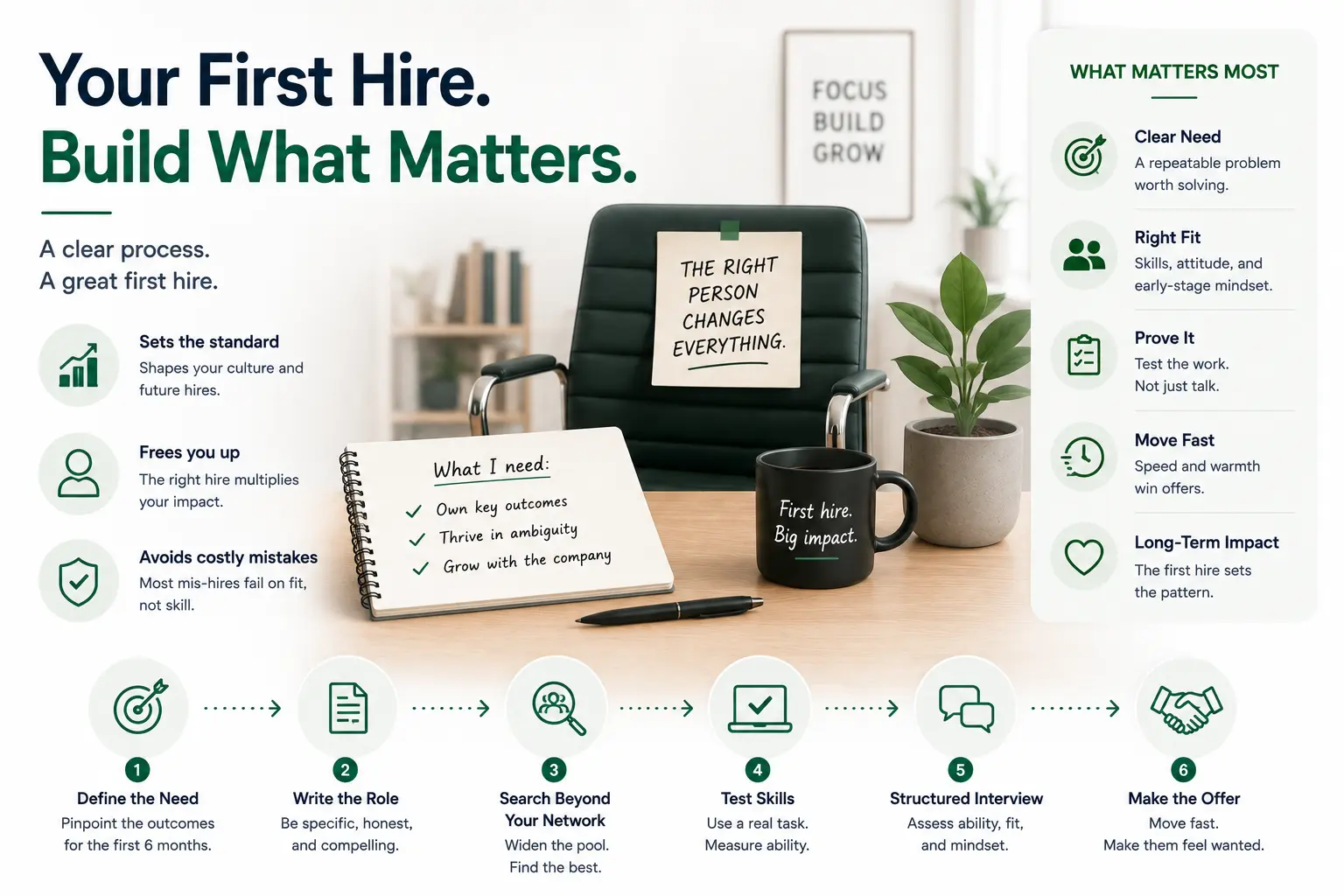
How to Make Your First Hire in 2026: A Founder's Step-by-Step Guide
Key Takeaways (TL;DR)
- Your first hire is the highest-stakes hire you will ever make. On a team of one or two, a single person is a huge share of your company, so getting it right matters more than any hire that follows.
- The biggest first-hire mistakes are hiring from your network without testing ability, hiring for an impressive resume, and having no real process.
- Most new hires who fail do so for attitude and fit reasons, not skill, so test for both deliberately.
- The fix is a simple, evidence-based process: define the real need, test skills directly, run a structured interview, and sell the role.
- You do not need a recruiter or a big budget. You need to screen on proof of skill, not gut feel. Navero scores candidates on evidence; you make the call.
Why your first hire matters so much
When you have 100 employees, one hire is 1% of your company. When you have one, your first hire is half of it. That is the whole reason this decision carries so much weight. A great first hire sets the bar, builds your culture, and frees you to focus. A poor one drains your time, your money, and your momentum at the exact moment you have the least of all three to spare.
The cost of getting it wrong is steep for anyone, and steeper for a small team. Research from Leadership IQ, which tracked thousands of new hires, found that most who failed did so for attitudinal reasons such as poor fit and low motivation, not a lack of technical skill (Leadership IQ hiring research). For a founder, that means skill alone is not the thing to screen for. You have to test whether the person can do the work and whether they will thrive in the messy reality of an early-stage team.
The good news is that a first-time hirer with a clear process beats an experienced one who hires on gut feel. Here is that process.
When is the right time to make your first hire?
Before the how, a quick word on the when, because timing matters as much as choice. The signal to hire is not "we could use help." It is that a specific, repeatable job is now big enough to own someone's week, and that not doing it is costing you growth. If you are turning down work, missing deadlines on a core function, or spending your own time on something below your best use, that is the trigger.
Wait too long and you burn out and cap your growth. Hire too early, before the need is clear and repeatable, and you pay a salary you cannot yet justify for work that is still changing shape. The sweet spot is when the gap is obvious, steady, and clearly worth more than the cost of the hire. If you can describe the role's first six months concretely, you are probably ready.
Step 1: Define what you actually need
Before you write a job ad, get honest about the real gap. Founders often hire a copy of themselves, or the most impressive generalist they can find, when what the company needs is one specific problem solved. Write down the three or four outcomes this person must deliver in their first six months. That list, not a job title, is your brief.
Be realistic about level too. A hire who is too senior may be bored and expensive. One who is too junior may need more support than you can give right now. Aim for someone who can own the outcomes with light guidance, because you will not have time for heavy management.
Step 2: Write a job description that sells
Your job ad does two jobs. It filters for the right person, and it sells your company to candidates who have never heard of you. Be specific about the outcomes and the skills, and be honest about the stage: early, fast-moving, and hands-on. That honesty attracts the people who want exactly that and repels the ones who do not, which is what you want. Our guide to writing a job description covers the structure.
Step 3: Look beyond your network
Hiring a friend or a former colleague feels safe, and sometimes it works. But your network is small and rarely holds the best person for the specific gap you have. Treat referrals as one source, not the whole search. Widen the net so you are choosing from a real pool, then let evidence, not familiarity, decide. The complete guide to hiring platforms for startups is a good place to start on tooling.
Step 4: Test skills before you fall in love with a resume
This is the step that separates good first hires from expensive ones. A resume and a warm conversation are weak evidence, and with AI now writing polished resumes in seconds, they are weaker than ever. The strongest signal is proof that the person can do the actual work.
Give a short, real task that mirrors the job, and judge what they produce. This is where founders most often save themselves from a bad hire, because a candidate who interviews brilliantly but cannot do the work reveals it here. Skills-based screening lets you rank candidates on demonstrated ability rather than pedigree, which is exactly the evidence a high-stakes first hire deserves. If you want the background, see what skill validation is.
Step 5: Run one structured interview, not five casual chats
You do not need a long interview gauntlet for a first hire. You need one or two focused, structured conversations where you ask every candidate the same questions and score them the same way. Structure beats gut feel, especially when you are emotionally invested in a small search. Cover ability, working style, and fit with the reality of early-stage work. Our guide to structured interviews on a small budget shows how to do this without a recruiting team.
Assess fit deliberately, since that is where most mis-hires come from. Ask about how they handle ambiguity, ownership, and setbacks, and listen for real examples rather than confident theory.
Step 6: Sell the role and make the offer
Your best candidate has options, and a small unknown company has to win them. Once you decide, move fast and make them feel wanted. Be clear on the role, the pay, the equity if you offer it, and the story of where the company is going. Speed and warmth win at this stage, because the candidate is often weighing a safer, better-known offer against yours.
Common first-hire mistakes to avoid
Hiring a mini-you. You need a gap filled, not a clone. Hire for the outcomes the company needs, not the skills you already have.
Screening on the resume. A great CV is the easiest thing to fake and the weakest predictor. Test the work.
Defaulting to your network. Familiar is not the same as best. Use referrals as one input, not the whole search.
Skipping fit. Most mis-hires fail on attitude and fit, not skill. Assess how they handle ambiguity and ownership on purpose.
Moving too slowly. A drawn-out process loses strong candidates to faster offers. Decide, then move.
Employee or contractor for your first hire?
One decision founders often skip: should this first hire be an employee or a contractor? It is worth a moment, because it shapes cost, commitment, and compliance.
A contractor is faster to start, more flexible, and lighter on paperwork, which suits a need that is real but still taking shape. An employee is the right call when the role is core, ongoing, and central to your culture, which a genuine first hire usually is. Get the classification right, because treating an employee as a contractor to save on paperwork creates legal and tax risk that is expensive to unwind later. If in doubt for a core, long-term role, an employee is usually the cleaner choice, and worth a quick check with an adviser in your jurisdiction.
How Navero helps founders make a great first hire
You do not need a recruiter or a big budget to hire well. You need a way to see who can actually do the work, and that is what Navero gives a small team. It sources qualified candidates with AI sourcing, then screens and ranks them on verified skills rather than resume signals, so your shortlist is built on evidence. Navero filters out roughly 60% of unqualified applications and cuts time-to-hire by up to 75% (based on customer data), which matters enormously when you are hiring while also running the company.
Two principles keep it sound. First, Navero surfaces and scores candidates on evidence and shows its reasoning, while you make the final decision, which is exactly where a founder's judgment belongs. Second, that human-in-the-loop design keeps you aligned with the EU AI Act, NYC Local Law 144, and EEOC guidance as they tighten around automated hiring. For more on getting the decision right, see how to evaluate candidates in your screening process.
The bottom line
Your first hire sets the pattern for every hire after it, so it is worth doing with real rigour rather than gut feel. Wait for a clear, repeatable need, define the outcomes precisely, and then let evidence decide: test the work, run one or two structured interviews, and assess fit on purpose. You do not need a recruiter or a big budget to do this well. You need the discipline to hire on proof of skill instead of a familiar face or an impressive resume. Get the first one right, and you have a template you can trust for the rest.
Frequently Asked Questions
How do I make my first hire as a founder? Define the specific outcomes you need, write an honest job description, look beyond your network, test skills with a real task, run one or two structured interviews that assess ability and fit, and move fast on the offer. Screen on proof of skill, not on resumes or gut feel.
Should I hire a friend or someone from my network first? Treat your network as one source, not the whole search. Familiar people feel safe, but they are rarely the best fit for the specific gap. Let demonstrated ability and fit decide, not familiarity.
What is the most common first-hire mistake? Hiring on an impressive resume and a good conversation without ever testing whether the person can do the work. Most mis-hires also fail on attitude and fit rather than skill, so assess both deliberately.
Do I need a recruiter to make my first hire? No. A clear, evidence-based process beats an expensive one. Define the need, test skills directly, and run a structured interview. Tools that screen on skills let a small team hire well without a recruiter.
How senior should my first hire be? Aim for someone who can own the key outcomes with light guidance. Too senior can be costly and under-used at your stage, while too junior may need more support than you can give while building the company.