How to Hire Remote Employees in 2026: A Step-by-Step Guide
Key Takeaways (TL;DR)
- Hiring remote employees opens your search to talent anywhere, but it also removes the in-person signals managers used to lean on. The teams that win at remote hiring replace those signals with evidence.
- Remote and hybrid work are now mainstream. Gallup research finds about 27% of remote-capable employees work fully remote and 52% hybrid, and most organizations plan to expand remote hiring.
- The core shift: hire on proof of skill and self-management, not on where someone lives or how they present in a room.
- A strong remote process uses skills assessments, structured and asynchronous interviews, and clear tests of remote-specific competencies like written communication.
- Below is a step-by-step process, plus the compliance and onboarding points that trip teams up. Navero screens candidates on verified skills regardless of location, and your team decides.
Why remote hiring needs a different playbook
Remote work is not a fringe arrangement anymore. Gallup research reports that around 27% of remote-capable employees work fully remotely and about 52% work in a hybrid pattern, and a majority of organizations plan to expand remote hiring for cost efficiency and access to global talent (Robert Half, remote work statistics and trends).
That access is the prize. Hiring remotely means you are no longer limited to people who can commute to an office, so your talent pool widens enormously. But it also removes the informal signals managers used to rely on, like body language in a room or a sense of someone's presence. Lean on those signals over video and you will misread people.
The fix is to stop guessing and start measuring. Remote hiring rewards a process built on evidence: can this person do the work, communicate clearly in writing, and manage themselves without someone looking over their shoulder? Those are testable, and that is the whole game.
The benefits and trade-offs of hiring remotely
Before the steps, it helps to be clear-eyed about what you are signing up for. Remote hiring has real upsides, and real costs, and knowing both keeps your expectations honest.
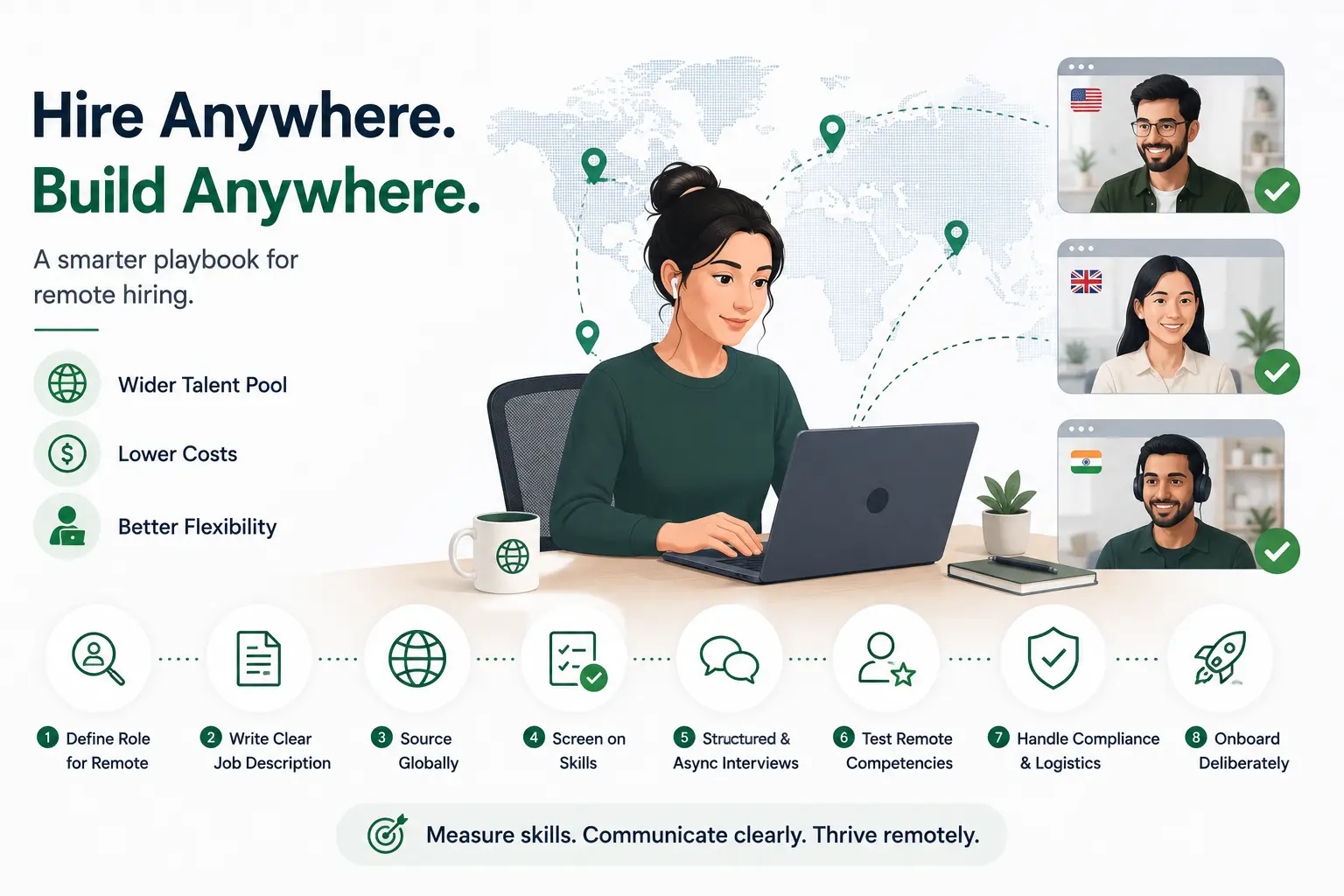
The benefits are large. You can hire from a much wider pool, so you are more likely to find the right skills. You often pay less in office and overhead costs. And you can offer the flexibility that many strong candidates now rank near the top of their list, which helps you win them.
The trade-offs are just as real. You lose the in-person signals managers used to lean on, so you have to replace them with tested evidence. Communication takes more effort and has to be more deliberate. And cross-border hiring adds tax, legal, and data rules you cannot ignore. None of these is a reason to avoid remote hiring. They are simply the things a good process has to handle on purpose, which is what the steps below do.
Step 1: Define the role for remote, not just the job
Start by writing the role for how it will actually be done. A remote role needs the core job skills plus a specific set of remote competencies: clear written communication, self-management, comfort with async tools, and the discipline to work without constant supervision.
Name these explicitly before you advertise. If the role genuinely needs some overlap with a timezone or occasional travel, say so. Being precise up front saves you from a great candidate who turns out to be wrong for the way the role really works.
Step 2: Write a remote-friendly job description
Your job ad should make the remote setup obvious and honest. State whether the role is fully remote or hybrid, which regions or timezones you can hire in, and any overlap hours you require. Vague location terms lead to mismatched applications and wasted time on both sides.
Sell the remote experience too. Candidates choosing between offers weigh flexibility heavily, so describe how your team actually works remotely, not just that it does.
Step 3: Source beyond your city
The point of remote hiring is reach, so source like it. Look past your local market to the regions and communities where the skills you need are strong. AI sourcing helps here by surfacing qualified candidates wherever they are, rather than waiting on local inbound applications.
A wider net means more applications, though, which makes the next step, screening, the part that decides whether remote hiring saves time or drowns you in it.
Step 4: Screen on skills, because location tells you nothing
This is the heart of remote hiring. When you cannot rely on in-person impressions, a resume and a friendly video chat are weak evidence, and they are easy to fake. The strongest signal is proof that the candidate can do the actual work.
A short, role-relevant skills assessment does exactly that. It shows you what a candidate can produce, regardless of where they are or how they interview. Skills-based screening is a natural fit for remote hiring because it measures ability directly, and it filters a large applicant pool down to the people worth interviewing. Navero filters out roughly 60% of unqualified applications and cuts time-to-hire by up to 75% (based on customer data).
Step 5: Run structured and asynchronous interviews
Once you have a shortlist, interview with structure. Ask every candidate the same questions and score them on the same rubric, because consistency matters even more when you cannot read a room.
Asynchronous interviews, where candidates record answers to set questions on their own time, are especially useful for remote and global hiring. They remove timezone friction and let you compare answers side by side. Used well alongside live conversations, they speed up the process without losing rigour. Our guides to asynchronous versus live interviews and running remote interviews go deeper on the how.
Step 6: Test the remote competencies directly
Do not just hope a candidate can work remotely. Test for it. Build small checks into your process: a written exercise reveals communication quality, a take-home task with light instructions reveals self-management, and how promptly and clearly they handle scheduling reveals how they will operate day to day. Async video screening also shows you how someone communicates on camera without a live prompt, which you can explore in our guide to async video screening.
The principle is simple: if a skill matters for remote work, find a way to see it before you hire, not after.
Step 7: Handle compliance and logistics
Remote hiring, especially across borders, brings real compliance questions. Confirm the person's right to work in their location, get the employment relationship right, since hiring a contractor is not the same as hiring an employee, and understand the tax and data-protection rules that apply where they are based. If you are hiring into the UK, our guide to right-to-work checks is a useful starting point.
This is the part teams most often underestimate, so build it into the plan early rather than discovering it after you have chosen someone.
Step 8: Onboard remote from day one
A remote hire cannot absorb your culture by sitting near people, so onboarding has to be deliberate. Set up their tools before they start, give them a clear first-week plan, assign a buddy, and schedule regular check-ins. The first two weeks decide how quickly a remote hire becomes productive and how connected they feel, so treat onboarding as part of hiring, not an afterthought.
Common mistakes in remote hiring
Screening on resumes and vibes. Without in-person signals, these are weaker than ever. Test skills directly.
Ignoring remote competencies. Someone can be brilliant at the job and poor at remote work. Assess written communication and self-management on purpose.
Being vague about location. Not stating timezones or eligible regions wastes everyone's time with mismatched applications.
Underestimating compliance. Right to work, contractor status, and tax rules vary by location. Sort them early.
Treating onboarding as optional. Remote hires who are left to sink disengage fast. Plan the first two weeks carefully.
How Navero helps you hire remote talent
Remote hiring works when you measure ability instead of guessing from a screen, and that is exactly what Navero is built for. It sources candidates wherever they are, screens and ranks them on verified skills rather than resume signals, and lets you compare a global shortlist on the same evidence. Because AI screening filters out unqualified applications automatically, the reach of remote hiring becomes an advantage rather than an overwhelming pile of applications.
Two principles keep it fair. First, Navero surfaces and scores candidates on evidence and shows its reasoning, while a human recruiter or hiring manager makes the final decision. Second, that human-in-the-loop design keeps you aligned with the EU AI Act, NYC Local Law 144, EEOC guidance, and data-protection rules as they tighten around automated and cross-border hiring.
Frequently Asked Questions
How do you hire remote employees? Define the role and its remote competencies, write a clear remote job description, source beyond your local market, screen on a skills assessment rather than resumes, run structured and asynchronous interviews, handle right-to-work and tax compliance, and plan a deliberate remote onboarding.
How do you assess if someone can work remotely? Test for it directly. A written exercise shows communication quality, a take-home task with light instructions shows self-management, and how they handle scheduling and async messages shows how they will operate day to day. Do not rely on a gut feeling from a video call.
What is the best way to screen remote candidates? Skills-based screening, because location and resumes tell you little about ability. A short, role-relevant assessment shows what a candidate can actually produce and filters a large, global applicant pool down to the people worth interviewing.
What compliance issues come with remote hiring? Confirm the right to work in the candidate's location, classify the relationship correctly as employee or contractor, and understand the tax and data-protection rules where they are based. Cross-border hiring adds complexity, so plan for it early.
Are asynchronous interviews good for remote hiring? Yes. They remove timezone friction, let candidates answer on their own time, and let you compare answers side by side on the same questions. Used alongside live conversations, they make remote and global hiring faster without losing rigour.
Is hiring remote employees cheaper? It often lowers office and overhead costs and gives access to a wider, sometimes more affordable talent pool, which is a major reason companies expand remote hiring. But budget for the offsets: cross-border compliance, collaboration tools, and deliberate onboarding. The saving is real when the process is run well, not automatic.