The UK Employment Rights Act and Hiring: What the New Six-Month Rule Means for 2026 Recruitment
Key Takeaways (TL;DR)
- The UK's Employment Rights Act changes how much time you have to correct a hiring mistake. The old two-year unfair-dismissal qualifying period is being cut to six months. That makes getting the hire right the first time far more important.
- The headline "day-one" unfair-dismissal right was proposed and then dropped. Do not plan around it.
- The real change: the qualifying period for unfair dismissal drops from two years to six months, effective 1 January 2027.
- Employees hired from July 2026 will reach that six-month mark inside the new regime.
- With a quarter of the old window to assess a hire, front-loaded screening matters more. Navero verifies skills before the offer and surfaces candidates on evidence; your team decides.
What the Employment Rights Act actually changed
There is a lot of noise here, so start with the correction. When the Employment Rights Bill was published in October 2024, the headline measure was to make unfair dismissal a "day-one" right by removing the qualifying period entirely. That proposal did not survive. After defeats in the House of Lords, the government reversed course and dropped it (Womble Bond Dickinson).
So if your planning still assumes day-one rights, it is planning for a law that does not exist.
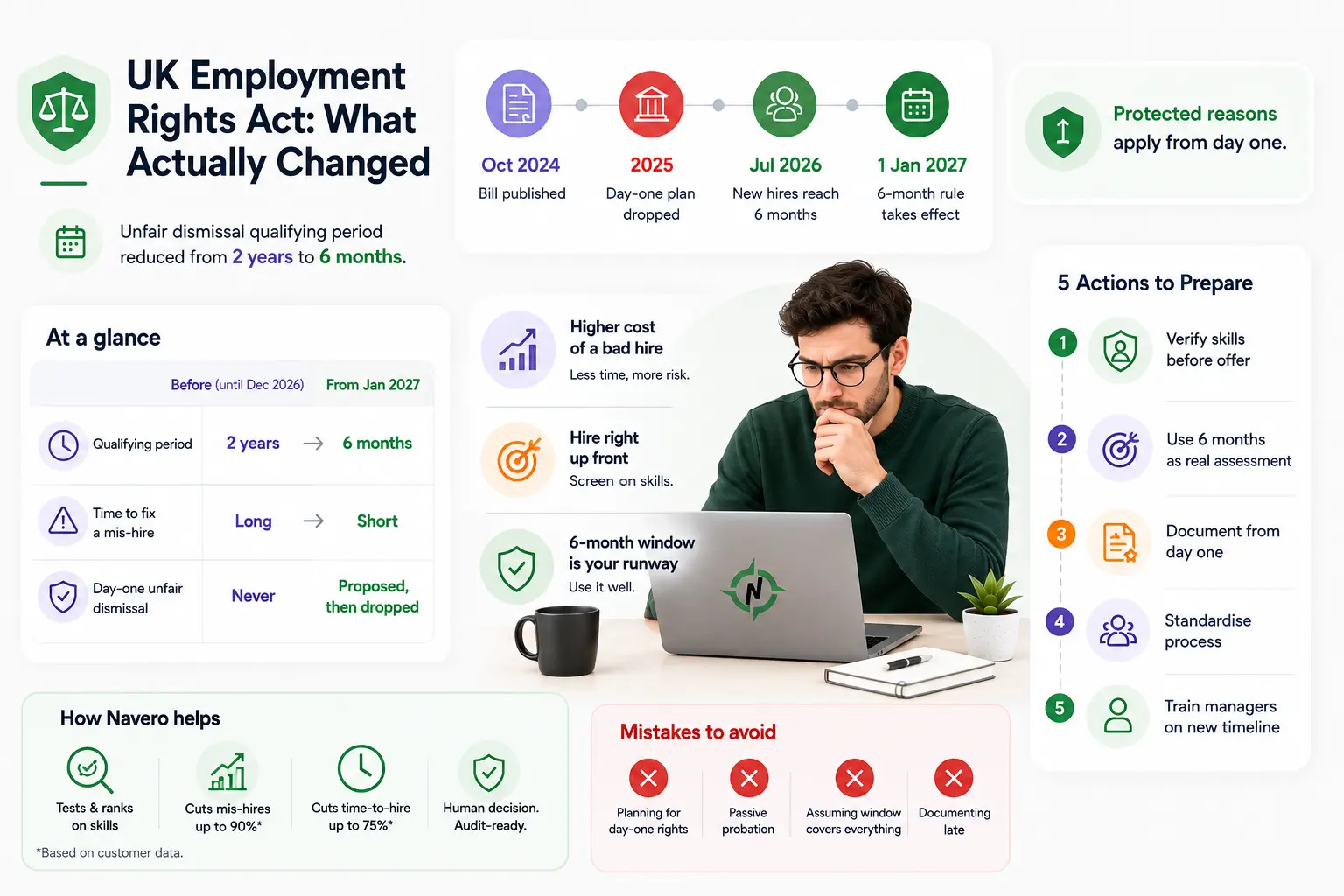
Here is the actual position. The qualifying period for ordinary unfair dismissal is being reduced from two years to six months, with effect from 1 January 2027 (Harper James). Employees who start from July 2026 will cross the six-month threshold once the change is in force. There is no separate statutory probationary period in the final version. The six-month qualifying window does that job in practice (Stone King).
One thing that has not changed: from day one, a dismissal can still be automatically unfair if it relates to a protected characteristic, whistleblowing, or another automatically unfair reason. The six-month window lowers ordinary unfair-dismissal risk, not discrimination risk.
The timeline that matters
The change did not arrive all at once, and the dates decide how you should prepare.
October 2024: The Employment Rights Bill is published, proposing day-one unfair-dismissal rights.
2025: The Bill passes through Parliament, and the House of Lords forces the government to drop the day-one proposal. The Bill becomes the Employment Rights Act.
From July 2026: Employees hired around this point are the first who will reach six months of service under the new rules.
1 January 2027: The six-month qualifying period takes effect.
The practical message is that anyone you hire in the second half of 2026 is already a candidate for the new regime. The time to tighten hiring is now, not in 2027.
Before and after, at a glance
Old regime | From January 2027 | |
|---|---|---|
Qualifying period for unfair dismissal | 2 years | 6 months |
Time to assess and exit a mis-hire at low risk | Long | Short |
Day-one unfair dismissal | Never applied | Proposed, then dropped |
Protected/automatic unfair reasons | Apply from day one | Apply from day one (unchanged) |
The single number that matters for hiring is the middle row. The runway to fix a hiring mistake without ordinary unfair-dismissal risk shrinks from two years to six months.
Why this matters for hiring, not just HR
It is tempting to file this under employment law and move on. That would be a mistake, because the change lands hardest on the front of the funnel, on who you hire and how you screen them.
Under the old regime, a weak hire was recoverable. You had up to two years to notice, manage, and part ways with limited unfair-dismissal exposure. That long runway quietly subsidised loose hiring. You could hire on a good resume and a strong interview, and sort it out later.
Six months removes that cushion. If a hire is wrong, you now have to identify it and act inside a much tighter window, with fair process and documentation from the start. The practical effect is simple: the cost of a bad hire goes up, and the value of getting the hire right up front goes up with it.
That is a screening problem before it is a dismissal problem. The cheapest way to reduce unfair-dismissal exposure is to make fewer mis-hires in the first place.
Consider a simple case. You hire a candidate in September 2026 on a strong resume and a good interview. By March 2027 it is clear they cannot do the core of the job. Under the old two-year rule, you had a wide, low-risk window to manage them out. Under the new rules, they are at or near the six-month mark, so your options narrow and your process has to have been fair and documented from the start. The mistake that used to be a manageable inconvenience is now a live risk. The only reliable way to avoid it is to have known, before the offer, that the person could do the work.
What UK employers should do to prepare
You do not need to overhaul everything. You need to tighten the front end and use the six-month window deliberately.
Action | Why it matters now |
|---|---|
Verify skills before the offer | Fewer mis-hires reach the payroll, so fewer dismissals are needed inside the tighter window |
Use the six-month window on purpose | Set clear objectives and check-ins early, not a passive "wait and see" |
Document from day one | Fair process and a paper trail need to start at the start, not at month five |
Standardise the process | Consistent, evidence-based hiring is easier to defend and reduces bias risk |
Train managers | The people making probation calls need to understand the new timeline |
1. Move quality upstream
The reform rewards precision at the hiring stage. Screening on verified skills, rather than a resume and a good interview, is the most direct way to reduce the mis-hires that create dismissal risk. A skills-based hiring approach tests whether a candidate can do the job before they are on the payroll, which is exactly the certainty a six-month window rewards.
2. Use probation as a real assessment, not a formality
Because the qualifying window is now six months, that period has to do genuine work. Set clear, role-specific goals on day one, review against them at fixed points, and give honest feedback early. A probation that only gets attention in the final week is a probation that fails under the new timeline.
3. Make the whole process evidence-based
Fairness, documentation, and consistency now need to be present from the first day of employment. A structured, evidence-based hiring and evaluation process is easier to run fairly and easier to defend, and it reduces the discrimination risk that survives the qualifying period entirely. Scoring every candidate on the same verified evidence is the foundation of that.
4. Reweight the offer decision
Under a two-year runway, a borderline hire was a reasonable bet, because you could correct it later. Under six months, borderline hires cost more. Treat the offer as a higher-stakes decision. Insist on evidence of ability for the specific role, be honest about gaps a probation cannot realistically close in six months, and do not let a single strong interview override a weak work sample. The goal is not to hire more slowly. It is to hire on better information.
Common mistakes to avoid
Still planning for day-one rights. They were dropped. Plan for six months.
Treating it as HR-only. The change lands on hiring quality first. Fix screening, not just paperwork.
Passive probation. A "wait and see" approach no longer fits a six-month window. Assess deliberately from day one.
Assuming the window covers everything. Discrimination and automatic-unfair-dismissal risks apply from day one, regardless of the qualifying period.
Documenting late. Fair process and records need to start at the start.
How Navero helps you hire right under the new rules
Navero is built to reduce mis-hires, which is precisely the exposure the six-month rule increases. It screens and ranks candidates on verified skills rather than resume signals, so weaker hires are caught before an offer rather than during a tight probation. That front-loaded certainty is what a shorter qualifying window rewards. Navero cuts time-to-hire by up to 75% and reduces mis-hires by up to 90% (based on customer data).
Two principles keep it fair and defensible. First, Navero scores and surfaces candidates and shows the reasoning behind each score, and a human recruiter or hiring manager makes the final decision. Second, that human-in-the-loop design and consistent, documented evidence support a fair, auditable process, which matters more when protections apply from day one and the EU AI Act and EEOC-style guidance are tightening around automated hiring.
Related reading: UK AI regulation vs the EU AI Act and how to evaluate candidates in your screening process.
The bottom line
The Employment Rights Act does not hand employees day-one protection, but it does cut the qualifying period to six months, and that quietly reshapes hiring. The old two-year window forgave loose screening. Six months does not. The practical response is not more paperwork. It is better hiring: verify skills before the offer, run probation as a real assessment, and document fairly from day one. Employers who tighten the front of the funnel now will carry far less risk into 2027 than those who wait and try to manage it at the back.
Frequently Asked Questions
Does the UK Employment Rights Act give day-one unfair dismissal rights? No. That was the original proposal, but it was dropped after House of Lords defeats. The final change reduces the qualifying period from two years to six months, effective 1 January 2027.
When does the six-month qualifying period start applying? The change takes effect from 1 January 2027. Employees who begin employment from July 2026 will reach the six-month mark under the new rules.
Can employers still use probationary periods? Yes. There is no separate statutory probationary period in the final Act, but the six-month qualifying window functions much like one. Dismissals in the first six months carry lower ordinary unfair-dismissal risk, though protected and automatically unfair reasons still apply from day one.
Why does this affect hiring rather than just HR? Because the runway to correct a mis-hire shrinks from two years to six months, so the cost of a bad hire rises. That puts more weight on getting the hire right up front through rigorous screening.
How should employers prepare? Tighten front-end screening to reduce mis-hires, use the six-month window as a genuine assessment with early goals and feedback, document from day one, and keep the process consistent and evidence-based.