Work Sample Tests: The Complete 2026 Guide (With Examples)
Key Takeaways (TL;DR)
- A work sample test asks a candidate to do a small, realistic piece of the actual job, then scores how they perform. It is the closest you can get to seeing someone do the work before you hire them.
- Work sample tests are among the strongest predictors of job performance in decades of research, ahead of resumes, interviews, and personality tests.
- They work because they measure ability directly, are hard to fake, and judge candidates on output rather than background.
- The keys to a good one: make it mirror the real job, keep it short, and score every candidate on the same rubric.
- Below are examples by role and how to design one. Navero runs skills-based, work-sample-style screening at scale, with a human deciding.
What is a work sample test?
A work sample test, sometimes called a job sample or work sample assessment, gives a candidate a task that reflects the real work of the role, then evaluates how they do it. Instead of asking whether someone can write, sell, code, or analyse, you ask them to actually do a small version of it and see for yourself.
That is the whole idea: replace claims and impressions with evidence. A resume says a candidate can do the job. An interview says they can talk about it. A work sample shows whether they can actually do it.
Why work sample tests are the gold standard
This is not just intuition, it is one of the best-evidenced findings in hiring. In the landmark Schmidt and Hunter meta-analysis, which pooled 85 years of research on selection methods, work sample tests predicted job performance at around 0.54, among the very highest of any method and well ahead of the proxies a resume relies on (Schmidt and Oh, validity and utility of selection methods).
Three things make them so strong.
They measure ability directly. You are not inferring skill from a title or a degree. You are watching the work.
They are hard to fake. AI can write a flawless resume in seconds, but a candidate still has to actually produce good work on the task.
They are fairer. Because they judge output, not pedigree, they give strong candidates from non-traditional backgrounds a real chance, which is why they sit at the heart of skills-based hiring versus resume screening.
Types of work sample tests
Work samples take different forms depending on the role. The best one always mirrors the actual job.
Role type | Example work sample |
|---|---|
Writing / marketing | Write a short blog intro, ad, or email for a given brief |
Software engineering | A realistic coding task or a small bug fix in a sample codebase |
Design | A short design brief or a critique of an existing design |
Sales | A roleplay call or a written response to a prospect scenario |
Data / analytics | Analyse a small dataset and summarise the insight |
Customer support | Handle a tricky customer message in writing |
Operations / admin | An in-tray exercise: prioritise and action a set of tasks |
The pattern is the same across all of them: a small, realistic slice of the real work, done under conditions close to the job.
How to design a good work sample test
A weak work sample can be as misleading as a resume. A few principles make the difference.
1. Mirror the real job
The task should look like the work the person will actually do. The closer it is to the role, the better it predicts performance. Avoid abstract puzzles that have nothing to do with the job.
2. Keep it short and respectful
A work sample should take a candidate a reasonable amount of time, usually well under an hour for most roles. Long, unpaid take-home projects cause strong candidates to drop out and damage your brand. If a task genuinely needs to be large, consider paying for the candidate's time.
3. Standardise it
Give every candidate for a role the same task and the same instructions, so results are comparable. A work sample only produces fair evidence if everyone is measured on the same thing.
4. Score on a clear rubric
Decide in advance what a strong answer looks like, and rate every submission against the same criteria. Scoring on a rubric, rather than a gut feeling, is what turns a work sample into defensible evidence. Our guide to evaluating candidates covers how.
5. Use it early
The biggest gains come from using the work sample as an early screen, before you spend interview time. That way you filter on real ability first, and only interview the people who have already shown they can do the job.
A quick example
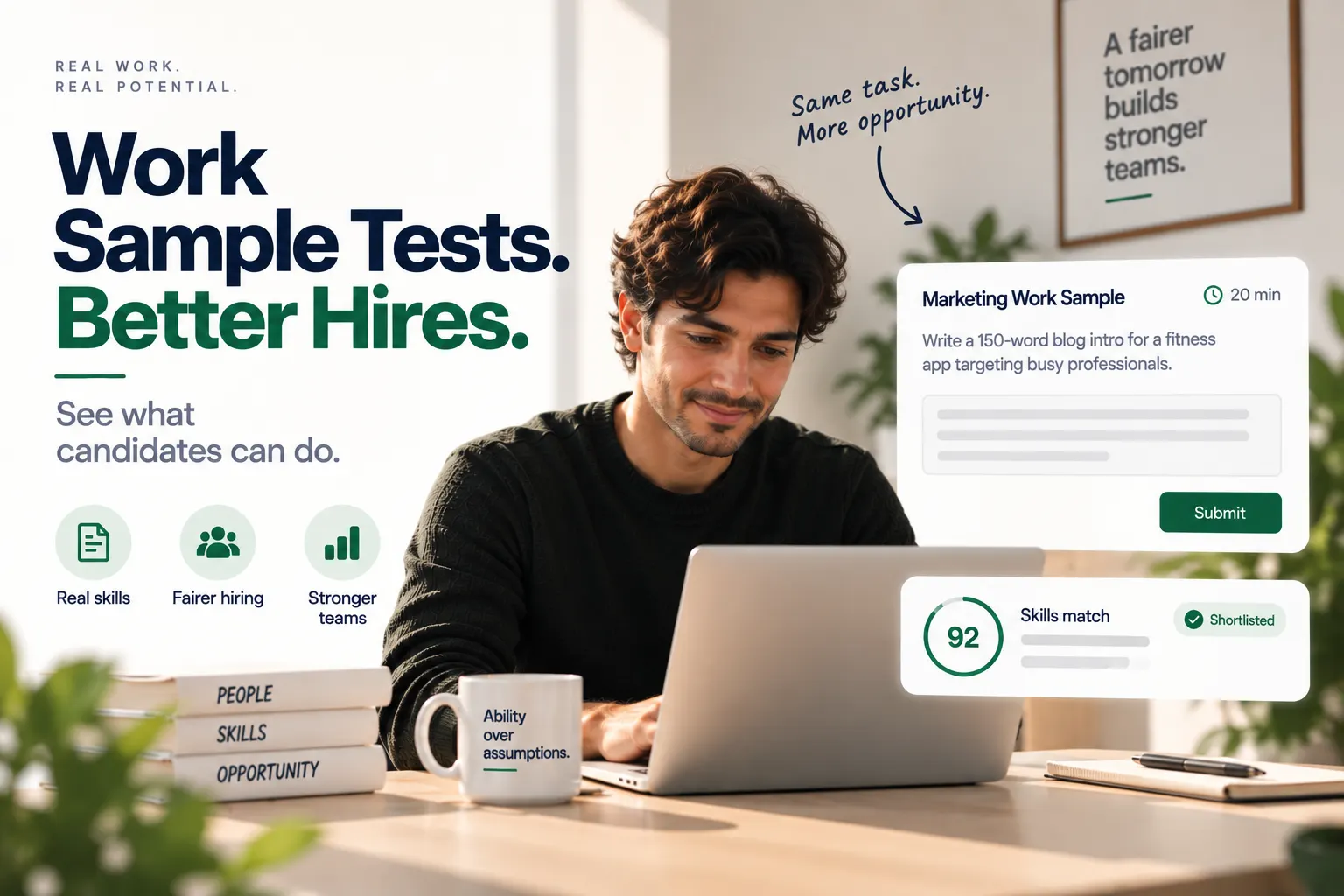
Say you are hiring a content marketer. The old way is to scan resumes for the right job titles and a good portfolio, then interview the ones who present well. The work-sample way is different. You give every shortlisted candidate the same short brief: "Write a 150-word intro for a blog post on this topic, for this audience." It takes them twenty minutes.
Now you are not comparing resumes or interview charm. You are comparing actual writing, side by side, scored on the same rubric: clarity, audience fit, and how well they followed the brief. The candidate with the polished resume writes something generic. A candidate with an uneven background writes something genuinely sharp. Under the resume-first process you might never have met the second person. The work sample surfaces them on merit, and it does it in twenty minutes of their time, not a multi-hour project.
Should you pay candidates for work samples?
For short, generic tasks, no payment is expected, and most candidates are happy to spend twenty to thirty minutes proving their ability. The picture changes when a task is long, or when it produces real, usable work for your business. Asking a candidate to build out a full campaign, design a complete feature, or solve a live company problem for free crosses a line: it is effectively unpaid labour, it drives strong candidates away, and it damages your brand. The rule of thumb is simple. If the task is short and clearly a test, it is fine unpaid. If it is long or you could actually use the output, pay for the candidate's time. Respecting people's effort is not just ethical, it is how you keep the strongest candidates in your process.
Common mistakes to avoid
Making it too long. Marathon take-homes lose good candidates. Keep tasks short and focused.
Testing the wrong thing. A generic puzzle that does not reflect the role will not predict performance in the role.
Inconsistent scoring. Judging submissions on gut feel reintroduces the bias work samples are meant to remove. Use a rubric.
Asking for free work. Never use a work sample to get real, usable output for free. It is unethical and it drives candidates away.
Using it only at the end. A work sample is most powerful as an early filter, not a final formality after you have already decided.
Work sample tests versus other assessments
It helps to see where work samples sit among the alternatives. A resume and an unstructured interview are weak predictors, because they measure claims and impressions. Cognitive and personality tests can add some signal, but personality tests especially are weaker on their own, as we cover in skills assessment versus personality tests. Work samples sit at the top because they measure the actual work. The strongest process uses a work sample as the backbone, with a structured interview for judgment and fit. For the wider menu of options, see types of pre-employment tests.
How Navero runs work-sample screening at scale
The catch with work samples has always been effort: building realistic tasks and scoring every submission by hand is slow, which is why many teams fall back on resumes. Navero removes that friction.
Navero screens and ranks candidates on verified skills using role-relevant, work-sample-style assessments, and scores them consistently at scale, so you get the predictive power of work samples without the manual burden. It filters out roughly 60% of unqualified applications and cuts time-to-hire by up to 75% (based on customer data), because the assessment does the early filtering for you.
Two principles keep it fair. First, Navero surfaces and scores candidates on evidence and shows its reasoning, while a human makes the final decision. Second, that job-relevant, human-in-the-loop design keeps you aligned with the EU AI Act, NYC Local Law 144, and EEOC guidance as they tighten around hiring. For related reading, see our technical skills assessment guide.
Want the predictive power of work samples without the manual work? See how Navero's skills-based screening scores candidates on real ability.
The bottom line
If you could use only one selection method, the research says it should be a work sample test, because nothing predicts job performance better than watching someone do a piece of the job. The reason so few teams lean on them is effort: building realistic tasks and scoring every submission by hand is slow, so hiring falls back on the resume, the weakest signal of all. Solve that friction, keep the tasks short and job-relevant, score everyone on the same rubric, and use the work sample early, and you get the single biggest upgrade available in hiring. The candidates who can do the work rise to the top, and the ones who only look good on paper no longer slip through.
Frequently Asked Questions
What is a work sample test? It is an assessment that asks a candidate to complete a small, realistic piece of the actual job, then scores how they perform. It measures ability directly rather than inferring it from a resume, degree, or interview.
Are work sample tests effective? Very. Work sample tests are among the strongest predictors of job performance in decades of research, ahead of resumes, unstructured interviews, and personality tests, because they measure what a candidate can actually do rather than what they claim.
How long should a work sample test be? Usually well under an hour for most roles. Long, unpaid take-home projects cause strong candidates to drop out and hurt your brand. If a task genuinely needs to be substantial, consider paying candidates for their time.
What are examples of work sample tests? A writing task for a marketer, a coding challenge for an engineer, a design brief for a designer, a sales roleplay, a small data analysis for an analyst, or an in-tray exercise for an operations role. The best one always mirrors the real job.
What is the difference between a work sample test and a skills assessment? They overlap heavily. A work sample is a type of skills assessment that has the candidate perform a realistic task. Broader skills assessments may also include structured questions or scenarios, but the strongest ones are built around real work, which is what a work sample provides.