Skills Assessment vs Personality Tests: Which Predicts Performance in 2026?
Key Takeaways (TL;DR)
- Skills assessments and personality tests answer different questions. A skills assessment asks "can this person do the job?" A personality test asks "how do they tend to behave?" Both can help, but only one is a strong primary screen.
- Work sample and skills tests are among the strongest predictors of job performance in decades of research. Personality tests, on their own, are weaker.
- That makes skills the better primary screen, and personality a useful secondary signal, not the other way round.
- Personality tests also carry more fairness and validity scrutiny, so they should never be the main gate on their own.
- The best setup is skills first, personality as an optional add-on. Navero screens on verified skills and keeps a human in the decision.
What each one actually measures
The two tools are often lumped together as "pre-employment tests," but they measure very different things.
A skills assessment gives a candidate a task that reflects the real job, then scores how they perform. It measures demonstrated ability: can they write the code, handle the customer, analyse the data, or do whatever the role requires. It is direct evidence of the work.
A personality test asks a candidate to answer questions about their preferences and tendencies, then maps them to traits such as conscientiousness, openness, or extraversion. It measures how someone tends to behave, not what they can do. It is an indirect signal about working style.
That difference is the whole debate. One measures the work. The other measures the person's disposition. For a hiring decision, the first is far closer to the thing you actually care about.
What the research says about predicting performance
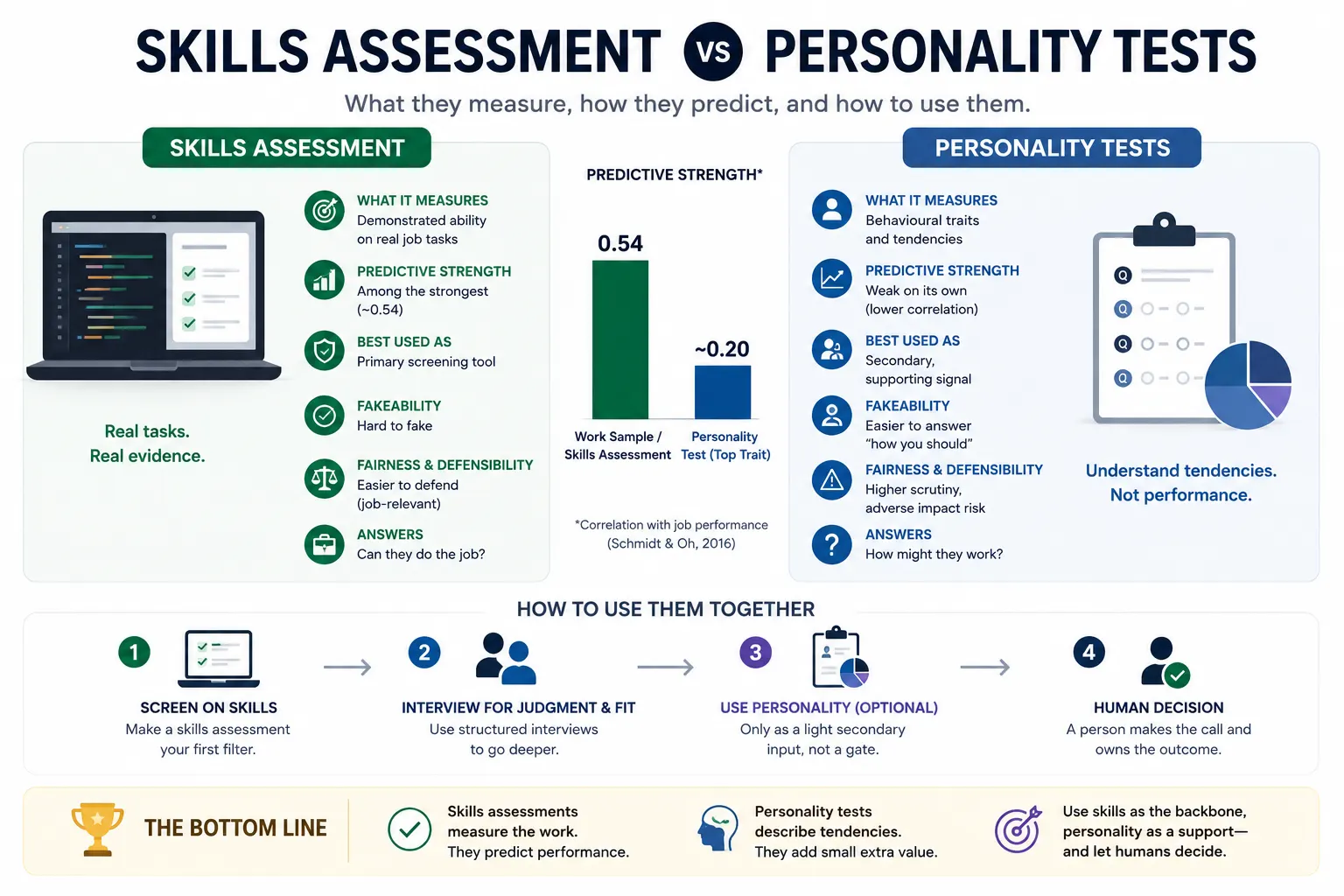
This is where the two separate clearly. In the landmark Schmidt and Hunter meta-analysis, which pooled 85 years of research on selection methods, work sample tests predict job performance at around 0.54, among the very highest of any method, alongside cognitive ability and structured interviews (Schmidt and Oh, validity and utility of selection methods).
Personality measures sit well below that. Individual traits, with conscientiousness usually the most useful, are far weaker predictors on their own than a work sample or a structured interview. They can add a little incremental value when combined with stronger methods, but as a standalone screen they are among the weaker options.
The takeaway is not that personality is worthless. It is that if you had to choose one primary screen, the evidence points clearly to skills, because measuring the work beats inferring behaviour every time.
Skills assessment vs personality tests, side by side
Skills assessment | Personality test | |
|---|---|---|
What it measures | Demonstrated ability on real tasks | Behavioural traits and tendencies |
Predictive strength | Among the strongest predictors | Weak on its own |
Best used as | The primary screen | A secondary, supporting signal |
Fakeability | Hard to fake a work sample | Easier to answer "how you should" |
Fairness scrutiny | Defensible when job-relevant | Higher scrutiny, adverse-impact risk |
Answers the question | Can they do the job? | How might they work? |
The pattern is consistent. On the axes that decide a hire, skills assessments do the heavier lifting.
Where personality tests do help
To be fair to personality tests, they are not useless, and dismissing them entirely is a mistake too. Used well, as a secondary input, they can add value in a few ways.
They can surface working-style signals that matter for a specific team, like how someone tends to handle collaboration or structure. They can prompt better interview questions, giving you areas to probe with real examples. And for roles where temperament genuinely matters, they can be one input among several.
The key word is secondary. A personality test is a useful supporting signal, not a gate. The problems start when teams use it as a primary filter, rejecting candidates on a trait profile rather than on evidence they can do the work. If you want the deeper background, see our complete guide to personality tests for recruitment.
The fairness and legal angle
There is a second reason to keep personality tests in a supporting role. Because they measure traits rather than job tasks, they attract more fairness and validity scrutiny, and they can create adverse impact if they screen out groups without a clear job-related reason.
Skills assessments are easier to defend, because a task that mirrors the job has an obvious, direct link to performance. As rules around hiring tighten, that job-relatedness matters. Whatever mix you use, keep a human in the decision and be able to explain why a candidate scored the way they did, which is the same principle behind hiring on verified skills rather than a trait profile.
How to use them together
This is not strictly an either-or. The strongest process uses skills as the backbone and personality, if at all, as a light secondary layer.
Screen on skills first. Make a role-relevant skills assessment your primary filter, so ability decides who advances. This is the change that most improves hire quality.
Use structured interviews for judgment and fit. A structured interview assesses working style and fit with real examples, often better than a trait questionnaire.
Add personality only as a supporting input. If you use one, treat it as a prompt for conversation, not a gate, and never reject on it alone.
Keep a human deciding. Whatever the mix, a person weighs the evidence and makes the call.
Run it this way and you get the predictive power of skills with whatever extra colour personality offers, without letting the weaker signal drive the decision. It is the same logic as choosing evidence over proxies in skills-based hiring versus resume screening.
Which should you use for your roles?
The right mix shifts a little by role, but the backbone stays the same: skills first, always.
Technical and specialist roles. Lean heavily on a skills assessment that mirrors the work, such as a coding task or a real analysis. Personality adds little here, because ability is the thing that matters most.
Customer-facing roles. Still screen on skills first, using a realistic scenario, then a personality signal can add colour on temperament, as long as it never becomes the gate.
High-volume hiring. A skills assessment is the efficient filter, because it scores at scale on real ability. A personality test alone would let too many unqualified people through.
Team-lead and manager roles. Use a structured interview and work samples to test judgment and past behaviour, with personality as at most a light supporting input.
In every case the pattern holds. Skills decide who can do the job, and personality, where used, only adds texture around it.
Common mistakes to avoid
Using a personality test as the main filter. It is the weaker predictor and carries fairness risk. It should never be the gate that decides who advances.
Rejecting on a trait profile. Screening people out because they are not "extraverted enough" is both poor prediction and a legal risk, unless the trait is clearly job-related.
Treating a skills quiz as a skills test. A multiple-choice trivia quiz is not a work sample. If the assessment does not look like the job, it will not predict performance in the job.
Dropping personality entirely then over-relying on gut feel. If you remove the trait test, replace it with a structured interview, not with instinct, which is where bias lives.
No human in the loop. Whichever tools you use, a person should weigh the evidence and make the final call.
How Navero fits
Navero is built on the stronger side of this comparison: measure ability, do not infer it. It screens and ranks candidates on verified skills with role-relevant assessments, so the people who rise to the top of your shortlist are the ones who demonstrated they can do the work. That is the primary screen the research supports, and it is far harder to fake than a questionnaire.
Navero filters out roughly 60% of unqualified applications and cuts time-to-hire by up to 75% (based on customer data), and it shows the reasoning behind every score, while a human makes the final decision. That human-in-the-loop, job-relevant design also keeps you aligned with the EU AI Act, NYC Local Law 144, and EEOC guidance as they tighten around automated and trait-based testing.
If you are deciding how to screen candidates, the strongest starting point is a skills-based process. See how Navero's skills screening builds your shortlist on evidence.
The bottom line
Skills assessments and personality tests are not equals, and treating them as interchangeable pre-employment tests is the core mistake. One measures whether a candidate can do the job, and it is among the strongest predictors of performance there is. The other measures how they tend to behave, and on its own it is a weak, harder-to-defend signal. So the answer is not to pick one and ignore the other. It is to get the order right: screen on skills as your backbone, use structured interviews for judgment and fit, and add a personality test only as a light supporting input if the role genuinely calls for it. Lead with evidence of ability, and let everything else support that decision rather than drive it.
Frequently Asked Questions
Are skills assessments or personality tests better for hiring? For predicting job performance, skills assessments are stronger. Work sample tests are among the best predictors in decades of research, while personality tests are weaker on their own. Use skills as your primary screen and personality, if at all, as a secondary signal.
Do personality tests predict job performance? Weakly, on their own. Certain traits like conscientiousness have some value, and personality can add a little when combined with stronger methods, but as a standalone screen it is among the weaker options and should not be your main filter.
Should I use personality tests at all? They can help as a secondary input, for example to surface working-style signals or prompt better interview questions. The mistake is using them as a gate. Never reject a candidate on a trait profile alone, especially given the fairness scrutiny they attract.
Why are skills assessments considered fairer? Because a task that mirrors the actual job has a clear, direct link to performance, which is easier to defend than screening on personality traits. Trait-based tests carry more adverse-impact risk when they are not clearly job-related.
How do I combine skills and personality assessments? Screen on skills first as the primary filter, use structured interviews for judgment and fit, and add a personality test only as a light secondary input if the role warrants it. Keep a human making the final decision throughout.