TestGorilla vs Vervoe (2026): Which Skills Assessment Tool Should You Choose?
Key Takeaways (TL;DR)
- TestGorilla and Vervoe are two of the best-known skills assessment platforms, and they take different approaches. TestGorilla wins on breadth and budget. Vervoe wins on depth of real-task evaluation.
- TestGorilla offers a very large test library, a free tier, and strong technical coverage, which suits teams that want ready-made tests across many roles.
- Vervoe focuses on AI-graded, task-based assessments that show real performance, which suits teams that want to see candidates do the work.
- The decision comes down to whether you want a broad library of tests or a smaller set of deeper, performance-based tasks.
- If you want sourcing and skills screening in one platform, rather than a standalone testing tool, Navero is a strong alternative to both. Prices below are indicative, so confirm current details with each vendor.
TestGorilla vs Vervoe at a glance
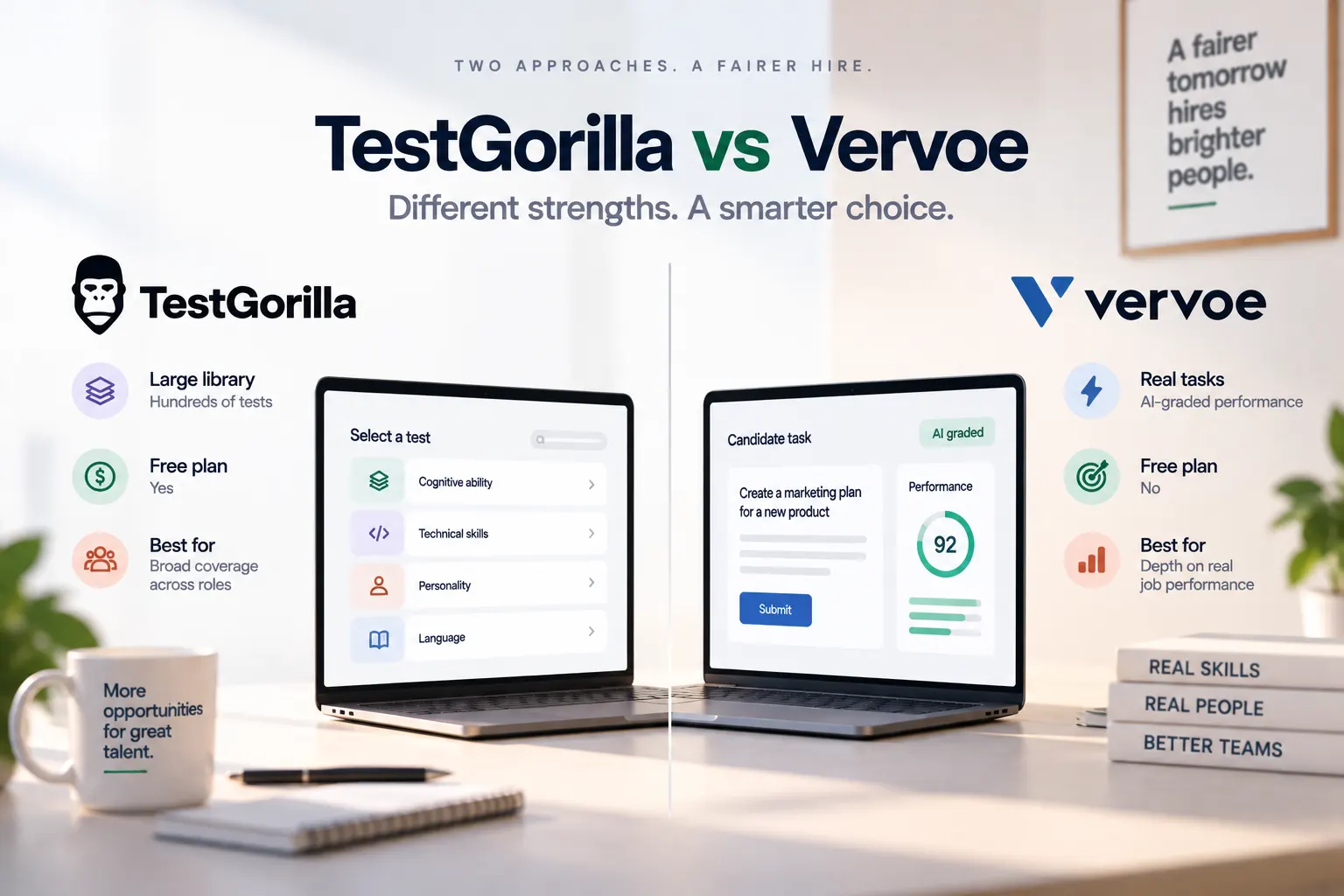
Choose TestGorilla if you want a big library of ready-made tests, a free plan to start, and broad coverage across many roles. Choose Vervoe if you want AI-graded, real-task assessments that show how candidates actually perform. Here is how they compare in detail.
TestGorilla | Vervoe | |
|---|---|---|
Approach | Large library of ready-made tests | AI-graded, task-based performance tests |
Test library | Very large (hundreds of tests) | Focused on job-relevant tasks and skills |
AI grading | Automated scoring across test types | Automatic grading of real task responses |
Free plan | Yes, a limited free tier | No free tier, paid plans only |
Pricing model | Monthly plans, from roughly $75 to $400+ | Pay-as-you-go and higher tiers, billed annually |
Best for | Breadth, budget, many role types | Depth on real-task performance |
Pricing and features change often. Confirm current details with each vendor before deciding.
TestGorilla: strengths and limits
TestGorilla's biggest strength is breadth. It offers a very large library of tests covering cognitive ability, personality, software and technical skills, language, and role-specific knowledge, so you can assemble an assessment for almost any role quickly. It also has a free tier, which lowers the barrier to trying it, and strong technical coverage for roles like software engineering.
The trade-off is that a large share of its tests are structured and multiple-choice, which are efficient and scalable but measure knowledge more than demonstrated performance. For roles where you really want to see the work done, that can feel a step removed from the job. Its paid plans also scale in price with volume and features, so costs rise as you grow.
Vervoe: strengths and limits
Vervoe's biggest strength is depth. It is built around task-based, performance evaluations, where candidates complete realistic work and its AI grades the output. That is closer to a work sample than a quiz, and for many roles it gives a more direct read on ability. Reviewers often praise the quality of its assessment content.
The trade-offs are cost and flexibility. Vervoe leans toward annual billing and higher-volume or enterprise buyers, with no free tier, which can feel heavy for a small team making a few hires a year. Its AI grading is strong but, like any automated scoring, benefits from human review on senior or nuanced roles.
Which fits your situation?
The abstract comparison is useful, but it is easier to decide from real scenarios. Here is how the two tend to shake out.
You hire across many different roles. TestGorilla's large library means you can find a ready-made test for almost any role, from finance to support to engineering, without building anything.
You care most about seeing real work. Vervoe's task-based tests get you closer to a work sample, so for roles where output is everything, it gives a more direct read.
You are on a tight or variable budget. TestGorilla's free tier and monthly plans are easier to start and stop. Vervoe's annual model rewards steadier volume.
You hire developers at scale. TestGorilla has strong technical coverage, while Vervoe also supports coding tasks and custom challenges. Both can work, so weigh library breadth against task realism.
You hire mostly people-facing or soft-skill roles. Vervoe's performance focus suits roles where you want to watch judgment and communication in action.
If your situation spans several of these, that is a hint that the choice is not really about the tool. It is about how much of the process you want a single platform to handle, which is the point the next section makes.
Candidate experience and ease of use
For a small team, how easy a tool is to run matters as much as its features. Both platforms automate scoring, which saves hours over manual review. TestGorilla's ready-made tests are quick to assemble, while Vervoe's task-based assessments take a little more thought to set up but give richer results. On the candidate side, keep assessments short whichever you choose, because long tests cause strong candidates to drop out regardless of platform. A tool that is powerful but painful to run, or that frustrates candidates, quietly costs you good hires, so weigh the day-to-day experience, not just the feature list.
How to choose between them
Three questions settle it.
First, do you want breadth or depth? If you hire across many role types and want ready-made tests for each, TestGorilla's library is the draw. If you care most about seeing candidates perform realistic tasks, Vervoe's approach fits better.
Second, what is your budget and volume? TestGorilla's free tier and monthly plans suit smaller or variable needs. Vervoe's annual, higher-tier model suits steadier, higher-volume hiring.
Third, do you want a test, or a hiring process? This is the question both tools leave unanswered, because both are assessment tools. If your real problem is the whole front of the funnel, sourcing and screening, not just adding a test, neither is a complete answer. Our comparison of skills assessment versus personality tests and our types of pre-employment tests guide help with the assessment side of that decision.
Where Navero fits as an alternative
Both TestGorilla and Vervoe give you assessments. Navero is an alternative for teams that want more than that: it combines sourcing and skills screening in one platform, rather than being a standalone testing tool.
Navero sources qualified candidates and then screens and ranks them on verified skills with realistic, work-sample-style assessments, so you move from "found" to "shortlisted" in one flow instead of exporting results between tools. It filters out roughly 60% of unqualified applications and cuts time-to-hire by up to 75% (based on customer data), and it shows the reasoning behind every score while a human makes the final decision. That human-in-the-loop design also supports alignment with the EU AI Act, NYC Local Law 144, and EEOC guidance. If you are weighing the assessment-only tools against a full platform, see our TestGorilla vs Navero comparison and our wider TestGorilla alternatives guide.
Want sourcing and skills screening in one place, not just a test? See how Navero's skills-based screening builds your shortlist on real work.
The bottom line
TestGorilla and Vervoe are both good tools that simply optimise for different things. TestGorilla is the breadth-and-budget choice: a huge library, a free tier, and easy coverage across many roles. Vervoe is the depth choice: fewer, richer, AI-graded tasks that show real performance. If you know which of those you value more, the decision is straightforward. What neither answers is the bigger question of whether you want a test or a whole hiring process, because both are assessment tools that sit inside a process you still have to run. If sourcing and screening are your real bottleneck, a full platform is a different and often better answer than either. Match the tool to the problem, and be honest about whether your problem is really "which test," or "the whole front of the funnel."
Frequently Asked Questions
Is TestGorilla or Vervoe better? Neither is universally better. TestGorilla wins on a large test library, a free tier, and budget flexibility. Vervoe wins on deep, AI-graded, task-based assessments that show real performance. The right choice depends on whether you want breadth of tests or depth of real-task evaluation.
What is the main difference between TestGorilla and Vervoe? TestGorilla offers a very large library of mostly structured tests across many skills, while Vervoe focuses on a smaller set of realistic, performance-based tasks graded by AI. TestGorilla is broader, Vervoe is deeper on actual work.
Which is cheaper, TestGorilla or Vervoe? It depends on usage. TestGorilla has a free tier and monthly plans, which suits smaller or variable needs. Vervoe leans toward annual billing and higher tiers. Confirm current pricing with each vendor, since plans change.
Which should a small team choose? For a small team, weigh budget and effort heavily. TestGorilla's free tier and ready-made tests are quick to start, while Vervoe's richer tasks reward steadier hiring. But if sourcing and screening are your real bottleneck, a full platform that handles both, rather than a standalone test, often saves a small team the most time.
Do TestGorilla and Vervoe replace a full hiring process? No. Both are assessment tools, so they add testing to your process rather than running sourcing, screening, and workflow end to end. Teams whose problem is the whole front of the funnel often prefer a full platform like Navero.
Which is better for hiring developers, TestGorilla or Vervoe? Both can work. TestGorilla has strong, broad technical coverage with many ready-made coding and role tests. Vervoe supports coding tasks and custom challenges with a more performance-based feel. Choose TestGorilla for library breadth and quick setup, and Vervoe if you want developers to complete richer, task-based work.
Do TestGorilla and Vervoe offer free trials? TestGorilla has a limited free tier, which lets a small team start assessing at low volume. Vervoe does not offer a free tier and leans toward paid, annual plans. Whichever you consider, run one real role through it before committing, and judge the shortlist quality rather than the demo.
What is a good alternative to TestGorilla and Vervoe? If you want sourcing and skills screening in one platform rather than a standalone test, Navero is a strong alternative. It screens candidates on verified skills and hands your team an evidence-based shortlist, with a human making the final call.