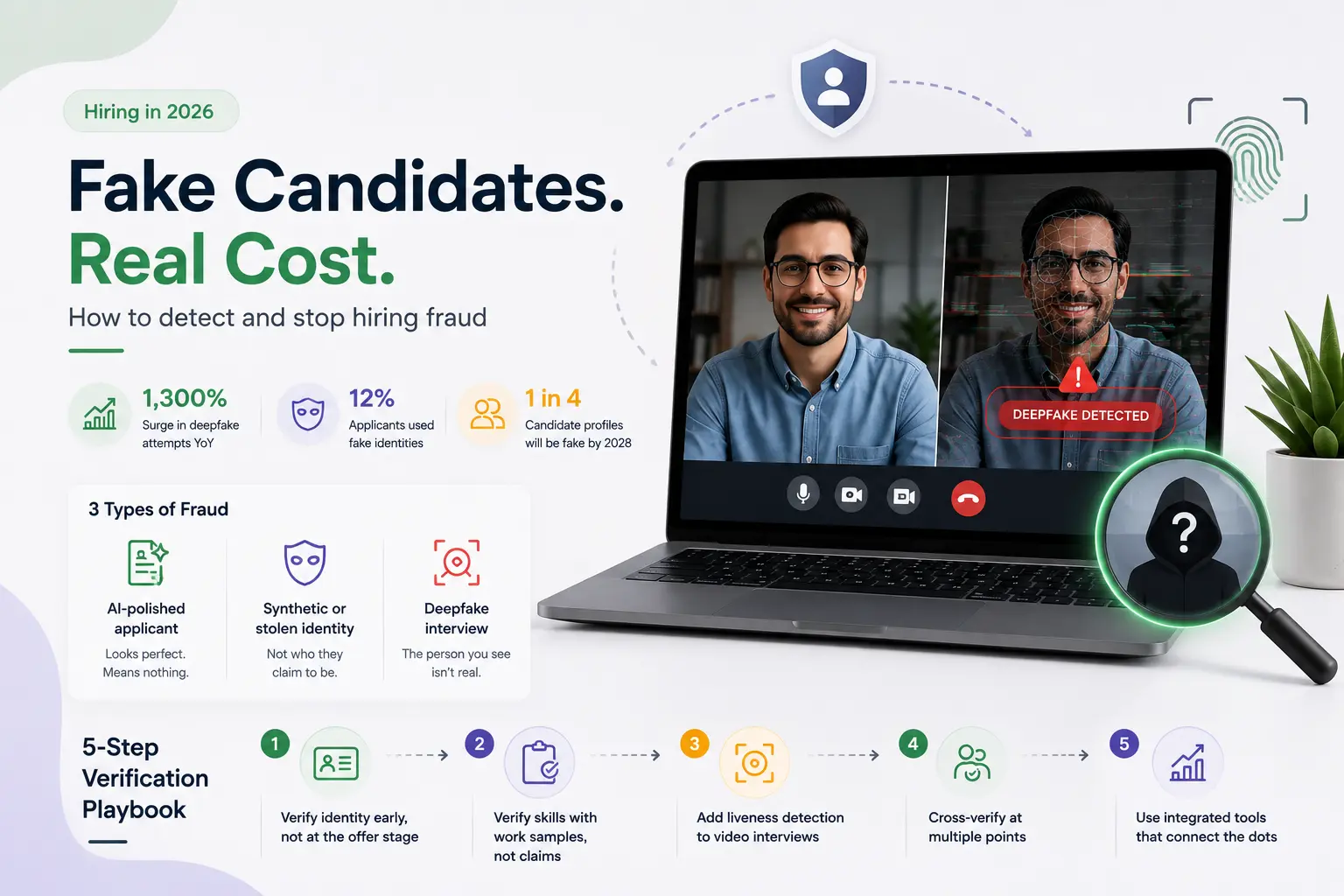
How to Spot Fake and Deepfake Candidates in 2026: A Hiring Verification Playbook
Key Takeaways (TL;DR)
- A fake candidate is an applicant who is not who they claim to be, or cannot do what their application says. In 2026 this stopped being an edge case. AI-generated resumes, synthetic identities, and deepfake video interviews now reach the final round of real hiring processes.
- Fraudulent and AI-generated candidates rank as the #1 hiring threat of 2026.
- Deepfake attempts in hiring rose about 1,300% in a year (Pindrop).
- A striking share of organizations report having unknowingly hired a fraudulent candidate.
- Gartner projects 1 in 4 candidate profiles will be fake by 2028.
- Resumes and standard interviews no longer catch this. Verification does. Navero verifies skills and surfaces candidates on evidence; your team makes the call.
What are fake and deepfake candidates?
A fake candidate is any applicant whose identity or ability is not real. In practice it shows up in three ways:
AI-polished applicants at scale. Real people using AI to mass-produce tailored resumes and cover letters for jobs they are not qualified for. The application looks perfect and means nothing.
Synthetic or stolen identities. A person applying and interviewing under a fake or borrowed identity, sometimes to pass background checks they would otherwise fail, sometimes as part of an organized scheme.
Deepfake interviews. A candidate using real-time face or voice manipulation on a video call, so the person you interview is not the person who would show up to work.
Here is how the three types compare:
Fraud type | What it looks like | What it defeats | How you catch it |
|---|---|---|---|
AI-polished applicant | A real but unqualified person mass-producing tailored resumes with AI | Resume and keyword screening | Skills work samples |
Synthetic or stolen identity | Applying or interviewing as someone they are not | Background checks (sometimes) | Identity verification, done early |
Deepfake interview | Real-time face or voice manipulation on a live call | Standard video interviews | Liveness detection plus a live task |
The common thread: the signals hiring teams have always trusted, a strong resume and a confident interview, can now be manufactured. That is why detection has to move from what a candidate says to what a candidate can prove.
Why 2026 is the tipping point
This is not a scare story. The numbers are specific and they are steep.
It is the top threat. Fraudulent and AI-generated candidates now rank as the number one hiring threat for 2026, according to survey data from talent acquisition leaders (Cumberlink).
The application flood is real. Applications have grown far faster than open roles, driven by one-click AI apply tools. More volume means more places for fakes to hide.
Fake identities are common. Security firm Pindrop posted a single job listing and found roughly 12% of applicants used fake identities.
Deepfakes are surging. Deepfake attempts in hiring jumped about 1,300% year over year, per Pindrop's Voice Intelligence research.
Fakes are getting hired. A large share of organizations now report having unknowingly hired a fraudulent candidate, and fakes increasingly make it to the final interview round.
It gets worse before it gets better. Gartner projects that by 2028, one in four candidate profiles worldwide will be fake.
The takeaway for hiring teams: you can no longer assume the applicant pool is real. You have to verify it.
Why resume and interview screening no longer catch it
Traditional screening was built for a world where faking was expensive. That world is gone.
Resumes are now free to fake. AI writes a flawless, keyword-matched resume in seconds. Screening for a polished CV now screens for AI access, not ability.
Interviews test performance, not identity. A standard video interview confirms that someone can hold a conversation. It does not confirm who they are or whether the answers are theirs. A candidate can read AI output off a second screen or run a deepfake filter on the call.
Background checks come too late. By the time a check runs, the fake candidate has already consumed your team's time, and a synthetic identity may pass the check anyway.
Every one of these gaps has the same root cause. The process trusts self-presentation. The fix is to trust evidence instead.
What a fake hire actually costs you
A fake candidate who gets through is not just a wasted interview. It is a mis-hire, and mis-hires are expensive. You pay for the recruiter hours spent on someone who was never real, the salary until you notice, the lost momentum on the team, and the cost of running the whole search again.
Fraud adds risks a normal bad hire does not. A synthetic or stolen identity inside your systems is a security and data problem, not just a performance one. It can mean access handed to the wrong person, compliance exposure, and a cleanup that reaches well beyond HR.
That is why catching a fake early is so much cheaper than unwinding one later. Screening on verified skills, rather than trusting a resume, is what lets Navero help teams cut mis-hires by up to 90% (based on customer data). The best time to stop a fake candidate is before the first interview. The worst time is after the offer.
How to build a verification defense: a 5-step playbook
The goal is simple. Confirm the person is real, confirm the skills are real, and do it before anyone spends hours on a candidate who is neither.
1. Verify identity early, not at the offer stage
Move identity confirmation to the front of the process, not the end. Confirming that a candidate is a real, consistent person before the first interview stops fakes from consuming your team's time. Do this in a way that respects data-protection law: collect only what you need, tell candidates why, and store it securely.
2. Verify skills with work samples, not claims
The single strongest defense is to make candidates prove ability on a real task. A fake application cannot fake a work-sample result. Skills-based screening that scores candidates on what they actually produce filters out the AI-polished-but-unqualified applicant automatically, because the resume never gets a vote.
3. Add integrity checks to assessments and interviews
Since candidates now use AI and manipulation tools mid-process, assessments need anti-cheating verification: browser lockdown, session recording, behavioral flags, and liveness signals that catch a deepfake or a second screen. The point is not to ban AI everywhere. It is to confirm the work and the face are the candidate's own.
4. Make the process structured and evidence-based
Fraud thrives in unstructured, resume-led hiring, where a good-looking application skips the queue. A structured process, where every candidate is scored on the same verified evidence, removes the shortcut fakes rely on. It also strengthens your position under hiring regulations.
5. Know the red flags
No single tell is proof. But a cluster of them is a signal to verify harder. Train your team to watch these categories:
Where | Red flags to watch for |
|---|---|
Application | Flawless but generic resume; identical phrasing across applicants; skills that do not match the career history |
Video | Lag or blur around the face; lighting that shifts oddly; a face that does not move naturally with speech |
Audio | Voice that does not sync with mouth movement; robotic cadence; background sound that does not match the setting |
Behavior | Reluctance to turn on camera or do a live task; fluent answers that never get specific; a long pause before every reply |
Identity | Details that do not line up across resume, profile, and ID; a brand-new online presence with almost no history |
Treat any cluster as a prompt to verify, not a reason to reject. The goal is confirmation, not accusation.
The verification defense stack at a glance
Think of it as layers. Each one catches a different kind of fake, and together they close the gaps a single check leaves open.
Layer | What it catches | How |
|---|---|---|
Identity verification | Synthetic and stolen identities | Confirm a real, consistent person before the first interview |
Skills work samples | AI-polished but unqualified applicants | Score real output, so the resume never gets a vote |
Assessment integrity | Mid-process AI use and second screens | Browser lockdown, session recording, behavioral flags |
Interview liveness | Deepfake video and voice | Liveness signals plus a live, unscripted task |
Structured scoring | The resume-led shortcuts fraud relies on | The same verified evidence for every candidate |
No layer is enough alone. Stacked, they turn hiring from trust-based to evidence-based, which is the only reliable defense as fakes get cheaper to produce.
How Navero helps you stop fake candidates
Navero is built around a single idea: verify who can actually do the job, rather than trust the resume. That makes it a direct defense against candidate fraud.
It screens and ranks candidates on verified skills, so an AI-polished application with no real ability behind it does not advance.
It confirms the work is the candidate's own with built-in anti-cheating and verification, including session monitoring and integrity signals.
It gives you an auditable record of why each candidate scored the way they did, not a black box.
Two principles keep this fair and lawful. First, Navero scores and surfaces candidates and shows the reasoning. A human recruiter or hiring manager makes the final decision. Second, keep a human in the loop and handle any identity data with care. That keeps you aligned with the EU AI Act, NYC Local Law 144, EEOC guidance, and data-protection rules, which are all tightening around automated and biometric hiring.
Related reading: What is a background check? and the 12 best anti-cheating software for technical interviews.
Frequently Asked Questions
What is a fake or deepfake candidate? A fake candidate is an applicant whose identity or ability is not genuine. This includes AI-mass-produced applications, people applying under false or stolen identities, and candidates using real-time deepfake video or voice to disguise who they are in an interview.
How common are fake candidates in 2026? Very. They rank as the top hiring threat for 2026. One security firm found about 12% of applicants to a single job used fake identities, deepfake attempts rose roughly 1,300% year over year, and 41% of organizations say they have unknowingly hired a fraudulent candidate.
How do you detect a deepfake in a video interview? Watch for visual and audio mismatches: lag or distortion around the face, audio that does not sync with mouth movements, and reluctance to perform a live, unscripted task. Pair this with identity verification and liveness detection rather than relying on the human eye alone.
Can background checks stop fake candidates? Not on their own. Checks run late in the process and a synthetic identity can sometimes pass them. Verifying identity early and verifying skills through work samples catches fakes sooner and more reliably.
What is the best defense against candidate fraud? Verification over trust. Confirm identity early, score candidates on real work samples rather than resumes, and add integrity checks to assessments and interviews. The final hiring decision stays with a human.