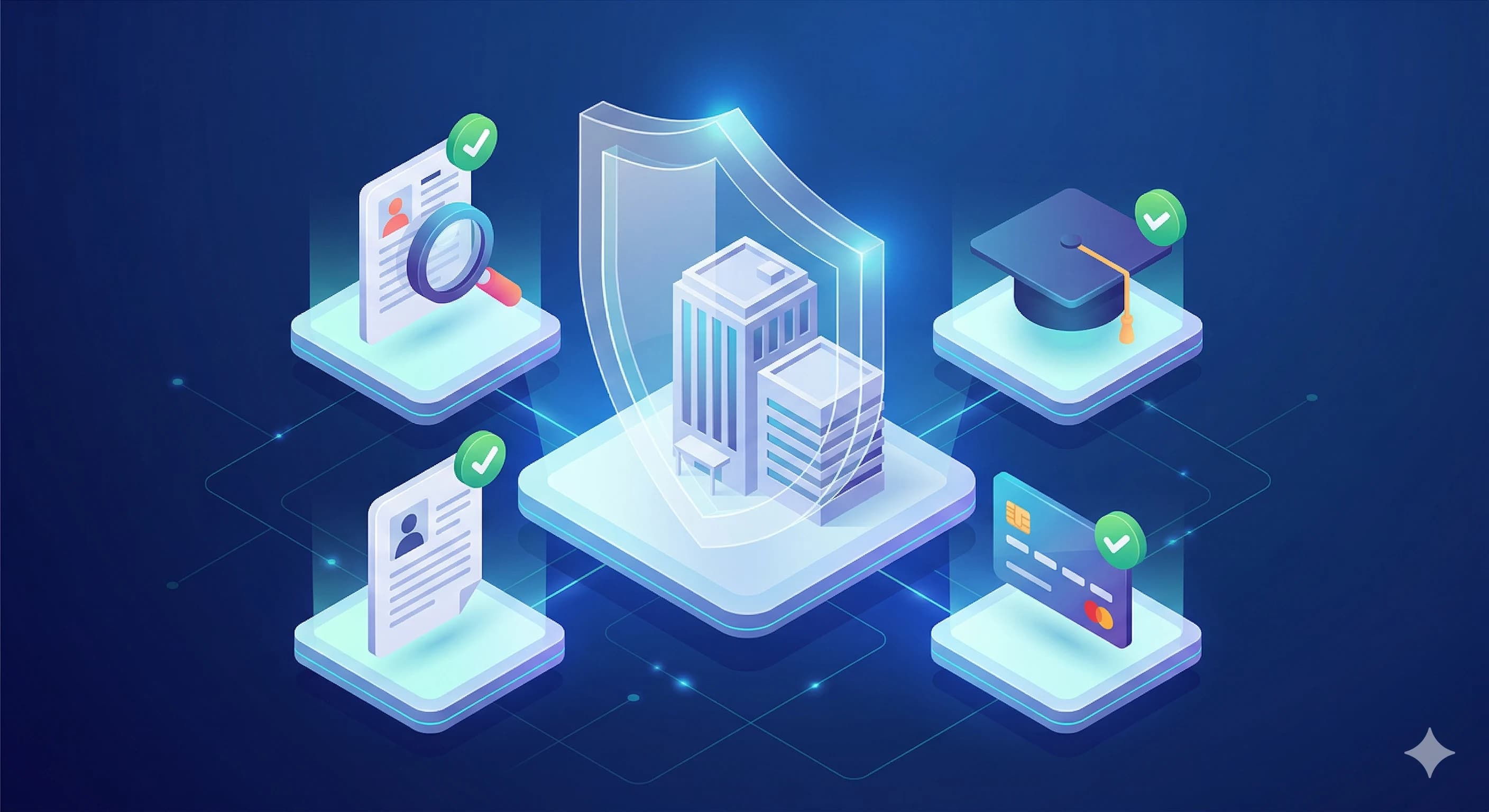
What Is a Background Check? The Truth About Screening That Could Save Your Business
Key Takeaways (TL;DR)
- 95% of U.S. businesses conduct background checks [14] [15] - thorough screening is standard business practice, not an optional safeguard.
- Negligent hiring costs average £1.27 million in settlements - employers lose 72% of cases when screening fails, creating direct financial liability.
- Workplace fraud drains £39.71 billion annually from organizations - background screening identifies candidates with theft, fraud, or financial misconduct records.
- Four-step legal compliance process: conditional job offers first, written candidate consent, FCRA/EEOC adherence, and proper adverse action notifications.
- PBSA-accredited providers with ISO 27001 certification offer transparent pricing and proven compliance expertise that prevents legal exposure.
- Role-specific screening depth matters - positions involving vulnerable populations, financial access, or safety responsibilities require enhanced verification protocols.
- Background checks deliver measurable returns through reduced turnover, protected reputation, and safer workplaces when implemented with proper legal compliance.
Understanding background checks and implementing them correctly is no longer optional; it's business protection. Without proper screening, employers rely solely on candidate-supplied information, exposing themselves to fraud, theft, litigation, and costly mis-hires [14]. Background checks for employment verify credentials, criminal history, and other critical data that protect workplace safety and company reputation. This guide explains the correct process for conducting background checks while maintaining compliance and making informed hiring decisions.
What Background Checks Actually Are
Background checks verify candidate identity and confirm historical records including education, employment, and criminal history [1]. Organizations use this verification to validate information beyond resume claims. The screening process examines multiple data sources to build an accurate candidate profile.
How the Screening Process Works
Background verification involves database searches and direct contact with institutions to confirm candidate details [1]. Employers collect historical information to assess candidate suitability for specific roles [14]. This goes beyond surface-level CV details to reveal actual experience patterns and behavior history.
The screening examines core areas based on job requirements. Criminal history, employment verification, education credentials, credit reports, and driving records form the foundation [1]. Professional licensing, certifications, and international checks apply to specialized positions requiring specific qualifications.
These checks serve clear business purposes. Employers identify potential risks related to safety, security, and workplace fit [1]. The verification detects resume inconsistencies and false claims that could indicate broader integrity issues [1]. The goal is protecting existing employees and maintaining workplace security [1].
Public Records vs. Private Verification
Background screening draws from both public and private data sources. Public records include criminal convictions, court judgments, bankruptcy filings, and government databases accessible to screening providers. Private records require direct institutional contact for employment histories, education verification, and financial reports.
Government agencies handle some verification for nominal fees, while private companies offer comprehensive services [1]. Third-party providers access multiple databases and contact institutions directly. The combination improves accuracy, though records may contain gaps or inconsistencies [14].
Data protection regulations govern how employers handle personal information during screening [16]. Companies must restrict comprehensive checks to selected candidates rather than screening all applicants [16].
When Background Checks Happen
Employment background checks typically occur after conditional job offers rather than during initial application phases [1]. Most employers use this timing to avoid delays while maintaining data protection compliance [5].
High-security positions require enhanced screening. Schools, hospitals, financial institutions, airports, and government facilities mandate extensive verification [1]. Roles involving vulnerable populations or regulatory compliance face particularly thorough checks [14].
Completion timelines range from days to weeks depending on screening depth [5]. Some industries require ongoing verification, with annual background checks mandatory for certain positions [16].
What Background Checks Actually Reveal About Candidates
Employment background checks expose information that candidates rarely volunteer during interviews. These checks examine multiple data sources to build an accurate picture of who you're actually hiring, not just who they claim to be.
Employment and Education Verification
Employment verification cuts through resume inflation by contacting previous employers directly. HR departments confirm job titles, employment dates, salary ranges, and reasons for departure. This process removes fabricated positions and inflated responsibilities that 58% of employers discover on resumes [6].
Education verification prevents credential fraud by validating degrees, enrollment dates, and institutional accreditation. The process has become essential as diploma mills sell worthless degrees to unqualified candidates. A nurse who never completed nursing school or an engineer with an unaccredited degree creates serious liability for any organization that hires them.
Criminal History and Legal Records
Criminal background checks reveal conviction history through official databases like the Disclosure and Barring Service. Basic checks show unspent convictions and cautions, while enhanced checks include local police intelligence and barred lists for positions involving vulnerable populations.
These checks prevent dangerous individuals from accessing workplaces where they could cause harm. Healthcare facilities, schools, and childcare organizations rely on criminal screening to maintain safe environments and meet regulatory requirements.
Financial Background and Credit History
Credit checks examine financial responsibility through County Court Judgements, bankruptcy filings, and payment histories spanning six years. Organizations use financial screening primarily for roles involving money management, accounting responsibilities, or access to sensitive financial data.
Candidates with poor financial standing present higher fraud risks. These soft credit searches don't impact candidate credit scores but reveal financial pressures that could compromise job performance or create theft incentives.
Driving Records and Professional Licenses
Motor Vehicle Record checks validate driving history for positions requiring vehicle operation. These reports show license status, traffic violations, accidents, and impaired driving charges over three to seven years.
Organizations requiring employees to drive company vehicles must verify driving records to reduce accident liability and manage insurance costs effectively. Professional license verification ensures candidates maintain required certifications for regulated roles.
Digital Footprint Analysis
Social media screening analyzes candidate online presence across platforms to identify concerning behavior patterns. Screening providers examine up to seven years of posts, comments, and interactions to flag discriminatory language, illegal activity evidence, or violent content.
Digital screening requires written consent and FCRA-compliant third-party providers to avoid accessing protected information that could create discrimination claims. The process helps organizations avoid hiring candidates whose online behavior could damage company reputation or create workplace conflicts.
The Hidden Costs of Skipping Background Checks
Background screening isn't about compliance paperwork. It's about preventing business-threatening disasters that destroy companies overnight. Organizations that skip proper candidate verification face negligent hiring lawsuits, workplace fraud epidemics, and regulatory penalties that can eliminate decades of growth.
The numbers tell the story clearly. Employers lose 72% of negligent hiring cases with settlements averaging £1.27 million [8]. Workplace fraud costs organizations £39.71 billion annually [8]. These aren't abstract risks. They're predictable outcomes when businesses rely on candidate-supplied information without verification.
Negligent Hiring: A £1.27 Million Problem
Negligent hiring occurs when employers fail to screen candidates who later harm others. Courts hold companies directly liable for their hiring negligence, separate from employee actions. This liability exists regardless of whether harmful employees acted within job scope or committed intentional crimes.
Research examining negligent hiring decisions from 1974 through 2022 found approximately 435 trial court decisions holding employers liable, averaging nine cases annually [3]. Including settled cases, that figure reaches around 2,260 total cases [3].
Liability concentrates in predictable job categories. Cases resulting in employer verdicts involve:
Contact with vulnerable populations
Motor vehicle operation
Access to financial assets or homes
Use of force or firearms
Alcohol service
A security system salesman with an undisclosed violent history returned to a client's home and raped a minor, resulting in employer liability for failing to conduct criminal screening [9]. A concert screener with prior violent offenses attempted rape at his workplace after the employer ignored background check warnings [9]. These cases share a common factor: preventable harm caused by inadequate screening.
Workplace Fraud: The 5% Revenue Killer
Businesses lose 5% of annual revenue to occupational fraud, according to the Association of Certified Fraud Examiners [10]. Employee theft represents one-third of retail inventory shrinkage [4].
Background checks directly address fraud risk by identifying candidates with:
Prior theft, fraud, or embezzlement convictions
Bankruptcies or excessive debt that increase fraud risk
Terminations due to misconduct
The screening gap is massive. Studies show 84% of fraudsters had no documented criminal or employment history check conducted [2]. Meanwhile, 20% to 30% of job applications contain verifiable false information [2]. Organizations create fraud vulnerabilities by accepting candidate claims without verification.
Safety and Culture Impact
Background screening creates measurable safety improvements. Over 20 million U.S. workers annually experience workplace violence [8]. Comprehensive screening reduces this risk while addressing turnover costs that range between 100% and 250% of an employee's annual salary plus benefits [11].
Employee satisfaction correlates positively with customer loyalty and negatively with staff turnover [12]. Thorough screening supports informed hiring decisions that build cultures of safety and productivity [13].
Regulatory Compliance: Non-Negotiable Requirements
Regulated industries mandate specific screening requirements. Banking and finance must adhere to KYC, AML, and regulatory standards [14]. Healthcare requires medical licensing verification and patient safety compliance [15]. Education and childcare mandate criminal checks preventing individuals with abuse histories from hire [14]. Transportation requires license verification, criminal checks, and drug testing [14].
UK employers face fines up to £20,000 for failing to verify right to work status [16]. Positions involving vulnerable demographics require Disclosure and Barring Service checks [16]. Organizations must maintain annual DBS rechecks to ensure continuous compliance and safety [6].
These aren't suggestions. They're legal requirements that carry substantial penalties for non-compliance.
How to Execute Background Checks: The Four-Step Legal Process
Proper background check execution requires following specific legal procedures that protect both employer and candidate rights. The process involves four distinct stages that must occur in sequence to maintain compliance with federal regulations.
Making the Conditional Job Offer
Employers conduct background checks after extending a conditional job offer rather than during initial screening phases [17]. This timing prevents unnecessary delays while ensuring compliance with data protection laws [18]. The conditional offer states that employment depends on successfully completing background verification [19]. This approach allows candidates to begin onboarding procedures while screening completes, though actual employment cannot commence until checks clear satisfactorily [20].
Obtaining Proper Candidate Consent
Before ordering a background check, employers must complete two mandatory steps. First, provide clear written disclosure in a standalone document explaining that consumer reports will be obtained for employment decisions [21]. This disclosure cannot be bundled with job applications or contain extraneous information [22].
Second, obtain written authorization from the candidate, which can appear on the same form as the disclosure but must remain separate from the application [23]. Proceeding without consent violates federal law [22]. Employers must retain documented consent with the candidate's file for five years after obtaining the report [22].
Following FCRA and EEOC Compliance
Consumer reporting agencies must receive certification that employers notified applicants and obtained permission [24]. Employers certify they will comply with FCRA requirements and won't discriminate based on protected characteristics [21]. Background checks must relate to business necessity and job requirements [25].
EEOC guidelines prohibit blanket policies rejecting all candidates with criminal records [26]. Instead, employers must consider offense type, severity, time elapsed, and relevance to the position [25].
Reviewing Results and Taking Action
When background information may result in non-hire decisions, employers must follow a two-step adverse action process. First, send a pre-adverse action notice including a complete copy of the background report and a summary of rights under FCRA [27]. Wait at least five business days before making final determinations [27] [28]. This period allows candidates to dispute inaccuracies or provide context.
Subsequently, if proceeding with the negative decision, send a final adverse action notice within three business days confirming the decision and reminding candidates of their dispute rights [27].
Choosing the Right Background Screening Provider
Selecting a background screening provider determines whether organizations achieve compliant, accurate results or face legal exposure and hiring mistakes. Four criteria separate capable providers from inadequate ones.
Compliance expertise and accreditations
Professional Background Screening Association (PBSA) accreditation represents the industry gold standard, requiring rigorous third-party audits verifying information security, legal compliance, client education, researcher standards, verification capabilities, and business practices [7]. Accredited providers undergo evaluation every five years to maintain credentials [7].
ISO 27001 certification confirms providers implement stringent information security management systems protecting candidate and client data through encryption, personnel training, and incident response protocols [29]. Providers should demonstrate FCRA compliance expertise, with designated individuals responsible for federal, state, and DPPA regulations [7].
These accreditations are not optional extras. They represent the minimum threshold for protecting your organization from legal exposure and data breaches that can devastate business operations.
Technology integrations and turnaround time
Integration capabilities accelerate hiring workflows without creating additional administrative burden. Leading providers offer 100+ flexible integration options with major ATS platforms, maintaining average partner relationships spanning 10 years [30].
Approximately 90% of US criminal searches utilize intelligent automation to speed background check processing from data verification through adjudication [30]. Standard integrations activate in days rather than weeks through proprietary automated onboarding tools [30] [31].
Organizations should verify multi-regional compliance support for international data housing requirements [31]. Manual processes that require duplicate data entry or separate logins create bottlenecks that defeat the purpose of efficient screening.
Pricing transparency and customization options
Transparent pricing structures prevent hidden costs and unexpected surcharges that erode budget control [32]. All-inclusive pricing models forcing providers to bundle variable court fees create problems: quality providers may decline bids, vendors may cut corners violating FCRA standards, or employers overpay as providers build worst-case scenarios into rates [33].
Customizable screening packages allow organizations to tailor verification depth based on role requirements and risk profiles [34] [35]. A retail cashier requires different screening than a financial advisor or childcare worker.
Providers who cannot explain their pricing structure clearly or refuse to itemize costs are signaling potential problems with transparency and service quality.
Data accuracy and security standards
Providers must demonstrate maximum possible accuracy through multi-source verification, regular database updates, and human review processes [36] [7]. ISO 27001 alignment ensures internationally approved security protocols and robust internal data handling [37].
Accuracy prevents wrongful rejections and legal liability under FCRA [36]. Inaccurate background reports create two problems: qualified candidates get rejected unnecessarily, and unqualified candidates slip through screening.
The cost of using an inferior provider extends far beyond their fees. Poor accuracy leads to bad hires, legal disputes, and compliance violations that can cost significantly more than investing in quality screening from the start.
Conclusion
Background checks protect businesses from devastating lawsuits, fraud losses, and compliance penalties that threaten viability. With negligent hiring settlements averaging £1.27 million and workplace fraud costing organizations £39.71 billion annually, thorough screening isn't just best practice; it's financial protection.
Organizations that implement proper verification processes reduce legal exposure while building safer, more productive workplaces. The key lies in choosing PBSA-accredited providers with proven compliance expertise and transparent pricing models.
For that reason, businesses should treat background screening as an investment rather than an expense. When executed correctly with proper consent and FCRA compliance, comprehensive checks deliver measurable returns through reduced turnover, protected reputation, and informed hiring decisions that strengthen organizational foundations.
FAQs
Q1. What exactly is a background check and why do employers use it? A background check is a comprehensive verification process that examines an individual's history, including criminal records, employment and education credentials, credit history, and other relevant information. Employers use background checks to verify the accuracy of candidate-provided information, assess qualifications and character, ensure workplace safety, and protect their organization from potential risks such as fraud, theft, and negligent hiring lawsuits.
Q2. What information typically appears in an employment background check? Employment background checks typically reveal employment and education history, criminal records and convictions, credit reports and financial history, motor vehicle records and driving history, and professional licensing verification. Depending on the position, checks may also include social media screening and digital footprint analysis. The specific components included depend on the job requirements and industry regulations.
Q3. Why is conducting background checks critical for protecting a business? Background checks protect businesses from negligent hiring lawsuits that average £1.27 million in settlements, reduce workplace fraud and theft that costs organizations £39.71 billion annually, ensure workplace safety by identifying candidates with violent or problematic histories, and help meet mandatory industry compliance requirements. Without proper screening, companies face direct legal liability, financial losses, and regulatory penalties.
Q4. What is the proper legal process for conducting a background check? The proper process involves four key steps: first, make a conditional job offer; second, provide clear written disclosure and obtain written consent from the candidate; third, ensure compliance with FCRA and EEOC regulations by certifying proper use and avoiding discriminatory practices; and fourth, follow the adverse action process if negative information is found, including providing pre-adverse action notice and waiting at least five business days before making final decisions.
Q5. What should businesses look for when choosing a background screening provider? Businesses should prioritize providers with PBSA accreditation and ISO 27001 certification, which demonstrate compliance expertise and data security standards. Look for technology integration capabilities with major ATS platforms, transparent pricing without hidden fees, customizable screening packages tailored to specific roles, and proven data accuracy through multi-source verification and human review processes.
References
[1] - https://www.adp.com/resources/articles-and-insights/articles/b/background-screening.aspx
[2] - https://www.veremark.com/blog/why-run-a-background-check-why-background-checks-are-important
[3] - https://en.wikipedia.org/wiki/Background_check
[4] - https://www.ciphr.com/blog/background-checks-basics
[5] - https://www.enformion.com/blog/public-and-private-records-use/
[6] - https://ogletreedeakins.co.uk/insights-resources/blog-posts/data-privacy-law-in-the-uk-part-iii-employment-background-checks-and-monitoring/
[7] - https://www.chexperts.co.uk/post/pre-employment-background-checks-in-the-uk-a-guide-for-employers
[8] - https://www.reed.com/screening/articles/pre-employment-background-check-process
[9] - https://ebcglobal.co.uk/employment-background-checks-a-step-by-step-guide/
[10] - https://www.lspm.org.uk/2022/news.aspx?id=12411511&CourseTitle=Tips+for+employers+to+verify+education+qualifications
[11] - https://www.choicescreening.com/blog/mitigate-negligent-hiring-through-comprehensive-background-screening
[12] - https://www.shrm.org/topics-tools/news/talent-acquisition/negligent-hiring-risk-less-than-employers-believe
[13] - https://www.primerus.com/article/criminal-background-checks-controlling-risks-employee-related-litigation
[14] - https://www.ekentech.com/blog/2025/4/24/the-role-of-background-checks-in-preventing-workplace-theft-and-fraud
[15] - https://credence.co.uk/lower-risk-background-checks-for-employment/
[16] - https://www.fticonsulting.com/insights/articles/safeguard-against-fraud-importance-background-checks
[17] - https://www.sterlingcheck.co.uk/blog/2015/07/3-ways-background-checks-save-employers-money/
[18] - https://www.neotas.com/corporate-background-checks-building-company-culture/
[19] - https://employers.org/2025/09/17/blog-background-checks-improve-company-culture/
[20] - https://www.coincircletrust.com/blog/best-practices-for-background-checks-in-highly-regulated-industries
[21] - https://www.referenceservices.com/understanding-compliance-in-background-screening-regulations-best-practices-and-compliance-tips/
[22] - https://www.gov.uk/employers-checks-job-applicants
[23] - https://teammatrix.com/insights/workplace-safety-and-the-imperative-of-background-screening/
[24] - https://uk.indeed.com/career-advice/starting-new-job/what-is-conditional-employment-offer
[25] - https://uk.practicallaw.thomsonreuters.com/6-618-2492?transitionType=Default&contextData=(sc.Default)
[26] - https://www.vettinggateway.com/post/how-to-streamline-conditional-offers-of-employment
[27] - https://www.ftc.gov/system/files/documents/plain-language/pdf-0142-background-checks-what-employers-need-know.pdf
[28] - https://www.backgroundchecks.com/candidate-experience/what-to-know-about-background-check-consent-requirements?srsltid=AfmBOorUdq1zlwx33G6ZK5_WJfnPABGriBtJ2kzxVpdi-7owJQKNPsyZ
[29] - https://www.truescreen.com/resource-center/compliance-services/fcra-requirements-for-using-a-consumer-report-for-employment-purposes/
[30] - https://www.ftc.gov/business-guidance/resources/what-employment-background-screening-companies-need-know-about-fair-credit-reporting-act
[31] - https://www.infomart-usa.com/blog/eeoc-compliant-employment-background-check-guidelines/
[32] - https://essentialscreens.com/how-to-read-a-background-report-like-a-pro/
[33] - https://disa.com/news/fcra-adverse-action-process-a-step-by-step-guide-for-employers/
[34] - https://www.sterlingcheck.com/blog/2023/08/adverse-action-best-practices-under-the-fcra/
[35] - https://www.linkedin.com/pulse/protecting-your-company-why-choosing-accredited-screening-white
[36] - https://cbscreening.co.uk/how-complete-background-screening-achieves-accreditation-a-comprehensive-overview/
[37] - https://fadv.com/integrations/
[38] - https://www.sterlingcheck.com/resources/integrations/
[39] - https://www.gap-personnel.com/job-seekers-news/the-power-of-transparent-pricing-in-recruitment/
[40] - https://www.linkedin.com/posts/johntlawrence_backgroundscreening-hr-compliance-activity-7357045239653572608-N_3t
[41] - https://cbscreening.co.uk/service/cbs-screening-packages/
[42] - https://nsascreening.co.uk/screening/custom-screening/
[43] - https://www.protectionplussolutions.com/data-accuracy-foundation-background-checks/
[44] - https://zincwork.com/blog/background-checks-iso-27001