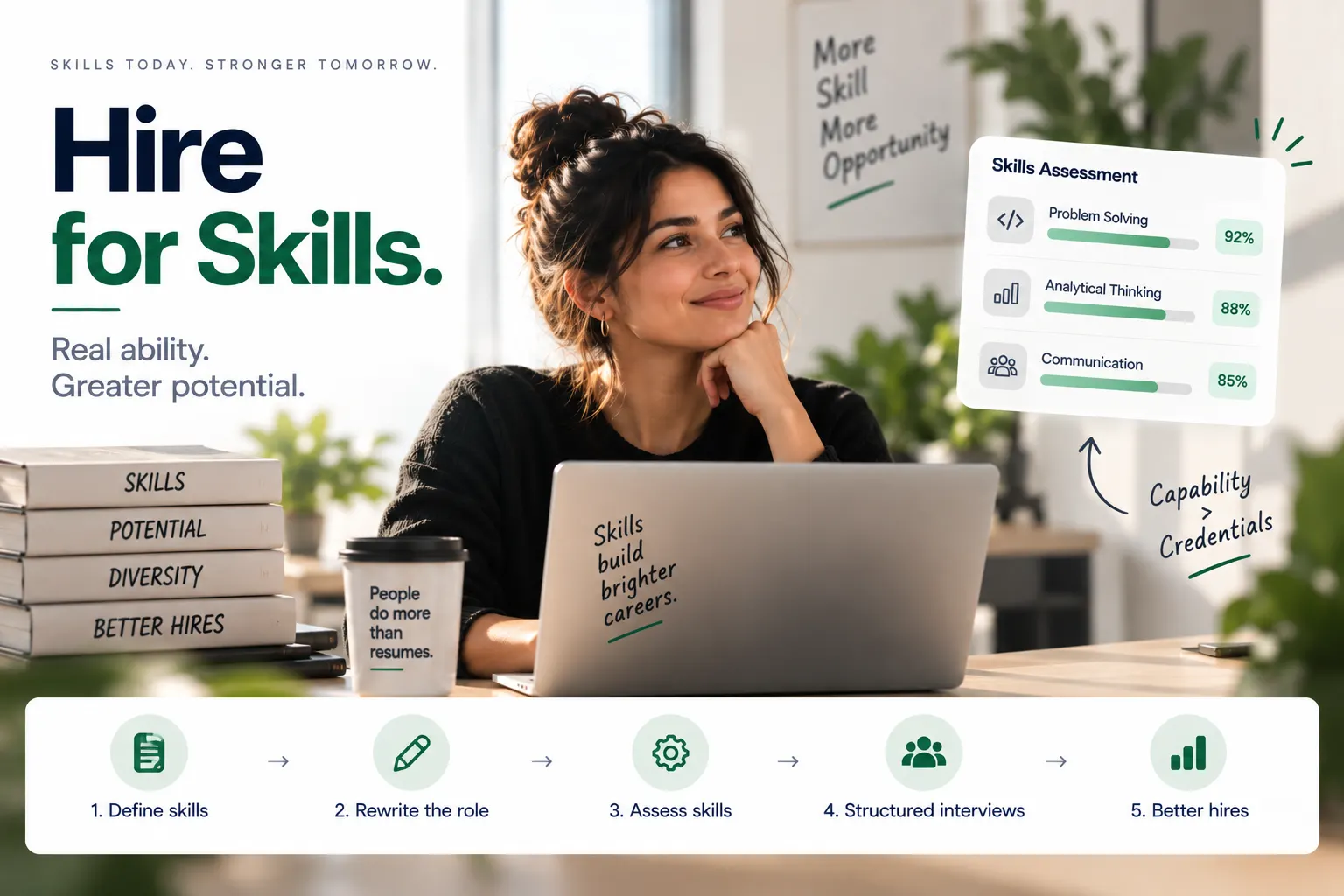
How to Implement Skills-Based Hiring in 2026: A Step-by-Step Guide
Key Takeaways (TL;DR)
- Skills-based hiring means deciding who to hire on demonstrated ability, tested directly, rather than on resumes, degrees, and pedigree. It predicts performance far better, and adopting it is more about changing your process than buying a single tool.
- Testing skills is one of the strongest predictors of job performance in decades of research, well ahead of the resume proxies most hiring relies on.
- The core shift is order: test ability first, then read the resume for context, not the other way round.
- Implementation is seven steps, from defining the skills each role needs to measuring the results and iterating.
- Navero handles the heaviest part, screening candidates on verified skills, while your team makes the decision.
What skills-based hiring actually is
Skills-based hiring judges candidates on what they can do, measured through assessments and work samples, rather than inferring ability from a resume, a degree, or where they used to work. It does not mean ignoring experience entirely. It means putting evidence of skill first and using everything else as context.
The case for it is strong. Work sample and skills tests are among the best predictors of job performance in the research, far ahead of the proxies a resume is built from, such as years of experience and education. If you want the background, see what skill validation is and our comparison of skills-based hiring versus resume screening. This guide is about the harder question: how to actually do it.
Why implement it now
Three forces make 2026 the moment to switch. AI now writes flawless resumes in seconds, so the resume is a weaker signal than ever. Skills shortages mean the best candidate often does not have the traditional background. And regulators increasingly expect hiring decisions to be job-related and defensible, which a skills-based process supports. Put together, the old resume-first model is both less accurate and less safe than it used to be. Here is how to move to something better.
Step 1: Define the skills each role really needs
Everything starts here. For each role, write down the handful of skills that genuinely separate a strong performer from a weak one, based on the actual work, not the old job description. Be specific and honest: distinguish the skills someone must have on day one from those they can learn. This list becomes the standard you assess every candidate against, so if you get this wrong, nothing downstream can fix it.
Step 2: Rewrite job descriptions around skills
Turn those skills into the job ad. Lead with what the person will do and the abilities the role needs, and strip out requirements that are really proxies, like a specific degree or an arbitrary number of years, unless they are genuinely essential. Removing unnecessary credential barriers widens your pool to strong candidates from non-traditional paths, which is much of the point. Our guide to writing a job description helps.
Step 3: Replace resume screening with a skills assessment
This is the heart of the change. Instead of filtering first on resumes, put a short, role-relevant skills assessment at the front of the process, and use it as your primary screen. Score candidates on what they produce, and only then read the resume for context on the people who already proved they can do the work. A skills-based screening approach filters on ability rather than pedigree, which is the single change that most improves hire quality.
Step 4: Use structured interviews for judgment and fit
Skills assessments tell you if someone can do the work. Structured interviews tell you how they think and whether they fit, which the assessment cannot. Ask every candidate the same questions and score them the same way, because structured interviews predict performance far better than free-flowing chats. Our guide to running structured interviews covers it.
Step 5: Score every candidate on the same evidence
Consistency is what makes skills-based hiring fair and defensible. Rate every candidate against the same rubric, tied to the skills you defined in step one, and have interviewers score independently before discussing. This is what turns skills testing into evidence you can stand behind, and it is covered in evaluating candidates in your screening process.
Step 6: Fit it into your wider hiring process
Skills-based hiring is not a bolt-on, it is a way of running the whole funnel. Make sure sourcing, screening, interviewing, and the final decision all point at the same skills, so the process is coherent from first touch to offer. If you are building or refreshing your process, our hiring process guide shows where each piece fits.
Step 7: Measure and iterate
Finally, prove it is working and keep improving. Track quality of hire, time-to-hire, and the diversity of your pipeline before and after the switch, and use what you learn to refine your assessments and rubrics. Skills-based hiring gets sharper the more you tune it to your actual roles and outcomes.
What to expect when you switch
Moving to skills-based hiring is a change of habit as much as tooling, so it helps to know what the transition looks like. Early on, the biggest shift is psychological: your team has to trust a work sample over a familiar-looking resume, which can feel strange at first. Start with one or two roles rather than the whole company, prove the shortlist quality against your own judgment, and expand from that win. Expect the pool of candidates to widen, because dropping unnecessary credential requirements surfaces strong people from non-traditional paths you would previously have filtered out. And expect some internal questions about fairness and consistency, which a clear rubric and explainable scoring answer directly. Within a few hires, most teams stop missing the resume-first process, because the quality of who reaches the interview is visibly better.
A quick example
Picture a support role you have always filled by scanning resumes for relevant job titles. Under skills-based hiring, you instead send every applicant a short, realistic task: handle a tricky customer scenario in writing. Two candidates stand out. One has the polished resume and the right past employers. The other has an uneven background you would once have skipped, but produces a clearly sharper response to the task. Under the old process, you never see the second person. Under the new one, they rise to the top on merit. Multiply that across every hire, and the change is not subtle: you consistently surface better performers, and you find them in places a resume filter never looked.
Common mistakes when implementing skills-based hiring
Testing trivia, not the job. An assessment that does not look like the real work will not predict performance. Make tasks realistic.
Keeping resume screening as the real gate. If you still filter on resumes first, you have not changed anything. The assessment has to be the primary screen.
Removing all structure. Skills-based does not mean gut feel. Consistent scoring is what makes it fair and predictive.
Ignoring fit. Skills get someone in the door, but attitude and fit decide who stays. Assess both, deliberately.
Not measuring results. Without tracking quality of hire, you cannot prove the change worked or improve it.
How Navero implements skills-based hiring for you
Navero is, in effect, skills-based hiring as a platform. It sources candidates and screens them on verified skills rather than resume signals, so the highest-leverage steps, replacing resume screening and scoring on consistent evidence, are handled for you. That removes the practical barrier that stops most teams, which is not wanting to build assessments and scoring from scratch.
Navero filters out roughly 60% of unqualified applications and cuts time-to-hire by up to 75% (based on customer data), and it shows the reasoning behind every score, while a human makes the final decision. That human-in-the-loop, job-relevant design also keeps you aligned with the EU AI Act, NYC Local Law 144, and EEOC guidance as they tighten around hiring. Skills-based hiring is a big reason mid-market firms are winning the talent war.
Ready to hire on skills instead of resumes? See how Navero builds your shortlist on evidence.
The bottom line
Implementing skills-based hiring is less about a single purchase and more about reversing one habit: test ability first, read the resume second. The seven steps, defining the skills, rewriting job ads, assessing before screening resumes, structured interviews, consistent scoring, a coherent process, and measurement, all serve that one reversal. Start with a role or two, use realistic assessments, keep a human deciding, and measure the results. The payoff is better hires from a wider pool, a fairer and more defensible process, and decisions you can actually explain. The resume is not dead, but in 2026 it belongs after the evidence, not in front of it.
Frequently Asked Questions
What is skills-based hiring? It is deciding who to hire on demonstrated ability, tested through assessments and work samples, rather than inferring it from resumes, degrees, and pedigree. It does not ignore experience, it just puts evidence of skill first and uses the rest as context.
How do I implement skills-based hiring? Define the skills each role needs, rewrite job descriptions around them, replace resume screening with a role-relevant skills assessment as your primary filter, use structured interviews for judgment and fit, score everyone on the same rubric, and measure the results to keep improving.
Does skills-based hiring mean ignoring degrees and experience? No. It means not using them as the main gate. Degrees and experience become context you read after a candidate has proved they can do the work, rather than the filter that decides who advances. Unnecessary credential requirements are removed to widen the pool.
Is skills-based hiring better than resume screening? For predicting performance, yes. Tested skills are among the strongest predictors in decades of research, while the proxies a resume relies on rank among the weakest. Skills-based hiring also widens your pool and, done consistently, reduces bias.
Where should I start with skills-based hiring? Start small, with one or two roles you hire often, rather than the whole company at once. Define the skills, build a realistic assessment, put it before your resume screen, and compare the shortlist to your usual judgment. Once you see the quality difference, expand from that proven win to more roles.
What is the hardest part of implementing skills-based hiring? Usually building and scoring the assessments, and having the discipline to make them the primary screen rather than reverting to resumes. Using a platform that scores candidates on verified skills removes most of that friction.