How to Build a Hiring Process in 2026: A Step-by-Step Guide
Key Takeaways (TL;DR)
- A hiring process is the repeatable set of steps you run every time you hire, from defining the role to closing the offer. A good one makes better hires, faster and more fairly. An ad-hoc one is where mis-hires, bias, and lost candidates come from.
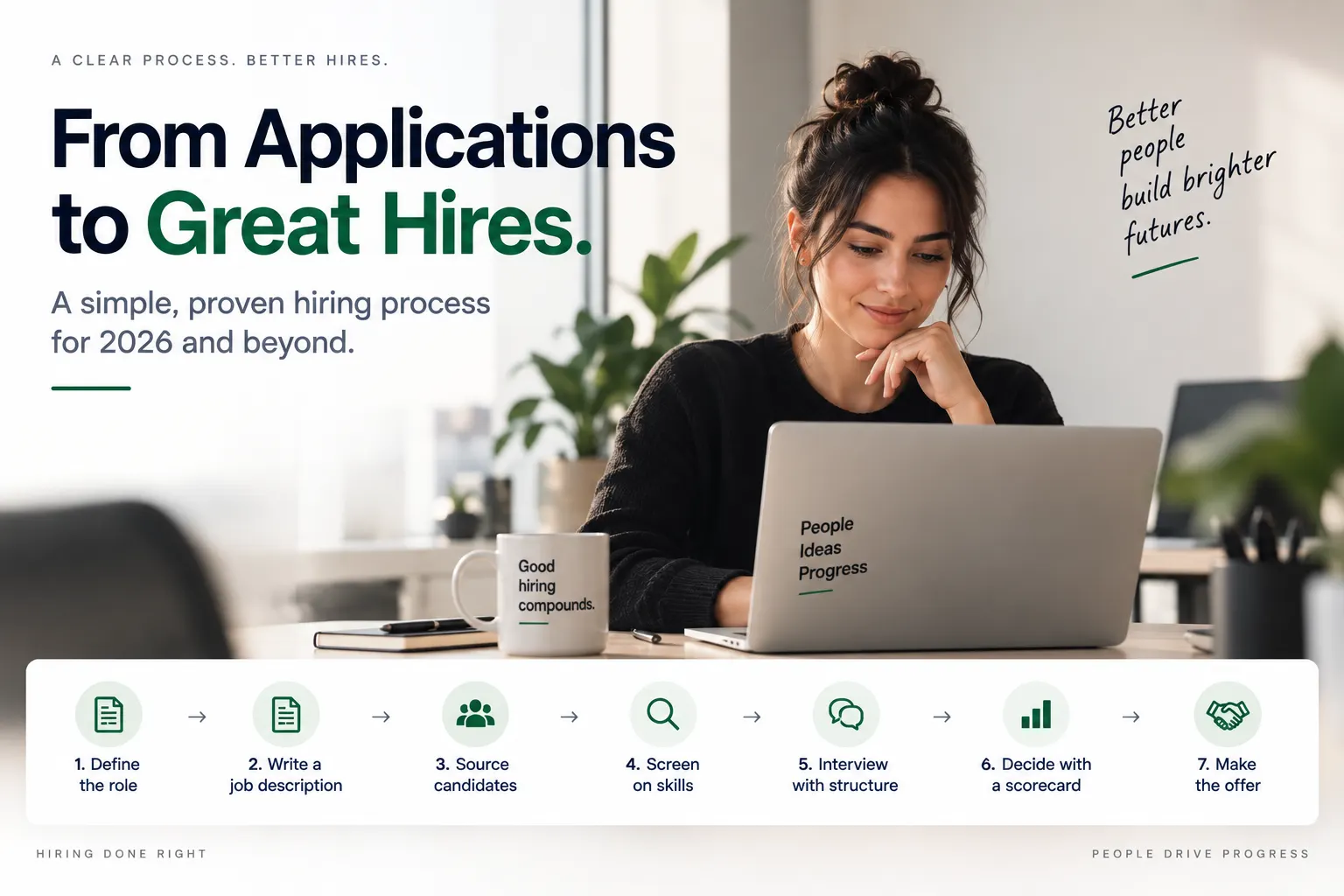
- The seven core stages: define the role, write the job description, source, screen on skills, interview in a structured way, decide with a scorecard, and make the offer.
- The biggest single upgrade is screening on evidence of skill early, so weak candidates are caught before they eat your interview time.
- Structure and consistency at every stage are what make hiring fast, fair, and defensible.
- Navero handles the sourcing and skills-screening stages in one place, and keeps a human making the decision.
Why you need a defined hiring process
Most hiring pain comes from not having a real process. When every hire is improvised, you get slow decisions, inconsistent interviews, gut-feel calls, and strong candidates who drift away while you dither. You also get bias, because an undefined process leaves too much to instinct.
A defined process fixes this in four ways. It is faster, because everyone knows the next step. It is fairer, because every candidate is treated and scored the same way. It produces better hires, because decisions rest on evidence rather than impressions. And it is repeatable, so each hire teaches you how to run the next one better.
You do not need something heavy or bureaucratic. You need a clear, consistent set of stages. Here they are.
Step 1: Define the role and what success looks like
Before anything else, get specific about what you actually need. Write down the three or four outcomes this person must deliver in their first six months, and the handful of skills the role genuinely requires. This becomes your scorecard, the standard you will measure every candidate against.
Skipping this step is the root of most bad hires, because you cannot assess against a target you never set. A clear scorecard keeps the whole process honest.
Step 2: Write a job description that filters and sells
Your job description does two jobs: it attracts the right people and repels the wrong ones. Be specific about the outcomes and skills, and honest about the role and stage. A vague, everything-to-everyone ad draws a flood of mismatched applications. Our guide to writing a job description covers the structure.
Step 3: Source candidates
Do not just post and pray. The strongest candidates are often not actively looking, so combine inbound applications with active sourcing. Widen the net beyond your immediate network so you are choosing from a real pool. Our guides to proven sourcing strategies and sourcing passive candidates go deeper, and AI sourcing can surface qualified people faster than inbound alone.
Step 4: Screen on skills, not resumes
This is the highest-leverage step, and where most processes go wrong. A resume and a keyword match are weak evidence, and AI now writes flawless resumes in seconds. Instead, put a short, role-relevant skills assessment early, so you filter on demonstrated ability. This catches weak candidates before they consume interview time and surfaces strong ones a resume would have hidden. It is the core idea behind skills-based hiring, and it is what makes everything downstream faster.
Step 5: Interview in a structured way
Once you have a skills-based shortlist, interview with structure. Ask every candidate the same core questions and score them on the same rubric, because structured interviews predict performance far better than free-flowing chats. Use the interview for judgment and fit, not to re-test skills you already measured. Our guide to running structured interviews without a recruiting budget shows how, and our scenario-based interview questions give you a starting set.
Step 6: Decide with a scorecard, not a gut feeling
Bring the evidence together and decide deliberately. Score each candidate against the scorecard you set in step one, have interviewers rate independently before discussing, and choose on the combined evidence rather than the loudest opinion in the room. Our guide to standardising interview scoring keeps this consistent, and evaluating candidates covers the wider decision.
Step 7: Make the offer and close
The process is not done until the candidate says yes. Move fast, make a warm verbal offer first, then a clear written one, and be ready to negotiate. A slow or cold offer at this stage loses the person you worked hard to find. Our guide to writing a job offer covers it, and a strong start continues into onboarding.
Keep improving the process
A hiring process is not set once. Track a few simple measures, like time-to-hire and quality of hire, and use them to find the stage that slows you down or lets weak hires through. Our guide to optimising your recruitment funnel stages helps you tune it over time. Each hire should make the next one sharper.
How long should a hiring process take?
There is no single right number, but faster is almost always better, because every extra day is a chance to lose a strong candidate to a quicker offer. For most roles, aiming to move from application to offer in a couple of weeks is a healthy target, and it is very achievable when a skills assessment does the early filtering for you.
The stages that tend to drag are the gaps between steps, not the steps themselves. A candidate does not disengage during a 45-minute interview. They disengage during the ten days of silence waiting to hear if they passed it. So the biggest speed lever is not rushing any single stage, it is closing the gaps: schedule the next step quickly, give feedback promptly, and make the decision without letting it drift. A tight process is also a signal to candidates that you are organised and serious, which helps you win the people you want.
Adapt the process to your size and roles
The seven stages stay the same, but the weight you put on each shifts with your situation.
A small team or a first hire should keep the process lean: a skills screen, one or two structured interviews, and a fast offer. You do not need five rounds, and a long process will lose candidates you cannot afford to lose. A larger company hiring at volume will lean harder on automated sourcing and screening to manage the flow, and add a panel or stakeholder round for senior roles.
Role level matters too. A junior hire needs a shorter process focused on potential and core skills. A senior or specialist hire justifies an extra round to test depth and stakeholder fit. The principle to hold onto is that you add stages for a specific reason, never out of habit or nervousness. If you cannot name what a stage is for, cut it.
Common mistakes to avoid
No scorecard. Without a defined target, every interviewer measures something different, and gut feel wins.
Screening on resumes. The weakest, most fakeable signal should not be your main filter. Test skills instead.
Unstructured interviews. Different questions for each candidate breaks comparability and lets bias in.
A slow process. Every delay loses strong candidates to faster offers. Tighten the gaps between stages.
Never reviewing it. A process you never measure is one you never improve. Track the basics and adjust.
How Navero powers your hiring process
Navero is built to run the heaviest stages of this process in one place. It sources qualified candidates, then screens and ranks them on verified skills rather than resume signals, so steps three, four, and the shortlist for step five are handled on evidence. Navero filters out roughly 60% of unqualified applications and cuts time-to-hire by up to 75% (based on customer data), which is where most of the speed in a good process comes from.
Two principles keep it fair. First, Navero surfaces and scores candidates on evidence and shows its reasoning, while a human makes the final decision. Second, that human-in-the-loop design keeps you aligned with the EU AI Act, NYC Local Law 144, and EEOC guidance as they tighten around automated hiring.
If you are building or fixing your hiring process, start with the stage that matters most. See how Navero's skills-based screening builds your shortlist on evidence.
The bottom line
A hiring process is not bureaucracy. It is the difference between hiring by luck and hiring by design. The seven stages are simple: define the role, write the description, source, screen on skills, interview with structure, decide with a scorecard, and close the offer. What makes them work is consistency, evidence over gut feel, and speed. Get the skills-screening stage right and everything downstream gets faster and fairer, because you spend your time only on candidates who can actually do the job. Build the process once, measure it, and improve it with every hire, and you turn one of the riskiest things a company does into something repeatable and reliable.
Frequently Asked Questions
What are the steps in a hiring process? Define the role and a scorecard, write a job description, source candidates, screen on skills, run structured interviews, decide against the scorecard, and make the offer, followed by onboarding. Consistency at each stage is what makes the process work.
What is the most important step in the hiring process? Screening on skills early. It is the highest-leverage stage, because testing demonstrated ability filters out weak candidates before they consume interview time and surfaces strong ones a resume would hide, which improves every step that follows.
How do I make my hiring process faster? Front-load a skills assessment so you interview fewer, stronger candidates, give each stage a clear purpose, tighten the gaps between stages, and use a shared scorecard so you decide with confidence instead of adding rounds.
How do I reduce bias in my hiring process? Define a scorecard up front, screen on job-relevant skills, ask every candidate the same structured questions, and have interviewers score independently on a consistent rubric. Structure and evidence are what remove most gut-feel bias.
Do I need software to run a good hiring process? Not for every stage, but the sourcing and skills-screening steps are far faster and fairer with a tool that scores candidates on evidence. The rest, like structured interviews and a scorecard, you can run with discipline and a simple rubric.
How often should I review my hiring process? Revisit it regularly, and at least after any hire that went badly or any role that took too long to fill. Track time-to-hire and quality of hire, look for the stage that consistently slows you down or lets weak candidates through, and adjust. A process you never review is one you never improve.