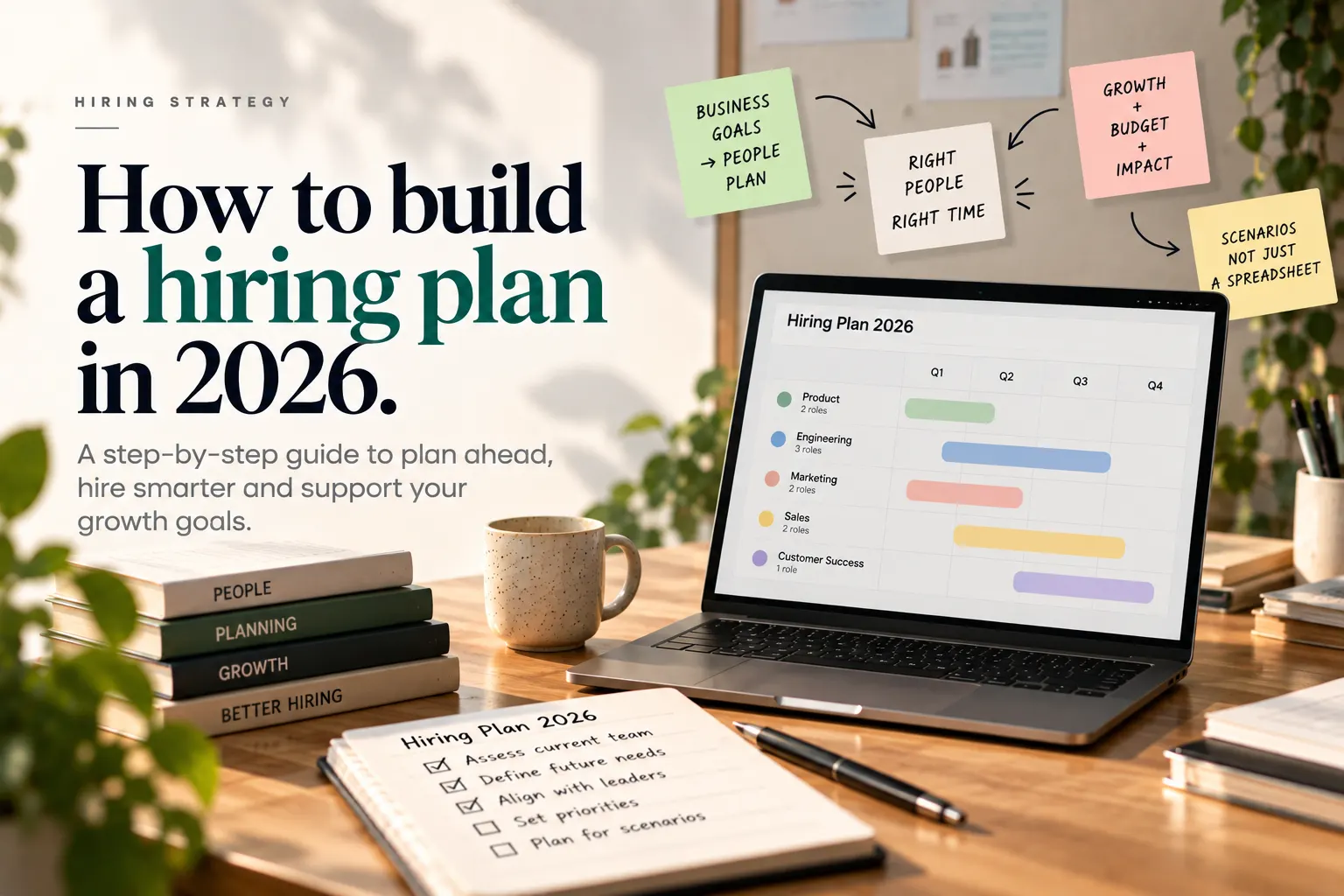
How to Build a Hiring Plan in 2026: A Step-by-Step Guide
Key Takeaways (TL;DR)
- A hiring plan turns reactive, panic hiring into a calm roadmap: who you need, when you need them, and how you will pay for it. It is the difference between hiring ahead of growth and always scrambling to catch up.
- Start from the business plan, not a wish-list, so every role you plan for maps to a real goal.
- Account for both net-new roles and backfills, since normal attrition creates hiring you can predict.
- Turn each gap into an action with an owner, a target date, and a budget, so the plan actually drives hiring.
- Build best, worst, and expected scenarios, and refresh the plan quarterly, because reality never follows a spreadsheet exactly.
What a hiring plan is, and why you need one
A hiring plan, sometimes called headcount or workforce planning, maps the roles you will hire over a period against your business goals and your budget. It answers three questions clearly: who you need, when you need them, and how you will fund them. Done well, it also covers whether each gap is best filled by hiring, promoting, training, or restructuring, not just by adding people.
Without a plan, hiring is reactive. A team suddenly cannot cope, a manager raises an urgent request, and you scramble to fill a role you should have seen coming months ago. Rushed hiring is worse hiring, and it is more expensive, since urgency pushes teams to lower the bar and pay a premium. A hiring plan replaces that scramble with foresight, so you recruit ahead of the need rather than behind it. Here is how to build one, step by step.
Step 1: Assess your current workforce
Start with a clear picture of what you already have. List your current headcount by team and role, and pull the numbers that reveal pressure: your turnover rate, your average time to hire, and where you have skills gaps or roles at risk. Note the teams with high attrition or where one departure would hurt most. This honest baseline tells you where you are stretched today, which is often where next year's hiring really needs to go, and it stops you from planning in a vacuum.
Step 2: Define what the business will need
Now look forward. Take your company's plan for the next twelve months and translate it into people. What is each team trying to achieve, and what skills and headcount will that take? Be specific about two kinds of roles. Net-new roles come from growth, new products, or expansion. Backfills come from expected attrition, the predictable reality that some people will leave and need replacing. Many teams plan only for growth and are then blindsided by the backfills, so count both. The output of this step is a rough list of the roles the business will need, and why.
Step 3: Align with leaders and finance
A hiring plan built in isolation is fiction. Sit down with team leaders to understand upcoming projects, expansion, and capability gaps, and to agree which roles are genuinely critical and when they are needed. Then align with finance on the budget, because every planned hire has a cost, and revenue targets or funding constraints shape how much hiring is realistic. This is also where you sequence roles: which hires unlock others, which are urgent, and which can wait. A plan that both the business and finance have signed off on is one that will actually be funded and followed.
Step 4: Run a gap analysis and assign actions
Compare where you are against where you need to be, team by team, and each difference is a gap. For every gap, decide the resolution path, since hiring is not always the answer. Some gaps are best closed by promoting or developing someone internally, some by restructuring how work is done, and some genuinely need a new external hire. For each one, assign an owner, set a target start date, and estimate the budget. This is the step that turns a plan from a document into action, because a gap with no owner and no date is just a wish.
Step 5: Sequence and prioritise the roles
You cannot hire everyone at once, and you should not try. Order the roles by priority and by dependency. Some hires are urgent because a team is already breaking, some unlock other work or other hires, and some are important but can wait a quarter. Be honest about your own capacity to hire well, since a team that tries to fill ten roles at once tends to fill all of them badly. A realistic sequence, spread across the year, protects the quality of each hire and keeps your recruiting effort sane.
Step 6: Plan for scenarios, not certainty
No plan survives contact with reality, so do not build just one. Sketch three versions: an expected case, a best case where growth or funding is strong and you hire more, and a worst case where you slow or freeze hiring. For each, know your headcount and budget. This scenario planning means that when the year turns out different from the forecast, and it will, you already know how to respond instead of starting from scratch. It turns your plan from a brittle prediction into a flexible playbook.
A simple hiring plan template
Here is a lightweight structure you can copy into a spreadsheet.
Role | Team | New or backfill | Priority | Target start | Resolution (hire/promote/train) | Owner | Est. budget |
|---|---|---|---|---|---|---|---|
e.g. Senior Engineer | Product | New | High | Q1 | Hire | Eng Lead | [cost] |
e.g. Support Rep | CX | Backfill | Medium | Q2 | Hire | CX Lead | [cost] |
Add columns for status and notes as roles move through your pipeline. The point is not a fancy tool, it is one shared view everyone trusts.
Step 7: Track, review, and refresh quarterly
A hiring plan is a living document, not a January ritual you file away. Business priorities shift, people leave unexpectedly, and budgets change, so review the plan every quarter. Check what you have hired against the plan, update the gaps, and adjust the sequence and scenarios to match reality. Tracking your plan against actual hiring also improves next year's forecast, because you learn where you consistently under- or over-estimate. A plan that is refreshed regularly stays useful all year, while one that is written once and forgotten is out of date by spring.
Common mistakes when building a hiring plan
Planning only for growth. Forgetting backfills for normal attrition leaves you blindsided by hiring you could have predicted. Plan for both.
Building it in a silo. A plan HR writes alone, without leaders and finance, will not be funded or followed. Align early.
Assuming hiring is the only answer. Some gaps are better closed by promoting, training, or restructuring. Decide the path per gap.
One rigid forecast. Reality never matches a single prediction. Build best, expected, and worst-case scenarios.
Setting it and forgetting it. A plan written once is stale within months. Refresh it quarterly against what actually happened.
How Navero helps you deliver the plan
A hiring plan tells you which roles to fill and when. Navero helps you actually fill them, faster and with less risk, which is what keeps a plan on schedule. It sources qualified candidates and screens them on verified skills, so when a planned role comes up, you can move from open seat to evidence-based shortlist quickly instead of starting a slow search from scratch.
Navero filters out roughly 60% of unqualified applications and cuts time-to-hire by up to 75% (based on customer data), which directly protects your planned start dates, and it shows the reasoning behind every score with a human making the final call. Faster, more reliable hiring means your plan is a schedule you can actually keep, not an aspiration. For the wider view, pair this with our guide to building a hiring process and the true cost of a bad hire you are trying to avoid.
Turning a hiring plan into hires? See how Navero's skills-based screening helps you fill planned roles on time, on evidence.
The bottom line
A hiring plan turns hiring from a series of emergencies into a roadmap you control. Start from the business plan so every role maps to a real goal, count both new roles and the backfills that attrition guarantees, and align with leaders and finance so the plan is funded and followed. Turn each gap into an action with an owner, a date, and a budget, sequence the roles by priority and dependency, and build best, expected, and worst-case scenarios so surprises do not derail you. Then refresh it quarterly. Do that, and you hire ahead of your growth instead of scrambling behind it, which means better hires, lower costs, and teams that are staffed before they break rather than after.
Frequently Asked Questions
What is a hiring plan? A hiring plan, also called headcount or workforce planning, maps the roles you intend to fill over a period against your business goals and budget. It answers who you need, when you need them, and how you will fund them, and it also decides whether each gap is best filled by hiring, promoting, training, or restructuring rather than automatically adding a new person.
How do you create a hiring plan? Assess your current workforce and its pressure points, translate the next year's business goals into the roles and skills each team will need, align with leaders and finance, run a gap analysis and assign each gap an owner, date, and budget, sequence the roles by priority, and build best, expected, and worst-case scenarios. Then review and refresh it every quarter.
What should a hiring plan include? At minimum, the roles to be filled, which team each belongs to, whether it is a new role or a backfill, its priority, a target start date, the resolution path, an owner, and an estimated budget. Strong plans add turnover and time-to-hire data, a scenario for different growth cases, and a regular review cadence so the plan stays current.
What is the difference between a hiring plan and workforce planning? They overlap heavily and the terms are often used interchangeably. Workforce planning is the broader, longer-term practice of forecasting talent demand and supply and closing the gap through hiring, mobility, upskilling, or restructuring. A hiring plan is usually the nearer-term, hiring-focused output of that, the concrete list of roles you will recruit for, when, and at what cost.
How often should you update a hiring plan? At least quarterly. Business priorities shift, people leave unexpectedly, and budgets change through the year, so a plan written once in January is out of date within months. Reviewing it every quarter, checking actual hires against the plan and adjusting the gaps and scenarios, keeps it useful and steadily improves the accuracy of your future forecasts.