The Real Cost of a Bad Hire in 2026 (and How to Avoid It)
Key Takeaways (TL;DR)
- A bad hire is not a rounding error. It is one of the most expensive mistakes a team can make, and the cost is far higher than the recruiter fee and the salary you paid.
- Conservatively, a bad hire costs up to 30% of the employee's first-year salary (US Department of Labor).
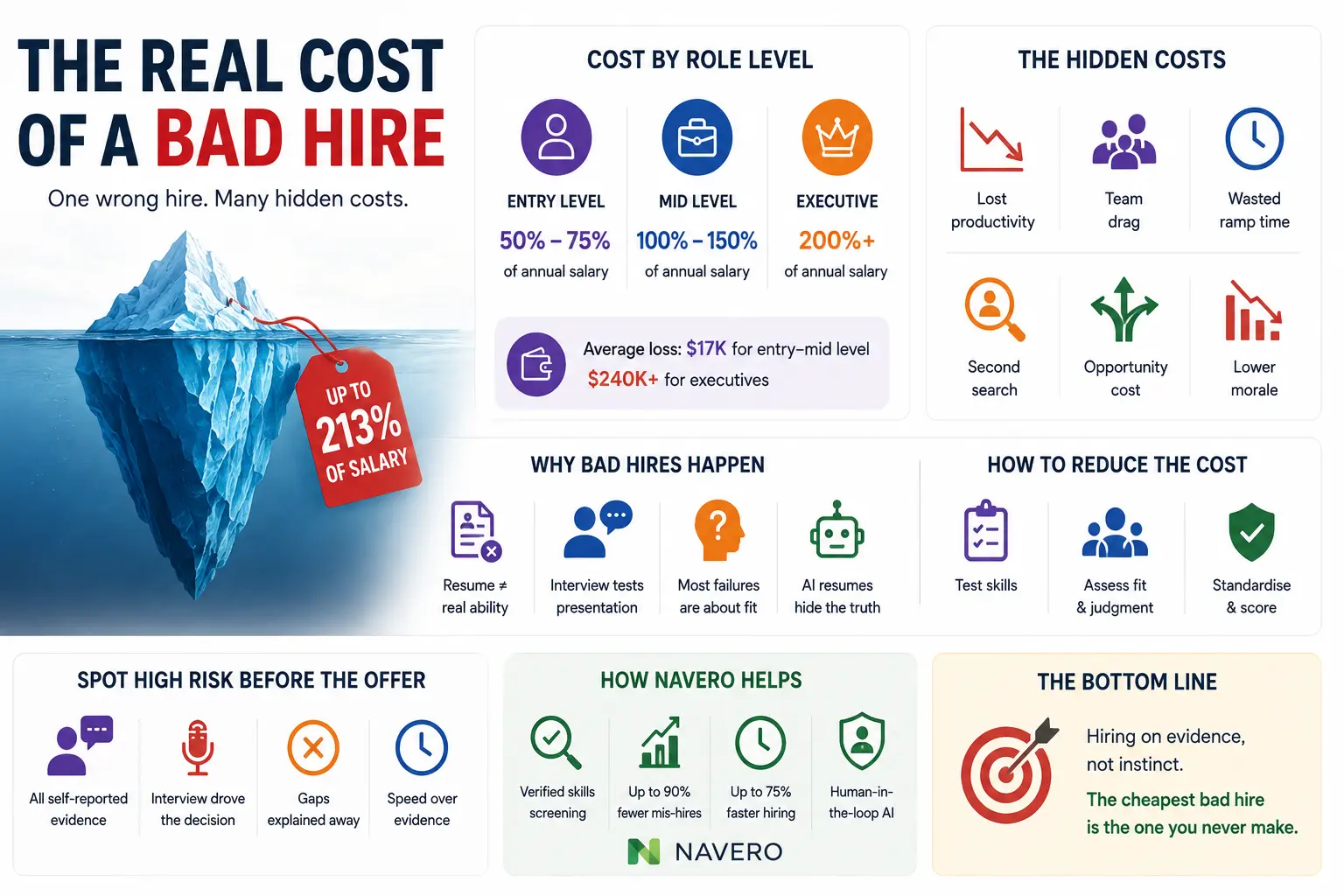
- More completely, it runs 50% to 75% of salary for entry roles, 100% to 150% for mid-level, and over 200% for executives (SHRM).
- Nearly half of new hires fail within 18 months, and most fail for attitude and fit, not lack of skill (Leadership IQ).
- The cheapest bad hire is the one you never make. Navero verifies skills before the offer and reduces mis-hires by up to 90% (based on customer data). It scores candidates on evidence; your team decides.
What counts as a bad hire?
A bad hire is anyone who does not work out: someone who cannot do the job, does not fit the team, or leaves quickly and forces you to start over. It is not always obvious at the offer stage, which is exactly the problem. A strong resume and a good interview can hide a bad hire until they are on the payroll.
The cost is not one number. It is a stack of costs that build up from the moment you decide to hire the wrong person.
What a bad hire actually costs
Start with the conservative floor. The US Department of Labor puts the cost of a bad hire at up to 30% of the employee's first-year salary, and that figure mostly captures direct replacement costs (Inop, citing DOL and SHRM).
The more complete picture comes from SHRM, which scales the cost by the level of the role:
Role level | Cost of a bad hire (share of annual salary) |
|---|---|
Entry-level or hourly | 50% to 75% |
Mid-level technical or managerial | 100% to 150% |
C-suite and executive leadership | 200% to 213% |
In cash terms, CareerBuilder's employer surveys put the average bad hire loss at around $17,000 across entry to mid-level roles, and $240,000 or more for executive missteps. The more senior and specialised the role, the more a wrong hire costs, because more depends on them and more breaks when they fail.
A worked example
Put real numbers on it. Take a mid-level hire on a £50,000 salary. At SHRM's mid-level range of 100% to 150% of salary, a bad hire in that seat costs roughly £50,000 to £75,000 once you add replacement, lost productivity, and the drag on the team. Now scale up. A senior hire on £100,000, at the executive range of 200% or more, can cost £200,000 or more when it fails. These are not worst cases. They are the standard multiples, which is why a single bad senior hire can quietly erase the savings a small company squeezed out of a whole year of careful budgeting elsewhere. The number is large because the failure touches everything the role was supposed to hold up.
The hidden costs that make it worse
The headline percentage is only the part you can invoice. The real damage sits in the costs that never show up on a purchase order.
Lost productivity. A struggling hire produces less, and the work they should be doing either stalls or lands on someone else.
Team drag. A weak or disruptive hire pulls down the people around them. Managers spend time managing the problem instead of building the business.
Wasted ramp time. Every week you invest in onboarding a bad hire is a week you do not get back when they leave.
The second search. When the hire fails, you pay the recruiting cost again, and the role sits open longer.
Opportunity cost. The strong candidate you passed over took another job. You do not just lose the bad hire, you lose the good one you could have made.
Stack these on top of the SHRM percentages and it is clear why a single senior mis-hire can quietly cost a small company a serious share of its runway.
Why bad hires happen
If bad hires are this expensive, why do they keep happening? Because most hiring still runs on the wrong evidence.
Nearly half of new hires fail within 18 months, and, according to Leadership IQ's long-running study, about 89% of them fail for attitudinal reasons, such as poor fit, low motivation, or an inability to be coached, rather than a lack of technical skill. In other words, the resume and the technical interview, which is what most processes lean on, screen for the thing that is least likely to be the problem.
The pattern is familiar. Hiring trusts self-presentation: a polished CV, a confident interview, a good reference. None of those reliably predict whether the person can actually do the job and work well doing it. And with AI now writing flawless resumes, the resume predicts even less than it used to.
How to reduce the cost of a bad hire
You cannot eliminate hiring risk, but you can move the decision onto better evidence. Three shifts do most of the work.
Test skills, do not take them on faith. A work sample or skills assessment shows whether a candidate can do the job before you hire them, which is the single strongest predictor you can get.
Assess fit and judgment deliberately. Since most failures are about attitude and fit, build structured, consistent evaluation of those into the process rather than leaving them to gut feel.
Standardise the process. Score every candidate on the same evidence. Consistency reduces both mis-hires and bias, and it makes your decisions defensible.
The theme is simple. The cheapest bad hire is the one you never make, and prevention lives at the screening stage, not the exit interview.
Common mistakes that lead to bad hires
Screening on the resume. A polished CV predicts less than ever now that AI writes them in seconds. It is the cheapest signal to fake and the weakest to trust.
Over-weighting the interview. A confident, articulate candidate is not the same as a capable one. Interviews test presentation more than performance.
Skipping the skills test. If you never watch the candidate do the actual work, you are guessing, and guessing is what produces the failures on fit.
Rushing to fill. An empty seat feels urgent, so teams lower the bar. A bad hire costs far more than a slightly longer search.
No consistent scorecard. When every interviewer weighs different things, gut feel decides, and gut feel is where both bias and mis-hires live.
How to spot the risk before you make the offer
Prevention is easier when you know what a high-risk hire looks like at the decision stage. A few tells recur:
The evidence is all self-reported. Everything you know about the candidate comes from them: their resume, their answers, their own account of past results. Nothing has been demonstrated.
The interview carried the decision. The candidate interviewed well, but you never watched them do the actual work. Charm is not competence.
The gaps are being explained away. A missing skill is waved off as something they will "pick up quickly," on a timeline nobody has tested.
Speed is driving the call. The seat has been open too long and the pressure to fill is outweighing the evidence.
None of these means reject. Each one means verify before you commit, because that is far cheaper than discovering the truth on the payroll.
How Navero helps you avoid bad hires
Navero is built to attack exactly this cost. It screens and ranks candidates on verified skills rather than resume signals, so weaker hires are caught before an offer rather than after they have started. That is why Navero helps teams reduce mis-hires by up to 90% and cut time-to-hire by up to 75% (based on customer data).
You can put real numbers on your own exposure with the Navero cost calculator, then use AI screening to lower it by hiring on evidence.
Two principles keep it fair. First, Navero scores and surfaces candidates and shows the reasoning behind each score, and a human recruiter or hiring manager makes the final decision. Second, that human-in-the-loop design keeps you aligned with the EU AI Act, EEOC-style guidance, and similar rules as they tighten around automated hiring.
Related reading: how to calculate cost per hire and how to evaluate candidates in your screening process.
The bottom line
A bad hire is one of the most expensive mistakes a team makes, and almost all of the cost is avoidable. The percentages are large, but they are also a choice, because they are what you pay for trusting a resume and an interview over evidence. Move the decision onto verified skills and structured judgment, and you make fewer mis-hires, which is the only thing that actually lowers the number. Everything else, the calculators and the benchmarks, just tells you how much the last mistake cost. The cheapest bad hire, every time, is the one you never make.
Frequently Asked Questions
How much does a bad hire cost? Conservatively, up to 30% of the employee's first-year salary (US Department of Labor). More completely, SHRM puts it at 50% to 75% of salary for entry roles, 100% to 150% for mid-level, and over 200% for executives, once lost productivity and rehiring are included.
Why is a bad hire so expensive? Because the cost is a stack: the direct replacement expense, plus lost productivity, team disruption, wasted onboarding time, a second recruiting cycle, and the strong candidate you passed over.
Why do most bad hires happen? Most new hires who fail do so for attitude and fit reasons, not a lack of technical skill (Leadership IQ). Traditional resume-and-interview screening tests for the wrong thing, and AI-written resumes have made the resume an even weaker signal.
How can employers reduce bad hires? Test skills with work samples, assess fit and judgment deliberately, and score every candidate on the same evidence. Prevention at the screening stage is far cheaper than fixing a mis-hire later.
What is the cost of a bad executive hire specifically? SHRM estimates 200% to 213% of annual salary, and CareerBuilder surveys put executive missteps at $240,000 or more, because more depends on a senior hire and more breaks when they fail.