How to Calculate Time to Hire: Formula + 2026 Industry Benchmarks
Key Takeaways (TL;DR)
- Speed matters in hiring, but measuring time to hire correctly determines whether your recruitment process truly competes for top talent.
- Time to hire tracks days from candidate entry to offer acceptance - not from job posting to hire like time to fill. This distinction reveals how efficiently you move qualified candidates through your pipeline.
- Industry benchmarks vary wildly: hospitality fills roles in 14 days while software engineering takes 95+ days - comparing your metrics against the wrong benchmark creates unrealistic expectations and poor strategic decisions.
- Calculate by tracking calendar days from pipeline entry to acceptance date - then average across multiple hires to identify patterns and improvement opportunities within your organization.
- Streamlined processes reduce time to hire by 25-60% without quality loss - through focused interview rounds, automated screening, pre-built talent pipelines, and efficient scheduling systems.
- Hiring speed directly affects candidate perception: 75% judge employers by process speed - while top performers exit the market within 10 days of beginning their search.
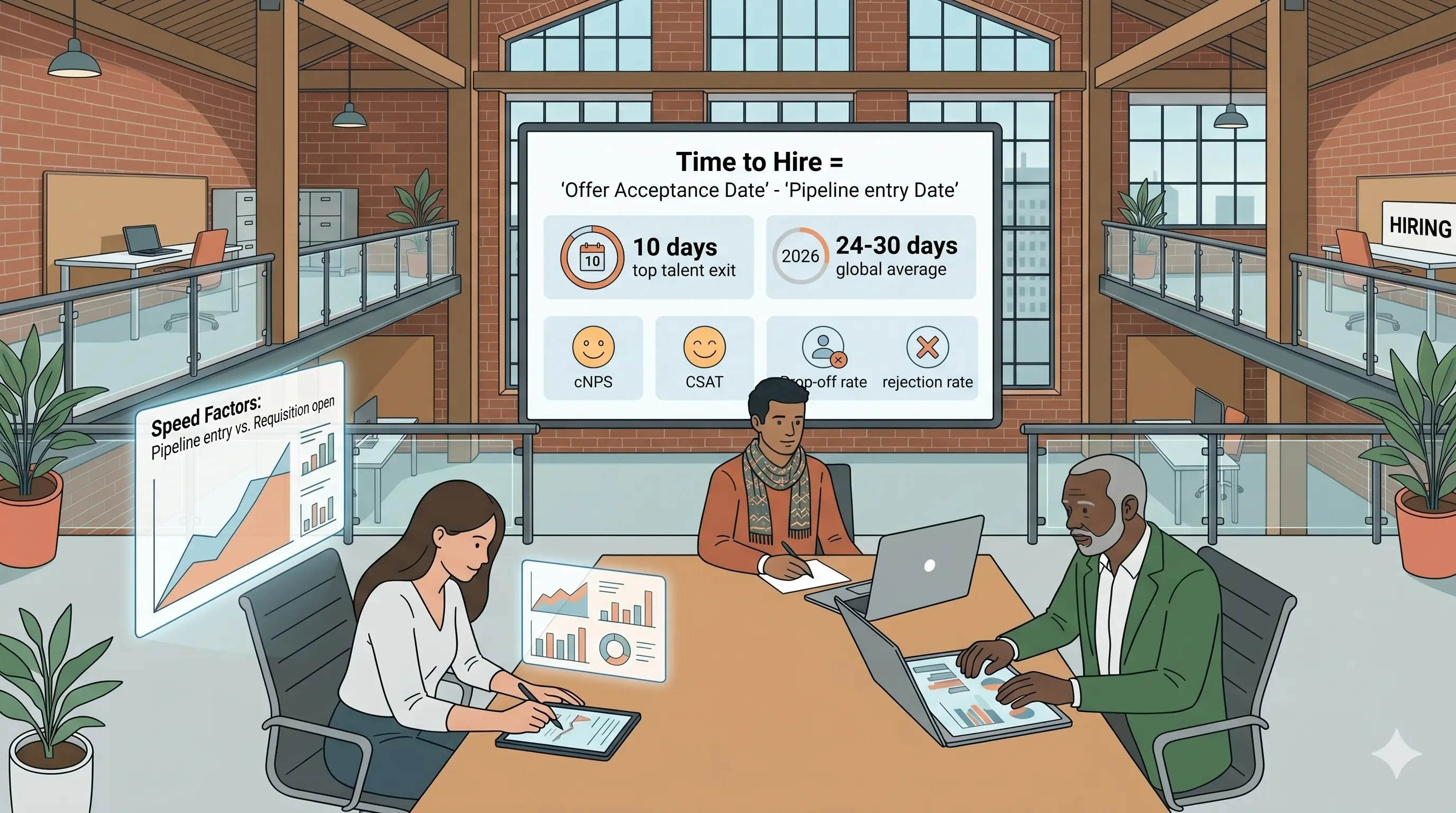
Time to hire now averages 24 to 30 days globally in 2026, yet companies run 42% more interviews per hire than in 2021 [6]. The pressure to hire faster is real. Reducing time in the interview stage by just five days can improve candidate Net Promoter Score by 20% [5]. Speed matters for both business efficiency and candidate experience. This guide breaks down how to calculate time to hire accurately, compares time to hire vs time to fill, and provides 2026 industry benchmarks. Most importantly, it shows hiring teams how to reduce time to hire without compromising quality.
What is Time to Hire?
Time to hire measures the number of days between when a candidate enters the hiring process and when they accept a job offer [4] [1]. This recruitment metric applies only to the final candidate who takes the position [4]. The clock starts ticking when the successful hire applies, gets sourced, or receives a referral, then stops when they formally accept the offer [1].
Time to Hire vs Time to Fill
The distinction between time to hire vs time to fill centers on when measurement begins. Both metrics share the same endpoint: the date a selected candidate accepts the job offer [4].
Time to hire starts counting from when the eventual hire enters the recruitment pipeline [4] [2]. Time to fill begins earlier in the process, tracking from when a job requisition opens or when a position is first posted [8].
A job posted on January 1 receives an application from the successful candidate on January 10, who then accepts the offer on January 31. Time to fill equals 31 days, while time to hire equals 22 days [4]. Time to fill captures the entire recruitment timeline and gives insight into overall process efficiency [4]. Time to hire focuses specifically on one candidate's journey through the recruitment funnel [4][4].
Why Time to Hire Matters
This metric reveals critical information about talent acquisition performance:
Recruitment Efficiency: Time to hire shows how quickly teams spot qualified candidates, move applicants through interviews, and make informed decisions [1]. Long hiring timelines often signal unnecessary delays like slow interview scheduling, feedback bottlenecks, or overcomplicated approval chains [1].
Candidate Experience: Over 75% of candidates associate hiring speed with how much an employer values them [1]. 57% of job seekers lose interest when the process drags on [1]. A streamlined time to hire demonstrates respect for candidates' time and signals organizational decisiveness [1].
Competitive Advantage: Top candidates leave the market within 10 days [2]. Faster processes increase the chances of securing preferred candidates before competitors do [1]. A 2023 survey revealed that 83% of hiring managers missed a good hire, with 29% attributing that loss to excessive time to hire [7].
Cost Reduction: Every day a position remains unfilled affects productivity, morale, and revenue [1]. Longer hiring timelines increase coverage costs through temporary staff, overtime, and lost output [1]. Tracking time to hire identifies delays that drive these hidden expenses [1].
Strategic Workforce Planning: This metric helps organizations forecast how long it takes to fill roles once candidates enter the pipeline [1]. The data supports project planning, seasonal hiring preparation, and agile resource allocation across departments [1].
Continuous Improvement: Measuring time to hire consistently across departments establishes baselines for setting goals, testing new tools, and comparing against industry standards [1].
Common Mistakes When Measuring Time to Hire
Companies often confuse time to hire with time to fill, leading to inaccurate tracking [8]. Another error involves inconsistent start and end point definitions across different roles or departments [4]. Organizations must maintain uniform measurement criteria to ensure meaningful comparisons.
Prioritizing speed over quality presents another pitfall. Rushing the hiring process can result in poor cultural fits, which forces teams to restart recruitment within months [3]. High time to hire scores may indicate legitimate complexity in specialized roles rather than process inefficiency [7]. Energy and defense companies required 67 days on average to hire in 2022 due to specialized skill requirements [7].
How to Calculate Time to Hire: Step-by-Step Formula
Calculating time to hire requires three data points: when the successful candidate entered your pipeline, when they accepted your offer, and consistent tracking methods. The formula is simple. The accuracy depends on how rigorously you track these points.
The Basic Time to Hire Formula
Time to Hire = Offer Acceptance Date - Date Candidate Entered Pipeline [4] [5] [6]
A candidate applies on March 19 and accepts your offer on April 4. Time to hire equals 16 days [7]. The math is straightforward. The challenge lies in defining consistent start and end points across all your hires.
Step 1: Define Your Start Point
The start point marks when your eventual hire first entered your recruitment process. This could be their application date, when a recruiter sourced them, or when they received a referral [6].
Choose one method and stick with it across every role. A candidate who applied on day 10 after you posted the job on day 1 has a start point of day 10, not day 1 [5]. Consistency here determines whether your data reveals meaningful patterns or just noise.
Step 2: Define Your End Point
The end point is always when the candidate formally accepts your job offer [4] [132]. Not when you send the offer. Not when they verbally agree. When they officially accept.
Candidates often need several days to review terms and make decisions. An offer sent on the 25th but accepted on the 28th has an end point of the 28th [5]. Those three days matter for accurate measurement.
Step 3: Track Calendar Days
Count all calendar days between start and end points. Someone who applied October 1 and accepted October 20 took 19 days to hire [6].
Some organizations track working days instead of calendar days [8]. Calendar days provide a clearer picture of actual candidate wait time. Weekends and holidays don't pause the candidate's experience of your process.
Step 4: Calculate Your Average
Individual calculations show performance for specific roles. Average time to hire reveals organizational trends. Add up time to hire for each position filled during your measurement period, then divide by total hires [4] [7].
Five hires with times of 15, 12, 16, 8, and 17 days: (15 + 12 + 16 + 8 + 17) ÷ 5 = 13.6 days [4]. Calculate averages by department, role type, or company-wide [9] [8]. Each view tells a different story about your recruitment performance.
What to Include and Exclude in Your Calculation
Fast, transparent processes signal respect for candidates' time [9]. Slow processes increase drop-offs and damage your employer brand. Speed matters, but accurate measurement matters more.
Track only the candidates who actually got hired. Failed hires tell you about your screening process, not your time to hire. Include every step from pipeline entry to acceptance. Exclude time before the successful candidate entered your system.
2026 Industry Benchmarks for Time to Hire
Industry benchmarks show dramatic variation in hiring speed across sectors. The overall average time to hire sits at 44 days according to multiple industry analyses [10] [8]. National averages for time to fill reach between 63-68 days as of January 2026 [11]. The gap between these metrics reflects the difference between candidate journey time and total vacancy duration.
Average Time to Hire Across Industries
Cross-industry data from 2026 reveals distinct patterns. Hospitality leads with the shortest timelines at 14 days [11] [12], while energy and defense sectors require 67+ days [11]. Professional services fall in the middle at 47 days [11].
Organizations hiring at scale face additional complexity. Recruiters now handle 93% more applications than in 2021 while teams have shrunk by 14% [13]. Time to fill increased progressively in Europe from 44.39 days in 2022 to 62.24 days in 2025 [14].
Technology and Software Engineering
Software engineering positions present extended timelines. The average time to hire a software engineer reached 95 days in 2026 [15], far exceeding the cross-industry standard. Traditional hiring methods stretch even longer, up to 126 days, while senior roles demand three to six months [15].
Technical positions remain unfilled 50% longer than non-technical roles. Typical vacancies last 51+ days compared to 36 days for other fields [15]. Junior roles fill in 15-25 days, mid-level positions take 30-45 days, and senior or staff-level roles require 60-90+ days [16]. The technology and media sector averages 39 days according to alternative measurements [11].
Healthcare and Life Sciences
Healthcare hiring spans 35 to 50 days due to licensing, credentialing, and background verification requirements [17]. Another analysis places healthcare time to fill at 56 days [11], while pharma and life sciences average 44 days [11].
Despite receiving the lowest applicants per hire at roughly 40 candidates, healthcare maintains the highest offer rate at 2% [18]. Technology companies show an offer rate of just 0.66% [18].
Retail and Hospitality
These sectors demonstrate the fastest recruitment cycles. Retail averages 38 days for time to fill [11], though time to hire benchmarks sit at 18 days [12]. Hospitality matches this speed at 14 days [11].
The combination of high turnover, lower skill barriers, and seasonal urgency drives these compressed timelines [17]. Retail hiring occurs 34% faster than the global median of 38 days [18].
Financial Services
Financial services time to hire often exceeds 60+ days [10]. Investment banking requires approximately 60 days [11], while broader financial services average 35-45 days [17] [19].
Compliance screening and regulatory checks extend these timelines [17]. Multi-stage interviews, complex assessments, and stakeholder alignment further slow the process in fintech and quantitative trading firms [10].
Manufacturing
Manufacturing roles average 40-55 days to fill [17], with specialized skill requirements and safety certifications driving longer searches. The median time to hire reaches 55 days, 45% longer than the global median [20].
Engineering positions specifically require 62 days [11]. Manufacturing takes 45% more time than the global standard, potentially reflecting difficulty sourcing specialized skill sets for critical roles [18].
Factors That Impact Your Time to Hire
Several organizational and market forces create the wide variation in time to hire across companies and sectors. Recognizing these variables allows hiring teams to set realistic expectations and spot improvement opportunities.
Role Level and Complexity
Senior positions demand longer decision-making processes due to additional interview rounds, assessments, and stakeholder alignment [1]. Specialized roles extend timelines considerably. Energy and defense companies required 67 days on average in 2022, with expectations for continued growth [7]. Tech and media companies achieved the shortest timelines at 20 days [7].
Niche skill requirements create narrower candidate pools. When companies need cutting-edge technology expertise or rare certifications, identifying suitable candidates takes significantly longer [21]. The complexity is unavoidable, not inefficient.
Recruiter Bandwidth and Volume Pressure
Recruiter capacity directly determines hiring speed. The Society for Human Resource Management recommends 15 to 20 requisitions per recruiter [22]. Overloaded teams struggle to move candidates efficiently through pipelines [22]. Days become weeks [22].
High-volume environments face distinct pressures. Organizations like BT Group hire 6,500 to 12,000 people annually, experiencing slower response times as scale increases [23]. Survey data shows 60% of companies experienced increased time to hire in 2024, up from 44% in 2023 [24].
Geographic and Market Dynamics
Location shapes how quickly positions fill. Dense urban areas provide access to larger talent pools, enabling faster fills [21]. Rural regions present qualification challenges, extending timelines [21].
Labor market conditions matter. Talent shortages or surpluses in specific industries create significant regional variation [21]. High demand periods in technology or healthcare make qualified candidates scarce [21].
Channel Performance Varies Dramatically
Different recruitment channels produce vastly different efficiency rates. Job boards require 74 applications per hire [25]. Career sites perform better at 46 applications per hire [25]. Internal mobility needs only six applications per hire [25]. Talent relationships prove most efficient at four applications per hire [25]. Referrals require 10 applicants per hire [25].
Organizations that track channel performance can redirect resources toward methods producing faster, higher-quality results.
How to Reduce Time to Hire Without Sacrificing Quality
Cutting time to hire requires systematic process changes, not shortcuts that compromise candidate quality. The most effective organizations achieve faster hiring cycles through targeted improvements across five key areas.
Streamline Your Interview Process
Unnecessary interview rounds create the biggest bottleneck in most hiring processes. Companies that eliminate redundant stages reduce time to hire by 25% while maintaining assessment quality [26]. Panel interviews compress multiple evaluations into single sessions without sacrificing depth.
Structured interviews with consistent, role-specific questions enable faster candidate comparisons [26]. Clear scorecards eliminate lengthy post-interview debates about unclear impressions [19]. When interviewers know exactly what they're evaluating, decisions happen faster.
Use AI-Powered Screening Tools
Manual resume screening devours recruiter time unnecessarily. Automating this phase reduces time to hire by up to 50% without compromising quality [26].
AI-powered platforms scan and parse resumes instantly, identifying qualified candidates based on predefined criteria [27]. These systems use semantic matching to catch qualified applicants even when resume wording differs from job descriptions [28]. AI screening processes high application volumes while maintaining consistent evaluation standards [29].
The key difference: AI doesn't get tired, distracted, or inconsistent after reviewing the hundredth resume.
Build Talent Pipelines Before You Need Them
Organizations with active talent pipelines reduce time to hire by 40% by tapping into pools of pre-screened candidates [26]. Companies with mature pipelines fill positions 2-3 times faster than those starting from scratch [30].
Maintaining a CRM system to engage passive candidates ensures qualified professionals stay warm for future opportunities [26]. Pre-qualified pipeline candidates cut hiring timelines by 60% compared to cold outreach [31].
The best hiring teams recruit continuously, not reactively.
Improve Scheduling Efficiency
Interview scheduling delays add 3-5 days to every hire [19]. Automated scheduling tools eliminate calendar coordination headaches by finding available slots instantly [32].
Self-scheduling links allow candidates to book interview times directly, removing email back-and-forth [33]. Automated reminders reduce no-shows and keep momentum flowing throughout the process [32].
Simple scheduling improvements often deliver the fastest time-to-hire gains.
Pre-Approve Headcount and Requisitions
Approval delays create unnecessary bottlenecks when hiring decisions are ready to move. Streamlined headcount approval processes route requests through structured paths rather than informal email chains [34].
Clear service level agreements with 48-hour review windows keep approvals moving [35]. Pre-approval prevents mid-process budget surprises that stall hiring decisions [34].
The fastest-hiring organizations remove friction from their own internal processes first.
Conclusion
All things considered, calculating time to hire accurately gives hiring teams the visibility needed to compete for top talent. The formula itself is simple: measure days from when candidates enter the pipeline until they accept offers. The real challenge lies in reducing those timelines without sacrificing hire quality.
Organizations that streamline interview processes, leverage AI-powered screening, build talent pipelines, and improve scheduling efficiency consistently outperform competitors. Indeed, these strategies can cut time to hire by 25-60% while maintaining rigorous evaluation standards.
Track your metrics consistently, benchmark against your industry, and focus on removing bottlenecks rather than rushing decisions. Speed matters, but quality hires matter more. The best hiring teams achieve both.
FAQs
Q1. What formula should I use to calculate time to hire? Time to hire is calculated by subtracting the date a candidate entered your recruitment pipeline from the date they accepted your job offer. For example, if a candidate applied on March 19 and accepted an offer on April 4, your time to hire is 16 days. The key is to track calendar days consistently across all hires.
Q2. How can I calculate average time to hire for multiple positions? Add up the time to hire for each individual position filled during your measurement period, then divide by the total number of hires. For instance, if you filled five positions with hiring times of 15, 12, 16, 8, and 17 days, your average would be 13.6 days (68 total days ÷ 5 positions).
Q3. What's considered a good time to hire benchmark? The global average time to hire is approximately 24-30 days, though this varies significantly by industry. Hospitality and retail typically hire within 14-18 days, while specialized fields like software engineering can take 60-95 days. Compare your metrics against your specific industry rather than overall averages.
Q4. How is time to hire different from time to fill? Time to hire measures days from when your successful candidate entered the pipeline until they accepted the offer. Time to fill tracks from when you first posted the job opening until offer acceptance. If you posted a job on January 1, your hired candidate applied on January 10, and accepted on January 31, time to fill is 31 days while time to hire is 22 days.
Q5. How can I reduce time to hire without compromising candidate quality? Streamline your interview process by eliminating unnecessary rounds, use AI-powered screening tools to automate resume review, build talent pipelines before positions open, implement automated scheduling tools, and pre-approve headcount to avoid approval delays. These strategies can reduce time to hire by 25-60% while maintaining quality standards.
References
[1] - https://recruitera.ai/blog/how-to-reduce-time-to-hire
[2] - https://trends.pinpointhq.com/industry-time-to-hire
[3] - https://www.indeed.com/hire/c/info/time-to-fill-vs-time-to-hire
[4] - https://www.talenthub.eu/blog/time-to-hire-what-it-is-why-it-matters-and-how-to-reduce-it
[5] - https://resources.workable.com/tutorial/faq-time-to-fill-hire
[6] - https://www.hibob.com/blog/time-to-hire-and-time-to-fill/
[7] - https://www.visier.com/hr-metrics/time-to-hire/
[8] - https://www.bamboohr.com/resources/hr-glossary/time-to-hire
[9] - https://www.spotlightrecruitment.com/why-speed-matters-reducing-time-to-hire/
[10] - https://www.thomas.co/resources/type/hr-blog/time-hire-complete-guide
[11] - https://www.greenhouse.com/resources/glossary/what-is-time-to-hire
[12] - https://heartcount.com/data-driven-hr/time-to-fill-vs-time-to-hire/
[13] - https://www.linkedin.com/pulse/why-hiring-takes-so-long-fintech-financial-services-2025-greene-7xule
[14] - https://www.corporatenavigators.com/articles/recruiting-trends/the-average-time-to-fill-by-industry-in-2024/
[15] - https://www.talenthr.io/blog/time-to-hire-vs-time-to-fill/
[16] - https://www.gem.com/resource/recruiting-benchmarks
[17] - https://www.greenhouse.com/uk/recruiting-benchmarks
[18] - https://recruiter.daily.dev/resources/reduce-time-to-hire-software-engineering-roles/
[19] - https://talmatic.com/blog/hiring/average-time-to-hire-software-engineer/
[20] - https://curriculo.me/time-to-hire-2026/
[21] - https://ta.smartrecruiters.com/rs/664-NIC-529/images/Recruiting-Benchmarks 2025-2026.pdf?version=0&ref=blog.searchright.net
[22] - https://recruiterflow.com/blog/time-to-hire/
[23] - https://www.smartrecruiters.com/resources/article/manufacturing-benchmark-recruiting-metrics/
[24] - https://www.tempexperts.com/2024/09/27/factors-that-affect-time-to-hire/
[25] - https://blog.talentsforce.io/what-is-the-optimal-number-of-requisitions-for-recruiters/
[26] - https://tribepad.com/article/how-bts-head-of-volume-recruitment-copes-with-thousands-of-jobs-each-year/
[27] - https://lightcast.io/resources/blog/recruiting-talent-in-a-tight-labor-market-a-guide
[28] - https://www.pageuppeople.com/resource/maximizing-sourcing-channel-effectiveness-in-a-high-volume-applicant-market/
[29] - https://www.lioncrestpeople.com/blog/how-to-reduce-time-to-hire-without-sacrificing-quality
[30] - https://www.zoho.com/recruit/ai-recruitment.html
[31] - https://peoplemanagingpeople.com/tools/best-ai-recruiting-software/
[32] - https://www.oleeo.com/products/ai-candidate-screening/
[33] - https://www.recruitmint.com/from-passive-to-proactive-how-to-build-a-talent-pipeline-that-eliminates-recruitment-panic
[34] - https://www.tracker-rms.com/blog/the-long-game-how-to-keep-your-talent-pipeline-organically-healthy/
[35] - https://www.cronofy.com/blog/how-to-streamline-your-hiring-automated-interview-scheduling
[36] - https://recruitbpm.com/blog/top-6-process-improve-hiring-efficiency
[37] - https://www.moxo.com/process/headcount-approval
[38] - https://juicebox.ai/blog/job-requisition