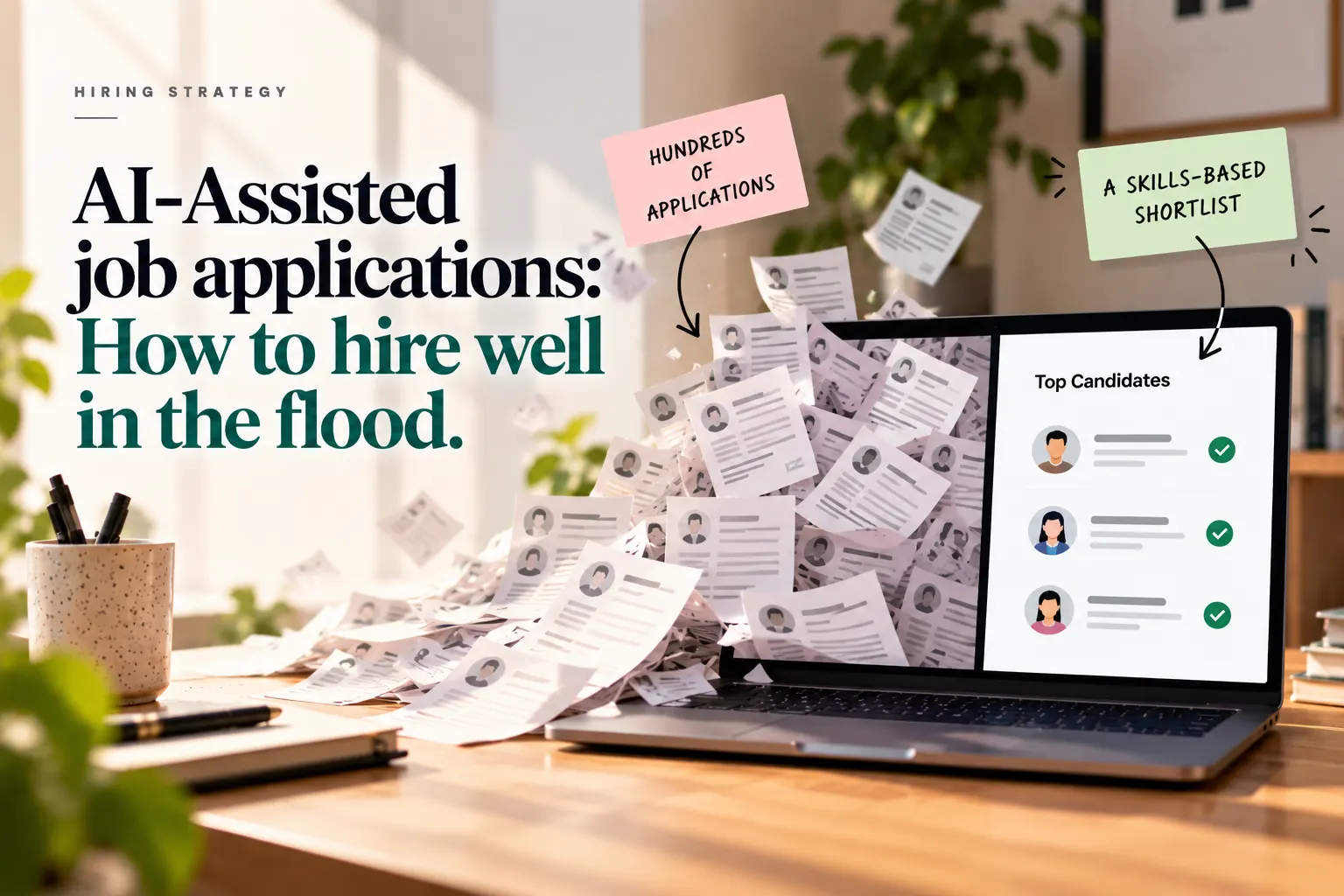
AI-Assisted Job Applications: How to Hire Well in the Flood
Key Takeaways (TL;DR)
- AI has made applying almost effortless, so volumes have exploded and the resume has become a weaker signal than ever. The answer is not to fight AI applications, it is to change what you measure.
- The average open role now draws around 244 applications, up more than 400% since 2022, and much of that growth is AI-generated.
- Most hiring teams now regularly see AI-assisted applications, and many have shrunk at the same time, so manual review no longer scales.
- Rejecting all AI use is both unrealistic and unwise, since good candidates use AI too. Judge the work, not the tool.
- A skills-based first filter turns the flood into a ranked shortlist, because a realistic task is far harder to fake than a resume.
The flood is real, and it is not going away
Applying for a job used to take effort, which naturally limited volume. AI removed that friction. A candidate can now tailor a resume and cover letter to a posting in seconds, and apply to dozens of roles in an afternoon. The result is a surge in applications that is breaking traditional hiring. The average open role now attracts roughly 244 applications, and the typical recruiter absorbs hundreds more per year than they did a few years ago, a rise of more than 400% since 2022 (The Hire Hub, on AI-generated applications). Most of that growth is AI-assisted.
At the same time, many recruiting teams have shrunk. So you have more applications than ever reaching fewer people than ever. Any process that still depends on a human reading each resume has already quietly broken. The teams that cope are not the ones working harder, they are the ones that changed what they measure. Here is how to hire well when most applications are AI-assisted.
Why you cannot just ban AI applications
The instinct is to penalise or reject anyone who used AI. That fails for two reasons. First, it is unenforceable, since you usually cannot prove whether AI was used, and detectors are unreliable. Second, and more importantly, it is the wrong target. Plenty of excellent candidates use AI to write a tighter resume or a clearer cover letter, just as they would use a spellchecker. Punishing that filters out good people for using a normal tool. The problem is not that a candidate used AI to apply. The problem is that the resume, AI-polished or not, was never good proof of whether someone can do the job. So the fix is to stop relying on the document and start testing the work.
What AI applications actually break
It helps to be precise about what the flood damages. AI-assisted applications make the resume and cover letter nearly worthless as a filter, because everyone can now produce a polished, keyword-perfect version. Keyword matching, already weak, becomes noise. Volume overwhelms manual review, so good candidates get missed simply because no one reached them in time. And the speed of applying means strong people often accept another offer before a slow process even replies. None of these is solved by trying to detect AI. All of them are solved by a faster, skills-based filter.
Fix 1: Screen on a skills-based first filter
The single most effective response is to put an automatic, skills-based filter at the very top of your funnel, before any human reads anything. Instead of ranking resumes, score every applicant on a short, realistic task that reflects the actual job. A task is far harder to fake with AI than a resume, and it measures the thing you actually care about. This turns a pile of hundreds of lookalike applications into a ranked shortlist based on demonstrated ability. Our guide to skills-based hiring over resume screening explains why this predicts performance so much better than the document.
Fix 2: Use realistic work samples
Lean into assessments that are hard to game and close to the real role. A work sample test that asks a candidate to do a slice of the actual job gives you a direct read on ability, and it exposes the gap between an AI-polished application and a person who can genuinely do the work. For roles where AI could help complete the task, design the task so that using AI well is part of the test, or so that a short, live follow-up confirms the work is genuinely theirs. The goal is a signal that survives the AI era, not a test that pretends AI does not exist.
Fix 3: Keep a short, human, verifying step
Automation handles the volume, but a brief human step still matters, especially for confirming the work is real. A short, structured conversation or a live follow-up on the assessment lets you check that the person in the interview matches the quality of the application. This is where you catch the rare case of a faked or fully outsourced application, without treating every candidate as a suspect. Our guide to evaluating candidates in your screening process covers how to keep that step consistent and fair.
Fix 4: Move fast, because speed now wins
When candidates apply to many roles at once with AI, the first strong, respectful offer often wins. A slow process loses good people before you even finish reviewing. An automated skills-based filter is not just about handling volume, it is about speed: it gets you to a trustworthy shortlist in a fraction of the time, so you can move on strong candidates before a competitor does. In the AI-application era, speed and quality stop being a trade-off and become the same capability.
Do not lose the good candidates in the noise
One risk of high volume is over-correcting into coldness, auto-rejecting so aggressively that you lose strong people and damage your brand. Keep the experience human even at scale. Reply promptly, tell candidates where they stand, and make the assessment short and relevant. A fast, respectful, skills-based process does double duty: it handles the flood, and it signals a company worth joining to the good candidates hidden inside it. The volume is a problem, but it is also a bigger pool, and the point is to find the strong people in it, not to wall yourself off from everyone.
Common mistakes when handling AI applications
Trying to detect and ban AI. Detectors are unreliable and good candidates use AI too. Judge the work, not the tool.
Still filtering on resumes. AI makes every resume look great, so keyword matching is now noise. Screen on demonstrated skills.
Reading everything manually. With hundreds of applications per role and smaller teams, manual review misses strong people. Automate the first pass.
Keeping a slow process. Candidates apply widely and accept fast. A slow reply loses them. Speed is now a core advantage.
Dropping the human step entirely. Automation handles volume, but a short human check still confirms the work is genuine. Keep one.
How Navero helps you hire in the flood
Navero is built for exactly this problem. It screens every applicant on verified skills with realistic, job-relevant tasks, automatically, so a flood of AI-assisted applications becomes a ranked, evidence-based shortlist instead of an impossible pile. Because the screen tests real work rather than a document, an AI-polished resume gives a candidate no advantage over someone who can actually do the job.
Navero filters out roughly 60% of unqualified applications and cuts time-to-hire by up to 75% (based on customer data), which is precisely what rising volume and shrinking teams require. It shows the reasoning behind every score and keeps a human making the final decision, which supports alignment with the EU AI Act, NYC Local Law 144, and EEOC guidance. For the bigger picture on what is coming next, see our guide to hiring trends for 2027.
Drowning in AI-assisted applications? See how Navero's skills-based screening turns the flood into a shortlist you can trust.
The bottom line
AI-assisted applications are the new normal, and they are not going away. Volumes have surged past what any team can read by hand, and the AI-polished resume is a weaker signal than it has ever been. Fighting AI with detectors is a losing game, because good candidates use it too and the real problem was always the resume itself. The teams that win change what they measure: a skills-based first filter and realistic work samples that are hard to fake, a short human step to verify the work is genuine, and a fast process that reaches strong candidates before competitors do. Do that, and the flood stops being a threat. It becomes a bigger pool to find great people in, as long as you judge them on what they can actually do.
Frequently Asked Questions
How many applications does the average job get now? Recent data puts the average open role at around 244 applications, with the typical recruiter absorbing hundreds more per year than a few years ago, a rise of more than 400% since 2022. Much of that growth is AI-generated or AI-assisted, since AI has made it almost effortless for candidates to tailor and submit applications at scale.
Should I reject candidates who use AI in their application? Generally no. Rejecting all AI use is both hard to enforce, since detection is unreliable, and counterproductive, since many strong candidates use AI to polish a resume just as they would use a spellchecker. The better approach is to stop relying on the easily-polished document and instead judge candidates on a realistic task that shows whether they can actually do the job.
How do you screen a huge volume of AI applications? Put an automatic, skills-based filter at the top of your funnel, before a human reads anything. Score every applicant on a short, realistic task that reflects the real role, which is far harder to fake than a resume, and let that produce a ranked shortlist. Then add a brief human step to confirm the work is genuine and assess fit.
Can you detect AI-generated job applications? Not reliably. AI-detection tools produce frequent false positives and negatives, and they are easy to work around, so building your process on detection is risky and unfair. It is far more effective to use assessment methods that are inherently hard to fake, such as realistic work samples and short live follow-ups, which reveal real ability regardless of whether AI helped write the application.
Does AI in applications mean resumes are dead? Not dead, but much less useful as a filter. When AI can produce a polished, keyword-perfect resume for anyone, the document stops separating strong candidates from weak ones. It still has a place as context, but the primary signal should shift to demonstrated skills, assessments and work samples that show what a candidate can actually do rather than what they can write.