AI sourcing tools and agentic recruiting: what changes when an agent does the work
Key Takeaways (TL;DR)
- AI sourcing tools search and rank candidates. An AI recruiting agent keeps doing the work and brings you the decisions.
- MCP lets assistants such as ChatGPT, Claude, Cursor and Grok connect to recruiting software, while that software keeps the record.
- Shortlisting, sending messages, rejections and offers should still need a person.
AI sourcing tools find candidates for a role by searching profiles and ranking people against your criteria. Agentic recruiting goes a step further: an AI agent keeps doing the sourcing, shortlisting and interview admin, and brings you the decisions, often inside the AI assistant you already use, connected through MCP.
This guide explains how the two differ, what MCP has to do with it, what a good tool should show you, what must stay with a person, and the questions to ask before you buy. For the technical side of MCP, read recruiting from ChatGPT, Claude and Cursor.
What are AI sourcing tools?
An AI sourcing tool takes a description of the person you want and searches for people who match. Older sourcing tools rely on keyword and boolean search, which you write yourself (see our guide to boolean search for recruiters). AI sourcing tools read profiles the way a recruiter would and judge how well each person fits each criterion.
Most fall into three groups:
- Search tools. You run a search and get a ranked list.
- Outreach tools. They find contact details and send sequences of messages.
- Add-ons to an applicant tracking system. AI features bolted onto software you already use for applications.
What is agentic recruiting?
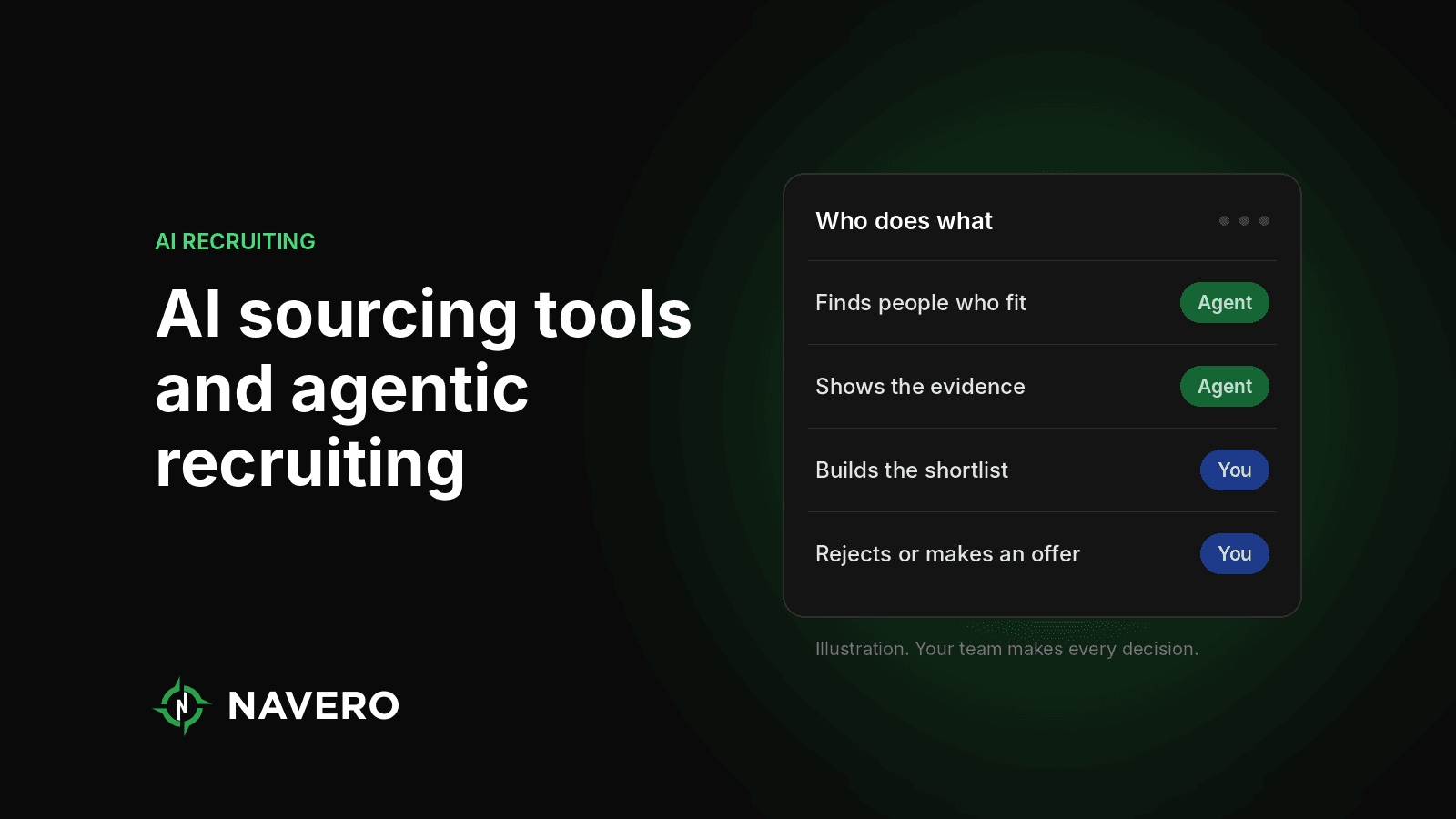
Agentic recruiting means software that does the work rather than giving you tools to do it. You set the criteria and make the decisions. The agent searches, keeps searching, drafts the first message, schedules interviews, takes notes and brings you a short queue of things that need your judgement.
The difference shows up in what you do each day. With a search tool, you run searches. With an agent, you review results and decide. Our page on the AI recruiting agent explains how Navero works this way.
How is an AI recruiting agent different from AI recruiting software?
| AI recruiting software | AI recruiting agent | |
|---|---|---|
| Who does the work | You, with better tools | The agent, with you deciding |
| Sourcing | You run a search when you need one | Keeps looking until you pause it |
| Where you use it | In the vendor's app | In its app, or from your own AI assistant |
| What you see | Lists and scores | Decisions that need you, with the evidence |
What does MCP have to do with agentic recruiting?
MCP, the Model Context Protocol, is an open standard that lets AI assistants such as ChatGPT, Claude, Cursor and Grok connect to other software. A recruiting product that publishes an MCP server can be reached from any of those assistants.
That matters because many people already have an assistant that knows their company, their documents and how they like to work. With MCP, the assistant can ask the recruiting system about a role or a candidate and combine the answer with your calendar or notes in one request. The recruiting system still holds the record and enforces the rules.
What should an AI sourcing tool show you?
- Evidence for each criterion. Not a single match score, but what the person has done against each thing you asked for, and where that came from.
- Gaps as clearly as strengths. "Not shown" is as useful as "met".
- The criteria it searched for. You should approve them before any search runs, and change them when the brief changes.
- Why someone is on the list, before you spend time on them.
More on judging the evidence in our guide to the best sourcing tools for recruiters.
Run your next hire from one place
Find people who fit, shortlist with evidence, and get interviews scheduled, transcribed and scored. Free to start, no card needed.
Try nowWhat should stay with a person?
An agent can do a lot of the work. Some steps should still need a human every time:
- Approving the criteria for the role.
- Choosing who goes on the shortlist.
- Sending messages to candidates, or at least approving them.
- Rejecting a candidate.
- Making an offer.
Ask every vendor where these lines sit, and whether they are the same when a request comes from an assistant instead of the app.
How do you evaluate an AI sourcing tool or recruiting agent?
- Does it show evidence per criterion, or one score?
- Which steps need a person to approve? Rejections and offers should.
- Is every action logged, with who asked and when?
- Whose permissions apply? An assistant should only see what the signed-in person can see.
- How does it treat text from candidates? A CV or message should be read as data, never followed as instructions.
- Can you reach it from your own assistant, and what can that connection do today?
- Which languages does it work in? In the Gulf, Arabic matters for outreach and interviews.
- How is it priced? Per seat, per role, or per contact found. See per-role vs per-seat pricing.
How does Navero work as an AI recruiting agent?
Navero Recruit starts from a profile you approve. Describe the hire in a sentence, paste a job description, or point to someone you would hire again. Its sourcing agent then keeps finding people who fit until you pause it, shows what each person has done against every criterion (met, partly met or not shown), and drafts the first message in English or Arabic. You choose the shortlist and approve every message.
Navero Interview schedules interviews, transcribes them with the candidate's consent, and sets each answer against your scorecard with quotes. Your team runs the interview and decides. For the questions themselves, see our hub of interview questions to ask candidates.
You can use Navero in its own app, or connect ChatGPT, Claude, Cursor, Grok or Grok Bot through MCP at https://api.prod.navero.me/mcp. The connection is read-only today: your assistant can list your roles, read a role's profile, see the people on a role's board or found by Recruit, and read the evidence for each one. Starting searches, shortlisting from your assistant and reading interviews are coming next, and Slack is coming soon. See how to connect.
The same controls apply wherever a request comes from. A candidate is never rejected without a person approving it, and offers and hires are made only in the Navero app. Navero is priced per open role: US$149 per role per month once paid plans are switched on, and free to use until then.
Will AI recruiting agents replace recruiters?
They replace much of the admin: searching, chasing calendars, writing up notes. The judgement stays with people: what the role really needs, who to hire, and how to win a candidate who has other offers. More in will AI replace recruiters?
Is agentic recruiting fair to candidates?
It can be fairer than a rushed manual process, because every candidate is checked against the same criteria with evidence. It depends on the controls: a person approving rejections, clear criteria, consent for recordings, and an audit log.
Do I need to replace my applicant tracking system?
Not necessarily. An agent can sit alongside your current system. If you want Navero to connect to yours, request a connection to your ATS.