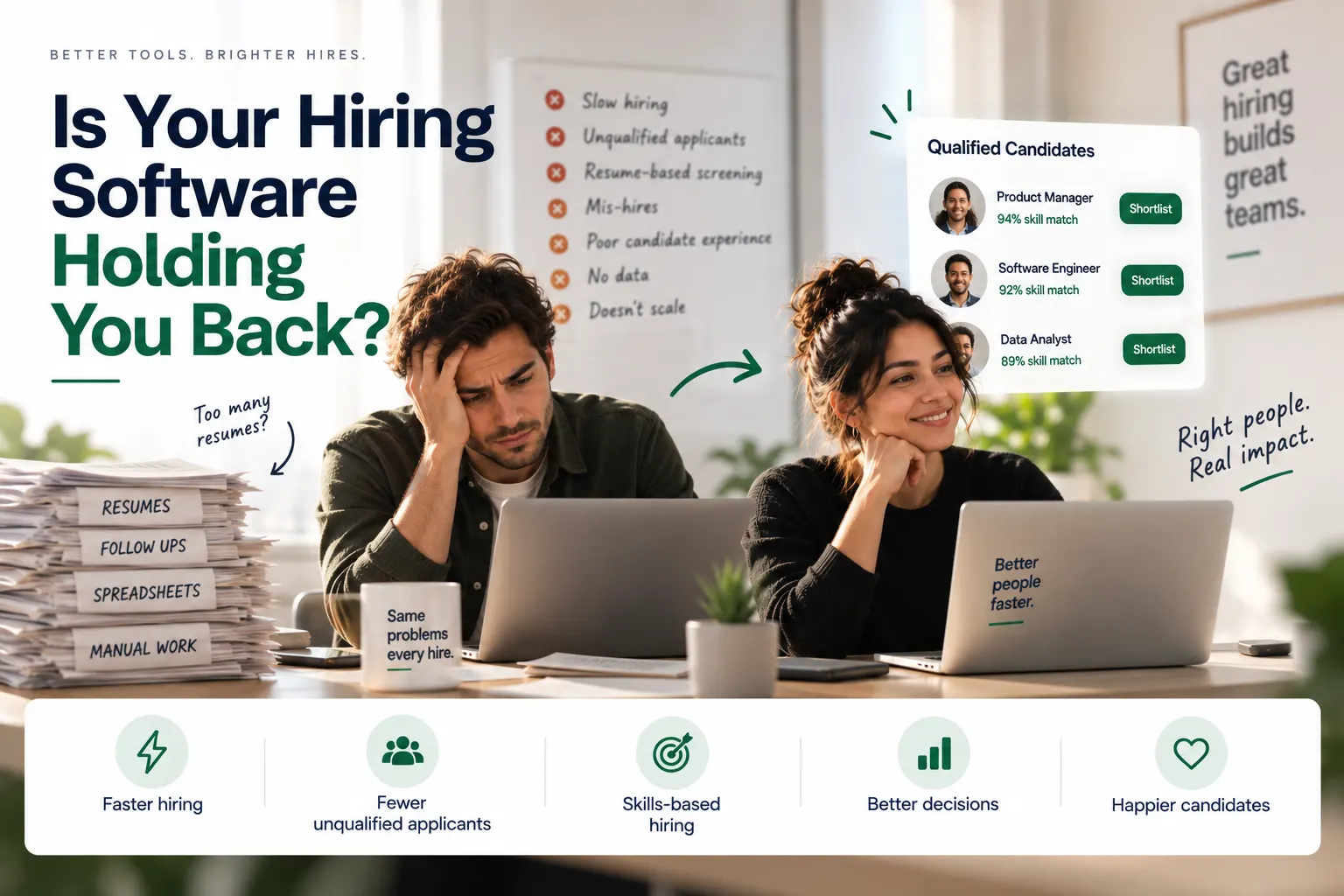
8 Signs It's Time to Change Your Hiring Software in 2026
Key Takeaways (TL;DR)
- Most teams keep their hiring software far too long, because switching feels like a hassle. But outdated tools quietly cost you in slow hires, mis-hires, and lost candidates, and those costs dwarf the effort of changing.
- The clearest signs: hiring is slow, you drown in unqualified applicants, and you have no real data on candidate skills.
- If your tool screens on resumes rather than ability, it is working against the way hiring is going in 2026.
- Poor candidate experience, no useful reporting, and manual busywork are all signals your tool has been outgrown.
- The fix is a platform that screens on verified skills and does the heavy lifting. Navero sources, screens, and ranks candidates on evidence, with a human deciding.
Why the right hiring software matters now
Hiring has changed fast. AI now writes flawless resumes in seconds, application volumes have exploded, and candidates expect a quick, respectful process. Software built for an older, slower world cannot keep up, and the gap shows in your results long before you notice the tool is the cause.
The reason teams stay too long is inertia. Switching feels risky and time-consuming, so a tool that is quietly costing you hires gets a pass year after year. The way to break that is to look at the symptoms honestly. If several of the signs below are true, your software is not neutral, it is holding you back.
Sign 1: Hiring takes too long
If roles sit open for weeks and strong candidates drift to faster competitors, your process, and the tool running it, is too slow. Good software should compress the time from application to shortlist, not add steps. If you cannot even see where the delay is, that is a reporting problem too. Our guide to calculating time-to-hire helps you measure it.
Sign 2: You are drowning in unqualified applicants
If every role brings a flood of applications your team sorts by hand, your tool is not doing its main job. Modern hiring software should filter out the clearly unqualified automatically, so your team only spends time on people worth interviewing. Manually wading through hundreds of resumes is a sign the tool has been outgrown.
Sign 3: You are screening on resumes, not skills
This is the big one. If your software ranks candidates on keywords and resume signals, it is optimising for the weakest, most fakeable evidence there is, and AI-written resumes have made that worse. A tool that cannot assess what a candidate can actually do is built for the wrong era. The shift to skills-based screening is exactly what current tools are missing.
Sign 4: You keep making mis-hires
If hires who looked great on paper keep failing on the job, your process is selecting on the wrong signals. A tool that helps you hire on evidence of skill should reduce mis-hires over time. If yours does not, it is not giving you the information you need to choose well.
Sign 5: The candidate experience is poor
If candidates complain about a clunky application, go silent mid-process, or ghost you, part of the blame sits with software that makes the process slow and impersonal. A poor candidate experience damages your brand and costs you hires, and good tooling should make communication and speed easier, not harder. Our guide to improving the candidate experience covers the wider fix.
Sign 6: You have no useful data or reporting
If you cannot answer basic questions like where candidates drop off, how long each stage takes, or which sources produce your best hires, your tool is a black box. You cannot improve what you cannot measure, and a modern platform should give you a clear view of your funnel, as covered in optimising your recruitment funnel stages.
Sign 7: It does not scale with you
Software that was fine at five hires a year can buckle at fifty. If your tool slows down under volume, forces workarounds, or cannot handle the way your team now hires, you have outgrown it. Hiring tools should remove friction as you scale, not add it.
Sign 8: Your team lives in spreadsheets and manual work
If your real hiring process happens in spreadsheets, email threads, and manual copying between systems, your software is not actually running your hiring, it is just storing some of it. Constant manual busywork is a clear sign the tool is not doing enough, and that the time your team spends fighting it would be better spent on candidates.
How to evaluate a replacement
Spotting the signs is the easy part. Choosing well is what matters. Focus on the tool's ability to screen candidates on real skills rather than resumes, how much of the manual work it genuinely removes, whether it keeps a human in the decision, and how cleanly it fits your existing process. Test any option on a real role before committing, and judge it on shortlist quality, not a demo. When you are ready to move, our guides to switching to an AI-powered recruitment platform and choosing the right hiring platform walk through it.
Making the switch without the pain
The fear that stops most teams from switching is disruption, but a change managed well is far less painful than the daily cost of the wrong tool. A few things keep it smooth.
Start by writing down what your current tool does badly, using the signs above, so you know exactly what "better" looks like and do not just buy a shinier version of the same problem. Trial your shortlist of replacements on one real, live role rather than judging a demo, and compare the shortlist each produces against your own read of the candidates. Move one team or one role type over first, prove it works, then expand from that win rather than switching everything at once. And bring your team into the choice early, because the tool only helps if people actually use it.
Done this way, switching is a short, contained project with a clear payoff, not the open-ended risk it feels like from the outside. The teams that put it off usually overestimate the pain of moving and underestimate the ongoing cost of staying.
The cost of staying too long
It is worth being blunt about the price of inertia. Every extra week a role stays open, every strong candidate lost to a faster competitor, and every mis-hire that slips through is a real cost, and they recur for as long as the wrong tool is in place. A single bad hire can cost well over half a role's salary once you add lost productivity and rehiring. Measured against that, the effort of switching is small and one-time. The expensive option is usually to do nothing.
How Navero fits
Navero is built to fix the exact signs above. It sources qualified candidates and screens them on verified skills rather than resume keywords, so you stop drowning in unqualified applicants and stop making mis-hires on the wrong signals. It filters out roughly 60% of unqualified applications and cuts time-to-hire by up to 75% (based on customer data), which directly attacks the slow-hiring and manual-work problems.
Two principles keep it sound. First, Navero surfaces and scores candidates on evidence and shows its reasoning, while a human makes the final decision. Second, that human-in-the-loop design keeps you aligned with the EU AI Act, NYC Local Law 144, and EEOC guidance as they tighten around automated hiring.
Recognise a few of these signs? See how Navero's skills-based screening fixes them, on one of your real roles.
The bottom line
Hiring software is easy to keep and hard to question, which is exactly why so many teams run tools that quietly cost them hires. The signs are not subtle once you look: slow hiring, floods of unqualified applicants, resume-based screening, repeated mis-hires, poor candidate experience, no data, no scale, and a team buried in spreadsheets. Any one might be tolerable. Several together mean the tool is working against you, and the recurring cost of that dwarfs the one-time effort of changing. The single upgrade that matters most is moving from resume-based screening to skills-based, because that is where the modern gains in speed and hire quality come from. If a few of these signs feel familiar, it is time. The teams that act on them do not just fix an annoyance, they hire faster, make fewer mistakes, and stop losing good candidates to competitors who moved quicker, and that advantage compounds with every role they fill.
Frequently Asked Questions
How do I know if I need new hiring software? Look for the symptoms: slow time-to-hire, floods of unqualified applicants, screening on resumes instead of skills, repeated mis-hires, poor candidate experience, no useful reporting, tools that do not scale, and lots of manual spreadsheet work. Several of these together mean your tool is holding you back.
Is it worth switching hiring software? Usually yes, if the signs are there. The effort of switching is one-time, while the cost of staying, in slow hires, mis-hires, and lost candidates, recurs continuously. A single bad hire alone can outweigh the cost of changing tools.
What should new hiring software do that old tools do not? Screen candidates on verified skills rather than resume keywords, filter out unqualified applicants automatically, give you clear funnel data, scale with your volume, and keep a human in the decision. The biggest upgrade is moving from resume-based to skills-based screening.
How disruptive is it to change hiring software? Less than most teams fear. The key is to test a replacement on a real role first, judge it on shortlist quality, and choose a tool that fits your existing process. The disruption is short-lived, while the benefits are ongoing.
How often should we review whether our hiring tools still fit? At least once a year, and any time hiring feels harder than it should, such as after a stretch of slow hires, mis-hires, or a spike in application volume you cannot manage. Tools that fit at one size or pace often stop fitting as you grow, so a quick annual check against the signs above catches the problem before it costs you a season of hiring.
What is the biggest sign of outdated hiring software? Screening on resumes and keywords rather than a candidate's actual skills. With AI-written resumes now the norm, a tool that cannot assess real ability is optimising for the weakest signal, which is the clearest sign it belongs to an older era of hiring.