How to Test AI Fluency in Candidates: A 2026 Skills-Based Framework
Key Takeaways (TL;DR)
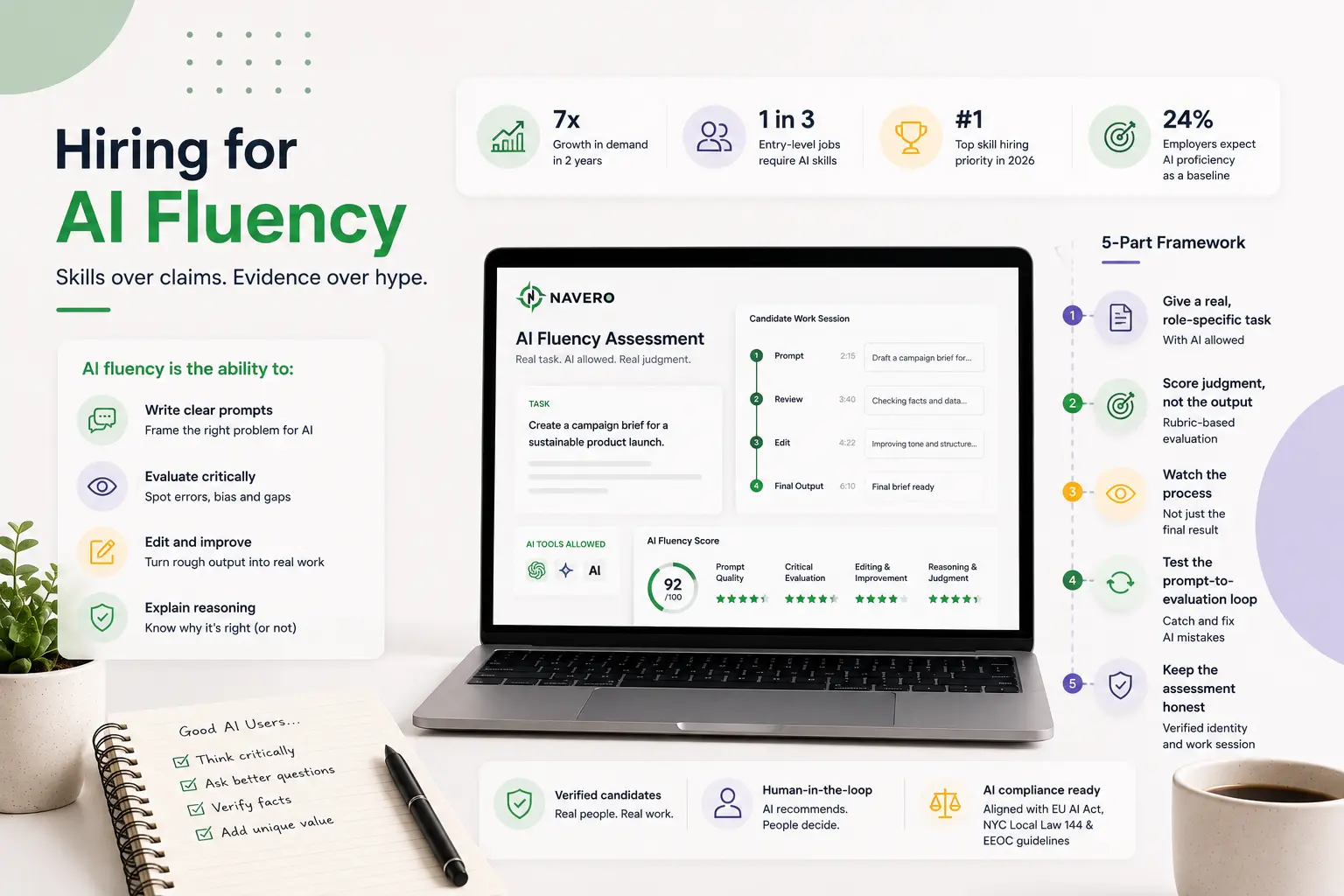
- AI fluency is the ability to use AI tools well: to prompt them, judge their output, and apply the result to real work. In 2026 it is the most requested hiring skill, and most teams still test it by asking about it instead of watching candidates do it.
- AI fluency is the #1 hiring priority for 2026, named by roughly 35% of employers.
- Demand for it grew about sevenfold in two years (McKinsey).
- You cannot verify it from a resume or an interview answer. You have to see the work.
- Test it with real, AI-allowed tasks and score the judgment, not the tool. Navero scores and surfaces candidates; your team makes the call.
What is AI fluency (and what it is not)?
AI fluency is the ability to get useful results from AI tools and to know when not to trust them. A fluent candidate can write a clear prompt, spot when the output is wrong or biased, edit it into something correct, and explain their reasoning.
It is not the same as being an AI engineer. Most employers are not hiring people to build models. They want people who can use AI tools effectively, evaluate AI-generated output, and apply it to improve business results. Fluency is a working skill, like being good with a spreadsheet, not a research specialty.
It also is not "has used ChatGPT." Everyone has now. The gap between candidates is judgment: knowing which task to hand to AI, catching the confident-but-wrong answer, and turning a rough draft into finished work.
Why AI fluency matters for hiring in 2026
The demand is not a trend piece. It is measurable and it is steep.
It is the top hiring priority. In 2026, AI fluency ranks first among skills employers are hiring for, ahead of the ability to quantify business impact and a portfolio of applied work (Pin).
It grew fast. McKinsey research from late 2025 found demand for AI fluency grew roughly sevenfold in two years.
It reaches entry level. More than a third of entry-level jobs now require some AI competency, according to NACE's Job Outlook 2026, close to triple the share from a year earlier.
It is becoming a baseline, not a bonus. Nearly one in four employers say AI proficiency is now expected for MBA-level roles rather than a differentiator (Concordia).
The takeaway for hiring teams: AI fluency has moved from "nice to have" to a screen you need to run on almost every role. The problem is how you run it.
Why you cannot hire AI fluency by asking about it
Here is where most teams get it wrong. They add a line to the interview: "How do you use AI in your work?" Every candidate has a good answer ready. That question tests storytelling, not skill.
Three reasons self-report fails for AI fluency specifically:
It is easy to claim. "I use AI daily to speed up my work" costs nothing to say and proves nothing.
It is easy to fake in the moment. In a live interview, a candidate can read AI-generated answers off a second screen, so a fluent-sounding spoken answer can come straight from a model the candidate barely understands.
Confidence hides the gap. The dangerous candidate is not the one who avoids AI. It is the one who pastes whatever the model says without checking it. You only see that by watching them work, not by hearing them talk.
AI fluency is a skill, and skills are proven by doing, not describing. That means a work sample, not a conversation.
How to test AI fluency: a 5-part framework
The goal is to watch a candidate use AI on a realistic task and to score their judgment. Here is a framework that works across roles.
1. Give a real, role-specific task, with AI allowed
Do not ban AI and do not run a trivia quiz about prompts. Give the candidate a task they would actually do in the job and tell them AI is allowed. A marketer drafts a campaign brief. A support lead writes responses to three tricky tickets. An analyst turns messy data into a summary. The point is to see how they work when the tools are on the table.
2. Score the judgment, not the output
A polished output is not the signal. The signal is the thinking. Did they choose the right task to hand to AI? Did they catch errors? Did they add context the model could not know? Build a rubric that scores decisions: prompt quality, error-catching, editing, and knowing when to override the AI entirely.
3. Watch the process, not just the result
Two candidates can submit similar work. One prompted once and pasted the result. The other iterated, checked sources, and rewrote half of it. Those are very different hires. Structured assessments that capture the working session, not just the final file, let you tell them apart.
4. Test the prompt-to-evaluation loop
Fluency is a loop: prompt, read critically, correct, repeat. Design at least one task where the AI's first answer is subtly wrong, so the fluent candidate catches it and the over-reliant one ships the mistake. This single test separates real fluency from surface familiarity better than any other.
5. Keep the assessment honest
Because AI is allowed here, integrity means something different than in a normal test. You are not stopping AI use. You are confirming that the person doing the work is the candidate, that the judgment on display is theirs, and that they are not simply relaying an answer without understanding it. Verified identity and a recorded working session make the score trustworthy.
How to test AI fluency by role
The framework is the same. The task changes.
Technical roles (engineering, data): a scoped coding or analysis task with AI assistants available. Score how they use AI to move faster while still catching bugs, security issues, and hallucinated APIs.
Marketing and content: a brief or draft where AI produces the first pass. Score brand judgment, fact-checking, and the edits that turn generic output into something on-message.
Customer service and operations: real scenarios where AI drafts a response. Score empathy, accuracy, and the decision of when to escalate to a human instead of trusting the model.
Non-technical and generalist roles: a planning or research task. Score how they structure the problem for AI and how well they sanity-check what comes back.
Common mistakes when assessing AI fluency
Banning AI in the assessment. That tests the wrong thing. The job allows AI, so the test should too.
Grading the final artifact only. You miss the judgment, which is the whole point.
Trivia about prompt syntax. Knowing prompt tricks is not the same as using AI well on real work.
One-and-done tasks. Fluency shows up in iteration. Give at least one task that requires catching and fixing an AI mistake.
No integrity layer. If you cannot confirm the candidate did the work themselves, the score means little.
How Navero helps you test AI fluency
Navero is a skills-based hiring platform, so testing a skill like AI fluency is exactly what it is built for. You can run realistic, role-specific tasks through skills-based assessments, score candidates on evidence rather than claims with AI CV screening and structured evaluation, and keep the assessment honest with built-in verification that confirms the work is the candidate's own.
Two principles keep it fair and compliant. First, Navero scores and surfaces candidates and shows the reasoning behind each score. A human recruiter or hiring manager makes the final decision. Second, that human-in-the-loop design matters as rules like the EU AI Act, NYC Local Law 144, and EEOC guidance tighten around automated hiring decisions.
Related reading: What is skill validation? and the 12 best anti-cheating software for technical interviews.
Frequently Asked Questions
What is AI fluency in hiring? AI fluency is a candidate's ability to use AI tools effectively: to prompt them, evaluate their output critically, and apply the result to real work. It is a practical working skill, not the ability to build AI systems.
Why is AI fluency important in 2026? It is the top hiring priority for 2026, named by around 35% of employers, and demand grew roughly sevenfold in two years. More than a third of entry-level roles now expect some AI competency.
How do you test for AI fluency? Give candidates a real, role-specific task with AI allowed, then score their judgment: prompt quality, error-catching, editing, and knowing when to override the AI. Watch the process, not just the final output.
Can you fake AI fluency in an interview? Yes. Self-reported answers and even live interviews are easy to game, since a candidate can read AI output off a second screen. That is why a hands-on work sample with verified integrity is more reliable.
Does AI fluency mean the candidate must be technical? No. Most employers want people who can use AI tools well in everyday work, not AI engineers. Marketing, sales, support, and operations roles all benefit from AI fluency.