Cognitive Ability Tests for Hiring: A Complete 2026 Guide
Key Takeaways (TL;DR)
- A cognitive ability test measures how well a candidate reasons, solves problems, and learns new things. It is one of the strongest predictors of job performance in research, but it also carries real fairness risks you have to manage.
- Cognitive ability, sometimes called general mental ability, predicts performance at around 0.51 in decades of research, among the highest of any single method.
- It works because most jobs reward reasoning and fast learning, especially complex ones.
- The catch: cognitive tests can create adverse impact, so they must be job-relevant and never used alone as a pass or fail gate.
- Work sample tests predict just as well with less fairness risk, which is why the strongest approach pairs ability with real work. Navero screens on verified skills, and a human decides.
What is a cognitive ability test?
A cognitive ability test measures general mental horsepower: how well someone reasons, processes information, solves problems, and picks up new things. It is not about what a candidate already knows, but about how quickly and effectively they can think and learn.
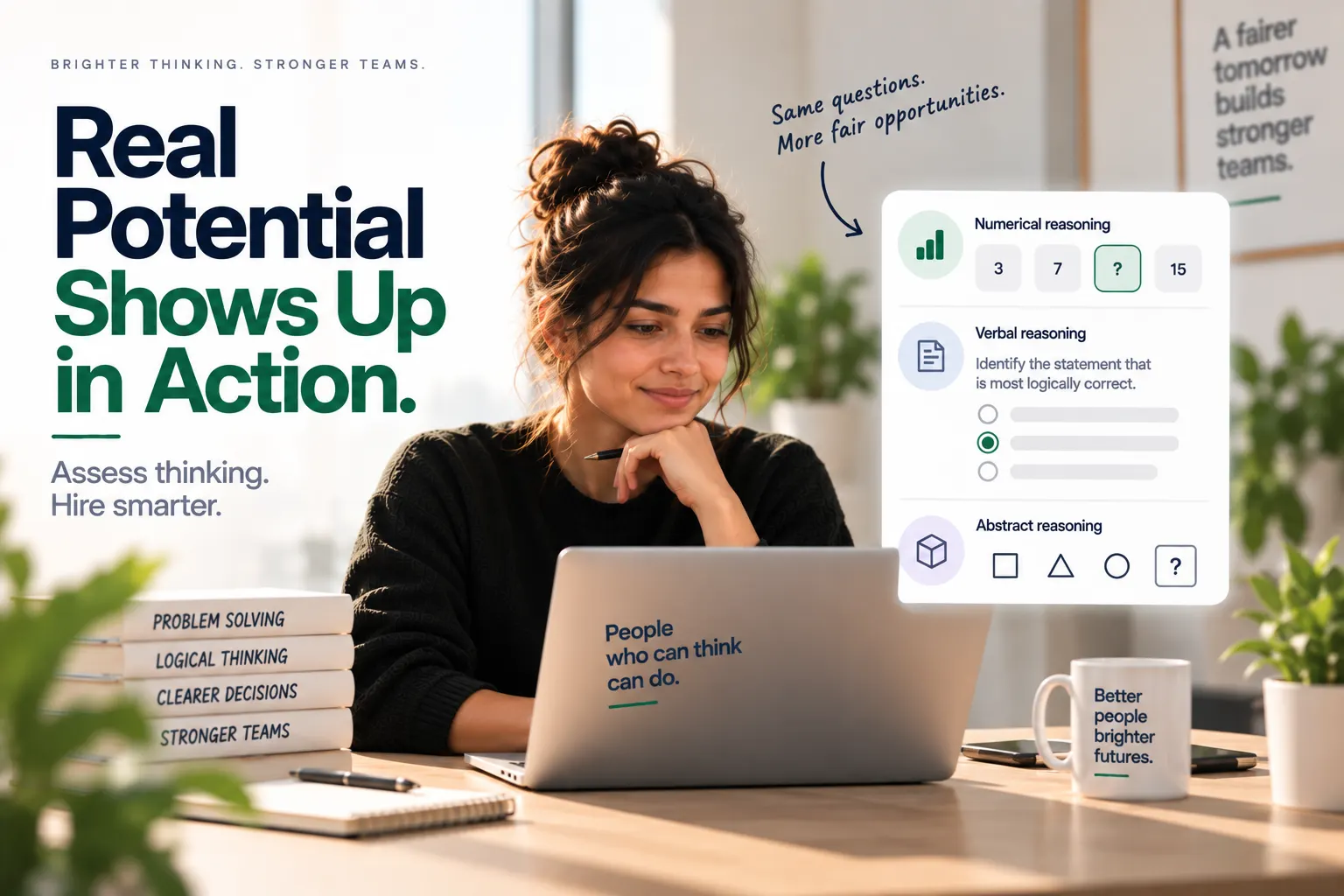
These tests usually cover a few areas, such as numerical reasoning, verbal reasoning, and logical or abstract reasoning. The idea is simple: roles that involve solving problems and learning quickly tend to reward people who do those things well, and a cognitive test measures that directly rather than guessing it from a resume.
Why cognitive ability tests predict performance
The evidence here is strong. The landmark Schmidt and Hunter research pooled 85 years of studies on how well different methods predict job performance. General mental ability came out near the top, at a validity of around 0.51 (Schmidt and Oh, validity and utility of selection methods). That is high for this kind of research.
The reason is simple. Cognitive ability predicts how fast someone learns the job. In a simple, steady role that matters less. But in a complex or fast-moving one, the person who reasons and learns quickly tends to win. That broad relevance is why cognitive tests rank so high.
A quick example
Picture two candidates for an analyst role. One has a strong resume from a known company. The other has a thinner background but scores well on a numerical and logical reasoning test. On the resume alone, you would pick the first. But the role involves learning new tools fast and reasoning through messy data, and the test suggests the second candidate may pick that up quicker.
That is what a cognitive test adds: a read on how fast someone will learn and reason, which a resume cannot give you. It does not tell you they are a better person or even a better hire on its own. It tells you they are likely to get up to speed faster, which matters a lot in a complex role and much less in a simple one.
Types of cognitive ability tests
Most cognitive tests measure one or more of these areas.
Type | What it measures |
|---|---|
Numerical reasoning | Working with numbers, data, and quantitative logic |
Verbal reasoning | Understanding and reasoning from written information |
Logical / abstract reasoning | Spotting patterns and reasoning without prior knowledge |
Spatial reasoning | Visualising and manipulating shapes and space |
Critical thinking | Evaluating arguments and reaching sound conclusions |
Some platforms combine several into a single general mental ability score, while others test specific reasoning types relevant to a role.
The fairness problem you must manage
Here is the part responsible employers cannot skip. Cognitive tests are strong predictors, but they can create adverse impact. That means they can screen out some groups at higher rates, sometimes without a clear job-related reason. Used carelessly, that is a legal and ethical risk.
This does not mean avoid them. It means use them carefully: make sure the test is genuinely relevant to the job, never use a single score as an automatic pass or fail gate, and always keep a human in the decision. As hiring rules tighten, job-relatedness and human oversight are what keep any test defensible. Our guide to fair recruitment practices covers the wider principle.
Cognitive ability versus work samples
This is the key insight that changes how you should use cognitive tests. Work sample tests, where a candidate does a realistic piece of the actual job, predict performance about as well as cognitive ability, and they tend to carry less adverse impact, because they measure job-relevant work directly.
So while a cognitive test is a strong tool, it is often not the first tool to reach for. A work-sample or skills-based assessment gives you similar predictive power with a fairer footprint, and it is easier to defend because the link to the job is obvious. Cognitive ability is best used as one input, especially for complex roles, alongside real work rather than instead of it. Our comparison of skills assessment versus personality tests sits in the same family of choices, and the wider menu is in types of pre-employment tests.
Do cognitive tests just measure how smart someone is?
This is a common worry, and the honest answer is nuanced. A cognitive test measures reasoning and learning speed, which is one part of what people loosely call intelligence. It does not measure motivation, judgment, people skills, or whether someone will actually apply their ability well. Plenty of high-scoring people underperform because they lack drive or fit, and plenty of average scorers thrive because they work hard and learn on the job.
So do not treat a cognitive score as a verdict on a person. Treat it as one useful data point about how quickly they are likely to learn a complex role. That framing keeps you from over-weighting it, and it is also why the test should always sit alongside evidence of real work and fit, never replace it.
A note on candidate experience
Cognitive tests can feel high-pressure, so how you run them matters. Keep them short. Tell candidates in advance what to expect and why the test is part of the process. Make sure the format is accessible, and offer adjustments where needed. A test that feels fair and quick protects your brand. A long, stressful, unexplained one drives good people away and makes the whole process feel cold. The test is meant to inform your decision, not to trip candidates up, so treat it as a small, respectful step rather than a gauntlet.
How to use cognitive ability tests well
Confirm job-relevance. Only test the reasoning the role actually needs. A complex analytical role justifies it more than a narrow, routine one.
Never use it as a sole gate. Combine it with other evidence, especially a work sample, rather than rejecting on a single score.
Keep a human in the loop. A person should weigh the evidence and make the call, which is both fairer and more defensible.
Watch for adverse impact. Monitor whether the test screens out groups at different rates, and adjust if it does.
Respect candidate experience. Keep tests reasonably short and explain why you use them.
How Navero fits
Navero is built around the method that gives you strong prediction with less fairness risk: assessing candidates on verified skills through realistic, job-relevant tasks. That gives you much of the predictive power people seek from cognitive tests, while judging candidates on work that clearly relates to the role.
Navero filters out roughly 60% of unqualified applications and cuts time-to-hire by up to 75% (based on customer data), and it shows the reasoning behind every score, while a human makes the final decision. That job-relevant, human-in-the-loop design keeps you aligned with the EU AI Act, NYC Local Law 144, and EEOC guidance as they tighten around testing in hiring. For related reading, see evaluating candidates in your screening process.
Want strong prediction without the fairness headache? See how Navero's skills-based screening assesses candidates on real, job-relevant work.
The bottom line
Cognitive ability tests are powerful, and the research backing them is hard to argue with. But power is not the only thing that matters in hiring. These tests carry real fairness risk, and they measure only one slice of what makes someone succeed. So the smart way to use them is with care: only for roles that genuinely reward reasoning and fast learning, never as a sole pass or fail gate, and always alongside a work sample that shows real ability. Used that way, a cognitive test is a useful input. Used as the whole decision, it is a legal and ethical risk that also misses most of the picture. For most teams, a job-relevant work sample is the fairer, safer first choice, with cognitive ability as a supporting signal for complex roles.
Frequently Asked Questions
What is a cognitive ability test? It is an assessment that measures how well a candidate reasons, solves problems, and learns, rather than what they already know. It usually covers areas like numerical, verbal, and logical reasoning, and it predicts how quickly someone can pick up a role.
Are cognitive ability tests accurate predictors of job performance? Yes, they are among the strongest single predictors in decades of research, at around 0.51 validity, especially for complex roles. But they should be used as one input alongside job-relevant evidence, not as a standalone pass or fail gate.
Do cognitive ability tests have fairness issues? They can. Cognitive tests may create adverse impact, screening out some groups at higher rates. That is why they must be job-relevant, combined with other evidence, monitored for disparate impact, and always used with a human in the decision.
Are cognitive tests better than work sample tests? They predict performance about equally, but work samples tend to carry less adverse impact because they measure the actual job directly. For most roles, a work-sample or skills-based assessment is the fairer first choice, with cognitive ability as a supporting input.
Do cognitive tests measure intelligence? Partly. They measure reasoning and how fast someone learns, which is one part of intelligence. They do not measure drive, judgment, people skills, or whether someone will use their ability well. So treat a score as one data point about learning speed, not a verdict on the person, and never as the whole hiring decision.
When should I use a cognitive ability test? For complex roles that reward fast learning and reasoning, and as one input among several rather than the whole decision. For simpler or narrowly defined roles, a job-relevant work sample is usually the more appropriate and defensible choice.