Qatarization in 2026: An Employer Guide to Qatari Hiring Quotas
Key Takeaways (TL;DR)
- Qatarization is Qatar's policy of increasing the share of Qatari nationals in the private-sector workforce. A 2024 law made it a formal legal obligation, and it now carries reporting duties and real penalties.
- Law No. 12 of 2024 on Qatarization took effect in April 2025. It applies to almost all private companies.
- The national target is 20% Qatari nationals in the private and mixed sectors by 2030, up from around 17%, with higher targets in priority sectors.
- Employers must report vacancies and workforce composition to the Ministry of Labour, and some roles are reserved for Qataris.
- Penalties run from a warning to a block on immigration transactions or a fine up to QAR 1,000,000.
- The hard part is hiring enough qualified Qataris, fast. Navero surfaces and scores candidates on verified skills; your team decides.
- This article is general information, not legal advice. Confirm specifics with a Qatar-qualified adviser.
What is Qatarization?
Qatarization is Qatar's version of workforce nationalisation, the same broad policy you see across the Gulf as Emiratisation in the UAE, Saudization in Saudi Arabia, and Omanisation in Oman. The aim is to raise the number of Qatari nationals in real, productive private-sector jobs, rather than leaving the private economy almost entirely staffed by expatriates.
For years, Qatarization was more of a goal than a rule. That changed in 2024.
What Law No. 12 of 2024 requires
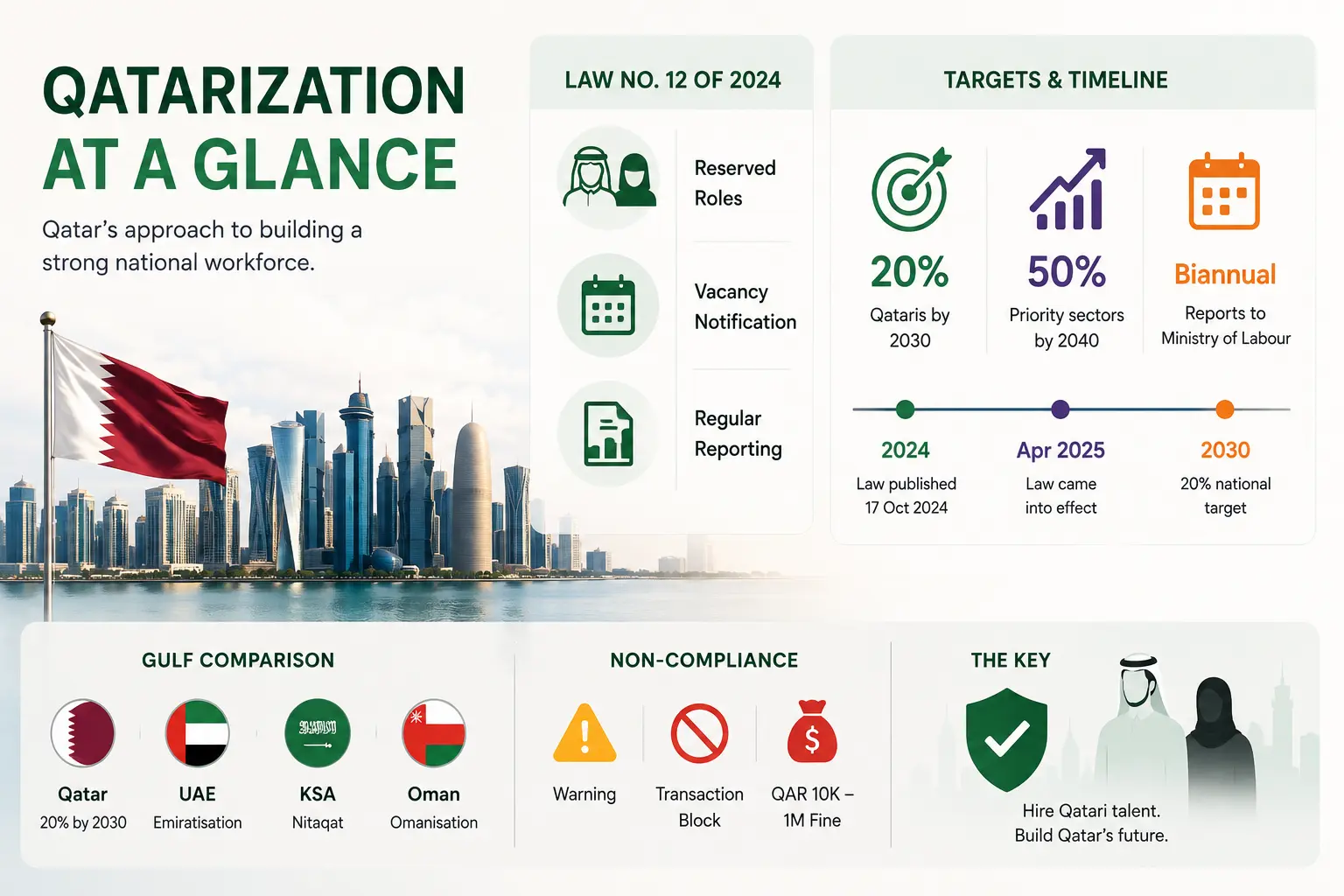
Law No. 12 of 2024 on the Qatarization of Jobs in the Private Sector was published in the Official Gazette on 17 October 2024 and came into effect in April 2025 (Crowell & Moring). It turns Qatarization from an aspiration into a set of obligations. The main ones for employers:
Reserved roles. Certain jobs must be filled by Qataris, or by non-Qatari children of Qatari women, rather than by other expatriates.
Vacancy notification. Employers must notify the Ministry of Labour of job vacancies within one month, including the job conditions, wages, and timelines.
Regular reporting. Employers must submit biannual reports on their workforce composition, so compliance is tracked, not assumed.
The law applies broadly, to all commercial companies operating in Qatar and to private institutions, associations and similar bodies. Companies owned by Qatar Energy and those in petroleum and petrochemical operations are excluded (UNCTAD).
The targets and timeline
The headline number is a national target of 20% Qatari nationals in the private and mixed sectors by 2030, up from roughly 17% today, with higher targets in priority and core sectors. The longer-term vision reaches for 50% in priority sectors by 2040 (Crowell & Moring).
Measure | 2026 position |
|---|---|
National private-sector target | 20% Qatari nationals by 2030 |
Current share | Around 17% |
Priority sectors (long term) | Up to 50% by 2040 |
Reporting | Biannual workforce reports to the Ministry of Labour |
Vacancy notice | Within one month of a vacancy |
Figures are indicative and evolving. Confirm your specific obligations with the Ministry of Labour or a local adviser.
How Qatarization compares across the Gulf
Qatarization is one of several nationalisation schemes in the Gulf. If you hire across the region, it helps to see them side by side, because the mechanics differ even though the goal is the same.
Country | Scheme | Rough private-sector aim |
|---|---|---|
Qatar | Qatarization | 20% Qatari nationals by 2030 |
UAE | Emiratisation | Rising annual targets, with fines per unfilled role |
Saudi Arabia | Saudization (Nitaqat) | Sector quotas from 15% to 75% |
Oman | Omanisation | Sector-specific quotas |
The direction is the same everywhere: higher national-hire targets, real reporting, and real penalties. A team that hires across the Gulf needs one habit that travels, which is to source and screen national talent fast enough to hit each country's number on time. Get that right once and you can apply it in every market.
What happens if you do not comply
Qatarization is now enforceable, and the penalties escalate. Non-compliance can lead to:
A written warning.
A block on the company's employment and immigration transactions, which can freeze your ability to hire or renew visas for expatriate staff.
A fine between QAR 10,000 and QAR 1,000,000 (UNCTAD).
There is a carrot as well as a stick. Employers who comply are eligible for incentives and financial support, set by the Council of Ministers. The direction of travel is clear: nationalisation is being rewarded and non-compliance is being penalised.
The real challenge is hiring speed, not the quota
Here is what compliance guides tend to skip. Meeting a rising Qatarization target does not just mean wanting to hire Qataris. It means finding, screening, and hiring enough qualified Qatari nationals, quickly, often across many roles at once, before a reporting deadline exposes a shortfall.
That is a throughput problem. Qatari nationals are a small talent pool relative to the expatriate workforce, competition for them is intense, and manual CV review cannot keep pace when targets rise and biannual reports loom. Teams end up either missing the target or lowering the bar, and a rushed hire is expensive to unwind.
The answer is to shorten the distance between "we need Qatari hires" and "we have a verified shortlist."
Picture the common version of this. A biannual report is due in eight weeks and shows you two points below your sector target. You need to hire, say, six Qatari nationals across different roles, fast, and you cannot lower the bar because a hire who fails still counts against you later. Reviewing CVs by hand will not get you there in time. What gets you there is a way to source qualified nationals and rank them on proven ability in days, not weeks. That is the gap the right process closes.
What this means for foreign-owned businesses
Many private employers in Qatar are foreign-owned, and the law applies to them just as it applies to local companies, with the narrow exception of petroleum and petrochemical operations. If you run a Qatar entity from abroad, the risk is bigger than a fine. A block on your employment and immigration transactions does not just slow local hiring. It can stall your ability to move expatriate staff in and out of the country. That turns the national-hire target into a business-continuity issue, not just a compliance line item. The teams that see it that way, and build a Qatari hiring pipeline early, are the ones who avoid the scramble that turns a reporting deadline into a crisis. Waiting until you are already behind is the most expensive way to approach it.
How Navero helps you hit Qatarization targets faster
Navero is an AI-native hiring platform that sources, screens, and verifies candidates in one place. For a nationalisation target, three things matter.
Find Qatari talent at volume. Navero's AI sourcing surfaces qualified national candidates instead of waiting on inbound applications to a small pool.
Screen on verified skills, not CV claims. AI screening ranks applicants on evidence, so you can fill quota roles without dropping quality. Navero cuts time-to-hire by up to 75% and filters roughly 60% of unqualified applications (based on customer data).
Move fast enough to beat the deadline. Most teams get a verified shortlist in around three days, which matters when a biannual report is weeks away.
One line worth stating plainly: Navero scores and surfaces candidates and shows the reasoning; your recruiters and managers make the hiring decision. That human-in-the-loop design also keeps you aligned with global AI-hiring norms as they influence Gulf regulation.
Related reading: how to avoid the AED 108,000 Emiratisation penalty and the complete guide to AI hiring compliance in the UAE.
A 6-step action plan for 2026
Map your gap. Compare your current Qatari share against your sector target, not just the 20% national headline.
Register vacancies on time. Notify the Ministry of Labour of openings within one month, as the law requires.
Reserve the right roles. Identify which positions must go to Qataris and plan around them.
Build a national pipeline early. Start sourcing Qatari talent months ahead of any reporting deadline.
Compress screening. Use skills-based assessment to shortlist qualified nationals quickly, without lowering standards.
Keep your reports clean. Track workforce composition continuously so the biannual report is a formality, not a scramble.
Common mistakes to avoid
Reading only the national headline. The 20% figure is a floor. Priority sectors and specific roles can carry higher requirements, so map your gap by sector, not by the headline.
Leaving vacancies unregistered. The law requires you to tell the Ministry of Labour about openings within a month. Missing that is a compliance failure on its own, separate from the quota.
Treating the report as an afterthought. Biannual workforce reports are how compliance is checked. Track your composition all year, not in the week before the report is due.
Lowering the bar under deadline pressure. A rushed national hire who does not work out is expensive to unwind and still counts against you. Screen on skills so speed does not cost quality.
Waiting to start sourcing. The Qatari talent pool is small and in demand. The teams that hit their targets begin months ahead, not weeks.
The bottom line
Qatarization has moved from a goal to a legal duty, with reporting and fines attached. The number that matters is your sector target, and the real work is hitting it without lowering standards. The employers who cope well are not the ones with the biggest recruitment budgets. They are the ones who can source and verify qualified Qatari talent quickly, keep clean workforce records, and treat each biannual report as a checkpoint they have already met. Build that habit now and the 2030 target becomes a series of manageable steps rather than a cliff.
Frequently Asked Questions
What is Qatarization? Qatarization is Qatar's policy of increasing the share of Qatari nationals in private-sector jobs. Law No. 12 of 2024 turned it into a legal obligation with reporting duties and penalties.
What is the Qatarization target for 2026? The national target is 20% Qatari nationals in the private and mixed sectors by 2030, up from around 17%, with higher targets in priority sectors and a longer-term aim of 50% in priority sectors by 2040.
What are the penalties for not meeting Qatarization rules? Penalties range from a written warning to a block on the company's employment and immigration transactions, or a fine between QAR 10,000 and QAR 1,000,000.
Which companies does the law apply to? It applies to almost all commercial companies and private institutions operating in Qatar. Companies owned by Qatar Energy and those in petroleum and petrochemical operations are excluded.
How can employers hit Qatarization targets on time? Map the gap by sector, register vacancies within a month, build a Qatari talent pipeline early, and use skills-based screening to shortlist qualified nationals quickly. The final hiring decision stays with your team.