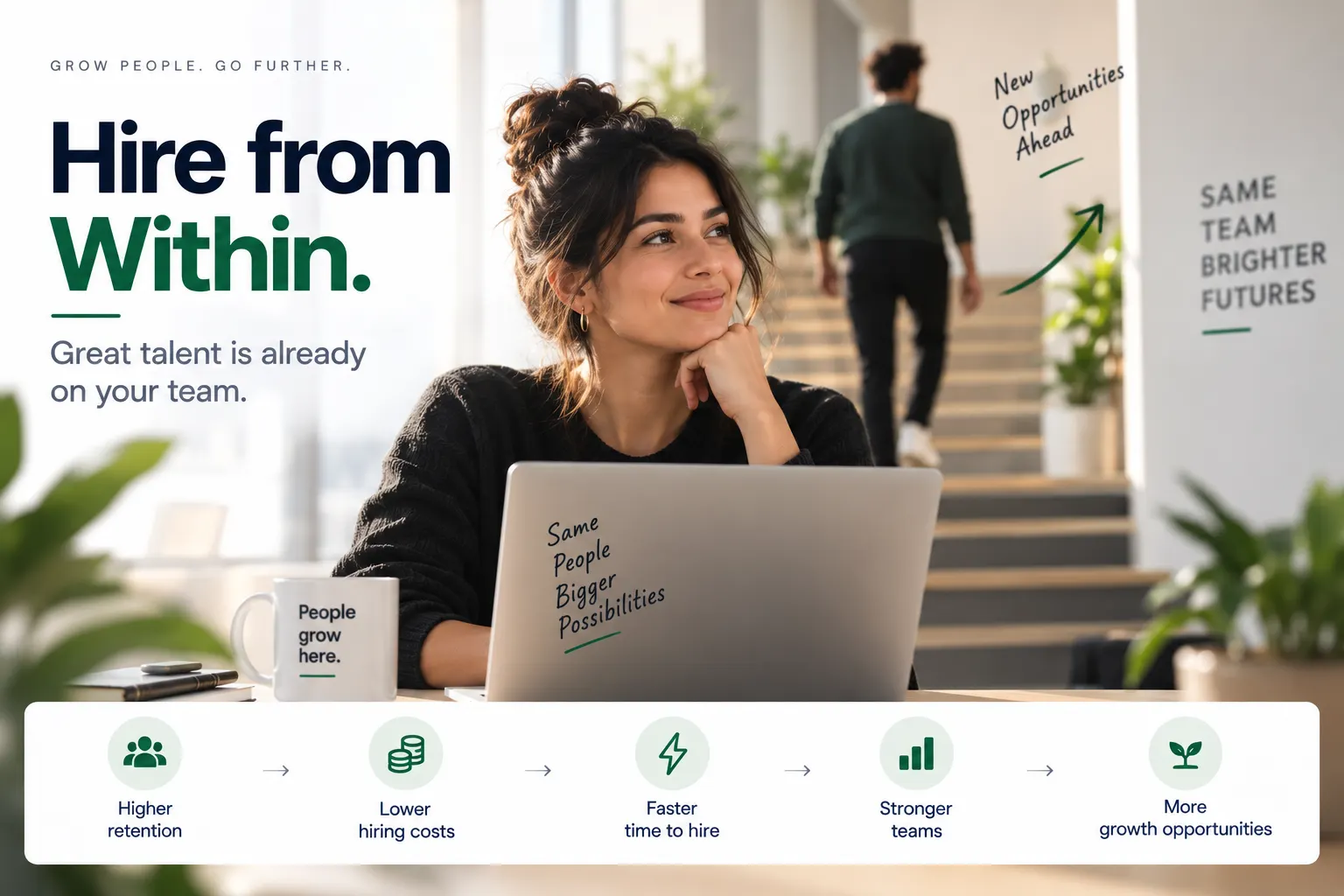
Internal Mobility: How to Hire From Within in 2026
Key Takeaways (TL;DR)
- Internal mobility means filling open roles with people you already employ, through promotions and lateral moves, instead of always hiring externally. It is one of the most underused levers in hiring, and the numbers behind it are hard to ignore.
- Internal hires are faster, cheaper, and stay longer. External hiring can cost 3 to 5 times more than an internal placement.
- Employees who move internally are far more likely to stay, and lack of growth is a top reason good people leave.
- Yet only about a third of organisations run a formal internal hiring program, so the advantage is there for the taking.
- The fix is to treat internal candidates as seriously as external ones, and assess them on skills. Navero scores candidates on evidence, internal or external.
Why internal mobility matters
Most companies default to external hiring even when the right person is already on the payroll. That is an expensive habit, because internal moves win on almost every measure.
Retention. Promoted employees are around 70% more likely to stay long-term, and employees who make an internal move are far more likely to stay than those who do not (Fuel50, talent mobility statistics). Companies with high internal mobility retain people significantly longer.
Cost. External hiring can cost 3 to 5 times more than an internal placement once you add sourcing, interviewing, onboarding, and ramp time, and external hires are often paid 18 to 20% more than an internal promotion for the same role (Pin, internal mobility hiring).
Speed and productivity. Internal moves fill roles faster, and an internal hire who already knows your tools and unwritten rules typically reaches full productivity in 60 to 90 days, while an external hire can take 6 to 12 months (Pin).
There is a flip side too. When employees see no path to grow, they leave to find one elsewhere. So internal mobility is not just a cheaper way to hire, it is one of your strongest retention tools. Gartner expects HR to shift a meaningful share of recruiting capacity inward in 2026, which tells you where this is heading.
Why so few companies do it well
If internal mobility is this good, why is it rare? Only about a third of organisations run a formal internal hiring program, and the reasons are usually cultural and practical, not strategic.
Managers hoard talent, reluctant to lose a good performer to another team. There is no visible way for employees to see or apply for internal openings. And crucially, most companies have no objective way to assess whether an internal candidate can actually do the new role, so they either promote on tenure and gut feel or default to hiring externally. Each of these is fixable, and fixing them is what turns internal mobility from an occasional accident into a reliable channel.
How to build an internal mobility program
1. Make internal openings visible
The first blocker is simple: people cannot apply for roles they cannot see. Post internal openings somewhere every employee can find them, and make it normal and safe to apply without fear of upsetting their current manager. Visibility alone unlocks a surprising amount of movement.
2. Assess internal candidates on skills, not just tenure
This is the step most companies get wrong. Promoting on tenure or a manager's gut feel is how you end up with a strong individual contributor failing in a role they were not ready for. Assess internal candidates on the skills the new role actually needs, the same way you would an external hire. A skills-based approach lets you see whether someone can do the target job, not just whether they were good at their last one. Our guide to skill validation covers the principle.
3. Build visible career paths
People move internally when they can see where they could go. Map out the realistic paths from each role, and the skills needed to get there, so employees have something concrete to aim at. This turns "I have to leave to grow" into "I can grow here."
4. Get managers on board
Talent hoarding kills internal mobility. Make it clear that developing and releasing good people is part of a manager's job, not a loss, and recognise managers who do it. A culture that celebrates internal moves beats a policy that merely allows them.
5. Support the transition
An internal move is still a new job. Give internal hires the same onboarding and support you would give an external one, so they succeed in the new role rather than being left to sink because "they already work here." Pair the move with a clear plan, as in our guide to onboarding best practices.
Internal vs external hiring: when to use each
Internal mobility is powerful, but it is not always the answer, and the goal is to choose deliberately rather than default to either.
Hire internally when someone already has, or can quickly build, the skills the role needs, when speed and retention matter, and when you want to reward and keep good people. It is usually the cheaper, faster, lower-risk option, and it sends a signal to the whole team that growth is possible here.
Hire externally when the role needs skills or experience no one internal has, when you need fresh perspective to break groupthink, or when the team is scaling faster than it can promote from within. External hiring brings in new ideas and capabilities, which a purely internal culture can lack over time.
The healthiest approach is a mix, with internal candidates given a genuine, first look and assessed on the same skills bar as external ones. When you evaluate both on the same evidence, the right answer usually becomes obvious, and you avoid both the trap of promoting someone who is not ready and the waste of hiring out for a role someone internal could own.
How to measure internal mobility
What gets measured gets managed. A few simple metrics tell you whether the program works. First, your internal fill rate, which is the share of open roles filled by existing people. Only about a quarter of companies fill more than half their roles this way, so even reaching a third is real progress. Second, retention of people who moved internally versus those who did not, because the whole case for mobility rests on keeping people. Third, time-to-fill and ramp time for internal versus external hires, which is where most of the cost saving shows up. Review these regularly, as you would with any quality-of-hire tracking, and you will see where the program is working and where it stalls.
Where internal mobility goes wrong
It is not a free win, and a few traps recur.
Promoting the wrong person. Great in the current role is not the same as ready for the next one. Assess for the target role's skills, not past performance alone.
Ignoring skills gaps. An internal hire may need development to fully step up. Plan for it rather than assuming proximity equals readiness.
Neglecting fairness. Internal hiring can quietly favour the visible and well-connected. Score internal candidates on the same evidence as everyone else to keep it fair.
Leaving a hole behind. Every internal move opens the role the person left. Plan the backfill so a promotion does not just shift the gap.
How Navero supports internal mobility
The single biggest barrier to hiring from within is not knowing whether an internal candidate can actually do the target role. That is a skills question, and it is exactly what Navero answers.
Navero assesses candidates on verified skills for the role in question, so you can compare an internal candidate against the real requirements, and against external candidates, on the same evidence. That removes the guesswork that makes companies default to external hiring, and it keeps internal promotion decisions fair and defensible. It also means you can spot the internal person who is genuinely ready, rather than promoting on tenure and hoping.
Two principles keep it sound. First, Navero surfaces and scores candidates on evidence and shows its reasoning, while a human makes the final decision. Second, that human-in-the-loop design keeps you aligned with the EU AI Act, NYC Local Law 144, and EEOC guidance as they tighten around hiring. Skills-based assessment is also why mid-market firms are winning the talent war.
Want to know if your next hire is already on your team? See how Navero's skills-based screening assesses internal and external candidates on the same evidence.
The bottom line
Internal mobility is one of the rare moves in hiring that is cheaper, faster, and better for retention all at once, and most companies barely use it. The reason is not that it does not work, it is that few teams make internal openings visible, assess internal candidates properly, or give managers a reason to let good people move. Fix those three things, assess internal candidates on the same skills bar as external ones, and you turn your existing team into your best and most loyal talent pool. The next great hire for a role is often someone who already works for you. The only question is whether your process is set up to notice.
Frequently Asked Questions
What is internal mobility? Internal mobility is filling open roles with existing employees through promotions and lateral moves, rather than hiring externally. It covers both moving up and moving across, and it is used as both a hiring channel and a retention strategy.
Why is internal mobility important? Because internal hires are cheaper, faster, and more likely to stay, and because a clear path to grow keeps your best people from leaving. External hiring can cost several times more than an internal move, and internal hires reach full productivity far faster.
Why do so few companies hire internally? Only about a third run a formal internal hiring program. The common blockers are managers hoarding talent, no visible way for employees to find internal openings, and no objective way to assess whether an internal candidate can do the new role.
How do you decide between an internal and external hire? Assess both on the skills the role actually requires, using the same evidence. If an internal candidate meets the bar, they usually win on cost, speed, and retention. If the role needs skills no one internal has, hire externally, but make that a deliberate, evidence-based call.
How do I avoid promoting the wrong internal candidate? Assess for the target role's skills, not just past performance, since being great in one job does not guarantee readiness for the next. Score internal candidates on the same evidence as external ones, and plan development for any gaps.