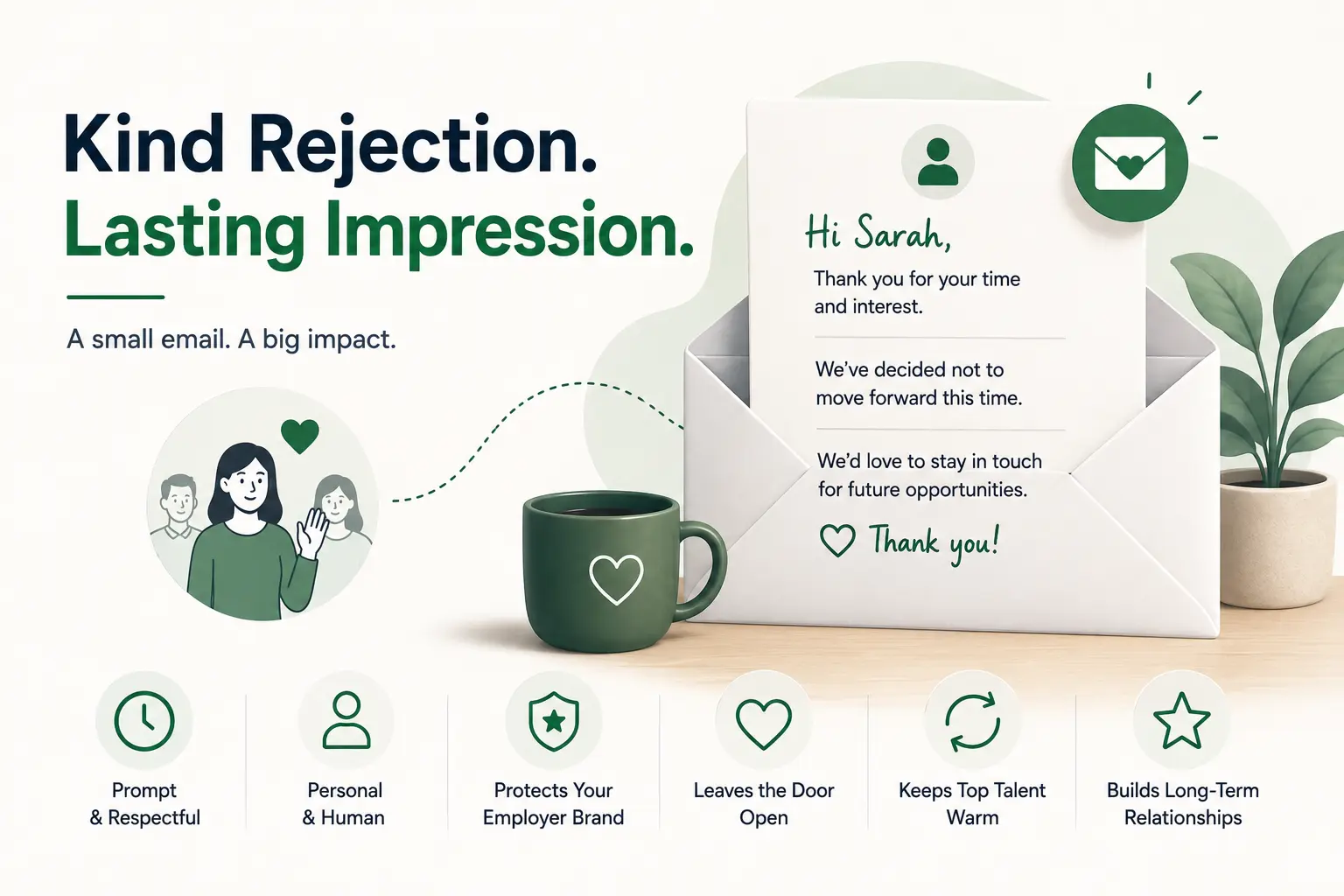
How to Write a Candidate Rejection Email in 2026 (With 6 Templates)
Key Takeaways (TL;DR)
- A candidate rejection email is the message you send to tell someone they will not be moving forward. It is easy to skip, and skipping it is one of the most common and costly hiring mistakes teams make.
- Employer silence is rampant. Around 53% of job seekers say they were ghosted by an employer in the past year, up from the year before, which is exactly the reputation you do not want.
- A good rejection email protects your brand, keeps strong candidates open to future roles, and reduces the ghosting cycle where ignored candidates ignore you back.
- The formula is simple: be prompt, be human, be clear, and be kind. Say no cleanly, thank them, and keep the door open where you mean it.
- Below are six templates you can copy for each stage of the process, plus what to avoid.
Why candidate rejection emails matter
It is tempting to treat rejections as optional. There are more applicants than roles, so why spend time on the people you are not hiring? Because that silence is expensive, and the cost is easy to miss.
Employer ghosting has become normal. About 53% of job seekers report being ghosted by an employer in the past year, a figure that keeps rising (The Interview Guys, 2025 Ghosting Index). Every one of those candidates remembers it. They leave reviews, they tell friends, and they do not apply again, including for the role that would have been perfect.
There is a compounding effect too. When employers go silent, candidates stop feeling any obligation to reply, so your own no-show and drop-off problem gets worse. A prompt, respectful rejection breaks that cycle. It costs a few minutes and protects something that takes years to build, which is your reputation as an employer.
A good rejection email does three things at once: it closes the loop kindly, it protects your brand, and it keeps a strong candidate warm for the next opening. That is a lot of value for a short message.
What every good rejection email needs
You do not need to write something long or agonise over the wording. Strong rejection emails share the same handful of traits.
Promptness. Send it as soon as the decision is made. A fast no is far kinder than weeks of silence followed by nothing.
The candidate's name. A personal greeting, not "Dear Applicant." The more time they invested, the more personal it should be.
A clear decision. Say plainly that they will not be moving forward. Do not bury it so deep they have to guess.
Warmth and thanks. Acknowledge their time and effort. A little genuine appreciation goes a long way.
The right amount of feedback. For early stages, keep it brief. For final-round candidates, a specific, kind reason is a real gift, where you can give it.
An open door, if you mean it. Inviting a strong candidate to apply again, or to join a talent pool, turns a rejection into a relationship.
The golden rule: match the effort to the stage. A one-click applicant needs a short, warm note. A final-round candidate who spent hours with you deserves a personal, specific one.
6 candidate rejection email templates
Copy, adjust, and keep them on hand. Replace the bracketed parts with your details.
1. After application (early screen)
Subject: Your application to [Company]
Hi [Name],
Thank you for applying for the [Role] position and for your interest in [Company]. After reviewing your application, we have decided not to move forward at this stage.
We know it takes time to apply, and we appreciate you giving us the chance to consider you. We would genuinely welcome an application from you for future roles that fit your experience.
Wishing you all the best in your search, [Your name], [Company]
2. After a phone screen
Subject: Update on your application to [Company]
Hi [Name],
Thank you for taking the time to speak with us about the [Role] position. We enjoyed learning more about your background, but we have decided to move ahead with other candidates for this role.
We appreciate the time you gave us and would be glad to stay in touch for future openings that match your skills.
All the best, [Your name], [Company]
3. After a first interview
Subject: Your interview for [Role] at [Company]
Hi [Name],
Thank you for interviewing for the [Role] position and for the thoughtful conversation. This was a difficult decision, and after careful consideration we have decided not to move forward with your application.
We were genuinely impressed by [specific strength], and we hope you will consider us again as new roles open up.
Thank you again for your time and interest, [Your name], [Company]
4. After a final interview (with feedback)
Subject: An update on the [Role] role at [Company]
Hi [Name],
Thank you for the time and energy you put into the process for the [Role] position. This was a very close decision, and I want to be honest with you: we have chosen another candidate whose experience in [specific area] was a slightly closer match for what this role needs right now.
I want to be clear that this is not a reflection of your ability. [Specific, genuine strength you saw.] If it would help, I am happy to share more detailed feedback on a quick call.
You made a strong impression, and I would encourage you to apply again. Thank you for giving us the chance to meet you.
Warm regards, [Your name], [Company]
5. The silver-medalist (keep warm for future roles)
Subject: Not this time, but we would love to stay in touch
Hi [Name],
Thank you again for interviewing for [Role]. You were one of our strongest candidates, and the decision came down to the finest of margins.
We expect to be hiring for similar roles in the coming months, and I would love to keep you in mind. Would you be open to me reaching out when the right opening comes up?
Either way, thank you for a great process. I hope our paths cross again.
Best, [Your name], [Company]
6. High-volume (short and kind)
Subject: Your application to [Company]
Hi [Name],
Thank you for your interest in the [Role] position. We received a large number of strong applications and will not be moving forward with yours this time.
We are grateful you thought of us and encourage you to apply for future roles that fit your experience.
Best wishes, The [Company] Team
What to avoid in a rejection email
A few habits turn a helpful message into a harmful one.
Silence. The worst rejection is no rejection. If you can only fix one thing, reply to everyone.
False hope. Do not say "we will keep your details on file" unless you actually will. Empty promises erode trust.
Over-explaining. You do not owe a paragraph of legal reasoning. For early stages, brief and kind beats long and defensive.
Risky specifics. Keep feedback about the role's needs and observable skills, not personal traits, to stay fair and avoid discrimination risk.
A cold, templated tone for finalists. Someone who spent hours with your team can tell when they got a mail-merge. Personalise the ones that matter.
When a rejected candidate replies
Sometimes a rejection email gets a reply. A candidate thanks you, asks for feedback, or occasionally pushes back on the decision. How you handle that moment shapes what they remember, so it is worth a plan.
If they simply say thank you, a short, warm acknowledgement is enough. If they ask for feedback, give it where you can, kept to the role's needs and observable skills rather than personal traits, and keep it brief and kind. You do not owe a detailed report, but a specific, usable pointer is a genuine gift, especially to a final-round candidate.
If they push back or seem upset, stay calm and do not relitigate the decision. Acknowledge their disappointment, reaffirm the decision simply, and thank them again. You will not change every mind, and that is fine. The goal is to be respectful and consistent, not to win an argument. A candidate treated well even in disagreement often still speaks well of you.
How this fits a healthier hiring process
Rejection emails are the visible edge of candidate experience, but the deeper fix is a process that produces fewer, better-matched candidates in the first place. When your shortlist is built on evidence, you have fewer people to reject and more time to reject them well.
That is where the front of the funnel matters. Navero screens and ranks candidates on verified skills, so the people who reach your interviews are genuinely qualified, and AI screening filters out roughly 60% of unqualified applications before anyone books a call (based on customer data). Fewer mismatched applicants means every rejection can be more thoughtful, not less.
The strong candidates you do reject are worth keeping. Building a talent pool from your silver medalists turns today's rejection into tomorrow's fast hire, and it is exactly why a warm, honest rejection email pays off. For the bigger picture, see our guides to improving the candidate experience and measuring your candidate experience score.
One principle underpins all of it: Navero surfaces and scores candidates on evidence and shows its reasoning, while your team makes the final call, which keeps the process both fair and human.
Frequently Asked Questions
Should you send a rejection email to every candidate? Yes, wherever you reasonably can. Even a short, warm note to applicants who did not pass the first screen protects your brand and breaks the silence cycle. The more time a candidate invested, the more personal the message should be.
How soon should you send a rejection email? As soon as the decision is made. A prompt no is far kinder than weeks of silence. For candidates still in an active process, tell them the timeline and stick to it.
Should a rejection email include feedback? Keep it brief for early stages, and offer specific, kind feedback for final-round candidates where you can. Focus on the role's needs and observable skills, not personal characteristics, to stay fair and avoid legal risk.
How do you reject a candidate without discouraging them from reapplying? Be warm, acknowledge their strengths honestly, and explicitly invite them to apply again or join a talent pool if you mean it. A respectful rejection often keeps a strong candidate open to your next role.
What should you never do in a rejection email? Do not stay silent, do not make promises you will not keep, do not over-explain, and do not comment on personal traits. Say no clearly, thank them genuinely, and keep it human.