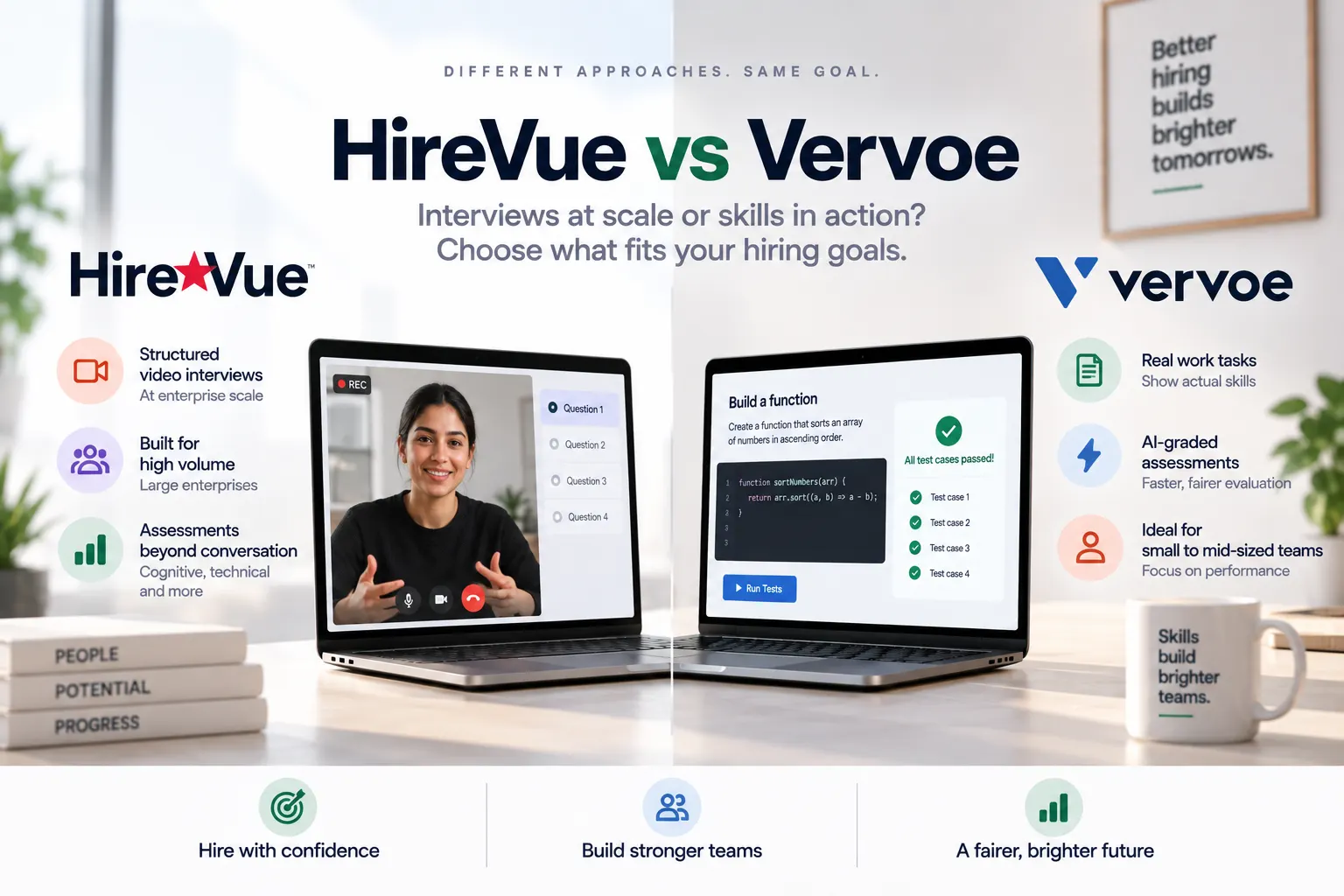
HireVue vs Vervoe (2026): Which Hiring Tool Should You Choose?
Key Takeaways (TL;DR)
- HireVue and Vervoe solve very different problems. HireVue is an enterprise video-interview platform. Vervoe is a skills-assessment tool built around AI-graded, real-task tests.
- HireVue runs structured video interviews plus assessments at large scale, which suits enterprises interviewing thousands of candidates.
- Vervoe focuses on task-based assessments that show how a candidate actually performs, which suits teams that want to see real work.
- The gap is scale and method: enterprise interviewing versus performance-based skills testing.The gap is scale and method: enterprise interviewing versus performance-based skills testing.
- If you want sourcing and skills screening in one platform, without enterprise cost or a separate interview tool, Navero is a strong alternative to both. Prices below are indicative, so confirm current details with each vendor.
HireVue vs Vervoe at a glance
Choose HireVue if you are an enterprise that needs structured video interviewing and assessment at very high volume. Choose Vervoe if you want AI-graded, task-based assessments that show real performance, without enterprise overhead. Here is how they compare in detail.
HireVue | Vervoe | |
|---|---|---|
Core focus | Video interviews plus assessments | AI-graded, task-based skills tests |
Scale | Large enterprise, high volume | Small to mid-sized teams |
Method | Recorded interviews and assessments | Realistic work tasks, auto-graded |
Free plan | No free trial | No free tier |
Pricing | Quote-based, enterprise | Pay-as-you-go and higher tiers, annual |
Best for | Enterprise interviewing at scale | Seeing real work performance |
Pricing and features change often. Confirm current details with each vendor before deciding.
HireVue: strengths and limits
HireVue's strength is scale and interviewing. It is built to run structured video interviews across thousands of candidates, combined with technical, cognitive, and game-based assessments, so a large enterprise can standardise interviewing across huge applicant volumes. Its support, training, and enterprise features reflect that focus.
The trade-offs are cost and complexity. HireVue is enterprise-priced and quote-based, with no free trial, so it is heavy for a smaller team. Its video-first approach is also more than many companies need, and AI-driven video assessment carries fairness questions that require careful, job-relevant use and human oversight.
Vervoe: strengths and limits
Vervoe's strength is performance-based assessment. It is built around task-based tests where candidates complete realistic work and its AI grades the output, which is closer to a work sample than a quiz. For many roles that gives a more direct read on ability, and reviewers often praise the quality of its assessment content.
The trade-offs are scope and pricing. Vervoe assesses skills but does not run interviewing at enterprise scale the way HireVue does, and it leans toward annual billing with no free tier, which can feel heavy for a team making only a few hires a year. Like any AI grading, it benefits from human review on senior or nuanced roles.
Which fits your situation?
Large enterprise, very high interview volume. HireVue's structured video interviewing at scale is built for exactly this.
You want to see real work, not a recorded interview. Vervoe's task-based approach shows performance directly.
Small or mid-sized team. Vervoe is lighter than an enterprise platform, though its annual pricing still suits steadier volume.
You want more than an interview tool or a test. If sourcing and screening are your real bottleneck, neither runs the whole front of the funnel.
Candidate experience and adoption
How a tool fits your process matters as much as its features. HireVue is an enterprise platform, so adoption usually involves a sales process, onboarding, and training, which pays off at scale but is heavy for a smaller team. Vervoe is more self-serve and quicker to start. On the candidate side, a recorded video interview asks more of applicants and can feel higher pressure, while a short, realistic skills task often feels fairer and more engaging. Whichever you use, keep it reasonable in length, because a long or intimidating process costs you strong candidates, and explain clearly why each step is there.
Common mistakes when comparing them
Buying enterprise scale you do not need. HireVue is built for very high volume. For a handful of hires, it is overkill and overpriced.
Assuming a video interview measures skill. A recorded interview shows communication and presence, not whether someone can do the work. Pair it with a real skills signal.
Overlooking fairness in AI video. AI-driven video and game-based assessment carries real fairness risk. Keep it job-relevant and human-reviewed.
Treating either as a full process. HireVue adds interviewing, Vervoe adds skills tests, but neither runs sourcing and screening end to end.
Skipping a trial on a real role. Whatever you shortlist, test it on an actual opening and judge the outcome, not the demo.
How to choose between them
Two questions settle most of it. First, what is your scale? A large enterprise with huge interview volume is HireVue's core use case, while a small or mid-sized team is usually better served by a lighter, skills-focused tool like Vervoe. Second, do you want to interview at scale, or assess real skills? HireVue leads on structured video interviewing, Vervoe on performance-based testing, and neither runs the whole hiring process. Our guides to evaluating candidates and types of pre-employment tests help with the assessment side, and our HireVue alternatives guide covers lighter options.
When neither is the right answer
It is worth naming the case where you should pick neither. Both tools assume you already have candidates and just need to interview or test them. But for many teams the real bottleneck is earlier: not enough qualified applicants, too many unqualified ones to sort, and no time to source. Adding an interview platform or a test does not fix that, it just processes a broken funnel faster. In that situation a platform that sources and screens together saves more time than either, because you are not stitching a sourcing tool, a testing tool, and an interview tool into one clumsy process. Be honest about where your hiring actually breaks before you buy for the symptom.
Do you actually need video interviews?
One question is worth asking before you pick HireVue: does your process genuinely need recorded video interviews at scale? For a large enterprise sifting thousands of applicants, structured video can bring real consistency. For most other teams, a one-way video interview adds friction for candidates and can create fairness questions, while telling you less about ability than a realistic skills task does. If your goal is to know whether someone can do the job, a work-sample or skills assessment is usually the stronger and fairer signal, and you can keep live conversation for a human interview later. In other words, do not buy an enterprise video platform to solve a problem a short, well-designed skills test would solve better and more cheaply. Match the method to what you actually need to learn about a candidate.
Where Navero fits as an alternative
HireVue focuses on interviews, Vervoe on skills tests. Navero is an alternative for teams that want the whole front of the funnel in one place, without enterprise cost or a separate interview tool.
Navero sources qualified candidates and screens them on verified skills with realistic, work-sample-style assessments, so you move from finding candidates to a ranked shortlist in one flow. It filters out roughly 60% of unqualified applications and cuts time-to-hire by up to 75% (based on customer data), shows the reasoning behind every score, and keeps a human making the final decision. That human-in-the-loop design also supports alignment with the EU AI Act, NYC Local Law 144, and EEOC guidance, which matters most with AI-driven video and assessment. For a closer look at a full platform versus a point tool, see our TestGorilla vs Navero comparison.
Want sourcing and skills screening in one place, not just interviews or tests? See how Navero's skills-based screening builds your shortlist on real work.
The bottom line
HireVue and Vervoe are not really competing for the same buyer. HireVue is the enterprise choice for organisations running structured video interviews across thousands of candidates, and able to justify the cost and setup. Vervoe is the lighter, skills-focused choice for teams that want to see real work without enterprise overhead. So decide from your scale and method first, not a feature checklist. If you are not a large enterprise doing high-volume interviewing, Vervoe or a broader skills platform will usually serve you better than HireVue. And if your real problem is the whole front of the funnel, a platform that sources and screens together is a better answer than either point tool.
Frequently Asked Questions
Is HireVue or Vervoe better? Neither is universally better. HireVue is the enterprise choice for structured video interviewing at very high volume. Vervoe is the skills-focused choice for teams that want AI-graded, real-task assessments without enterprise overhead. The right pick depends on your scale and whether you want interviewing or performance testing.
What is the main difference between HireVue and Vervoe? HireVue is primarily an enterprise video-interviewing and assessment platform, while Vervoe is a skills-assessment tool built around realistic, AI-graded work tasks. One is built for interviewing at scale, the other for seeing how candidates actually perform.
Which is cheaper, HireVue or Vervoe? Vervoe, in most cases. HireVue is enterprise-priced and quote-based with no free trial, while Vervoe offers pay-as-you-go and higher tiers, typically billed annually. Confirm current pricing with each vendor, since plans change.
Do HireVue and Vervoe replace a full hiring process? No. HireVue adds interviewing and Vervoe adds skills testing, but neither runs sourcing, screening, and workflow end to end. Teams whose bottleneck is the whole front of the funnel often prefer a full platform like Navero.
Which is better for a small business, HireVue or Vervoe? Vervoe, in almost every case. HireVue is an enterprise platform priced and built for very high interview volume, which a small business rarely needs and would pay heavily for. Vervoe is lighter and more self-serve, though a broader skills platform can be an even better fit for a small team hiring across roles.
Is AI video assessment fair? It can be a fairness risk if used carelessly. AI-driven video and game-based assessments must be genuinely job-relevant, validated, and reviewed by a human, not used as an automatic gate. Rules like the EU AI Act and EEOC guidance are tightening around exactly this, so keep a person in the decision and be able to explain any score.
What is a good alternative to HireVue and Vervoe? If you want sourcing and skills screening in one platform, without enterprise cost or a separate interview tool, Navero is a strong alternative. It screens candidates on verified skills and hands your team an evidence-based shortlist, with a human making the final call.