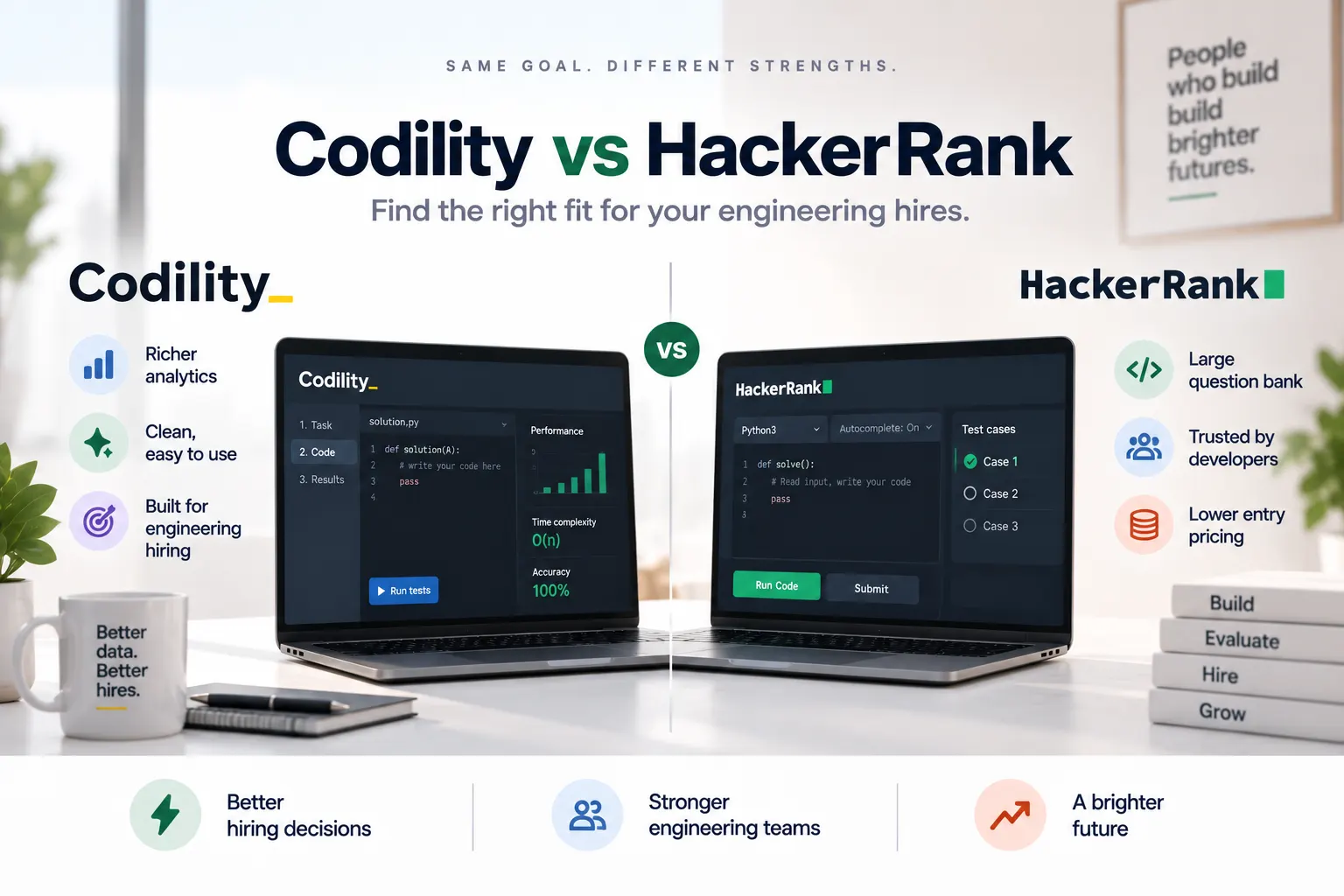
Codility vs HackerRank (2026): Which Coding Assessment Tool Should You Choose?
Key Takeaways (TL;DR)
- Codility and HackerRank are two of the most-used coding assessment platforms for engineering hiring. Both run automated coding tests with live interview tools, and both score well with users. The differences are in analytics, ease of use, and price.
- Codility is praised for a clean interface, strong performance analytics, and a tight focus on engineering hiring science.
- HackerRank is known for a very large question bank, a well-known developer brand, and lower entry pricing for high-volume screening.
- Both are excellent for pure coding assessment, so the choice comes down to analytics and UX versus question bank and cost.
- If you hire across technical and non-technical roles, or want sourcing and screening in one place, Navero is a broader alternative. Prices below are indicative, so confirm current details with each vendor.
Codility vs HackerRank at a glance
Choose Codility if you want richer analytics, a cleaner experience, and a tight engineering-hiring focus. Choose HackerRank if you want a bigger question bank, a familiar developer brand, and lower entry pricing for high-volume screening. Here is how they compare in detail.
Codility | HackerRank | |
|---|---|---|
Best known for | Analytics and clean UX | Large question bank and brand |
Focus | Engineering hiring science | High-volume developer screening |
Entry price | Higher baseline, per-candidate fees | Lower starting tier, per-attempt fees |
Ease of use | Often rated easier to set up | Extensive, feature-rich |
AI interviewer | More limited tooling | Live hinting, scoring, transcripts |
G2 rating | Around 4.6 / 5 | Around 4.6 / 5 |
Pricing and features change often, and both have adjusted pricing recently. Confirm current details with each vendor.
Codility: strengths and limits
Codility's strength is the experience and the data. Reviewers consistently praise its clean, intuitive interface, which keeps candidates focused on solving the problem, and its performance analytics, which help engineering teams make decisions on evidence rather than a raw pass or fail. Its tech-stack integration supports realistic, framework-based tasks, and it is often rated easier to set up and administer.
The trade-offs are cost and scope. Following a 2026 pricing change, Codility's baseline seat costs and per-candidate fees rose, which can make it pricier at entry. And like any coding-specific tool, it is built for engineering roles, so it is not the answer for hiring across a mixed team.
HackerRank: strengths and limits
HackerRank's strength is breadth and reach. It offers a very large library of prebuilt coding challenges and questions, which streamlines high-volume technical screening, and it has strong brand recognition among developers, so candidates often know the platform. Its AI interviewer adds live hinting, automated scoring, and transcript analysis, and its entry pricing is generally lower, which suits large-scale screening.
The trade-offs are experience and focus. Some reviewers find Codility's interface and setup smoother, and, like Codility, HackerRank is built specifically for coding assessment, so it does not help you hire the non-technical half of your team.
Which fits your situation?
You want the smoothest experience and deepest analytics. Codility tends to win on interface and decision data.
You screen developers at very high volume on a budget. HackerRank's large question bank and lower entry price fit that scale.
You want candidates to recognise the platform. HackerRank's developer brand is an advantage.
You hire beyond engineering. Neither tool helps with non-technical roles, so a broader skills platform may serve you better.
A closer look at candidate experience
For coding tests, the candidate's experience matters more than teams expect. A clunky editor or a confusing task makes strong developers drop out, and good engineers have options. Codility is often praised for a clean, focused interface that lets candidates concentrate on the problem. HackerRank is familiar to many developers, which lowers friction because they already know the format. Both are solid here, so the tie-breaker is whether you value a smoother, more modern feel (Codility) or a platform your candidates likely already recognise (HackerRank). Either way, keep the test length reasonable, because a long take-home loses good people no matter which tool you use.
Common mistakes when comparing them
Judging on question count alone. A huge question bank is nice, but the quality and realism of the tasks matter more than the number.
Ignoring the total cost. Both use per-candidate or per-attempt fees on top of a base price. Model your real volume, not just the entry tier.
Testing puzzles, not the job. Abstract algorithm puzzles do not always reflect real engineering work. Favour tasks that look like the job.
Forgetting the interview. A coding test is one step. Pair it with a structured interview and integrity checks for a full read.
Buying a coding tool for a mixed team. Both are engineering-only. If you hire non-technical roles too, you will need something else for them.
How to choose between them
For pure developer hiring, it comes down to two questions. First, do you value analytics and UX, or question bank and price? Codility leans toward the former, HackerRank toward the latter. Second, at what scale are you screening? HackerRank's lower entry tier suits high-volume screening, while Codility's analytics reward teams that want to hire on richer data. Whichever you pick, remember that a coding test is one part of hiring an engineer. Pair it with structured interviews and integrity checks, as covered in our guides to technical skills assessment and anti-cheating software for technical interviews.
Remember: a coding test is one signal
Whichever tool you pick, keep the coding test in perspective. It tells you whether a candidate can solve the problems you set, which is important but not the whole story of a good engineer. It does not tell you how they collaborate, how they handle ambiguity, whether they write maintainable code under real conditions, or whether they fit the team. So treat the test as a strong first filter, not the final verdict. Pair it with a structured interview for judgment and fit, a realistic task that mirrors your actual codebase where you can, and a clear, consistent rubric. The teams that hire the best engineers are not the ones with the hardest coding test. They are the ones who combine a fair test with good judgment about everything the test cannot see.
Where Navero fits as an alternative
Codility and HackerRank are excellent at one thing: assessing coding ability. But most companies hire more than developers, and even engineering teams need more than a coding test. Navero is a broader alternative for teams that want to screen across technical and non-technical roles, and that want sourcing and screening in one place rather than a standalone coding tool.
Navero screens and ranks candidates on verified skills with realistic, job-relevant assessments, whether the role is engineering or not, and it sources candidates too, so you get an evidence-based shortlist in one flow. It filters out roughly 60% of unqualified applications and cuts time-to-hire by up to 75% (based on customer data), shows the reasoning behind every score, and keeps a human deciding. That design also supports alignment with the EU AI Act, NYC Local Law 144, and EEOC guidance. For engineering-specific hiring, see our guide to AI recruitment software for engineering teams.
Hire across more than just developers? See how Navero's skills-based screening assesses any role on real, job-relevant work.
The bottom line
For pure developer hiring, Codility and HackerRank are both strong, and you will not go far wrong with either. Codility leans toward a cleaner experience and richer analytics. HackerRank leans toward a bigger question bank, a familiar brand, and lower entry pricing. Pick based on which of those you value and the scale you screen at. The bigger point is this: both tools do one thing, coding assessment, and most companies hire more than engineers. If your only need is dev screening, choose between them on the trade-offs above. If you hire across the whole team, or want sourcing and screening in one place, a broader skills platform will serve you better than a coding-only tool. Either way, match the tool to how you actually hire, and do not pay for a specialised coding platform to solve a problem that is really about your whole funnel.
Frequently Asked Questions
Is Codility or HackerRank better for high-volume screening? HackerRank often fits high volume well, thanks to its large question bank and lower entry pricing. Codility suits teams that want richer analytics and a smoother experience. Model your real candidate volume and per-attempt costs before deciding, since both charge beyond the base price.
Do Codility and HackerRank test more than coding? They center on coding and technical assessment, with some broader technical and problem-solving tasks. Neither is built to assess non-technical roles, so for a mixed workforce you will need a separate tool or a broader skills platform.
Is Codility or HackerRank better? Both are strong coding assessment tools, and neither is universally better. Codility tends to win on clean UX and performance analytics, while HackerRank wins on a larger question bank, developer brand recognition, and lower entry pricing for high-volume screening.
What is the main difference between Codility and HackerRank? Codility focuses on a smooth experience and rich engineering-hiring analytics, while HackerRank emphasises a very large question bank and scale for high-volume developer screening. Both run automated coding tests with live interview tooling.
Which is cheaper, Codility or HackerRank? HackerRank generally has a lower entry price, while Codility raised its baseline and per-candidate pricing in 2026. Exact costs depend on volume and plan, so confirm current pricing with each vendor before deciding.
Are Codility and HackerRank only for developers? Largely, yes. Both are built specifically for coding and technical assessment, so they do not help with hiring non-technical roles. Teams hiring across a mixed workforce often pair them with, or replace them by, a broader skills platform.
Is a coding test enough to hire an engineer? No, on its own. A coding test is a strong first filter for technical ability, but it does not show collaboration, communication, how someone handles ambiguity, or team fit. Pair it with a structured interview and, where possible, a realistic task that mirrors your codebase, then decide on the whole picture rather than the test score alone.
What is a good alternative to Codility and HackerRank? If you hire beyond engineering, or want sourcing and screening in one platform rather than a coding-only tool, Navero is a broader alternative. It assesses any role on verified skills and hands your team an evidence-based shortlist.