13 Essential Recruiting Software Platforms That Speed Up Hiring in 2026
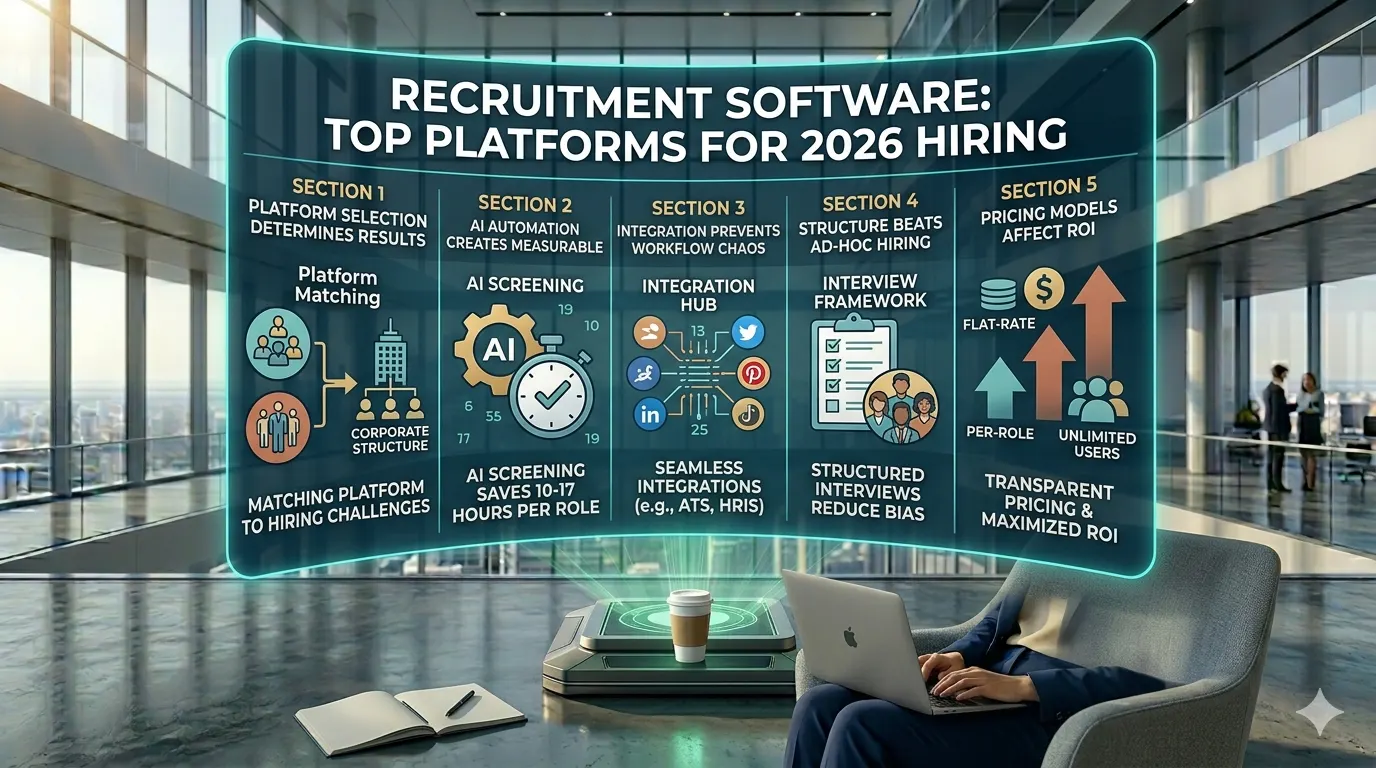
Key Takeaways (TL;DR)
- Platform Selection Determines Results: Small teams need unlimited-user solutions like BreezyHR, while enterprises require high-volume automation through Paradox or Bullhorn. Match platform capabilities to your hiring challenges, not feature lists.
- AI Automation Creates Measurable Speed: Platforms with automated screening and candidate matching save 10-17 hours per role while reducing mis-hires by up to 90%. The right software handles administrative work so recruiters focus on relationships.
- Integration Prevents Workflow Chaos: Choose platforms that connect with your existing ATS and HR systems. Top solutions offer 60-600+ integrations to maintain seamless operations without forcing system changes.
- Structure Beats Ad-Hoc Hiring: Platforms like Greenhouse that enforce consistent evaluation criteria and interview frameworks reduce bias while improving team collaboration. Consistency improves both speed and quality.
- Speed matters in hiring. AI-powered platforms reduce time-to-hire by up to 75%. More importantly, positive candidate experience influences over two-thirds of job seekers when accepting offers. For staffing firms, the impact is measurable: agencies using modern recruiting software see 15% increases in placements per recruiter.
This guide examines 13 platforms that deliver speed, accuracy, and efficiency in 2026. Each platform solves different problems. Success depends on matching the right solution to your specific hiring challenges.
Navero

Image Source: www.navero.me
Overview and Best Use Cases
Navero replaces the patchwork of recruiting tools that drain budgets and fragment workflows. The platform consolidates sourcing, screening, assessment, and interview coordination into one system that actually works. Organizations using Navero eliminate 75% of hiring hours while delivering verified shortlists within 3 days and average time-to-offer at 3 weeks.
Growing companies and tech startups making strategic technical hires see the strongest returns. Teams hiring 5+ people annually achieve positive ROI within 60 days. One seed-stage startup cut recruiting costs by 85% compared to traditional recruiters, spending $2,858.98 total for four roles instead of $25,000-$30,000 in standard placement fees.
The platform targets companies tired of resume gambling. Teams that need to verify real skills before investing interview time benefit most from Navero's approach.
Key Features That Speed Up Hiring
Navero reaches 1 billion+ candidates through automated job board distribution and offers LinkedIn promotion at 85% below direct posting costs. Every resume receives automated scoring against plain-English criteria with detailed evidence and reasoning. The system flags resume exaggerations before calls begin through trust verification signals.
Async video screening operates across 100+ languages. Candidates respond to role-specific questions on their schedule. Hiring teams receive transcripts, summaries, and scores for each response. This eliminates the scheduling nightmare for distributed teams.
Skills verification integrates work sample tests directly into workflows. Anti-cheating technology operates platform-wide through real-time screen monitoring, tab tracking, and AI detection that identifies ChatGPT responses. Candidates receive one attempt per assessment with multi-factor authentication confirming identity.
Interview coordination automates scheduling through synced team calendars. Candidates self-schedule in their timezone. Interviewers receive AI-generated preparation kits before sessions, with automatic transcription and structured scorecards afterward.
Pros and Cons
Pros:✅ Reduces mis-hires by 90% through objective skills verification before interview investment✅ Integrates with 60+ ATS platforms without disrupting existing tech stacks✅ Eliminates coordination bottlenecks, saving recruiters 10-15 hours weekly on scheduling alone
Cons:
Requires adaptation for teams accustomed to resume-only screening processes
Advanced AI features need training for teams unfamiliar with assessment technology
Pricing and Integration Options
Navero charges $499 per active role with complete functionality included: sourcing, evidence-based CV scoring, video screening, skills testing, interview automation, and anti-cheating technology. The platform connects natively with over 60 Applicant Tracking Systems.
This per-role pricing eliminates the seat-based costs that restrict team participation in other recruiting software.
Greenhouse

Image Source: www.greenhouse.com
Overview and Best Use Cases
Greenhouse earned recognition as Best Software for Enterprise in 2026, serving organizations like DoorDash, Betterment, and Major League Baseball. The platform operates on a fundamental principle: structured hiring methodology that requires teams to define interview questions, competencies, and evaluation criteria before any candidate assessment begins. This eliminates the guesswork and inconsistency that plague traditional hiring processes.
Mid-sized to large enterprises across technology, healthcare, finance, and retail sectors see the strongest returns from Greenhouse's approach. Okta achieved a 227% increase in ROI through the structure, automation, and strategic insights the platform delivers. Ocado Group reduced time-to-hire by nearly 30% after implementation. CarGurus handled a 2.5x surge in post-Covid applications without breaking their data-driven process.
Key Features That Speed Up Hiring
Greenhouse combines AI functionality with structured workflows to eliminate hiring bottlenecks. The system generates job descriptions by analyzing similar roles, helping recruiters articulate requirements clearly while saving time. AI creates scorecard attributes that define specific qualities and capabilities for evaluation.
Interview kits provide standardized questions and scorecards, while automation handles scheduling across team calendars. The platform summarizes interview notes and feedback automatically after sessions complete. Resume anonymization removes identifying details like names, gender, photos, and social media links to reduce unconscious bias during screening.
The Harvest API enables programmatic access to recruiting data for custom integrations and workflow automation. A Chrome extension adds candidates directly from LinkedIn and professional platforms without manual data entry. Greenhouse maintains over 500 approved integrations spanning scheduling tools, background check providers, HR systems, and communication platforms.
Pros and Cons
Pros:
✅ Structured hiring framework reduces bias and improves collaboration through standardized evaluation
✅ Intuitive pipeline view makes tracking straightforward with robust coordination features
✅ User-friendly design allows customization to suit specific company workflows
Cons:
Reporting and analytics setup can feel overly complex and not always intuitive
Interface may feel dated and cluttered for larger hiring pipelines
Administrative setup requires more effort than simpler recruiting software options
Pricing and Integration Options
Greenhouse pricing ranges from £5.56-10 per employee per month, positioning it at the higher end of mid-market solutions. Three plan tiers exist: Essential, Advanced, and Expert, with custom pricing based on company size and hiring requirements. The platform connects with 60+ business systems including BambooHR, Calendly, Checkr, and LinkedIn Recruiter System Connect.
Workable

Image Source: Recruiting Resources - Workable
Overview and Best Use Cases
Workable has powered hiring for 27,000+ companies since 2012, delivering 1.5 million successful hires from a database exceeding 160 million candidate profiles. The platform eliminates tool fragmentation by combining recruiting and HR management in one system. PWC, Starling Bank, and Ryanair rely on Workable for their operations.
Mid-market companies with 50-500 employees see the strongest ROI from Workable's flat pricing model. JOEY Restaurants cut time-to-interview by 60%. Lethbridge School District reduced time-to-hire by 50%. The platform works best for growing businesses that need structured workflows without per-seat pricing barriers.
Key Features That Speed Up Hiring
Job distribution reaches 200+ boards from a single interface. The AI Recruiter suggests up to 50 qualified candidates per role, sourcing from 400 million searchable profiles. Automated resume screening filters applicants by keywords and qualifications before human review.
Self-scheduling eliminates coordination overhead. Candidates book available slots that sync across team calendars and timezones. The mobile app enables remote resume review and decision-making. Native integration with 70+ applications connects existing HR systems, email platforms, and background check providers.
Pros and Cons
Pros:✅ Simple interface requires minimal training for HR teams✅ Broad job board reach and AI sourcing fill pipelines quickly
✅ Built-in HR features handle onboarding, time tracking, and payroll prep
Cons:
Advanced features require learning investment that slows initial rollout
Job ad customization options limit employer branding flexibility
Support response times lag during urgent issues
Pricing and Integration Options
Workable uses flat monthly pricing rather than per-recruiter fees:
Plan | Monthly Cost | Key Features |
Standard | £237.45 | Unlimited jobs, AI sourcing (50 candidates/job), basic HR tools |
Premier | £475.70 | Video interviews, SMS messaging, skills assessments, SSO |
Enterprise | £571.00 | Custom reports, additional permissions, priority support |
Annual billing saves 20% across all plans. The platform integrates with LinkedIn Recruiter System Connect, Indeed, Zoom, Microsoft 365, and Google Workspace.
Lever

Image Source: www.lever.co
Overview and Best Use Cases
LeverTRM solves a fundamental problem in recruitment: managing relationships with passive candidates while tracking active applicants requires separate systems that create data silos. Lever eliminates this fragmentation by combining full ATS functionality with candidate relationship management in a single platform.
Netflix, Spotify, KPMG, and over 5,000 companies worldwide use Lever to maintain unified candidate databases that preserve relationship history across hiring cycles. This approach particularly benefits mid-sized to enterprise organizations with dedicated recruiting teams who need to nurture talent pipelines consistently.
The results speak clearly. Companies using Lever achieve 37-day average time-to-fill with 50:50 gender parity and 51% racial minority representation. Organizations focused on proactive talent strategy rather than reactive hiring see the strongest returns.
Key Features That Speed Up Hiring
Lever's AI Interview Companion automates the most time-consuming aspects of interview coordination. The system generates structured interview guides, tracks conversation sentiment in real time, monitors talk-time balance, and flags biased language during sessions. Interview summaries generate automatically after each conversation, eliminating manual note-taking.
Talent Fit scoring ranks applicants instantly based on experience and skill alignment. The system provides transparent reasoning for candidate rankings rather than opaque numerical scores. Automated resume screening processes applications immediately, while calendar integration eliminates scheduling delays.
Nurture campaigns maintain consistent communication with potential candidates through template-based outreach that strengthens employer branding. Visual Insights dashboards track recruitment metrics from offer acceptance rates to interview feedback across the hiring process.
Pros and Cons
Pros: ✅ Combined ATS and CRM eliminates tool fragmentation and data silos ✅ Purpose-built DEI dashboards track EEO compliance and promote fair hiring ✅ Interface requires minimal training for hiring managers and recruiters
Cons:
API access fees significantly increase integration costs
Onboarding functionality limited to digital offer letters
Reporting customization lags behind enterprise-focused competitors
Pricing and Integration Options
Lever charges £4.76-8 per employee per month, positioning in the mid-market range. Two tiers are available: LeverTRM provides core ATS, CRM, and basic analytics, while LeverTRM Enterprise adds advanced automation, AI Interview Companion, and custom API access. Implementation fees range from £3,970-£6,353.
The platform connects with 300+ HR systems, background check providers, and assessment platforms.
SmartRecruiters

Image Source: SmartRecruiters
Overview and Best Use Cases
SmartRecruiters operates as a talent acquisition suite rather than standalone recruiting software, built around an extensive marketplace of 600+ integrated partners. This approach consolidates recruitment tool management under one vendor relationship. Founded in 2010 and headquartered in San Francisco, the platform serves 4,000 organizations including Amazon, Visa, and McDonald's, managing 140 million candidate profiles.
Mid-market to enterprise organizations with high-volume or global hiring operations extract maximum value from SmartRecruiters. Companies managing multiple geographic regions benefit from GDPR compliance features and localized career page builders. Healthcare organizations like Catholic Healthcare doubled hiring volume using the platform, while retail operations handle seasonal recruitment surges through workflow automation.
Key Features That Speed Up Hiring
The Winston AI suite accelerates hiring through three components: Winston Match automatically ranks candidates against job criteria, Winston Chat provides conversational guidance reducing application abandonment, and Winston Companion handles repetitive scheduling and screening tasks. The platform distributes jobs across multiple boards with single-click posting.
Collaborative scorecards and interview feedback systems coordinate large hiring teams. Calendar sync enables candidate self-scheduling across timezones. The mobile app maintains recruiting accessibility remotely.
Pros and Cons
Pros:✅ User-friendly interface requires minimal training for hiring managers✅ Marketplace integrations eliminate separate vendor management for assessments and background checks✅ Free SmartStart plan supports evaluation with 10 active jobs
Cons:
Enterprise pricing requires direct sales conversations without transparency
Notification system excludes recruitment teams, alerting only hiring managers
Performance degrades with large candidate databases
Pricing and Integration Options
Plan | Annual Cost | Best For |
SmartStart | Free | Startups (up to 10 jobs, 250 employees) |
Essential | Starting £11,908 | Mid-size corporate hiring[323] |
High-Volume | Custom | <citation index="41" link="https://www.smartrecruiters.com/pricing/" similar_text=" |
Enterprise | Custom | <citation index="41" link="https://www.smartrecruiters.com/pricing/" similar_text=" |
SmartRecruiters connects with LinkedIn, Indeed, SAP SuccessFactors, Workday, ADP, and BambooHR.
BreezyHR

Image Source: Breezy HR
Overview and Best Use Cases
BreezyHR eliminates the per-seat pricing model that restricts hiring team participation. All paid plans include unlimited users, removing cost barriers for company-wide recruitment involvement. The platform targets small to mid-sized companies with 25-750 employees who need recruitment management without enterprise complexity.
Results speak for themselves. Dodge Data & Analytics hired 80% faster after implementation. DP Logistics cut time-to-hire by 66% through automated workflows. The platform suits tech startups requiring customization and agile scaling. Healthcare practices handle high-volume hiring through automated distribution and video interviewing. Creative agencies manage multiple client roles through visual pipeline interfaces. Remote companies rely on cloud-based functionality with mobile access for distributed teams.
Key Features That Speed Up Hiring
Drag-and-drop pipelines customize recruitment stages for different roles. One-click job posting distributes openings to 50+ job boards and social platforms, consolidating applications while maximizing reach. Breezy Intelligence uses AI verification to block fake resumes.
Resume parsing extracts candidate information automatically. Interview scheduling syncs with Google Calendar and Outlook, eliminating coordination overhead. Email and SMS templates automate communication throughout hiring stages. Video interviewing handles remote screening directly within the platform. Team collaboration enables hiring managers to leave notes, rate candidates, and share feedback in real-time.
Pros and Cons
Pros:✅ Intuitive interface simplifies candidate tracking with minimal training required✅ Automated workflows save significant time on scheduling and follow-up communication✅ Unlimited users encourage company-wide hiring participation without additional costs
Cons:
Reporting capabilities remain basic compared to enterprise solutions
Onboarding tools absent, requiring separate software for post-hire processes
Interface navigation requires learning time for some users
Pricing and Integration Options
Plan | Monthly Cost | Annual Cost | Key Features |
Bootstrap | Free | Free | 1 active position |
Startup | £150.10 | £124.68 | Unlimited positions, unlimited users |
Growth | £261.28 | £216.81 | Advanced collaboration, reporting |
Business | £420.11 | £348.64 | Premium features, priority support |
BreezyHR integrates natively with Slack, LinkedIn, Google Calendar, Indeed, ZipRecruiter, Glassdoor, and Greenhouse. Additional connections work through API and Zapier.
Paradox

Image Source: www.paradox.ai
Overview and Best Use Cases
High-volume hiring is where most recruiting software breaks down. Paradox built Olivia specifically to handle this challenge through conversational AI that manages thousands of applications without human intervention. Since 2016, the platform has automated 90% of the hiring process for enterprises dealing with massive candidate volumes.
The numbers speak for themselves. Compass Group hires 120,000 workers annually with just 20 recruiters using Paradox. 7-Eleven saved store leaders 40,000 hours per week through automated workflows. These are not incremental improvements. They represent fundamental changes in how large-scale hiring operates.
Retail, healthcare, hospitality, and franchise organizations see the strongest returns. Companies managing multiple locations and seasonal hiring surges benefit most from Paradox's enterprise-grade automation.
Key Features That Speed Up Hiring
Conversational screening replaces traditional web forms with natural text-based conversations. Candidates engage through familiar messaging interfaces, dramatically improving mobile completion rates. Olivia handles the entire scheduling process autonomously—checking calendars, coordinating across timezones, managing reschedules, and sending reminders.
The AI assistant operates 24/7 across 100+ languages, answering candidate questions instantly without recruiter involvement. Job distribution pushes openings directly to Indeed, LinkedIn, and other boards from the platform. Event automation manages recruiting fairs and virtual events from registration through scheduling.
Analytics track over 1,000 metrics covering engagement, time-to-schedule, and candidate drop-off points. This visibility reveals bottlenecks that would otherwise remain hidden.
Pros and Cons
Pros:✅ Handles high-volume hiring at enterprise scale across multiple locations simultaneously✅ Reduces administrative recruiting time by 75% through complete automation✅ Integrates with major ATS platforms including Workday, SAP SuccessFactors, and Greenhouse
Cons:
Enterprise pricing requires lengthy sales conversations without published rates
Implementation needs dedicated project management and configuration time
Video interview transcripts lack automated highlight extraction
Pricing and Integration Options
Paradox operates on custom enterprise pricing without published rates. Implementation costs vary significantly based on scale:
Pricing Tier | Estimated Annual Cost |
Mid-Market | £23,824.80-£79,416.01+ |
Enterprise | £50,000-£200,000+ |
The platform connects natively with Workday, SAP SuccessFactors, Oracle Taleo, Greenhouse, Lever, JazzHR, and SmartRecruiters.
GoodTime

Image Source: GoodTime
Overview and Best Use Cases
GoodTime solves one specific problem exceptionally well: enterprise interview scheduling automation. The platform handles everything from basic phone screens to complex multi-day panel interviews across global teams. AI agents operate around the clock to eliminate bottlenecks, balance interviewer workloads, and coordinate schedules without human intervention.
Companies achieve 75% increases in hiring team productivity and 88% reductions in scheduling time. Job offer acceptance rates reach 85%. Mid-size to large organizations with high-volume hiring needs see the strongest returns.
Toast cut their time-to-fill from 60 to 45 days after implementation. Interview scheduling became 50% faster with 55% fewer cancelations. The platform excels at corporate hiring, high-volume roles, and campus recruiting events through purpose-built workflows.
Key Features That Speed Up Hiring
GoodTime automates 90% of interview management tasks. AI handles scheduling, interviewer selection, messaging, reminders, and rescheduling without manual oversight. Deep integrations with Workday, SuccessFactors, iCIMS, Greenhouse, and Lever maintain continuous data alignment.
Candidate self-scheduling through branded portals eliminates coordination overhead. AI-driven bottleneck detection identifies process inefficiencies and recommends improvements. Interview pool management distributes workload fairly across teams while preventing interviewer burnout.
New interviewers receive automated training paths to maintain consistent evaluation quality.
Pros and Cons
Pros:✅ Reduces administrative errors by 62% through automation✅ Deep ATS integrations eliminate duplicate data entry
✅ Real-time analytics reveal scheduling efficiency and bottlenecks
Cons:
Enterprise pricing requires sales conversations without published rates
Complex interface needs training for new users
ROI requires high interview volume to justify investment
Pricing and Integration Options
GoodTime offers three tiers with custom pricing based on annual candidate volume. Starter serves medium-volume recruiting teams, Professional includes deeper automation, and Enterprise provides advanced reporting for large-scale operations.
Annual costs range from $36,000 (Starter with $20,000 setup) to $72,000 (Professional with $35,000 setup). The platform connects natively with major ATS systems, Google Calendar, Office 365, Zoom, and Slack.
Zoho Recruit

Image Source: Zoho
Overview and Best Use Cases
Zoho Recruit operates on a Forever Free model that supports one active job posting, removing financial barriers for independent recruiters and startup agencies. The platform combines ATS functionality with recruitment CRM capabilities in a single interface designed for both corporate HR teams and staffing agencies. Small to mid-sized businesses benefit from straightforward setup and extensive customization options that adapt to specific workflows. One recruitment firm compressed their candidate profiling and shortlisting process from days to hours after implementation.
Key Features That Speed Up Hiring
Resume parsing handles 250 resumes daily on Standard plans, scaling to 500 on Professional and unlimited processing on Enterprise tiers. Single-click job distribution pushes openings to 15+ free job boards simultaneously. AI candidate matching calculates skill scores and identifies best-fit applicants within seconds.
Automated workflows eliminate manual tasks by handling email responses, interview status updates, and approval requests without human intervention. The mobile app enables recruiters to schedule calls, review candidates, and conduct interviews remotely.
Pros and Cons
Pros:✅ Forever Free plan eliminates barriers for solo recruiters and startups✅ Connects with 300+ applications including LinkedIn, Indeed, Slack, and Zapier✅ Customizable workflows adapt to specific recruitment processes
Cons:
Advanced features locked to higher-tier packages
Learning curve reported despite user-friendly design
Pricing and Integration Options
Plan | Monthly Cost | Key Inclusions |
Standard | £23.82/user | 100 active jobs, resume parsing, source boosters |
Professional | £60/user | 250 active jobs, AI matching, candidate portal |
Enterprise | £90/user | 750 active jobs, custom modules, client portals |
Annual billing available. Native integrations include Zoho CRM, Google Workspace, Microsoft Office, and major background check providers.
Bullhorn

Image Source: Bullhorn
Overview and Best Use Cases
Bullhorn operates as the central nervous system for staffing agencies, combining ATS and CRM functionality into one platform designed specifically for recruitment firms. The system connects sales and recruiting data in a single interface, eliminating the data silos that plague most agencies.
More than 10,000 staffing firms worldwide rely on Bullhorn, from small teams to enterprise operations. Agencies using Bullhorn Amplify AI generate 51% more submissions and achieve 22% higher fill rates. Customers see 24% more placements per head compared to agencies without the platform.
The results speak for themselves. Precision Resource Group found junior recruiters using Amplify ramp 30% faster, while experienced team members routinely double their daily output. Automated workflows save approximately 12.75 hours per recruiter per week.
Key Features That Speed Up Hiring
Bullhorn's AI Assistant writes, summarizes, and personalizes messages directly within the ATS without tab switching. The AI-powered matching system delivers 49% better candidate fit by automatically scoring and ranking applicants against specific role requirements.
Email activity tracking captures every interaction automatically, creating complete conversation history without manual data entry. The mobile app enables recruiters to view and edit candidate records, create notes, and access placement data from any location.
The platform connects with 300+ marketplace integrations through an open API, including LinkedIn, Daxtra, and Textkernel. This eliminates the need to manage multiple vendor relationships.
Pros and Cons
Pros:
Easy to learn and navigate for managing leads and candidates
Powerful CRM features with centralized candidate database and customizable workflows
Time-saving automations for resume screening, scheduling, and communications
Cons:
Slow loading and performance lag reported by users
Complex software requiring technical experience, expensive for startups
Customer support issues with slow response times and lengthy delivery for changes
Pricing and Integration Options
Bullhorn offers Team, Corporate, Enterprise, and Enterprise Plus tiers with custom pricing based on company size. The Team plan starts at £78.62 per user monthly. Corporate and Enterprise provide unlimited users with advanced features.
The platform integrates with major job boards, VMS platforms, and communication tools through its marketplace.
JazzHR
!Image
Image Source: JazzHR
Overview and Best Use Cases
JazzHR serves the often-overlooked small business market that needs real recruiting software without enterprise complexity. More than 5,000 growing companies use the platform, primarily because it replaces spreadsheet chaos with organized candidate tracking that actually works. The platform targets companies with fewer than 500 employees who need scalable recruitment without per-seat pricing anxiety.
Results speak clearly: one implementation cut time-to-hire by 50% through automated scheduling alone. Hunter Recruitment Advisors built their entire growth strategy around JazzHR, referring 123+ customers over six years while achieving 500% revenue growth. The platform works because it focuses on solving real small business problems rather than offering enterprise features that nobody needs.
Key Features That Speed Up Hiring
Customizable workflows handle the repetitive tasks that drain small recruiting teams. Email reminders, candidate progression, and follow-ups run automatically through template libraries. The Plus tier includes AI-powered candidate matching that explains its scoring transparently, helping small teams make better decisions faster.
Job syndication distributes postings to over a dozen free boards simultaneously. Self-scheduling eliminates coordination overhead, while collaborative scorecards keep hiring teams aligned. Mobile access ensures remote candidate review and decision-making work seamlessly.
Pros and Cons
Pros:
Unlimited users eliminate per-seat costs across all paid tiers
Intuitive interface requires minimal training for small teams
Quick same-day setup accelerates adoption
Cons:
Basic reporting with limited customization
Learning curve despite user-friendly design
Pricing and Integration Options
Plan | Monthly Cost | Key Inclusions |
Hero | £66.18 | 3 job postings, basic tools |
Plus | £230.31 | Unlimited jobs, AI matching |
Pro | Custom | Full ATS, reporting, support |
Native connections include LinkedIn, Indeed, Google Workspace, and major background check providers.
Fetcher

Image Source: fetcher.ai
Overview and Best Use Cases
Fetcher combines AI automation with human verification, separating it from pure-software recruiting platforms. The system searches a 500M+ candidate database and delivers qualified shortlists after human reviewers confirm quality before profiles reach recruiters. Small to mid-market companies see the strongest results, with 350+ organizations including Lyft, Reddit, and Shopify relying on the platform. Recruiters save 17 hours per role through automated sourcing.
The platform works best for companies that need consistent sourcing but lack dedicated research teams. Organizations struggling with manual Boolean searches or low response rates from cold outreach benefit most from Fetcher's approach.
Key Features That Speed Up Hiring
Automated candidate identification scans LinkedIn, GitHub, and professional networks to build role-specific pipelines without manual search strings. Multi-step email campaigns deliver 40% average response rates through personalized outreach sequences. The LinkedIn plugin enables one-click candidate addition directly from profiles.
Diversity targeting incorporates demographic goals into AI recommendations. Bidirectional ATS integration syncs with 20+ platforms including Greenhouse, Lever, and Workday through Merge's Unified API.
Pros and Cons
Pros:
Human quality control eliminates irrelevant AI recommendations before recruiter review
Strong response rates reduce time spent on candidate outreach
Global talent pool access extends beyond traditional sourcing methods
Cons:
Pricing transparency requires sales conversations rather than published rates
AI suggestions sometimes miss critical requirements, requiring additional filtering
Pricing and Integration Options
Plan | Monthly Cost | Annual Sourcing Capacity |
Growth | £300.99 | <citation index="103" link="https://fetcher.ai/pricing" similar_text="Fetcher-sourced talent |
Amplify | £515.41 | <citation index="103" link="https://fetcher.ai/pricing" similar_text="Fetcher-sourced talent |
Enterprise | Custom | <citation index="103" link="https://fetcher.ai/pricing" similar_text="Fetcher-sourced talent |
Annual payment provides a 30% discount.
Manatal

Image Source: Manatal.com
Overview and Best Use Cases
Manatal combines ATS and recruitment CRM functionality with AI automation, serving 10,000+ recruiting teams across 135+ countries. The system works particularly well for recruitment agencies managing both client relationships and candidate pipelines, especially staffing firms requiring customizable workflows.
Small to mid-sized businesses benefit from Professional plan pricing starting at £11.91 monthly. Agencies handling high-volume hiring scale effectively through Enterprise tiers. The platform addresses the specific needs of teams managing multiple client requirements while maintaining organized candidate databases.
Key Features That Speed Up Hiring
AI Interviewer handles automated video interviews with thousands of candidates simultaneously, delivering instant evaluations without scheduling coordination. AI enrichment automatically pulls candidate data from 20+ social platforms including LinkedIn, GitHub, and Twitter, building comprehensive profiles beyond standard resumes.
One-click distribution reaches 2,500+ job boards globally, maximizing candidate reach while minimizing posting effort. Customizable Kanban pipelines adapt to specific recruitment workflows, while automated sequences handle routine communication tasks. Analytics dashboards track recruitment performance metrics with custom report builders for data-driven decisions.
Key Benefits
✅ SOC II Type 2 certified with GDPR and CCPA compliance ensuring data security
✅ Unlimited hiring managers across all plans without additional seat costs
✅ 24/5 live chat and email support for immediate assistance
Limitations
Initial bugs reported with newer features like guest portals. Customer service responsiveness can vary depending on support volume.
Pricing and Integration Options
Plan | Monthly Cost | Key Inclusions |
Professional | £11.91/user | 15 jobs, 10,000 candidates, AI enrichment |
Enterprise | £27.80/user | Unlimited jobs/candidates, advanced CRM, API |
Enterprise Plus | £43.68/user | SSO, ChatGPT integration, priority support |
The platform connects natively with LinkedIn, Zapier, G Suite, and major job boards.
Platform Comparison: Quick Decision Guide
The table below cuts through the marketing noise to show what each platform actually delivers. Match your hiring volume, budget, and specific pain points to find the right solution.
For quick decisions: Navero for skills verification, Greenhouse for structured enterprise hiring, BreezyHR for unlimited users, Paradox for high-volume automation.
Platform | Best For | Key Differentiator | Starting Price | Top Speed Features | Main Advantage | Main Limitation | Integrations |
Navero | Growing companies and tech startups making strategic technical hires (5+ people annually) | Complete hiring intelligence platform consolidating sourcing, screening, assessment, and interview coordination | $499 per active role | Delivers verified shortlists within 3 days; 75% fewer hiring hours; automated CV scoring with evidence; async video screening in 100+ languages | Reduces mis-hires by 90% through objective skills verification | Requires adaptation for teams accustomed to resume-only screening | 60+ ATS platforms |
Greenhouse | Mid-sized to large enterprises across technology, healthcare, finance, and retail | Structured hiring methodology requiring defined interview questions and evaluation criteria before assessment | £5.56-10 per employee per month | AI-generated job descriptions and scorecard attributes; automated interview summaries; resume anonymization | Structured hiring framework reduces bias and improves collaboration | Reporting and analytics setup can feel overly complex | 500+ approved integrations including 60+ business systems |
Workable | Mid-market companies with 50-500 employees | Combines recruiting functionality with HR management in single system with flat pricing | £237.45/month (Standard plan) | AI Recruiter suggests 50 qualified candidates per job from 400M profiles; distributes to 200+ job boards; self-scheduling | Intuitive interface requires minimal technical knowledge; flat pricing (not per-recruiter) | Advanced modules carry a learning curve | 70+ applications including LinkedIn, Indeed, Zoom |
Lever | Mid-sized to enterprise organizations with consistent hiring volume | Merges applicant tracking and candidate relationship management into one platform | £4.76-8 per employee per month | AI Interview Companion with real-time sentiment tracking and bias flagging; Talent Fit instant scoring; automated interview summaries | Combined ATS and CRM reduces tool fragmentation | API access carries high fees | 300+ HR systems, background check providers, assessment platforms |
SmartRecruiters | Mid-market to enterprise organizations with high-volume or global hiring | Talent acquisition suite built around extensive marketplace of 600+ integrated partners | Free (SmartStart); £11,908+ annually (Essential) | Winston AI suite (Match, Chat, Companion); single-click job posting to multiple boards; collaborative scorecards | User-friendly interface requires minimal training; extensive marketplace integrations | Enterprise pricing requires direct sales conversations | 600+ integrated partners including LinkedIn, Indeed, SAP, Workday |
BreezyHR | Small to mid-sized companies with 25-750 employees | Unlimited users model across all paid plans | Free (Bootstrap); £150.10/month (Startup) | Automated job posting to 50+ boards; customizable drag-and-drop pipelines; Breezy Intelligence blocks fake resumes | Unlimited users encourage company-wide participation without additional costs | Reporting capabilities remain basic; no onboarding tools | 50+ including Slack, LinkedIn, Google Calendar, Indeed |
Paradox | Large retail, healthcare, hospitality, and franchise organizations with high-volume hiring | Conversational AI assistant (Olivia) handling 90% of hiring process through text/chat | £23,824.80-£79,416.01+ annually (Mid-Market) | Conversational screening via text; autonomous interview scheduling 24/7 in 100+ languages; event automation | Handles high-volume hiring at scale across multiple locations | Custom enterprise pricing lacks transparency; lengthy implementation | Major ATS including Workday, SAP SuccessFactors, iCIMS, Oracle HCM |
GoodTime | Mid-size to large companies with high-volume hiring needs | Specializes in complex enterprise interview scheduling automation | $36,000-$72,000 annually | AI agents automate 90% of interview management; AI-driven bottleneck detection; interview pool management | Reduces administrative errors by 62%; 88% reduction in time spent scheduling | Enterprise pricing lacks transparency; complex interface learning curve | Major ATS platforms, Google Calendar, Office 365, Zoom, Slack |
Zoho Recruit | Independent recruiters, emerging staffing agencies, small to mid-sized businesses | Forever Free plan supporting one active job posting | Free (Forever Free); £23.82/user monthly (Standard) | Resume parsing (250-unlimited daily); single-click distribution to 15+ free job boards; AI candidate matching | Forever Free plan eliminates barriers for solo recruiters | Advanced features locked to higher-tier packages | 300+ applications including LinkedIn, Indeed, Slack, Zapier |
Bullhorn | Staffing and recruitment agencies from small teams to enterprise operations | ATS and CRM specifically designed for staffing agencies with connected sales and recruiting data | £78.62 per user monthly (Team plan) | AI Assistant for message writing; AI-powered matching (49% better fit); email activity tracking | 24% more placements per head; 51% more submissions with Amplify AI | Slow loading and performance lag reported | 300+ marketplace integrations including LinkedIn, Daxtra, Textkernel |
JazzHR | Small businesses with fewer than 500 employees | Affordable recruiting software targeting small businesses without enterprise complexity | £66.18/month (Hero); £230.31/month (Plus) | AI-powered candidate matching (Plus tier); job syndication to dozen+ free boards; customizable workflows | Unlimited users eliminate per-seat costs; quick same-day setup | Basic reporting with limited customization | LinkedIn, Indeed, Google Workspace, major background check providers |
Fetcher | Small to mid-market companies needing automated sourcing | Pairs AI automation with dedicated human sourcers for quality verification | £300.99/month (Growth); £515.41/month (Amplify) | Automated sourcing from 500M+ database; personalized email sequences (40% response rate); diversity targeting | Saves recruiters 17 hours per role; human verification ensures quality | Pricing lacks transparency; AI occasionally misses requirements | 20+ ATS platforms including Greenhouse, Lever, Workday via Merge API |
Manatal | Recruitment agencies and staffing firms managing client relationships alongside candidate pipelines | Integrates ATS and recruitment CRM with AI-driven automation; serves 135+ countries | £11.91/user monthly (Professional) | AI Interviewer conducts automated video interviews at scale; AI enrichment from 20+ social platforms; distribution to 2,500+ job boards | SOC II Type 2 certified with GDPR/CCPA compliance; unlimited hiring managers | Initial bugs reported with new features; variable customer service | 2,500+ job boards; native connections with LinkedIn, Zapier, G Suite |
Conclusion
Selecting the right recruiting software comes down to matching platform strengths with specific organizational needs. As shown above, solutions range from Navero's comprehensive hiring intelligence to GoodTime's scheduling specialization, each addressing distinct pain points in the recruitment process. Small teams benefit from BreezyHR's unlimited user model or Zoho Recruit's free tier, while enterprises handling thousands of applications gain efficiency through Paradox or Bullhorn. On balance, the platforms that deliver fastest results combine AI automation with intuitive workflows, reducing administrative burden while maintaining candidate quality. Organizations should evaluate current bottlenecks before committing to ensure chosen software genuinely accelerates their unique hiring challenges.
FAQs
Q1. Which recruiting software platform is best for my organization? The best platform depends on your specific needs and company size. Small businesses with limited budgets benefit from solutions like BreezyHR with unlimited users or Zoho Recruit's free tier. Mid-sized companies often choose Workable or Greenhouse for their balance of features and scalability. Large enterprises handling high-volume hiring typically select Paradox or Bullhorn for their advanced automation capabilities. Evaluate your current hiring bottlenecks, team size, and budget to identify the platform that addresses your unique challenges.
Q2. What does the 70-30 rule mean in recruitment? The 70-30 hiring rule suggests hiring candidates who meet 70% of the job requirements rather than waiting for perfect matches. The remaining 30% represents skills or traits that candidates can develop after joining through onboarding, mentoring, or on-the-job training. This approach speeds up hiring by focusing on core competencies while recognizing that some capabilities can be learned, helping organizations fill positions faster without compromising quality.
Q3. What are the leading ATS systems available in 2026? The top ATS systems include Greenhouse, known for structured hiring methodology; Lever, which combines ATS and CRM functionality; Workable, offering flat-rate pricing with HR management; SmartRecruiters, featuring an extensive integration marketplace; and BreezyHR, providing unlimited users across all plans. Each system excels in different areas, from enterprise-scale operations to small business affordability, so the best choice depends on your organization's size, hiring volume, and specific requirements.
Q4. How much time can recruiting software save my team? Recruiting software can dramatically reduce time spent on hiring tasks. Platforms like Navero deliver 75% fewer hiring hours, while GoodTime users report 88% reductions in scheduling time. Fetcher saves approximately 17 hours per role through automated sourcing, and Bullhorn users save about 12.75 hours per recruiter weekly. The actual time savings depend on your current processes, hiring volume, and which platform features you implement, but most organizations see significant efficiency gains within the first few months.
Q5. Do I need separate software for applicant tracking and candidate relationship management? Not necessarily. Several modern platforms combine both functions in one system. Lever merges ATS and CRM to eliminate tool fragmentation, while Zoho Recruit and Manatal also integrate both capabilities. This unified approach reduces costs, simplifies workflows, and maintains all candidate data in one place. However, some organizations prefer specialized tools for each function depending on their complexity and scale. Consider whether your team needs to nurture long-term candidate relationships or primarily focuses on filling immediate openings when making this decision.