How to Build a Marketing and Recruitment Strategy That Attracts Top Talent Like Customers
Key Takeaways (TL;DR)
- Marketing principles work for talent acquisition: Use targeted content, employer branding, and data-driven campaigns to attract candidates proactively rather than posting jobs and waiting.
- Foundation determines success: Define your employer value proposition, create detailed candidate personas, and set clear goals before launching recruitment campaigns.
- Digital presence drives applications: Optimize your careers page for conversions, engage candidates on social platforms where they spend time, and ensure mobile-friendly experiences.
- Authentic content converts candidates: Employee testimonials, personalized outreach, and nurture campaigns engage both active job seekers and passive talent effectively.
- Data guides optimization: Track cost per applicant, quality of hire, and source performance to refine your approach and improve results continuously.
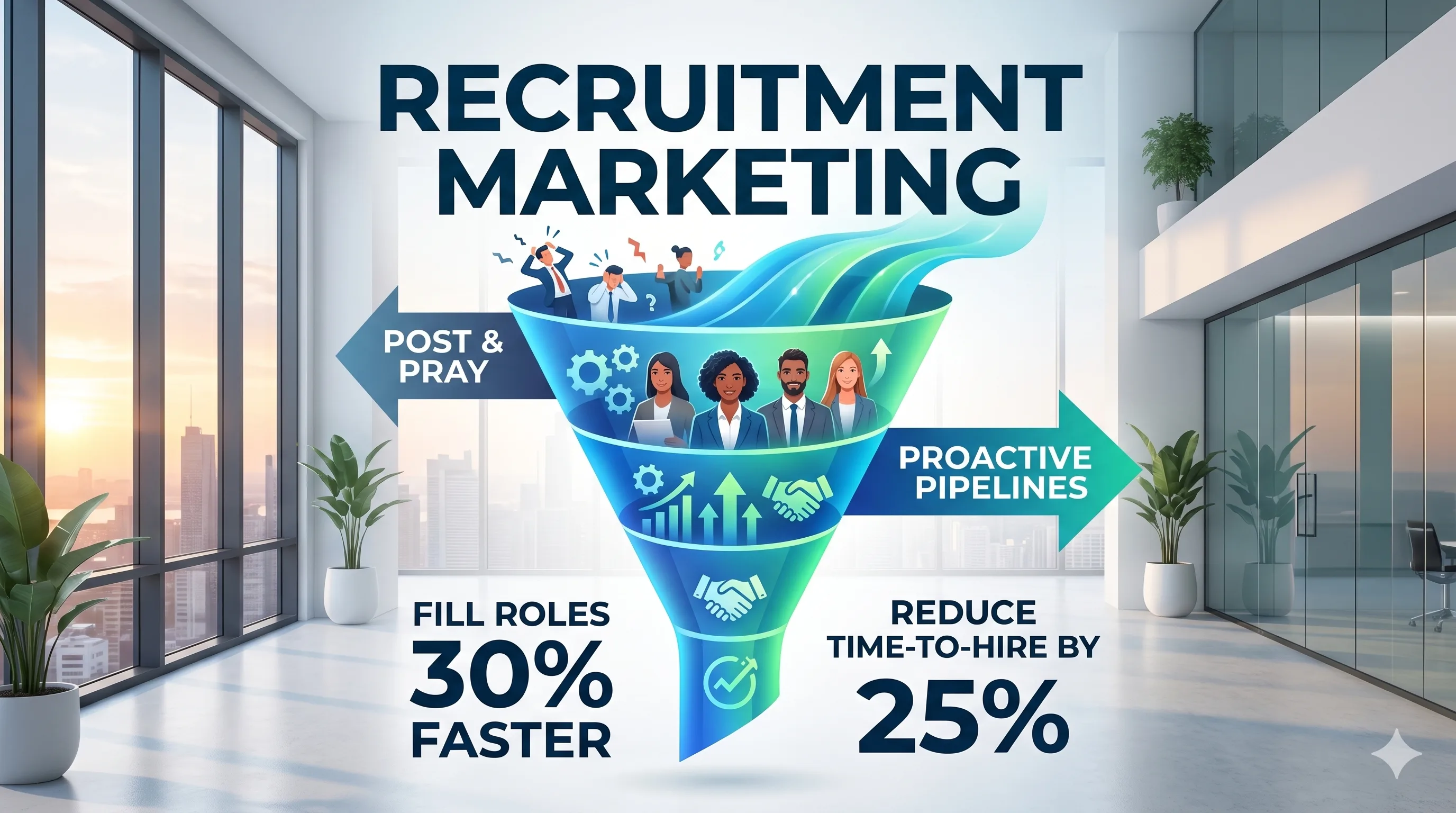
Organizations using recruitment marketing fill roles 30% faster and reduce time-to-hire by 25%. Success comes from shifting away from "post and pray" methods to building warm talent pipelines through consistent engagement and employer branding that resonates with your target candidates.
77% of organizations struggle to fill roles, marking a 17-year-high in talent shortages [1]. The competition for top talent has never been fiercer, and traditional recruiting methods are no longer enough.
Recruitment marketing treats candidates like customers, using proven marketing tactics to attract, engage, and convert top talent. This approach combines authentic employer branding, targeted content, and data-driven campaigns to stand out in crowded talent markets.
Organizations that focus on recruitment marketing can fill roles up to 30% faster [1]. This guide will show you how to build a recruitment marketing strategy that positions your company as the employer of choice.
What Is Recruitment Marketing and Why It Matters
The Shift from Traditional Recruiting to Marketing-Led Talent Acquisition
Recruitment marketing applies proven consumer marketing principles to hiring. Instead of posting jobs and waiting, organizations build relationships with potential talent before they need them.
Traditional recruiting operated on a "post and pray" model. Companies posted openings, received floods of unqualified applications, and spent weeks screening through irrelevant resumes. This reactive approach extended hiring cycles and burned through recruiter time.
Recruitment marketing flips this dynamic. Organizations use data to understand where their ideal candidates spend time online, then place targeted content and job opportunities on those specific platforms. The result is higher-quality applicants who already understand and connect with the company culture.
The difference is timing and intent. Traditional recruiting manages the conversion process after someone applies. Recruitment marketing handles everything needed to generate that application, whether from active job seekers or passive candidates considering a change.
How Recruitment Marketing Mirrors Customer Marketing
Job seekers behave exactly like consumers. They research companies online, read employee reviews, and evaluate opportunities against alternatives before deciding to apply. Organizations that recognize this pattern can craft authentic messages that resonate with their target talent.
Both disciplines use identical tools and channels. Social media, email campaigns, content marketing, and paid advertising work for products and for talent acquisition. CRM systems track engagement, marketing automation nurtures relationships, and analytics measure performance across both domains.
The marketing mindset requires thinking about employer branding like product positioning. Company culture, development programs, flexible work arrangements, and collaborative environments become your differentiators. When candidates encounter consistent messaging about these strengths across multiple touchpoints, they develop clear expectations about what working there actually offers.
Key Benefits of a Marketing-First Recruitment Approach
Organizations using recruitment marketing automation require 60% less time to fill open positions [15]. This speed comes from maintaining warm talent pipelines rather than starting searches from zero when roles open.
The pipeline approach addresses a critical reality. Around 60% of job seekers will not apply to companies that are not actively recruiting [16]. Passive outreach keeps your organization visible to talent who might consider opportunities given the right timing and presentation.
Data-driven campaigns improve both efficiency and quality. Analytics reveal which job boards consistently deliver strong candidates, enabling smarter budget allocation. Tracking source of hire, time-to-fill, and cost-per-hire provides insights that keep strategies aligned with business objectives.
Employer branding directly impacts attraction and retention. Around 50% of candidates refuse to work for companies with bad reputations, even for higher pay [17]. Furthermore, 68% of job seekers consider company reputation important when deciding whether to apply [16]. Strong recruitment marketing builds trust and positions your organization as the employer of choice.
The shift to marketing-led talent acquisition transforms how organizations think about hiring. Instead of reactive vacancy-filling, companies build proactive relationship strategies that support long-term workforce planning.
Building Your Foundation: Core Components of Recruitment Marketing Strategy
Four foundational elements determine whether your recruitment marketing succeeds or fails. Without these components, even sophisticated campaigns struggle to attract quality candidates consistently.
Define Your Employer Value Proposition
Your employer value proposition represents the unique combination of benefits, opportunities, and experiences you offer employees in exchange for their skills and commitment [4]. This goes far beyond salary to include culture, flexibility, growth opportunities, and purpose [4].
Building an authentic EVP requires data, not assumptions. Survey current employees about what they value most and what improvements they seek [17]. This research-based approach ensures your EVP reflects genuine organizational strengths rather than marketing wishful thinking.
Your EVP should address five core dimensions:
Culture and values that shape daily work experiences
Flexibility and work-life integration policies
Growth and development programs with clear pathways
Compensation and benefits packages that compete effectively
Purpose alignment with meaningful, impactful work [4]
Organizations that deliver effectively on their EVP decrease annual employee turnover by 69% [17]. Strong EVPs also improve new hire commitment by up to 29% [17]. The proposition must remain consistent across all recruitment touchpoints, from career sites to social media content [4].
Create Detailed Candidate Personas
A candidate persona is a research-based representation of your ideal hire, combining professional backgrounds with personal attributes, career aspirations, and motivations [2] [6].
These profiles enable precise targeting through informed job postings, advertisements, and sourcing strategies [18]. Personas streamline hiring by serving as evaluation guides, keeping focus on required qualifications and personality traits [18]. They enhance candidate experience by enabling recruiters to communicate at the appropriate level with targeted messaging [18].
Building accurate personas requires research, not guesswork [2]. Interview current employees in similar roles, survey candidates during interviews, and analyze data from top performers [18]. Each persona should answer these questions:
Who is the ideal candidate?
What skills and experience do they bring?
Why would they want to join your company?
Which values do they prioritize?
What objections might they raise? [18]
Establish Your Employer Brand Identity
Employer branding encompasses the perception and reputation of your company as an employer, including culture, values, and overall employee experience [9]. A strong employer brand attracts and retains quality talent while building loyalty among existing employees [9].
The data is clear: 50% of candidates refuse to work for companies with bad reputations, even for higher pay. Additionally, 68% of job seekers consider company reputation important when deciding whether to apply.
Building employer brand identity starts with defining your mission and vision, identifying unique selling points that differentiate your organization, and analyzing current brand perception [9]. Your careers site serves as the primary interface for showcasing your EVP through employee testimonials, values statements, and company news [10].
Set SMART Goals for Your Recruitment Campaign
SMART goals (Specific, Measurable, Achievable, Relevant, Time-bound) transform vague hiring ambitions into actionable objectives [11]. These goals cascade from organizational objectives to departmental OKRs to specific recruitment initiatives [11].
Setting effective goals begins with baseline audits of current metrics like time-to-fill, cost-per-hire, and quality of hire [11]. Goals must align with broader business strategy to secure buy-in and demonstrate ROI [11].
Rather than stating "hire better people," a SMART goal specifies "reduce time-to-fill from 60 days to 45 days by streamlining interviews within six months" [12]. This clarity enables measurement and accountability throughout your recruitment marketing efforts.
Channel Selection and Optimization for Talent Acquisition Marketing
The right channels determine whether your recruitment marketing reaches qualified candidates or wastes budget on unqualified applications. Each platform serves specific purposes in attracting, engaging, and converting talent.
Optimize Your Careers Page as Your Primary Conversion Hub
Your careers site functions as the most critical recruitment marketing asset. 67% of candidates visit a company's career page before applying for a position [13]. Career page conversion rates directly impact hiring velocity, though these rates dropped 22% from 11% to 8.6% year-over-year [1].
Mobile optimization is no longer optional. 60.7% of job applications were completed on mobile devices in 2020, surpassing desktop applications for the first time [14]. Application length matters significantly. Forms requiring 50 or more questions experienced 50% applicant abandonment compared to those with fewer than 25 questions [1].
Video content drives substantial conversion increases. Web pages see up to 80% higher conversions when video content is present [1]. Employee testimonials and authentic workplace footage build trust while showcasing company culture to candidates researching potential employers.
Social Media Recruiting Platforms
86% of candidates use social media when searching for roles [15], with 49% following companies that interest them on social channels [16]. Platform selection must align with your target demographics and content strategy.
LinkedIn remains the cornerstone platform. 49% of candidates use it to find jobs [17]. The platform favors thought leadership content and career growth stories.
Instagram dominates early careers recruitment. 50% of early careers candidates turn to the platform during job searches [17]. Employee takeover stories and behind-the-scenes workplace content perform best here.
TikTok has reached 1.59 billion monthly active users globally. 18% of candidates already use it in job searches [17]. Content must prioritize entertainment while occasionally incorporating recruitment messaging.
Facebook attracts 57% of executive-level candidates [17] among its 3.07 billion monthly active users.
Employee Referral Programs
Employee referral programs tap into existing networks to source qualified candidates. 45% of referral hires remain at companies for at least four years, compared to just 25% of job board hires [18]. Referrals also produce about 25% more profit than hires from other sources [18].
Successful programs require clear objectives, streamlined submission platforms, consistent communication, and meaningful incentives. Referral hires are 55% faster to recruit than traditional methods [18].
Programmatic Advertising to Reach Passive Candidates
Programmatic recruitment advertising automates job ad buying, placement, and optimization across multiple channels using real-time performance data. Only 34% of enterprise companies currently use programmatic job advertising [19], leaving efficiency gains available.
The technology reduces cost per hire by 30% compared to traditional methods [20]. It also reduces time-to-hire by 25% and increases applicant quality by targeting passive candidates more effectively [20]. Real-time bidding evaluates opportunities in milliseconds, assessing candidate profiles and role requirements across hundreds of publishers simultaneously.
Niche Job Boards vs General Platforms
Niche job boards generate three times more relevant applications than general platforms [21]. Specialized boards reduce time-to-hire by approximately 60 days compared to general platforms [21].
The average job posting on major platforms receives 250+ applications, making individual candidate evaluation difficult. Niche platforms naturally filter for relevant candidates, creating smaller, more qualified applicant pools where hiring managers can review individual submissions effectively.
Content and Engagement Tactics That Convert Candidates
Content quality determines whether talent acquisition marketing efforts convert prospects into applicants. Channels provide reach, but content drives engagement and application rates.
Develop a Content Marketing Strategy for Recruitment
Content functions as the primary touchpoint between organizations and potential talent. During awareness stages, content should showcase authentic employer brand and organizational culture. Consideration-stage content must provide detailed role insights and demonstrate clear career growth opportunities. Decision-stage content addresses candidate concerns and offers transparent recruitment process information [22].
The most effective recruitment content follows candidate journey stages rather than company priorities. Early-stage content focuses on culture, values, and workplace environment. Mid-stage content highlights specific opportunities, team dynamics, and growth paths. Final-stage content provides process clarity, timeline expectations, and next steps.
Create Employee Testimonials and Storytelling Content
Employee video testimonials generate 1200% more shares than text and image formats combined [5]. Job listings receive 36% more applications when accompanied by video [5]. Recruitment agencies report 800% more engagement on job ads with embedded video [5].
Strong testimonials follow a clear structure: why employees joined, challenges they encountered, support they received, improvements they experienced, and why they recommend the company [23]. Authenticity drives results. Employees should share genuine stories using guided prompts rather than reading scripts [23].
Video testimonials work because they provide social proof from credible sources. Candidates trust current employees more than marketing messages. These testimonials answer questions candidates ask but rarely voice: what's it really like to work here?
Personalize Candidate Communication Throughout the Journey
Personalized messages increase candidate engagement rates by more than 50% [24]. Effective personalization extends beyond using first names to include candidate relationship history, customized messaging by job category and interaction timeline, and providing value beyond immediate job opportunities [24]. Messages with multiple personalized elements boost reply rates by 142% [25].
Personalization requires data and systematic approach. Track candidate interactions, preferences, and engagement patterns. Use this information to tailor timing, content, and communication channels. Quality personalization demonstrates genuine interest in candidates as individuals.
Build Nurture Campaigns for Passive Talent
75% of people are passive candidates [26]. Nurture campaigns maintain relationships with talent through consistent messaging over extended periods, including company updates, funding announcements, and industry-relevant content [7]. Automation enables scheduled messaging that preserves context without manual effort [7].
Nurturing reduces time to hire and cost per hire by 33% compared to starting searches from scratch [26]. Passive candidates often represent the highest quality talent. They're currently employed, skilled, and selective about opportunities. Building relationships before you need them creates competitive advantage when these candidates become open to new roles.
Ensure Mobile Optimization Across All Touchpoints
58% of job seekers search for jobs on mobile devices [8]. Mobile candidates complete 53% fewer applications and take 80% longer when processes aren't mobile-friendly [8]. Mobile-friendly job ads increase candidate numbers by 11.6% [8]. Text messages see 98% open rates compared to 20% for email [8].
Mobile optimization affects every touchpoint: career pages, application forms, email communications, and social media content. Applications should load quickly, display clearly on small screens, and minimize required typing. Mobile-first design isn't optional anymore.
Measuring Success: Analytics and Continuous Improvement
Track Key Recruitment Marketing Metrics
Data transforms recruitment marketing from guesswork into predictable outcomes. 82% of talent acquisition teams already use recruiting analytics to guide strategy [27].
The most critical metrics reveal channel effectiveness and candidate quality. Cost per applicant shows which platforms deliver candidates most efficiently by dividing total campaign spend by applicants generated [27]. Source of hire identifies which channels produce candidates who perform best and stay longest [27]. Pipeline velocity tracks how quickly candidates move from initial engagement to application and interview stages [27].
These metrics create a clear picture of what works and what wastes budget. Teams that track systematically make better decisions faster.
Monitor Quality of Hire and Source Performance
Quality of hire remains the most important metric, yet the hardest to measure accurately. 89% of talent acquisition professionals agree measuring quality of hire will become more important, yet only 25% feel confident in their ability to measure it effectively [28].
Quality of hire functions as an aggregated index combining multiple data points [3]. 66% measure job performance, 60% track retention and turnover, 44% assess hiring manager satisfaction, and 44% evaluate skills match [28]. The key insight: measurements must occur both pre-hire and post-hire, as these represent distinct evaluation phases [3].
Strong source performance goes beyond volume. The best channels deliver candidates who succeed long-term, not just candidates who apply quickly.
Use Data to Optimize Your Recruiting Marketing Strategy
Recruitment analytics identifies bottlenecks, improves efficiency, and reduces costs [29]. The difference between teams that succeed and teams that struggle lies in how they act on data rather than simply collecting it.
Organizations should review dashboards regularly, share insights with hiring managers, and implement changes based on findings [30]. Tracking source effectiveness allows teams to shift budget toward high-performing channels and eliminate low-yield sources [27].
Data without action is just expensive reporting. The goal is continuous optimization based on what actually drives results.
Test and Iterate Your Campaigns
A/B testing reveals which campaign variations drive better conversion rates [31]. Small changes in job titles, email subject lines, or ad creative can produce significant differences in applicant volume and quality [32].
Successful testing requires discipline. Teams should clearly identify metrics before testing, run experiments long enough to gather reliable data, and apply successful findings across future campaigns [31].
The companies that improve fastest test constantly. They treat every campaign as an opportunity to learn something new about their target candidates.
Conclusion
Right now, you have everything needed to transform your recruitment approach from reactive hiring to proactive talent attraction. By treating candidates like customers, you can build authentic employer brands that resonate with top talent.
Start by defining your EVP and candidate personas, then optimize channels where your ideal candidates spend time. Create engaging content that showcases your culture authentically, and use data to refine what works.
Without delay, implement these strategies and monitor your metrics. The companies filling roles 30% faster aren't lucky; they're strategic. Focus on building relationships with talent before you need them, and your hiring pipeline will strengthen continuously.
FAQs
Q1. What are the most important factors that attract top talent to a company? Top talent typically evaluates opportunities based on three main factors: the company culture and people they'll work with, the actual work they'll be doing day-to-day, and the compensation package. Candidates also heavily weigh company reputation, with research showing that many won't apply to organizations with poor reputations even for higher pay. Additionally, factors like flexibility, growth opportunities, and alignment with personal values play significant roles in attracting quality candidates.
Q2. How effective are employee referral programs in recruiting top talent? Employee referral programs are highly effective recruitment tools. Referral hires tend to stay at companies significantly longer than candidates sourced from job boards, and they're also faster to recruit. Referrals typically generate higher-quality candidates because current employees understand both the role requirements and company culture, allowing them to recommend people who are genuinely good fits. Successful programs make the referral process simple and offer meaningful incentives to encourage participation.
Q3. Why is employer branding important in recruitment marketing? Employer branding shapes how potential candidates perceive your organization as a workplace. A strong employer brand attracts quality talent while fostering loyalty among existing employees. Candidates research companies extensively before applying, similar to how consumers research products before purchasing. Your employer brand communicates your culture, values, and employee experience across all touchpoints, helping you stand out in competitive talent markets and building trust with potential applicants.
Q4. How can companies reach passive candidates who aren't actively job searching? Companies can reach passive candidates through consistent nurture campaigns that maintain relationships over time, social media engagement where potential candidates spend their time, and programmatic advertising that targets specific profiles across multiple platforms. Since a large majority of workers are passive candidates, staying visible through valuable content like company updates, industry insights, and authentic workplace stories keeps your organization top-of-mind when these individuals become open to new opportunities.
Q5. What metrics should companies track to measure recruitment marketing success? Key metrics include cost per applicant to evaluate channel efficiency, source of hire to identify which platforms produce the best long-term employees, time-to-fill to measure hiring speed, and quality of hire which combines factors like job performance, retention rates, and hiring manager satisfaction. Additionally, tracking pipeline velocity shows how quickly candidates move through recruitment stages, while conversion rates on career pages indicate how effectively your content engages potential applicants.
References
[1] - https://www.jobvite.com/blog/recruitment-marketing-strategies/
[2] - https://survale.com/attract-talent-with-recruitment-marketing/
[3] - https://www.smartdreamers.com/blog/recruitment-marketing-as-a-core-function-in-talent-acquisition
[4] - https://www.jobtip.com/article/the-top-7-benefits-of-recruitment-marketing
[5] - https://www.phenom.com/blog/recruitment-marketing-guide
[6] - https://www.phenom.com/blog/employer-branding-strategy-guide
[7] - https://www.indeed.com/hire/c/info/employee-value-proposition
[8] - https://www.qualtrics.com/articles/employee-experience/employee-value-proposition/
[9] - https://www.aihr.com/blog/employee-value-proposition-examples/
[10] - https://www.avature.net/learning-hub/recruitment-marketing/build-candidate-profiles-based-on-data-not-gut-feelings/
[11] - https://www.sensehq.com/blog/candidate-personas
[12] - https://business.linkedin.com/hire/resources/hr-glossary/candidate-persona
[13] - https://www.symphonytalent.com/blog/personas-101-building-your-organizations-cast-of-characters/
[14] - https://ocs.yale.edu/tips-employer-branding/
[15] - https://www.icims.com/blog/employer-branding-strategy-guide/
[16] - https://easy.jobs/blog/how-to-set-smart-recruitment-goals-with-examples/
[17] - https://salesxceleration.com/the-power-of-smart-goals-in-recruiting/
[18] - https://www.weselect.com/blog/3-tips-to-create-a-high-converting-career-page
[19] - https://www.hirevue.com/blog/hiring/how-to-improve-your-career-page-conversion-rates
[20] - https://www.shrm.org/topics-tools/news/talent-acquisition/making-company-career-website
[21] - https://recruiters.theguardian.com/advice/social-media-recruitment-tips-and-strategies
[22] - https://www.indeed.com/hire/c/info/social-media-recruiting-tips-and-strategies
[23] - https://www.peoplescout.com/insights/platform-specific-social-media-recruitment-strategies/
[24] - https://www.bamboohr.com/blog/how-to-employee-referral-program
[25] - https://www.joveo.com/blog/programmatic-recruitment-advertising/
[26] - https://careernowbrands.com/expertise/programmatic-recruitment
[27] - https://blog.theinterviewguys.com/niche-job-boards-2025/
[28] - https://www.peoplescout.com/insights/content-marketing-in-recruitment/
[29] - https://www.seenit.io/resources/blog/employee-video-testimonials-why-they-work-(with-examples)
[30] - https://www.caseleap.com/post/employee-video-testimonials-how-to-use-internal-proof-to-strengthen-recruiting-and-brand-credibility
[31] - https://www.bullhorn.com/blog/4-ways-to-personalize-candidate-communication/
[32] - https://rentarecruiter.com/candidate-communication-best-practices/
[33] - https://breezy.hr/blog/why-long-term-candidate-nurture-is-a-must-for-modern-recruiters
[34] - https://www.gem.com/blog/nurturing-passive-talent-why-is-it-so-important
[35] - https://get.recright.com/blogs/mobile-recruitment-why-it-matters-and-how-to-do-it-well
[36] - https://www.jobvite.com/blog/prove-recruitment-marketing-roi-essential-kpis-for-ta-teams/
[37] - https://www.linkedin.com/business/talent/blog/talent-acquisition/solving-quality-of-hire-riddle
[38] - https://www.shrm.org/topics-tools/news/talent-acquisition/holy-grail-recruiting-how-to-measure-quality-hire
[39] - https://harver.com/blog/recruitment-analytics/
[40] - https://clearcompany.com/resources/blog/data-driven-recruiting-strategy
[41] - https://support.beamery.com/hc/en-us/articles/4408175844753-How-to-Use-A-B-Testing-to-Improve-Campaign-Performance
[42] - https://technologyadvice.com/blog/human-resources/a-b-testing-recruitment-strategy/