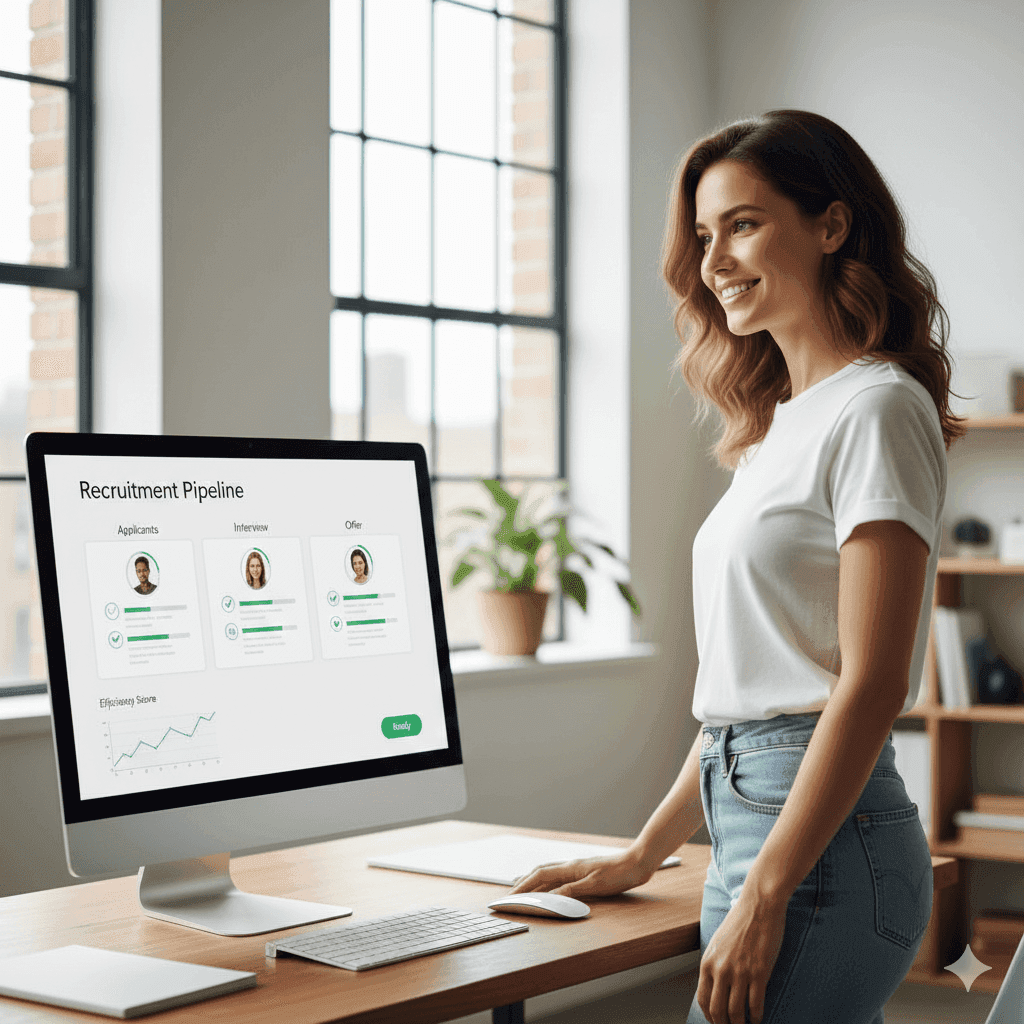
The Best Recruiting Software for Small Businesses (2026)
Key Takeaways (TL;DR)
- Efficiency is Essential: The right hiring software for small businesses automates time-consuming tasks like posting jobs, screening resumes, and scheduling interviews, freeing up your team to focus on growth.
- Key Features to Prioritize: Look for an Applicant Tracking System (ATS), seamless job board integrations, resume parsing, candidate communication tools, and collaborative hiring features.
- The Best Recruiting Software for Small Businesses: Navero stands out as the premier choice for small businesses that want to hire faster and fairer. Its AI-powered skills assessments and anti-cheating technology ensure you identify the most qualified candidates, reducing mis-hires by up to 90%.
- Scalability is a Must: Choose a solution that can grow with your business. While a simple tool might work now, a platform with robust integrations, reporting, and a strong feature set is a better long-term investment.
- Focus on Candidate Experience: The best software improves the applicant journey with clear communication and a simple process, strengthening your employer brand even if you're a small company.
Finding and hiring the right talent is a major challenge for small businesses. Juggling spreadsheets, lost emails, and manual job board postings waste time and resources. Hiring software for small businesses automates this administrative chaos, helping you compete for top talent and build your team.
In today's competitive job market, efficiency is crucial. Recruiters often spend too much time on manual tasks. For small teams, this lost time directly impacts growth. The right software centralizes your entire hiring process, from sourcing to offer letters, keeping you organized and professional.
This guide reviews the best recruiting software of 2026, helping you find the perfect tool to streamline your process, make smarter decisions, and hire better candidates, faster.
Why Your Small Business Needs Recruiting Software
For a small business, every hire is critical. A single great employee can transform your company, while a bad hire can be a significant setback. Yet, without a formal system, your hiring process can quickly become disorganized. Applications get lost in overflowing inboxes, candidate feedback is scattered across different message threads, and top prospects lose interest due to slow communication.
Recruiting software solves these problems by creating a single source of truth for your entire hiring pipeline. It brings structure and professionalism to your process, which is crucial for building a strong employer brand. When candidates have a smooth, organized, and responsive application experience, it reflects positively on your company, even if you’re a team of five. This professional image helps you attract high-quality talent that might otherwise gravitate toward larger corporations.
The Core Benefits of Using Hiring Software
Adopting recruiting software isn't just about getting organized; it's about gaining a strategic advantage. Here are the main benefits for small businesses:
- Save Significant Time:: Automate repetitive tasks like posting jobs to multiple boards, sending rejection emails, and scheduling interviews. This frees you and your team to focus on more strategic activities, like engaging with top candidates.
- Improve Quality of Hire:: Tools like skills assessments, structured interview kits, and collaborative scorecards help you make objective, data-driven decisions. This reduces the risk of making a hire based on "gut feelings" and increases the likelihood of finding a candidate who truly fits the role.
- Enhance Candidate Experience:: Provide a professional and streamlined application process. Automated acknowledgments and updates keep candidates informed and engaged, which is crucial for maintaining a positive employer brand.
- Centralize Collaboration:: Keep all hiring managers and team members on the same page. A central platform for notes, ratings, and feedback ensures everyone has access to the same information, making decision-making faster and more cohesive.
- Widen Your Talent Pool:: With one-click job posting to dozens or even hundreds of job boards (including free ones), you can easily reach a much larger and more diverse group of potential applicants.
The Best Recruiting Software for Small Businesses in 2026
Here is a curated list of the best recruiting software for a small business, chosen for their ease of use, scalability, and powerful features.
1. Navero
Navero is designed to solve the biggest problem in hiring: uncertainty. While most recruiting tools help you manage applicants, Navero helps you identify the right applicants. Its AI-powered assessment platform focuses on verifying a candidate's real-world skills, ensuring you hire people who can actually do the job. For small businesses where every hire has a huge impact, this is a game-changer.
Navero’s skills-based evaluations, combined with advanced anti-cheating technology, give you confidence that you’re making the best possible decision. By reducing mis-hires by up to 90% and time-to-hire by 75%, it offers a clear and powerful return on investment.
Key Features:
- AI-powered skills assessments tailored to your job roles.
- Proprietary anti-cheating technology to ensure assessment integrity.
- top applicant tracking systems for small businesses.: Seamless integration with over 60 of the
- A data-driven approach that prioritizes fairness and objectivity.
Who It's For: Small businesses, startups, and growing teams seeking an objective, efficient, and data-driven method to validate candidate skills and drastically reduce mis-hires.
2. Gusto
Gusto is a fantastic choice for small businesses that want to manage hiring, onboarding, payroll, and benefits all in one place. Its recruiting tools are integrated directly into its HR platform, creating a seamless transition from candidate to employee. While its ATS isn't as feature-rich as standalone options, the convenience of an all-in-one system is a huge advantage for lean teams.
Key Features:
- Built-in applicant tracking system.
- Syndication to popular job boards like Indeed and ZipRecruiter.
- Customizable offer letter templates with e-signatures.
- Smooth integration with Gusto’s payroll and onboarding workflows.
Who It's For: Small businesses already using or considering Gusto for payroll and HR that want a simple, integrated solution for occasional hiring.
3. BreezyHR
BreezyHR stands out with its generous "Bootstrap" plan, which is forever free and includes one active job posting. This makes it the perfect entry point for small businesses that hire infrequently but still want professional tools. Its user-friendly, drag-and-drop interface makes it easy to manage candidates, and even the free plan offers unlimited users and candidates.
Key Features:
- Visual, Kanban-style hiring pipelines.
- Branded careers page and resume parsing.
- Automated candidate messaging and interview scheduling.
- Team collaboration tools.
Who It's For: Startups and very small businesses on a tight budget that need a powerful-yet-free tool for their first few hires.
4. Greenhouse
Greenhouse is a favorite among fast-growing companies for a reason. It champions a "structured hiring" methodology, providing tools to reduce bias and make more consistent, data-driven decisions. With customizable scorecards, interview kits, and powerful reporting, it’s designed to help you build a fair and repeatable hiring process that scales with your business.
Key Features:
- Structured interview kits and scorecards.
- In-depth reporting and analytics.
- DE&I-focused features to promote fair hiring.
- Extensive integration marketplace with over 400 partners.
Who It's For: Growing small businesses that plan to hire frequently and want to establish a sophisticated, scalable, and fair hiring process from the start.
5. Workable
Workable excels at helping you fill your pipeline with qualified candidates. Its AI-powered sourcing tool scans millions of profiles to find passive talent that fits your needs. It also automates much of the initial engagement, making it easier to connect with a large number of prospects. With one-click posting to over 200 job boards, it’s built for speed and reach.
Key Features:
- AI-powered candidate sourcing.
- One-click posting to 200+ job boards.
- Built-in assessments and video interview tools.
- A mobile app for managing hiring on the go.
Who It's For: Small businesses in competitive industries that need to proactively source candidates and want powerful AI tools to speed up the process.
6. Rippling
Rippling is a workforce management platform that takes automation to the next level. Its recruiting module seamlessly connects hiring to payroll, benefits, app provisioning, and even device management. When you hire a candidate, Rippling can automatically set up their payroll, order their laptop, and grant them access to the right software. This level of automation is unmatched.
Key Features:
- Posts jobs to over 25,000 boards.
- Fully automated onboarding workflows (HR and IT).
- Global hiring support for employees and contractors.
- Modular pricing lets you pay only for what you need.
Who It's For: Tech-forward small businesses that want to automate as much of the employee lifecycle as possible, from hiring to offboarding.
7. JazzHR
JazzHR is known for its straightforward and beginner-friendly approach. It offers a simple, clean interface that makes it easy for small teams to get up and running quickly. It provides all the essential recruiting features–like customizable pipelines, branded communication, and collaborative tools–without the complexity or high price tag of more advanced systems.
Key Features:
- Intuitive and easy-to-learn user interface.
- Customizable hiring workflows and email templates.
- Candidate ranking and evaluation tools.
- Integrations with major HR and payroll providers.
Who It's For: Small businesses that need a no-fuss, affordable ATS and prioritize ease of use over advanced features.
8. Freshteam
Freshteam, from the makers of Freshworks, is designed to help small HR teams manage the entire employee lifecycle. Its recruiting module is particularly strong for handling high volumes of applicants. Each candidate gets a detailed profile that centralizes their resume, communications, and internal feedback, making it easy to screen and manage applicants efficiently.
Key Features:
- Single, comprehensive profile for each candidate.
- Customizable hiring workflows and checklists.
- Built-in email templates and automated reminders.
- Free plan available for businesses with under 50 employees.
Who It's For: Small businesses that receive a lot of applications and need a system to help them screen and organize candidates quickly.
9. Zoho Recruit
While Zoho Recruit is powerful enough for large enterprises, its affordable pricing and free plan make it accessible to small businesses. It offers robust tools for sourcing, tracking, and engaging candidates, including an AI-powered resume parser and candidate matching. It's particularly well-suited for staffing agencies but also works great for in-house corporate recruiters.
Key Features:
- AI-powered resume parsing and candidate matching.
- Extensive workflow automation rules.
- Customizable reports and dashboards.
- Integrates seamlessly with the broader Zoho ecosystem.
Who It's For: Small businesses with high-volume hiring needs or those already invested in the Zoho suite of business apps.
10. Lever
Lever combines a traditional ATS with a Candidate Relationship Management (CRM) system. This approach, which Lever calls TRM (Talent Relationship Management), helps you proactively build and nurture a pipeline of passive talent. Instead of just managing active applicants, Lever empowers you to maintain relationships with promising candidates for future opportunities.
Key Features:
- Unified ATS and CRM functionality.
- "Nurture" campaigns to keep passive candidates engaged.
- Chrome extension for easy sourcing from LinkedIn and other sites.
- Visual reporting on pipeline health and sourcing efforts.
Who It's For: Small businesses that want to adopt a long-term, proactive approach to talent acquisition rather than just filling immediate openings.
H2 How to Choose the Right Hiring Software for Your Small Business
With so many great options, selecting the right one depends on your specific needs. Follow these steps to make a smart decision:
- Identify Your Biggest Pain Points:: Are you spending too much time manually posting jobs? Is your team's feedback disorganized? Are you worried about making bad hires? Pinpoint your top 1-3 challenges to guide your search.
- Define Your Budget:: Pricing can range from free to several hundred dollars per month. Determine what you can realistically afford. Remember to consider the value of time saved and the cost of a mis-hire.
- Consider Your Hiring Volume:: If you only hire one or two people a year, a free or low-cost solution like BreezyHR might be perfect. If you're hiring monthly, you'll need a more robust system like Greenhouse or Workable.
- Evaluate Integration Needs:: Does the software need to connect with your existing tools, like your calendar, email, or HRIS? Check for native integrations or Zapier support.
- Request Demos and Free Trials:: There's no substitute for hands-on experience. Shortlist your top 2-3 choices and take them for a spin. Pay attention to ease of use and whether the workflow feels natural for your team.
Key Features to Look For in Recruiting Software for Small Businesses
When evaluating different platforms, focus on the features that will deliver the most value for your small team. Here are the essentials:
- Applicant Tracking System (ATS):: This is the core of any recruiting software. An ATS provides a visual pipeline (often a Kanban-style board) where you can track every candidate from application to hire.
- Job Board Syndication:: The ability to post your job opening to multiple job boards (like LinkedIn, Indeed, and ZipRecruiter) with a single click is a massive time-saver.
- Resume Parsing:: This feature automatically pulls key information (like contact details, work history, and skills) from a resume and organizes it into a clean, searchable candidate profile.
- Candidate Communication Tools:: Look for software that allows you to email candidates directly from the platform using customizable templates. This ensures consistent and professional communication.
- Collaborative Hiring:: Features like shared scorecards, team notes, and @-mentions make it easy to gather feedback from everyone involved in the interview process.
- Branded Careers Page:: A simple, easy-to-create careers page that integrates with your website helps you showcase your open roles and company culture professionally.
- Reporting and Analytics:: Basic reports on metrics like time-to-fill and source-of-hire can help you understand what's working and where you can improve your process.
Start Hiring with Navero
While all the tools on this list can help you get organized, only Navero is built to solve the core problem of hiring: identifying true skill. Traditional hiring relies on proxies like resumes and interviews, which are poor predictors of on-the-job success. Navero replaces this guesswork with data.
Our AI-powered skills assessments let you see what your candidates can actually do, ensuring you hire performers, not just good interviewees. For a small business, where every team member counts, there is no better way to protect your investment and build a winning team.
Learn how Navero can help you hire with confidence.
Recruiting Software for Small Business: At a Glance
| Software | Best For | Key Standout Feature | Starting Price |
|---|---|---|---|
| Navero | Skills-Based Hiring & Reducing Mis-Hires | AI-powered skills assessments with anti-cheating tech. | $349 per role |
| Gusto | All-in-One Payroll & Hiring | Fully integrated ATS, payroll, and onboarding. | $80/mo + $12/user |
| BreezyHR | Occasional Hiring & Tight Budgets | Generous forever-free plan for one active job. | Free |
| Greenhouse | Structured, Scalable Hiring | Structured interview kits and DE&I features. | Custom |
| Workable | AI-Powered Sourcing | AI tools to find and engage passive talent. | $149/mo |
| Rippling | Automated Hiring & IT Integration | Automates onboarding across HR and IT. | $8/user/mo (core) |
| JazzHR | Simplicity & Ease of Use | Beginner-friendly interface and transparent pricing. | $49/mo |
| Freshteam | Fast Resume Screening | Strong candidate profiles and organization tools. | Free |
| Zoho Recruit | High-Volume Needs & Zoho Users | AI-powered matching and workflow automation. | Free |
| Lever | Talent Relationship Management (TRM) | Combined ATS and CRM to nurture talent pipelines. | Custom |
Frequently Asked Questions (FAQs)
What is the best hiring software for a small business?
The best hiring software for small businesses is Navero due to its focus on skills-based assessments, world-class anti-cheating measures, and premium outbound talent sourcing.
How much does recruiting software cost?
Prices vary widely. Some platforms offer free plans for very light use. Paid plans for small businesses typically start around $50-$150 per month and can go up to $400+ for more advanced features and higher job post limits.
Do I need an ATS if I only hire a few people per year?
Even if you only hire occasionally, an ATS can be incredibly valuable. It keeps you organized, ensures a professional candidate experience, and creates a talent database you can tap into for future roles. A free tool like BreezyHR is a great place to start.
How does recruiting software help reduce bias?
Many of the top applicant tracking systems for small businesses include features designed to reduce unconscious bias. This can include anonymizing resumes (hiding names and schools), using structured scorecards to evaluate all candidates on the same criteria, and flagging potentially biased language in job descriptions.
What's the difference between an ATS and a CRM?
An ATS (Applicant Tracking System) is designed to manage active applicants for open jobs. A CRM (Candidate Relationship Management) system is used to build and nurture relationships with passive candidates who may not be actively looking but could be a great fit for future roles.