11 Best Employee Onboarding Software Tools for 2026
Key Takeaways (TL;DR)
- Company size determines software needs: Small businesses with 10-75 employees succeed with Gusto or BambooHR. Enterprises managing 2,000+ employees require Workday or Deel's advanced capabilities.
- Implementation costs matter more than base pricing: Enterprise solutions like Workday can charge 150-200% of annual fees for setup. Budget accordingly.
- Integration capabilities eliminate vendor chaos: Rippling connects HR, IT, payroll, and benefits in one system. Data silos disappear when platforms talk to each other.
- Geography drives compliance requirements: International teams need Deel's multi-country operations. U.S.-focused businesses can use simpler, cheaper solutions.
- Automation saves real time: Top platforms complete paperless onboarding in 90 seconds and eliminate 150 hours of compliance work.
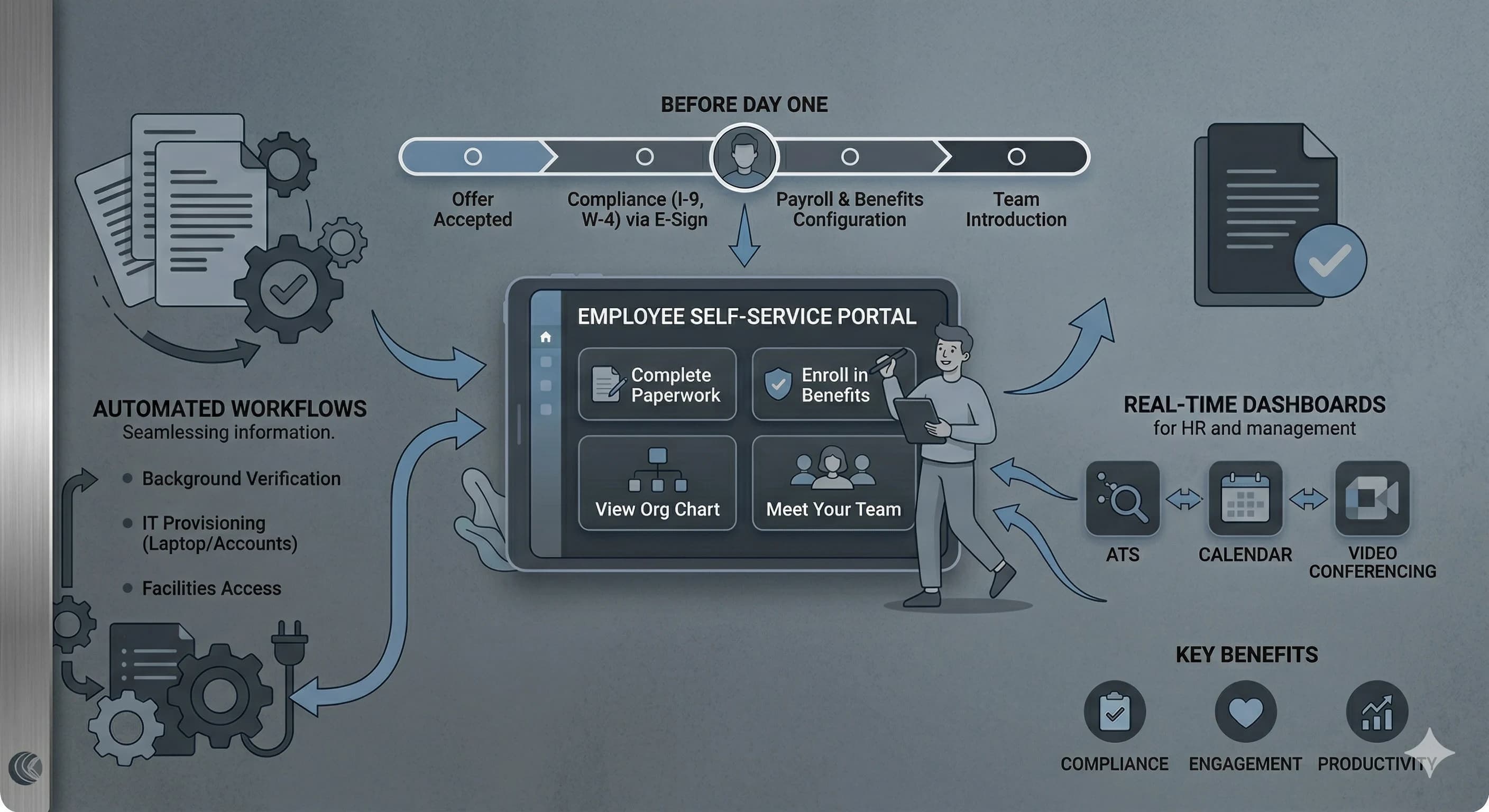
Typical onboarding involves 54 separate activities across HR, IT, payroll, and facilities. This complexity kills productivity and drives turnover when managed manually. Organizations with strong onboarding programs achieve 82% higher retention and 70% greater productivity.
Selecting effective employee onboarding software has become essential for building high-performing teams. This analysis covers 11 leading platforms to help you streamline processes, maintain compliance, and deliver exceptional new employee experiences from day one.
Gusto

Image Source: Software Advice
Overview
Gusto consolidates payroll, benefits, and HR management into a single platform built specifically for small businesses. Originally launched in 2011 as ZenPayroll, the company now serves over 400,000 businesses across the United States. The platform eliminates administrative complexity by automating onboarding workflows where new hires complete paperwork, configure benefits, and integrate into company systems without manual coordination.
Gusto's self-service approach allows employees to complete onboarding independently through e-signatures and digital forms, reducing HR workload while maintaining compliance standards.
Key Features
The onboarding process starts when administrators input basic employee details—name, salary, and email address. Gusto automatically sends invitations for new hires to complete required documentation including W-4s and I-9s electronically. Companies using the Complete plan can add custom documents such as offer letters and handbooks to this automated sequence. All signed forms store securely within the platform for instant retrieval during audits or reviews.
Direct integrations with leading applicant tracking systems create seamless hiring workflows without application switching. IT administrators can provision or remove employee accounts across connected tools within minutes through built-in software management. The platform includes organizational features like employee directories with contact information and birthdays, department structures, and visual org charts. Granular permission settings control access levels for different team members managing the system.
Pros and Cons
Pros: ✅ Automated compliance handling eliminates manual paperwork concerns ✅ Employee self-service portal reduces HR administrative burden ✅ Built-in time tracking and PTO management on higher tiers ✅ Unlimited payroll runs without per-transaction fees ✅ Multi-state payroll included without additional charges
Cons: • Time tracking unavailable on entry-level Simple plan • Premium features like same-day pay restricted to highest tier • Add-on costs for benefits administration escalate quickly • Limited enterprise capabilities compared to larger platforms
Pricing
Plan | Monthly Base | Per Employee | Best Suited For |
|---|---|---|---|
Simple | £38.91 | £4.76 | Single-state businesses with basic payroll needs |
Plus | £63.53 | £9.53 | Multi-state operations requiring benefits administration |
Premium | £142.95 | £17.47 | Scaling businesses needing dedicated support |
Contractor Only | Free | £4.76 | Contractor-only businesses (limited offer) |
For a 25-employee company, the Plus plan costs £301.78 monthly. The Simple plan covers core payroll and basic onboarding checklists but excludes time tracking and health insurance administration. Plus adds multi-state payroll support, advanced onboarding workflows with custom offer letters, and benefits management. Premium includes dedicated customer success managers, certified HR advisors, and same-day direct deposit capabilities.
Best For
Gusto works best for small to mid-sized businesses with 10-75 employees seeking integrated payroll and onboarding solutions. Companies find the Plus tier particularly valuable for its combination of payroll automation, benefits administration, and structured onboarding workflows. Organizations operating across multiple states benefit from included multi-state tax filing capabilities. Businesses focused on employee experience value the self-service portal that reduces administrative questions while giving team members direct control over their information and benefits.
Rippling

Image Source: Rippling
Overview
Rippling solves a fundamental problem that plagues growing businesses: data silos between HR and IT departments. Founded in 2016 by Parker Conrad, the platform has reached a valuation exceeding £10.32 billion by addressing what others couldn't—true integration across workforce management systems.
The platform's strength lies in its Employee Graph, a unified data model where a single change triggers actions across all connected systems. When a new hire accepts an offer, Rippling automatically handles e-signature documents, state tax registration, device provisioning, application access, and benefits enrollment. This eliminates the manual coordination that typically requires multiple tools and constant data syncing.
Key Features
The Employee Graph connects every module, ensuring changes update instantly across the entire system without overnight batch processing. Onboarding completes in 90 seconds through automated workflows that handle offer letters, compliance checks, and background verification.
Device management allows IT teams to configure and ship pre-loaded laptops before start dates. Application access control spans 650+ integrated platforms, automatically granting or removing credentials based on role and department. Workflow automation handles complex conditional logic, routing approvals by department hierarchy and regional requirements. Analytics pull real-time data from recruiting, performance, time tracking, and scheduling modules.
Pros and Cons
Pros: ✅ Eliminates data silos between HR and IT departments ✅ Instant updates across all modules from single employee record ✅ Intuitive interface requiring minimal training ✅ Scales from 5 to 5,000+ employees
Cons:
Custom quotes required beyond base pricing
Initial complexity due to feature depth
Per-employee costs increase with headcount growth
Limited live phone support across all time zones
Pricing
Tier | Monthly Cost Per Employee | Included Features |
|---|---|---|
Platform | £6.35 | Employee records, onboarding, custom workflows, basic reporting |
Plus Payroll | £12.71 | Platform features, payroll processing, tax filing, multi-state support |
Full Suite | £27.80 | All features, IT management, device provisioning, spend management |
A 50-employee company using HR and payroll modules pays approximately £595.62 monthly. Implementation fees and advanced features like biometric recognition may cost up to £150.89 per employee monthly.
Best For
Rippling suits mid-size companies with 50-500 employees managing the complexity of separate HR and IT systems. Remote teams benefit from automated device provisioning and centralized application access controls. Companies expanding globally use the platform's multi-country payroll compliance and localized documentation. The platform particularly serves businesses frustrated with managing multiple workforce administration tools, where unified data and automated cross-departmental workflows reduce administrative overhead.
BambooHR

Image Source: BambooHR
Overview
BambooHR built its reputation as the HRIS that small businesses actually want to use. Founded in 2008 by Ben Peterson and Ryan Sanders, the platform serves organizations that need more than spreadsheets but less than enterprise complexity. The Utah-based company focused on a simple premise: HR software should make work easier, not harder.
The platform handles the complete employee lifecycle without requiring a dedicated IT team to manage it. BambooHR works for businesses moving beyond manual processes while avoiding the cost and complexity of Fortune 500-grade systems.
Key Features
BambooHR centers everything around a unified employee database that stores personnel files, compensation history, and custom fields for equipment or certifications. The integrated applicant tracking system publishes jobs to major boards like Indeed and ZipRecruiter, then manages the entire hiring pipeline from resumes to offer letters.
Onboarding runs through customizable checklists that adapt to role, department, and location requirements. New hires complete digital paperwork, set up direct deposit, and receive team introductions before their first day. Electronic signatures and secure document storage eliminate paper processes entirely.
Performance management includes 360-degree feedback cycles, goal tracking, and scheduled 1:1 meetings with private notes. The Employee Performance Report displays workforce data on visual grids for quick assessment. Time-off management automates PTO calculations, approval workflows, and team calendar visibility.
BambooHR Payroll handles full-service processing for U.S. businesses, managing federal, state, and local taxes, W-2 generation, and employee self-service pay portals. Mobile apps deliver complete HR access for iOS and Android devices.
Pros and Cons
Pros:
Intuitive design requiring minimal training
Automated workflows across HR functions
Strong mobile experience for remote access
Complete employee lifecycle management
Cons:
Payroll restricted to U.S. operations
Limited customization for complex enterprise requirements
Per-employee costs increase significantly with growth
Pricing
Plan | Monthly Cost Per Employee | Core Capabilities |
|---|---|---|
Core | £7.94 | Employee records, custom reports, workflows, hiring, onboarding, time-off management, eNPS surveys |
Pro | £13.50 | Core features plus 360° reviews, 1:1s, employee community, 15 compliance courses |
Elite | £19.85 | Pro features plus compensation planning, salary benchmarking, custom dashboards, 300+ compliance courses |
Companies with 25 or fewer employees pay a flat monthly rate starting at £198.54. Volume discounts apply automatically as headcount grows. Nonprofit organizations receive an additional 15% discount.
Best For
BambooHR suits small to midsize companies that value simplicity over feature depth. Organizations seeking employee onboarding software with integrated performance management find the Pro tier particularly effective. HR teams without technical resources benefit from the straightforward implementation and ongoing management.
Deel

Image Source: Deel
Overview
Deel specializes in global workforce management for companies operating across multiple countries. Since launching in 2019, the platform has scaled rapidly to serve over 35,000 companies with 1.25 million workers across 150+ countries. The company achieved a £0.79 billion annual run rate in Q1 2025 with 75% year-over-year revenue growth.
Deel has maintained profitability since Q3 2023 while preparing for a U.S. IPO in 2026. The platform consolidates payroll, compliance, HRIS, and onboarding into one system, eliminating the need for multiple international vendor relationships.
Key Features
Contract automation handles local labor law compliance across all operating countries. The platform processes international payments with integrated currency conversion and tax handling, enabling companies to pay employees in local currencies without managing complex cross-border transactions.
Digital document management and identity verification streamline onboarding for distributed teams. The HRIS module centralizes workforce planning, compensation reviews, and career development tools. Time off policies automatically adjust to country-specific requirements with approval workflows and tracking.
Automated workflows coordinate equipment provisioning, system access, and compliance documentation when new hires join. Companies report saving 150 hours on hiring compliance through Deel's regulatory monitoring. Document storage accepts custom uploads with secure access controls.
Pros and Cons
Pros: ✅ 24/7 support with dedicated payroll, compliance, and legal teams ✅ Consistent experience across 150+ countries ✅ Built-in legal guidance for local labor laws and contracts ✅ Streamlined onboarding process for global teams
Cons:
Premium pricing reflects advanced international capabilities
Fast-paced environment requires adaptation
Salary disparities reported across similar roles
Pricing
Plan | Monthly Cost | Core Features |
|---|---|---|
Demo/Basic | £0 | Contract management, international payments, onboarding, API integration |
Pro | £38.91+ | Basic features plus analytics, priority support, tax management |
Enterprise | Custom | Pro features plus dedicated support, internal integrations, consulting |
New users receive £397.08 in billing credits. Contractor management starts at £38.91 monthly per person.
Best For
Deel serves companies expanding internationally or managing remote teams across multiple countries. Organizations requiring flexible compensation packages and localized benefits find value in the platform's customization options. The onboarding capabilities particularly benefit businesses needing legal support for varying labor regulations across jurisdictions.
Workday

Image Source: Workday
Overview
Workday delivers enterprise-grade Human Capital Management for organizations managing complex, multi-location operations. Built specifically for large corporations, the platform serves Fortune 500 companies across finance, healthcare, and technology sectors. The system handles substantial workforce complexity while maintaining unified data and compliance standards across departments, entities, and regions.
Recent enhancements focus on mobile-first onboarding capabilities. New hires complete documentation, training, and compliance requirements directly from smartphones, eliminating desktop dependency during the critical first-day experience.
Key Features
Continuous payroll processing operates across 60+ countries with real-time updates. Changes take effect immediately without batch processing delays. The system automatically tracks tax regulation updates for all U.S. jurisdictions while integrating with international payroll services including CloudPay, Deel, and Strada.
HiredScore AI for Recruiting identifies qualified candidates while removing selection bias. Skills assessment tools analyze employee capabilities and business needs, then generate individualized learning plans aligned with current roles and career trajectories.
Vision boards provide workforce analytics through drag-and-drop interfaces. Over 5,000 pre-built reports and 175 configurable dashboards deliver insights into performance metrics and workforce trends. Peakon Employee Voice collects feedback across devices and integrates with Slack or Microsoft Teams.
Illuminate AI manages scheduling, attendance tracking, and absence coordination by analyzing employee availability, skills, and preferences while forecasting labor demand patterns. VNDLY vendor management accommodates contract and freelance workers with hiring support, spending oversight, and compliance monitoring.
Pros and Cons
✅ Enterprise architecture supporting extensive customization without system compromise
✅ Seamless third-party integration through open APIs
✅ Comprehensive talent management covering performance reviews, compensation planning, and succession planning
✅ Mobile and desktop accessibility with unified experience
Cons:
Complex pricing models and implementation requirements
Navigation can require excessive clicks for routine tasks
Significant barriers for organizations under 300 employees
Implementation fees reaching 150-200% of annual software costs
Pricing
Component | Cost Range |
|---|---|
Annual HCM Subscription | Starting at £238,250 |
Per Employee Monthly (Large Employers) | £31.77-60 |
Implementation Fee | 150-200% of annual software fees |
Organizations require dedicated HRIS managers or full-time consultants to maintain optimal system performance.
Best For
Workday suits enterprises with 2,000+ employees operating across multiple departments, entities, and locations. The platform particularly benefits multinational corporations requiring unified workforce management while maintaining local labor law compliance. Organizations with fewer than 300 employees typically find the premium pricing and administrative overhead challenging relative to their operational complexity.
Justworks

Image Source: Justworks
Overview
Justworks operates as a Professional Employer Organization, becoming co-employer for client businesses to handle payroll, tax filings, and benefits administration legally. Founded in 2012, the platform serves over 12,000 small businesses across the United States. As an IRS Certified PEO and ESAC-accredited provider, Justworks meets the highest industry standards for financial security and compliance.
What sets Justworks apart is transparent pricing. No custom quotes or hidden fees. The company publishes rates upfront, allowing businesses to calculate monthly costs immediately. This transparency eliminates the pricing games common in the PEO industry.
Key Features
Automated onboarding reduces first-day friction through self-service portals accessible via desktop or mobile applications. The system collects documentation, processes tax forms, and handles benefits enrollment without manual HR intervention. Payroll setup completes in 2-7 business days depending on information availability, while PEO onboarding spans 2-6 weeks.
Multi-state payroll coverage handles federal, state, and local tax calculations automatically while filing necessary forms. Off-cycle payments for bonuses and commissions process without additional charges. HR tools include document centers for handbooks, PTO management with approval workflows, employee directories, and customizable reporting.
The PEO model includes workers' compensation insurance, unemployment insurance, and Employment Practices Liability Insurance as standard features. Customer support operates 24/7 through phone, email, chat, Slack, and SMS channels, with two-hour average response times.
Pros and Cons
Pros: ✅ Centralizes payroll, benefits, compliance, and HR into one platform ✅ Transparent pricing without hidden setup fees ✅ User-friendly interface scoring 9.9 out of 10 for ease of use ✅ 24/7 support access across multiple channels
Cons:
Scaling challenges for companies exceeding 200 employees
Higher costs compared to basic payroll providers
Some users report more time-consuming payroll processes
Pricing
Plan | Monthly Cost Per Employee | Core Features |
|---|---|---|
Payroll | £39.71 base + £6.35 | Payroll processing, tax filings, basic HR tools |
PEO Basic | £46.86 | Payroll plan plus compliance support, HR consulting, 24/7 support |
PEO Plus | £86.56 | Basic plan plus medical/dental/vision administration, HSA/FSA, wellness perks |
Best For
Justworks suits U.S.-based small to mid-sized businesses with 2-200 employees lacking dedicated HR departments. Startups and remote-first companies particularly benefit from accessible group benefits and simplified compliance management. The transparent pricing model appeals to organizations tired of vendor relationships built on custom quotes and hidden fees.
Enboarder

Image Source: Enboarder
Overview
Enboarder solves the coordination nightmare that plagues most onboarding programs. When HR teams rely on manual handoffs between departments, critical steps fall through cracks and new hires receive inconsistent experiences. The platform automates these workflows while maintaining the personal touch that drives engagement and retention.
The system creates structured employee journeys from offer acceptance through full productivity. AI Agents handle routine tasks while AI Assistants provide personalized guidance based on role, department, and location. Organizations using Enboarder report faster time-to-productivity and higher new hire satisfaction scores.
Key Features
Preboarding workflows begin before day one, sending equipment requests, access credentials, and personalized welcome messages. Cross-departmental coordination happens automatically - when someone joins, IT provisioning, compliance documentation, and manager introductions trigger simultaneously.
The platform connects with 85+ applications through native integrations, APIs, and secure data transfer protocols. Real-time dashboards track completion rates, engagement scores, and journey progress across all new hires.
Compliance support covers federal and state requirements including W-4s, I-9s, and eVerify integration. Remote verification capabilities handle distributed teams without compromising security standards.
AI-powered personalization adapts messaging and task sequences based on employee data. Context-aware support extends beyond initial onboarding to handle internal transfers, role changes, and leaves of absence.
Pros and Cons
✅ Eliminates manual coordination between HR, IT, and management teams ✅ Personalized experiences scale across multiple locations consistently
✅ Real-time analytics enable continuous process improvement ✅ Supports full employee lifecycle beyond initial onboarding
Cons:
Pricing requires custom quotes rather than published rates
Integration setup involves technical configuration effort
Feature depth may exceed needs for smaller organizations
Pricing
Tier | Focus | Key Capabilities |
|---|---|---|
Deliver | Day-one readiness | Preboarding workflows, compliance automation, personalized journeys, analytics dashboards |
Support | Lifecycle management | Deliver features plus AI Assistant, transition workflows, automated task routing |
Accelerate | Performance optimization | Support features plus AI-generated development plans, learning integration, workforce insights |
Custom pricing reflects company size and specific requirements rather than standardized rates.
Best For
Enboarder suits midsize to large organizations where consistent onboarding directly impacts retention and productivity. Companies managing employees across multiple locations benefit from standardized experiences that adapt to local requirements.
HR teams spending excessive time coordinating between departments find immediate value in automated workflows. Organizations prioritizing employee experience over basic task completion appreciate the platform's focus on engagement and long-term success.
Click Boarding

Image Source: Click Boarding
Overview
Click Boarding operates as a focused onboarding platform that connects applicant tracking systems with HRIS platforms. Founded in 2016 by Curtis Marks in Minneapolis, the company targets the specific gap between hiring and employee management systems. The platform serves businesses from startups to enterprises, though organizations processing 1,000+ annual onboards achieve the strongest return on investment.
Recognition from Unleash, iSmartRecruit, and HR Outlook Solution Providers in 2020 and 2021 reflects the platform's specialized approach to onboarding automation. The mobile-first design enables new hires to complete documentation and compliance requirements before their start date.
Key Features
Built-in eSignature capabilities eliminate the need for separate document signing tools. I-9 verification integrates directly with E-Verify, while automated tax form wizards guide employees through federal and state requirements. The platform connects with existing systems through 250+ pre-built integrations and Microsoft Teams workflow coordination.
Security standards include SOC 2 Type II, ISO 27001, and GDPR compliance for sensitive employee data protection. Customizable workflows adjust based on role requirements, department structures, and location-specific needs.
Real-world performance demonstrates significant efficiency gains. Kuehne + Nagel reduced preboarding paperwork from 1.5 hours to 20 minutes per employee. Ellis decreased average onboarding duration from 100+ days to 14 days through automated processes.
Pros and Cons
Pros: ✅ Eliminates manual data entry and administrative overhead ✅ Clean, intuitive interface requires minimal training ✅ Real-time process tracking and task monitoring ✅ Reduces employee no-shows through engaging preboarding ✅ Easy deployment with dedicated implementation support
Cons:
Native e-signature limitations require third-party integration for some users
API integration with enterprise systems like Oracle Recruiting Cloud extends implementation timelines
State tax form configuration presents challenges for multi-location operations
Pricing
Model | Structure |
|---|---|
Subscription | Per-user, per-year pricing available upon request |
Costs scale based on employee volume and selected features. Organizations should request custom quotes for accurate pricing estimates.
Best For
Click Boarding suits mid-market and enterprise organizations managing high-volume onboarding operations. Companies across healthcare, finance, and transportation benefit from the platform's compliance documentation and audit trail capabilities. The focused approach works particularly well for businesses that need robust onboarding automation without the complexity of full HR suites.
Homebase

Image Source: Homebase
Overview
Homebase focuses specifically on hourly workforce management, serving 100,000+ small businesses. The platform combines scheduling, time tracking, payroll, and basic HR functions into one system designed for retail, hospitality, and food service operations. Recent industry recognition includes Best Payroll for Hourly Teams 2024 and Best HR & Employee App 2025.
Key Features
The hiring module publishes job postings simultaneously across Indeed, ZipRecruiter, Glassdoor, and other major job boards from a single interface. Applicant tracking consolidates candidates from all sources with customizable screening questions. Interview scheduling integrates directly into the platform, while background checks process through the application.
Paperless onboarding delivers digital welcome packets containing federal and state forms that new hires complete electronically before their start date. Document storage centralizes employee files with secure access controls. Self-onboarding capabilities allow employees to handle administrative tasks independently, reducing first-day coordination requirements.
Pros and Cons
✅ Predictable flat-fee pricing per location ✅ Integrates with ADP, Paychex, Rippling, Gusto, and QuickBooks ✅ Sales-driven scheduling that connects POS data for labor optimization
Cons:
Limited scalability beyond 50 employees
No geo-fencing or GPS time tracking capabilities
Scheduling rules require multiple manual configuration steps
Pricing
Plan | Monthly Cost | Key Features |
|---|---|---|
Basic | £0 | 1 location, 10 employees maximum |
Essentials | £19.06 | Advanced scheduling, time tracking |
Plus | £44.47 | PTO controls, departments |
All-in-One | £76.24 | Employee onboarding, HR, compliance |
Best For
Homebase suits small businesses with hourly workforces in retail, hospitality, and food service sectors. Organizations with seasonal staffing patterns and fluctuating headcount find particular value in the onboarding capabilities available with the All-in-One plan.
ClearCompany
!Image
Image Source: ClearCompany
Overview
ClearCompany operates as a unified talent management platform that connects applicant tracking, onboarding, performance management, learning, and compensation functions. The company recently rebranded as ClearCo but maintains its enterprise-grade architecture designed for medium and large organizations. The platform serves industries including construction, financial services, healthcare, hospitality, manufacturing, nonprofit, real estate, and retail. AI-powered technology streamlines talent management processes, with particularly strong integration capabilities for ADP Workforce Now users.
Key Features
Automated workflows handle onboarding tasks from offer acceptance through Day 1 readiness. AI-generated job descriptions maintain consistency across postings. Paperless onboarding includes digital forms with e-signatures, built-in I-9 and E-Verify tools for compliance, and background check services.
Seamless payroll integration ensures accurate processing. Mobile accessibility allows managers and new hires to complete tasks remotely. The self-service portal enables pre-boarding engagement before start dates, with all documents, goals, and assignments centralized in one location.
Pros and Cons
Pros: ✅ Unified platform reducing vendor complexity ✅ Strong ADP integration capabilities ✅ AI-assisted recruiting features ✅ Responsive implementation support ✅ Scalable for enterprise needs
Cons:
Premium pricing compared to competitors
Limited custom reporting requiring professional services
Slow and costly customization
Excessive for very small teams
Occasional UI inconsistencies
Data migration challenges
Pricing
Model | Monthly Cost Per Employee |
|---|---|
Standard | £5.56-10 |
Quote-based pricing varies by company size and selected modules. No free version or trial available.
Best For
ClearCompany suits mid-market to enterprise organizations seeking employee onboarding software integrated with performance and learning systems. The platform particularly benefits ADP Workforce Now users requiring seamless data exchange. Organizations managing complex talent workflows across multiple departments find value in the unified approach, though smaller teams may find the feature depth unnecessary for their operational scale.
TriNet HR

Image Source: TriNet
Overview
TriNet operates as both a Professional Employer Organization and Administrative Services Organization, serving small to medium-sized businesses for over 30 years. The platform consolidates payroll processing, benefits administration, risk mitigation, and compliance support into one system. What sets TriNet apart is industry-specific expertise. Dedicated HR professionals and relationship managers provide tailored guidance for manufacturing, technology, and professional services sectors.
Key Features
Self-service onboarding completes paperwork in under 10 minutes through the platform or mobile app. New hires finish onboarding before their first day, with automatic connections to benefits enrollment, payroll setup, and scheduling.
Leave management assistance provides state-specific benefits information and checklists for each employee situation. Compliance resources include EEO-1 component tools, I-9 resources, and automated regulatory notices. The platform covers recruiting, performance management, learning and development, and workforce analytics with real-time insights.
Pros and Cons
Pros:
Industry-specific support addresses unique workforce needs like OSHA compliance and safety regulations
Comprehensive onboarding and compliance resources simplify complex HR tasks
30+ years of experience handling small business HR challenges
PEO model provides co-employment benefits and risk sharing
Cons:
Customer service inconsistencies affect some users, with delayed response times and occasional payroll errors reported
Platform performance occasionally lags during large batch processing
Requires minimum five employees
Custom pricing lacks transparency
Pricing
Structure | Requirements |
|---|---|
Per-employee monthly | Five employees minimum |
Customized quotes | Pricing varies by company size and selected modules |
Best For
TriNet suits small to midsize businesses needing employee onboarding software with industry-tailored compliance support and dedicated HR expertise. Companies in manufacturing, technology, and professional services benefit most from the specialized industry knowledge and regulatory guidance.
Employee Onboarding Software Comparison
Software | Best For | Starting Price | Key Strengths | Main Limitations | Standout Features |
|---|---|---|---|---|---|
Gusto | Small to mid-sized businesses (10-75 employees) seeking integrated payroll and onboarding | £38.91/month base + £4.76/employee | Automated compliance, employee self-service portal, unlimited payroll runs, multi-state payroll included | Time tracking unavailable on entry-level plan, premium features locked to highest tier, limited enterprise features | Self-onboarding through e-signatures, automated W-4 and I-9 completion, ATS integration |
Rippling | Mid-size companies (50-500 employees) needing integrated HR and IT management | £6.35/employee (Platform tier) | Eliminates HR/IT data silos, instant cross-module updates, 90-second paperless onboarding, scales 5-5,000+ employees | Custom quotes required, initial complexity due to feature depth, limited live phone support across all time zones | Employee Graph unified data model, device provisioning, 650+ app integrations, cross-departmental workflow automation |
BambooHR | Small to midsize companies prioritizing user-friendliness and centralized data | £7.94/employee (Core plan) | Excellent user experience requiring minimal training, time-saving automation, strong mobile apps, full HR suite | Payroll limited to U.S. only, limited customization for complex enterprise needs, pricing scales quickly with headcount | Applicant tracking system, 360-degree feedback, customizable onboarding packets, eNPS surveys |
Deel | Companies expanding internationally or managing remote teams across multiple countries | £0 (Demo/Basic) to £38.91+/month | 24/7 support, operations in 150+ countries, legal guidance, seamless onboarding | Higher pricing due to premium features, fast-paced environment, reported salary disparities | Automated contract creation with compliance checks, international payments, saves 150 hours on hiring compliance |
Workday | Enterprises with 2,000+ employees managing complex HR operations across multiple locations | £238,250/year (starting) or £31.77-60/employee monthly | Enterprise architecture, seamless third-party integration, robust talent management, mobile-first capabilities | Complex pricing, steep implementation (150-200% of annual fees), challenging for companies under 300 employees | Continuous payroll across 60+ countries, HiredScore AI recruiting, Peakon Employee Voice, 5,000+ pre-built reports |
Justworks | U.S.-based small to mid-sized businesses (2-200 employees) lacking dedicated HR departments | £39.71 base + £6.35/employee (Payroll plan) | Transparent pricing, user-friendly (9.9/10 ease of use), 24/7 support, IRS Certified PEO | May not scale beyond 200 employees, higher costs than basic payroll providers, some processes time-consuming | PEO co-employer model, workers' compensation included, 2-hour average support response time |
Enboarder | Midsize to large enterprises focused on improving retention through structured onboarding | Custom pricing (quote required) | Automation reduces HR burden, personalized lifecycle experiences, real-time insights, context-aware support | Pricing not publicly disclosed, integration setup effort required | AI Agents and Assistants, 85+ app integrations, AI-generated 30-60-90 ramp plans, preboarding workflows |
Click Boarding | Mid-market and enterprise organizations onboarding high volumes annually | Per-user, per-year (quote required) | Eliminates manual data entry, easy deployment, clean interface, real-time tracking, reduces no-shows | Lacks native e-signature (requires third-party), API integration extends timelines, state tax form configuration challenges | 250+ pre-built integrations, Microsoft Teams integration, SOC 2 Type II certified, reduced onboarding from 100+ to 14 days |
Homebase | Small businesses with hourly workforces in retail, hospitality, and food service | £0 (Basic) to £76.24/month (All-in-One) | Predictable flat-fee pricing per location, integration with major payroll providers, sales-driven scheduling | Limited scalability beyond 50 employees, no geo-fencing/GPS tracking, scheduling rules require manual steps | Posts to multiple job boards simultaneously, POS data integration, paperless onboarding in All-in-One plan |
ClearCompany | Mid-market to enterprise organizations seeking talent management with ADP integration | £5.56-10/employee monthly | Unified platform reducing vendor complexity, strong ADP integration, AI-assisted recruiting, scalable for enterprise | Premium pricing, limited custom reporting, slow/costly customization, excessive for very small teams | AI-generated job descriptions, built-in I-9 and E-Verify, combines ATS, onboarding, performance, learning, and compensation |
TriNet HR | Small to midsize businesses needing industry-tailored compliance support and dedicated HR expertise | Custom pricing (5 employee minimum) | Industry-specific support (30+ years experience), compliance resources, onboarding in under 10 minutes | Customer service inconsistencies, occasional payroll errors, platform lags during large batch processing | PEO and ASO models, industry-specific HR professionals, state-specific leave management, EEO-1 component tools |
Conclusion
Selecting the right employee onboarding software depends on your organization's size, budget, and specific workflow requirements. Small businesses with 10-75 employees may find Gusto or BambooHR sufficient, while enterprises managing 2,000+ employees across multiple countries benefit from Workday or Deel's extensive capabilities. Companies with hourly workforces should consider Homebase, whereas those prioritizing seamless HR-IT integration gain value from Rippling's unified platform.
The tools reviewed here each address different organizational needs, evidently requiring careful evaluation of your current processes and growth trajectory. Start by identifying your must-have features, then select the platform aligning closest with your operational complexity and compliance requirements.
FAQs
Q1. What is employee onboarding software and why do businesses need it? Employee onboarding software is a digital platform that automates and streamlines the process of integrating new hires into an organization. Businesses need it because typical onboarding involves 54 separate activities across HR, IT, payroll, and facilities. Without proper software, this complexity slows productivity and increases turnover. Organizations with strong onboarding programs achieve 82% higher retention and over 70% greater productivity, making these tools essential for building high-performing teams.
Q2. How much does employee onboarding software typically cost? Pricing varies significantly based on company size and features. Entry-level options like Homebase start at £0 for basic plans, while small business solutions like Gusto begin around £38.91/month base plus £4.76 per employee. Mid-tier platforms like BambooHR cost approximately £7.94 per employee monthly. Enterprise solutions like Workday start at £238,250 annually. Most providers offer tiered pricing with additional costs for premium features like benefits administration, compliance tools, and dedicated support.
Q3. Which onboarding software works best for small businesses versus large enterprises? Small businesses with 10-75 employees typically benefit from user-friendly, affordable solutions like Gusto, BambooHR, or Justworks that combine payroll and basic HR functions. Mid-sized companies with 50-500 employees often choose Rippling for its HR-IT integration or Enboarder for structured experiences. Large enterprises with 2,000+ employees require robust platforms like Workday that handle complex multi-location operations, or Deel for international workforce management across 150+ countries.
Q4. Can onboarding software help with compliance and legal requirements? Yes, most onboarding platforms include built-in compliance features. They automate federal and state tax forms like W-4s and I-9s, provide E-Verify integration for identity verification, and maintain secure document storage for audit trails. Platforms like Deel offer comprehensive legal guidance on local labor laws across different countries, while TriNet provides industry-specific compliance resources including EEO-1 tools and automated regulatory notices. These features help organizations navigate varying regulations and reduce compliance risks.
Q5. How long does it take to implement employee onboarding software? Implementation timelines vary by platform complexity and company size. Simple solutions like Homebase can be deployed quickly with minimal setup. Gusto's payroll onboarding takes 2-7 business days, while their PEO services require 2-6 weeks. Mid-tier platforms like Click Boarding may extend timelines when integrating with existing systems like Oracle Recruiting Cloud. Enterprise solutions like Workday require significant implementation effort, often costing 150-200% of annual software fees and necessitating dedicated HRIS managers or consultants.