
12 Best Applicant Tracking Systems in 2026: Honest Pros, Cons & Which Actually Work
Key Takeaways (TL;DR)
- Match your ATS to company size and hiring volume - Small businesses benefit from affordable options like Zoho Recruit ($25/month), while enterprise organizations need scalable platforms like Greenhouse or Ashby for complex workflows.
- Consider total cost beyond base pricing - Many platforms charge extra for essential features like video interviews, SMS, and advanced analytics, potentially doubling your actual monthly expenses.
- Prioritize integration compatibility over feature lists - Choose platforms that connect seamlessly with your existing HR tools, email systems, and job boards to avoid workflow disruptions.
- Test before committing with available free trials - Platforms like JazzHR (21 days), Workable (15 days), and Recruit CRM (unlimited) offer hands-on evaluation to ensure the interface matches your team's needs.
- Focus on your primary use case - Global companies need Deel HR's compliance features, high-volume recruiters benefit from Ashby's analytics, while employer branding-focused teams should consider Teamtailor's career site builder.
The right ATS should streamline your current hiring process rather than force you to adapt to complex workflows. With 86% of recruiting professionals reporting significant hiring speed improvements from ATS platforms, selecting one that actually fits your organization's specific requirements delivers measurable results. More than 98% of Fortune 500 companies now use applicant tracking system software to manage their recruitment activities. The market for these platforms is expected to grow from USD 1.38 Billion in 2019 to USD 2.22 Billion by 2027. Notwithstanding that, not all ats tracking systems deliver equal results. 86% of recruiting professionals believe an applicant tracking system recruitment platform substantially speeds up hiring, and choosing the right one matters. This review breaks down 12 leading platforms, their pros and cons, and which ones work for your hiring needs.
Greenhouse

Image Source: www.greenhouse.com
Best For
Greenhouse serves mid-sized to enterprise companies that need structured hiring processes and evidence-based recruitment decisions. Tech startups and fast-growing organizations benefit especially when you have scalability needs. Companies that operate across multiple regions, business units or brands find the platform handles complexity well. Organizations with three or more active recruiters running standardized interview processes get the most value.
Key Features
Greenhouse structures hiring around interview kits and scorecards that define evaluation criteria before interviews begin. The platform has candidate pipeline management, automated scheduling and workflow approvals. Sourcing capabilities range from simple CRM tools to advanced automation with contact lookups and email sequences. AI-powered report filters and business intelligence connectors provide recruiting analytics across teams. The system reduced time-to-hire by nearly 30% at Ocado Group. Real Talent features add talent matching, fraud detection and enterprise-level spam filtering depending on plan tier.
Pros and Cons
Pros: Greenhouse earned a 4.5 overall rating from verified users. The interface simplifies recruitment and boosts collaboration among hiring teams. Centralized candidate profiles, clear pipelines and structured scorecards improve interview quality and hiring consistency. Integration with tools like Google Sheets makes up-to-the-minute hiring metrics tracking possible. The platform ranks #1 on G2 across enterprise, mid-market and EMEA categories.
Cons: Customization options have limits, especially when larger organizations scale hiring operations. The interface feels dated and cluttered when you manage high-volume pipelines. Bulk actions require manual work since filtering candidates by specific criteria doesn't make mass rejection possible. Some advanced features and integrations only unlock at higher pricing tiers.
Pricing
Greenhouse renamed its tiers from Essential, Advanced and Expert to Core, Plus and Pro in 2025. Pricing uses an employee-based model rather than per-seat licensing. The median annual contract sits at USD 12,250.
Company Size | Annual Cost Range | Plan Tier |
|---|---|---|
Under 50 employees | USD 5,100 - USD 8,500 | Core |
50-250 employees | USD 10,000 - USD 20,000 | Plus |
250-1,000 employees | USD 20,000 - USD 40,000 | Plus/Pro |
1,000+ employees | USD 40,000 - USD 70,000+ | Pro |
Implementation fees run USD 1,000 to USD 15,000 depending on complexity. Annual renewal increases attempt 8-15% hikes typically.
Integrations
Greenhouse connects with over 400 native integrations spanning HRIS systems, background checks, assessment tools and communication platforms. Customer-preferred integrations have LinkedIn Recruiter System Connect, HackerRank and Namely. The platform integrates with BambooHR, Slack, Calendly, DocuSign and Workday through its Harvest API. Zapier connectivity extends integration possibilities to thousands of additional applications.
Workable

Image Source: Workable
Best For
Workable fits high-volume hiring teams managing multiple candidates at once through structured pipelines and bulk actions. Fast-growing SMBs and startups benefit from consistent hiring processes without heavy setup requirements. Decentralized hiring teams in different locations use shared scorecards and centralized candidate visibility for standardized evaluations. Remote hiring teams find the platform makes distributed collaboration possible through shared feedback and tracking.
Key Features
Workable provides access to a database of 400M+ profiles with AI identifying suitable passive candidates and generating personalized outreach emails. As a LinkedIn Platinum and Indeed Preferred Partner, the applicant tracking system software syndicates jobs to 200+ job boards in 100+ countries. SMS texting achieves 98% response rates and delivers replies 60x faster than email. The platform has AI-powered resume screening, customizable interview kits, science-backed assessments and automated calendar syncing. Self-service interview booking reduces scheduling friction. Custom pipelines, profiles and permissions tailor the ats tracking system to specific workflows. The career site builder creates branded pages showcasing company culture. The internal job board has a gamified reward system for employee referrals.
Pros and Cons
Pros: Workable earned a 4.4 overall rating with strong marks for ease-of-use at 4.5. The clean interface delivers good job posting distribution and candidate tracking capabilities. Centralized candidate management streamlines recruitment while improving communication. Structured interview kits, built-in evaluation forms and multi-interviewer feedback collection boost collaboration between hiring managers. AI-powered CV screening shows match percentages between job requirements and candidate qualifications.
Cons: Simple functionality lacks features like automatic ID assignment to job postings. Customization remains limited for teams requiring mandatory forms or specialized workflows. Post-integration support proves minimal, with some users escalating issues multiple times. Add-on costs for video interviews, texting and assessments increase expenses on lower-tier plans.
Pricing
Employee Count | Standard (Monthly) | Standard (Annual) | Premier (Annual) |
|---|---|---|---|
1-20 | ~$360 | $299 | $599 |
21-50 | ~$600 | $500 | Higher |
51+ | ~$960+ | $800+ | Custom |
Workable offers a 15-day free trial with Standard plan features. Pricing scales by company headcount rather than per-seat. Premier has video interviews, SMS and assessments; Standard requires paid add-ons.
Integrations
Workable connects natively with LinkedIn, Indeed, Glassdoor, Microsoft 365, G Suite, Zoom, Checkr and Deel. The applicant tracking system recruitment platform integrates with BambooHR for smooth onboarding and Slack for team collaboration. An API makes custom integrations possible, while Zapier connectivity extends to 270+ partners.
BambooHR

Image Source: BambooHR
Best For
BambooHR works best for companies with 25-150 employees managing inbound job applications rather than proactive candidate sourcing. Organizations that want a complete HR platform with applicant tracking system capabilities built in find value here. The platform suits US-based companies wanting payroll, benefits and recruitment in one system. Teams filling fewer than 10-15 roles quarterly and managing straightforward hiring workflows benefit most from the integrated approach.
Key Features
The built-in applicant tracking system allows job posting distribution to boards like Indeed and ZipRecruiter from a centralized platform. Hiring teams can review applications, collect interview feedback through scorecards and move candidates through customizable pipelines. The hiring mobile app supports remote candidate review and team coordination. Automated offer letter templates with electronic signatures make acceptance cycles more efficient. Candidate data flows directly into employee records once hired and eliminates duplicate entry. The platform hired 110 new employees in two weeks for one organization's vaccination clinic staffing needs. But the system lacks candidate sourcing tools, outreach automation or AI matching capabilities.
Pros and Cons
Pros: BambooHR holds a 4.4/5 star rating on G2. The interface receives consistent praise for its simplicity and ease of navigation. Employee information and files in one location eliminate scattered data management. Users find payroll processing straightforward. The platform tested as easy to use overall, with clear guidance through setup processes.
Cons: Verified users report that customization options remain limited. Self-service features require contacting support for configuration changes. Users report bugs. Multi-state workforce management lacks functionality available in competing HRIS platforms. The ATS treats recruiting as an initial employee lifecycle step rather than a standalone strategic function.
Pricing
BambooHR uses per-employee pricing starting at USD 10.00 per employee monthly for Core. Companies with 25 or fewer employees pay a flat USD 250.00 monthly across all tiers.
Plan | Est. Cost PEPM | Job Openings | Key Additions |
|---|---|---|---|
Core | ~$10 | 5 active | HR basics, time-off, 1 compliance course |
Pro | ~$17 | 25 active | Performance management, 15 courses |
Elite | ~$25 | 50 active | Compensation planning, 300+ courses |
Payroll costs USD 4-6 PEPM typically and Benefits Administration USD 3-6 PEPM.
Integrations
BambooHR offers 150+ pre-built integrations that connect payroll systems, performance tools and applicant tracking system software. The platform integrates with major job boards, LinkedIn, Slack and HRIS platforms through its marketplace. Custom integrations require developers who can build tailored solutions.
Lever
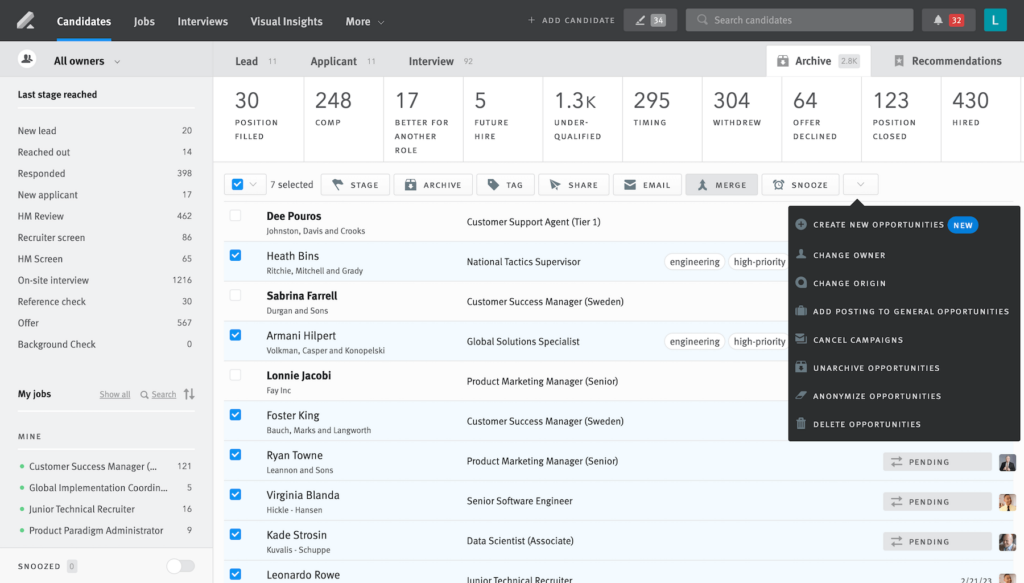
Image Source: Lever
Best For
Lever serves mid-sized companies that seek an accessible applicant tracking system with CRM capabilities, DEI tracking and collaborative candidate management. Organizations focused on engaging talent beyond the active hiring phase benefit from the natively built CRM features. Companies in competitive hiring markets use the platform to maintain relationships with passive candidates and improve their chances of filling future roles. Tech startups that manage rapid growth find the easy-to-use pipelines and collaborative features especially valuable. Teams that prioritize diversity, equity and inclusion initiatives get access to specialized tracking tools.
Key Features
The natively built CRM allows companies to keep candidates engaged even when they're not interviewing actively. Lever's simple, clean interface makes navigation easy for applicants, hiring managers and talent acquisition teams. This reduces training needs and enhances the candidate experience. Automation for candidate management and scheduling saves time by streamlining administrative tasks and helps recruiters focus more on engagement rather than logistics. DEI tools and dashboards allow tracking of EEO data, bias reduction and promotion of fair hiring environments. The platform has interview kits, visual workflows for task prioritization and AI-powered tools coupled with analytics.
Pros and Cons
Pros: The candidate relationship management functionality stands out as a differentiator for passive talent engagement. Accessible design encourages adoption across all user groups. Automated workflows reduce manual coordination for hiring teams. DEI solutions support building diverse teams through equitable practices. The mobile app keeps teams organized and connected during remote hiring.
Cons: Onboarding capabilities remain minimal, with digital offer letters as the main feature. This requires integration with another HRIS platform for robust onboarding. API access carries high fees and makes integrations pricey for companies that connect multiple HR tools. Customer service and sales team turnover has affected support quality following Lever's acquisition by Employ. Scalability limitations exist compared to enterprise-focused peers.
Pricing
Lever pricing falls in the mid-market range at USD 6.00-8.00 per employee per month approximately. The median negotiated contract for a 200-employee company runs about USD 12,240.00 per year. Pricing is customized based on bundle and employee count. Implementation fees range from USD 5,000.00 to USD 25,000.00.
Plan Tier | Est. Annual Cost | Target Size |
|---|---|---|
LeverTRM | USD 8,000 - USD 20,000 | 100-500 employees |
LeverTRM Enterprise | 2-3x base rate | 500+ employees |
Integrations
Lever offers over 300 integrations in all plans. The applicant tracking system recruitment platform connects with Slack, Indeed, BambooHR, ADP, Google Workspace, Microsoft Teams, Zoom and Zapier. API and webhook capabilities enable custom integrations for syncing recruiting tools efficiently.
Pinpoint

Image Source: www.pinpointhq.com
Best For
Pinpoint targets in-house talent acquisition teams at mid-market companies managing multi-stream hiring across roles, regions, or brands at the same time. The platform was founded in 2017 and bootstrapped for five years before raising USD 21.00M in 2023. It handles complex hiring workflows where consistency matters among other priorities. Organizations running 10+ recruiters benefit from the unlimited-seats pricing model. Companies prioritizing employer branding, DEI initiatives through blind screening, or international recruitment across 50+ countries find specialized value in the Enterprise tier.
Key Features
The platform delivers branded career site builders and automated job distribution to LinkedIn, Indeed, and Glassdoor. Interview scheduling with calendar sync is included. Workflow automation creates multi-step processes with triggers and branching logic across hiring stages. Enterprise features include blind screening that removes identifying information, AI Hiring Copilot to evaluate candidates, AI Match Scores, and multilingual candidate experiences. Resume parsing extracts candidate data while customizable workflows arrange with specific recruitment processes. Pinpoint reduced candidate wait times and brought efficiency gains to teams like River Island's talent acquisition function.
Pros and Cons
Pros: The platform holds a 4.8/5 rating on G2 and 4.7/5 on Capterra. Users praise the easy-to-use interface for hiring managers and responsive customer support. Implementation receives high marks for structure and expert guidance. The unlimited-seats model eliminates per-recruiter costs.
Cons: Annual contracts are mandatory with no month-to-month option or free trial available. Custom pricing requires sales conversations before seeing actual costs.
Pricing
Pinpoint costs approximately USD 345.00-USD 1200.00 monthly depending on company size. Growth plans start around USD 345.00 and Enterprise exceeds USD 1200.00. Implementation is included; onboarding carries additional fees.
Integrations
Hundreds of pre-built integrations connect Slack, LinkedIn Recruiter System Connect, Indeed, BambooHR, Rippling, Checkr, and DocuSign. The open API, webhooks, and SFTP file transfers enable custom integrations. LinkedIn Jobs integrations automate posting and promotion from the applicant tracking system software.
Zoho Recruit

Image Source: Zoho
Best For
Zoho Recruit serves small to mid-sized businesses, staffing agencies, and organizations already embedded in the Zoho ecosystem seeking affordable applicant tracking system software with customization options. Solo recruiters or 2-3 person teams managing simple recruitment needs find the Standard plan at USD 25.00-USD 50.00 monthly competitive. The platform earned a 4.5/5 rating on Capterra from 1,147 reviews in January 2026. Users praised its price-to-feature ratio and Zoho integrations. Organizations requiring AI-powered candidate matching, advanced analytics, and bulk hiring capabilities benefit from Professional and Enterprise tiers.
Key Features
The applicant tracking system centralizes candidate information and organizes multiple job openings. Multi-channel job posting distributes listings to over 75 job boards with one click and shares them on social media. Resume parsing extracts relevant details from resumes and email attachments, with limits of 250 parses daily on Standard, 500 on Professional, and unlimited on Enterprise. AI candidate matching through Zia scores and ranks applicants based on skills and experience. Customizable recruitment pipelines use custom stages, fields, and automation rules. Client and staffing portals allow external stakeholders to review candidates and provide feedback without accessing the main account. Interview scheduling integrates with Google Meet and Microsoft Teams.
Pros and Cons
Pros: Strong value for money makes the feature set versus price excellent for small to mid-sized teams. Resume parsing and job board integrations reduce manual sourcing time. Broad integration ecosystem speeds up sourcing and communication for email, calendars, and CRM systems. Built-in reports and custom dashboards help track KPIs and time-to-hire.
Cons: The interface feels outdated and less user-friendly according to multiple reviewers. This creates a noticeable learning curve. Setup and configuration for advanced automation requires time for administrators. Support response times prove inconsistent in complex cases, though many praise the assistance. Feature differences between plans gate useful capabilities like portals and advanced analytics behind higher tiers and raise total costs.
Pricing
Plan | Monthly Cost | Active Jobs | Key Features |
|---|---|---|---|
Free | USD 0 | 1 | Simple candidate management, 256MB storage |
Standard | USD 25 | 100 | Candidate sourcing, job boards, social recruiting |
Professional | USD 50 | 250 | AI matching, advanced analytics, SMS, 500 resume parses/day |
Enterprise | USD 75 | 750 | Client portals, territory management, unlimited parsing |
All plans bill annually with a 15-day free trial and 45-day money-back guarantee. Add-ons include client portals at USD 6.00/license/month and video interviews at USD 12.00/license/month.
Integrations
Zoho Recruit connects natively with Zoho CRM, Zoho Mail, Zoho People, and Zoho Analytics. Third-party integrations include LinkedIn, Indeed, Monster, Glassdoor, Facebook, Google Calendar, Slack, Microsoft Teams, DocuSign, and Zapier. The platform offers API access with 5,000-1,000,000 daily API credits depending on plan tier.
Deel HR

Image Source: Deel
Best For
Companies managing distributed teams in 150+ countries need Deel HR's global-first infrastructure. The platform handles international hiring where compliance, payroll, and recruitment join in one system. Organizations scaling from 10 to 500+ employees benefit from adding modules as they grow without rebuilding systems. Remote-first companies and those without dedicated HR departments find the integrated approach eliminates tool sprawl.
Key Features
The Recruit module delivers ATS workflows with pipelines, job posting, and candidate tracking at all hiring stages. AI-powered screening reviews applications automatically while interview scheduling coordinates feedback collection. LinkedIn, G-Suite, and productivity integrations connect sourcing to the applicant tracking system software. The platform saved 45 days on hiring and onboarding per hire according to customers' outcomes. Interview management, offers, and onboarding flow into the same employee profiles used for payroll and HR data.
Pros and Cons
Pros: Trusted by 40,000+ companies, Deel unifies planning, recruiting, onboarding, development, and compensation without data silos. The system runs on shared HR data and eliminates migrations when adding modules. A 90+ NPS for enterprise customers reflects satisfaction. Slack and Teams plugins keep workflows available.
Cons: Pricing requires custom quotes beyond published module costs. Feature depth focuses more on global compliance and payroll than standalone applicant tracking system recruitment capabilities.
Pricing
Module | Cost PEPM | Has |
|---|---|---|
Core HR | USD 5.00 | Worker profiles, time tracking, document management |
Recruit | USD 14.00 | ATS workflows, AI screening, interview scheduling |
Recruit & Develop | USD 30.00 | Core HR + Recruit + performance tools |
Full HR Solution | USD 56.00 | Complete suite with compensation cycles |
Integrations
Native connections include Greenhouse, Ashby, Lever, and Workable for ATS workflows. The platform integrates with Workday, SAP, NetSuite, Slack, and Microsoft Teams.
JazzHR

Image Source: JazzHR
Best For
JazzHR works for small businesses purchasing their first applicant tracking system software, especially organizations with 25-250 employees managing straightforward recruitment without dedicated talent acquisition functions. The platform serves over 10,000 companies and suits teams filling fewer than 15 roles quarterly. Solo recruiters or HR generalists running high-volume hiring for retail, hospitality, food service, or healthcare benefit from the unlimited-users model. Companies that need same-day setup without complex implementation find the simplified interface reduces training time.
Key Features
AI-powered Talent Fit surfaces best-match candidates with prioritized lists and clear explanations. Job posting syndicates automatically to dozens of free and premium boards without repetitive manual work. Customizable workflows with email templates, candidate texting, and branded career pages maintain engagement throughout hiring stages. The JazzCrowd tool compares salaries and candidate data against similar organizations. Interview scheduling, eSignature integration, and collaboration features allow hiring managers to review candidates and provide feedback within shared job requisitions. Resume parsing and candidate tracking organize applicant pools while automated questionnaires filter unqualified submissions.
Pros and Cons
Pros: JazzHR holds a 4.3/5 rating on both G2 and Capterra. Users praise very affordable pricing and accessible platform design that needs minimal training. The system simplifies workflows through tailored automation for text, email, and job postings. Unlimited users eliminate per-seat costs and make it available for multiple hiring managers.
Cons: Customization options prove limited as recruitment operations scale. Users report frustrations around duplicate candidate management and evergreen postings. Simple analytics lack depth for organizations that need advanced reporting. Recent acquisition by Employ Inc., owner of Jobvite and Lever, creates uncertainty around future system changes. Bulk action capabilities remain restricted for high-volume dispositions.
Pricing
JazzHR raised prices by a lot in January 2026:
Plan | Monthly Cost | Annual Cost | Active Jobs |
|---|---|---|---|
Hero | USD 110 | USD 1,320 | 3 (hard cap) |
Plus | USD 350 | USD 4,200 | Up to 200 |
Pro | USD 499 | USD 5,988 | Unlimited |
Annual billing saves 24% compared to monthly. All tiers include unlimited users and candidates. The Hero plan's 3-job cap requires USD 9.00 per additional posting monthly. Add-ons include candidate texting at USD 39.00 monthly, eSignature at USD 59.00 monthly, and advanced reporting at USD 59.00 monthly. A 21-day free trial is available.
Integrations
JazzHR connects with BambooHR, UKG, and payroll platforms for smooth candidate-to-employee data transfer. Background check integrations with providers like Checkr enable screening directly within the ats tracking system. LinkedIn Recruiter System Connect syncs candidate data while Job Wrapping automates posting. The applicant tracking system recruitment platform integrates with Google Workspace, Microsoft 365, and Slack for SSO and calendar coordination. Job board syndication reaches Indeed, ZipRecruiter, and dozens of free boards automatically.
Ashby

Image Source: Ashby
Best For
Ashby targets high-volume recruiting teams at tech companies and growth-stage organizations running evidence-based talent acquisition operations. The platform suits teams making 5+ hires monthly who need unified ATS, CRM, sourcing, scheduling, and analytics without stitching together separate tools. Engineering-driven companies that value recruiting metrics at the leadership level extract maximum value from the reporting infrastructure.
Key Features
The all-in-one applicant tracking system combines candidate tracking, sourcing with email lookups, interview scheduling automation, and advanced analytics in a single platform. AI-powered candidate search uses natural language queries while multi-channel outreach sequences achieve 48% higher positive response rates. Custom reporting dashboards, diversity tracking, and recruiting planners provide strategic visibility. Visual pipelines, customizable interview plans, and automated workflows create repeatability across hiring teams.
Pros and Cons
Pros: Recruiters managing high-volume environments praise the modern interface. Month-to-month pricing at USD 5.00-8 per employee monthly offers flexibility for fluctuating hiring needs. Evidence-based teams find the analytics depth justifies costs.
Cons: The learning curve is steep with overwhelming features that hamper effectiveness. Email lookup caps at 200 monthly on Foundations and creates a bottleneck for sourcing workflows. As a newer platform, occasional bugs and missing features appear. The interface operates in English only and limits multilingual hiring.
Pricing
Plan | Target Size | Monthly Cost | Notes |
|---|---|---|---|
Foundations | Up to 100 employees | USD 400 | 10% annual discount |
Plus | 101-1,000 employees | Custom quote | USD 30,000-70,000/yr typical |
Enterprise | 1,000+ employees | Custom quote | Predictable pricing model |
Advanced scheduling and AI Notetaker require paid add-ons.
Integrations
Ashby connects with 200+ partners including Workday, BambooHR, Rippling, Checkr, CodeSignal, HackerRank, Indeed, Glassdoor, Slack, and Zapier. The open API enables custom workflows unique to hiring processes.
Teamtailor

Image Source: Teamtailor
Best For
Teamtailor comes from Sweden and serves small to mid-sized businesses with 5 to 200 employees purchasing their first applicant tracking system. The platform handles companies formalizing hiring processes without major costs while prioritizing employer branding and candidate experience. Organizations seeking lightweight, engaging recruitment solutions with unlimited users benefit most from the structure.
Key Features
The career site builder creates customizable, multilingual pages representing locations, branches, or brands. Job posting management distributes openings to LinkedIn, Indeed, and Monster while managing advertising budgets from within the platform. Smart Triggers automate candidate movement, message sending, interview booking, and note adding throughout recruitment stages. The AI Co-pilot writes job ads, summarizes resumes and video interviews, generates interview questions, and maintains consistent brand voice. DEI tools anonymize candidate data to reduce unconscious bias. More than 200,000 recruiters at 10,000+ companies use the platform.
Pros and Cons
Pros: The accessible dashboard boosts candidate engagement. Users report a 97% customer satisfaction score. Unlimited users and job postings in most contracts eliminate per-seat costs. Automation and triggers save time versus other providers.
Cons: The casual interface may hinder suitability for larger or more professional organizations. No 2-factor authentication exists for applicants. Data migration proves time-consuming. Limited scalability affects growing companies.
Pricing
Company Size | Annual Cost Range |
|---|---|
Startups (<50) | USD 2,500 - USD 5,000 |
Mid-market (50-250) | USD 10,000 - USD 30,000 |
Large (250+) | USD 40,000 - USD 70,000+ |
Pricing runs USD 3.00-5.00 per employee monthly. Implementation ranges from free self-service to USD 5,000+ for managed migrations. Most contracts include 3-8% automatic renewal increases.
Integrations
Teamtailor connects with 500+ integrations, including LinkedIn Recruiter System Connect, Indeed, Slack, BambooHR, Zapier, and dozens of free job boards. The platform integrates assessment tools, onboarding software, and HRIS systems through its marketplace.
Manatal

Image Source: Manatal.com
Best For
10,000 recruitment teams across 135+ countries trust Manatal. The platform serves HR departments, recruitment agencies, and headhunters who manage simple to advanced hiring workflows. Tech startups, marketing agencies, and retail businesses of small to mid-size find solutions that work without steep learning curves. Solo recruiters or teams who need an applicant tracking system with AI capabilities can start with the Professional plan at USD 15.00 monthly.
Key Features
Jobs post across 2,500+ free and premium channels. The platform has Indeed, LinkedIn, Monster, and ZipRecruiter. AI-powered screening runs automated interviews with 24/7 availability and gives instant candidate assessments. The AI engine enriches candidate profiles by browsing 20+ social media platforms like LinkedIn, Facebook, and GitHub. Customizable pipelines use drag-and-drop Kanban boards. They track onboarding milestones from offer letters through probation periods.
Pros and Cons
Pros: Manatal holds a 4.6 overall rating. The accessible interface reduces learning curves. LinkedIn integration and candidate enrichment excel for sourcing. Collaboration tools streamline team communication at competitive pricing.
Cons: Users report navigation difficulty and clunky interface issues. Email limitations and missing features frustrate some users. Reporting and analytics remain simple compared to enterprise systems.
Pricing
Plan | Monthly Cost | Annual Cost | Jobs | Candidates |
|---|---|---|---|---|
Professional | USD 19 | USD 15 | 15 | 10,000 |
Enterprise | USD 39 | USD 35 | Unlimited | Unlimited |
Enterprise Plus | USD 59 | USD 55 | Unlimited | Unlimited |
Annual billing has workflow automation on Enterprise tiers. The 14-day free trial requires no credit card.
Integrations
Native connections have LinkedIn, Indeed, Monster, ZipRecruiter, Zapier, G Suite, and Microsoft Teams. The open API makes integration possible with payroll and HRIS solutions like SAP, Oracle, and ADP. Enterprise Plus offers this exclusively.
Recruit CRM

Image Source: Recruit CRM
Best For
Rated 4.9/5 on Capterra from 445 verified reviews, Recruit CRM specializes in recruitment agencies and staffing firms in 100+ countries. The platform serves small to mid-sized agencies under 50 people managing both candidate relationships and client accounts. Legacy system users switching from platforms like Bullhorn find modern functionality without clunky interfaces.
Key Features
The AI resume parser processes 100 resumes at once while the Chrome extension enriches LinkedIn profiles in seconds. Kanban-style pipelines organize candidates visually with drag-and-drop movement between recruitment phases. Email sequencing automates personalized outreach, though Business plans and above get this feature. Built-in reports have Recruiter KPI, Candidate Lifecycle and Client Performance analytics with exportable CSV data. LinkedIn messages sync up-to-the-minute and eliminate tab switching.
Pros and Cons
Pros: Unlimited training, GPT-4 features and multi-language support come standard on all plans. Free data migration has Excel/CSV imports with under two-minute average response times. The transparent pricing structure has a free trial.
Cons: Email sequencing restrictions on lower tiers limit functionality. The system slows during peak usage. Native integrations remain limited to LinkedIn, Zapier and email apps. Background checks require Zapier.
Pricing
Plan | Monthly Cost | Annual Cost |
|---|---|---|
Pro | USD 100 | USD 85-95 |
Business | USD 150 | USD 125-135 |
Enterprise | USD 165 | Contact sales |
Annual billing provides up to 20% discounts.
Integrations
Connect with 5,000+ apps through Zapier, 1,000+ through workflow automations, and 2,000+ via Pabbly. Native integrations have Gmail, Outlook, LinkedIn and calendar systems.
Comparison Table
Comparison Table: 12 Best Applicant Tracking Systems in 2026
ATS Platform | Best For | Starting Price | Key Strengths | Biggest Limitations | User Rating | Integrations | Free Trial |
|---|---|---|---|---|---|---|---|
Greenhouse | Mid-sized to enterprise companies (3+ recruiters) | ~$5,100/year (Under 50 employees) | Structured interview kits, scorecards, #1 on G2, reduced time-to-hire by 30% | Dated interface, limited customization, bulk actions require manual work | 4.5/5 | 400+ native integrations | Not mentioned |
Workable | High-volume hiring teams, fast-growing SMBs | $299/month (1-20 employees, annual) | 400M+ profile database, 98% SMS response rate, AI-powered screening | Limited customization, minimal post-integration support, add-on costs | 4.4/5 (ease-of-use: 4.5/5) | 270+ via Zapier, native LinkedIn, Indeed, BambooHR | 15-day free trial |
BambooHR | Companies with 25-150 employees, US-based | $10/employee/month (Core plan) | All-in-one HR platform, accessible interface, smooth onboarding integration | Limited ATS features, lacks sourcing tools, treats recruiting as secondary | 4.4/5 (G2) | 150+ pre-built integrations | Not mentioned |
Lever | Mid-sized companies, tech startups, DEI-focused teams | ~$6-8/employee/month | Native CRM, accessible design, DEI tracking tools, mobile app | Minimal onboarding features, high API fees, support issues post-acquisition | Not mentioned | 300+ integrations | Not mentioned |
Pinpoint | Mid-market companies with 10+ recruiters, multi-region hiring | ~$345-1,200/month | Unlimited seats, 4.8/5 rating, blind screening, workflow automation | Annual contracts mandatory, no free trial, custom pricing only | 4.8/5 (G2), 4.7/5 (Capterra) | Hundreds of pre-built integrations, open API | No free trial |
Zoho Recruit | Small to mid-sized businesses, Zoho ecosystem users | $25/month (Standard plan) | Affordable pricing, 75+ job boards, AI matching, strong value | Outdated interface, inconsistent support, learning curve | 4.5/5 (Capterra) | Native Zoho suite, LinkedIn, Indeed, Zapier | 15-day free trial |
Deel HR | Distributed teams across 150+ countries | $5/month (Core HR), $14/month (Recruit) | Global compliance, unified HR platform, 90+ NPS, saved 45 days per hire | Custom pricing required, less depth than standalone ATS | Not mentioned | Greenhouse, Ashby, Lever, Workable, Slack, Teams | Not mentioned |
JazzHR | Small businesses (25-250 employees), first-time ATS buyers | $110/month (Hero plan) | Unlimited users, AI Talent Fit, affordable, 21-day trial | Limited customization, simple analytics, 3-job cap on Hero plan | 4.3/5 (G2 & Capterra) | BambooHR, LinkedIn, Indeed, ZipRecruiter | 21-day free trial |
Ashby | High-volume tech companies, informed teams (5+ hires/month) | $400/month (Foundations, up to 100 employees) | All-in-one platform, advanced analytics, month-to-month pricing | Steep learning curve, 200 email lookup cap, English-only interface | Not mentioned | 200+ partners including Workday, BambooHR, Rippling | Not mentioned |
Teamtailor | Small to mid-sized businesses (5-200 employees), employer branding focus | ~$3-5/employee/month | Unlimited users, 97% satisfaction, AI Co-pilot, multilingual career sites | Casual interface, no 2FA for applicants, limited scalability | 97% customer satisfaction | 500+ integrations including LinkedIn, Indeed, BambooHR | Not mentioned |
Manatal | HR departments, recruitment agencies, solo recruiters | $15/month (Professional, annual) | 2,500+ job channels, AI screening 24/7, LinkedIn enrichment from 20+ platforms | Navigation difficulty, simple reporting, email limitations | 4.6/5 | LinkedIn, Indeed, Monster, ZipRecruiter, Zapier | 14-day free trial (no credit card) |
Recruit CRM | Recruitment agencies and staffing firms under 50 people | $85-95/month (Pro, annual) | 4.9/5 rating, AI resume parser (100 resumes), free data migration, unlimited training | Email sequencing only on Business+, system slows at peak, limited native integrations | 4.9/5 (Capterra) | 5,000+ via Zapier, native Gmail, Outlook, LinkedIn | Timeless free trial |
Conclusion
The right applicant tracking system depends on company size, hiring volume, and specific recruitment needs. Small businesses with simple requirements may find value in affordable options like Zoho Recruit or JazzHR. Mid-market companies benefit from platforms such as Greenhouse or Lever. Enterprise organizations that manage global hiring across multiple regions should assess Deel HR or Ashby for scalability.
Platforms that line up with current hiring workflows should be a priority rather than selecting based on feature lists alone. Teams should test available free trials and check integration compatibility with existing tools. Calculate total cost including add-ons. This will give teams applicant tracking system software that works for their specific situation.
Navero: An AI Hiring Layer Worth Knowing About
Before concluding, one platform deserves mention even though it falls outside the traditional ATS category: Navero.
Navero is not an applicant tracking system. It won't replace Greenhouse or Workable as a system of record. Instead, it sits on top of an existing ATS — connecting natively with over 60 ATS platforms, and handles the parts of hiring that traditional ATS software was never built for: deep candidate screening, skills verification, and structured interview operations.
What Makes It Different
Where most ATS platforms log and organize candidates, Navero scores CVs, runs video screening, verifies skills, and structures interviews — all in one place, with the goal of delivering a shortlist in three days.
The practical result for hiring teams: organizations using Navero eliminate 75% of hiring hours while delivering verified shortlists within three days and averaging a three-week time-to-offer.
The platform also positions itself as a direct alternative to agency fees. A recruiter charges 15–20% of annual salary per placement — across four roles, that amounts to $25,000–$30,000. Navero charges $499 per role, with the full pipeline included.
Who It's For
Companies that need to fill 5–50 roles a year without a dedicated recruiter get the full hiring pipeline — sourcing, screening, assessments, interview ops, and structured scorecards — without building a talent acquisition team first. In-house talent teams that want to keep their current ATS but reduce hours lost to screening and scheduling also benefit from the modular approach.
The Bottom Line
Organizations already satisfied with their ATS but overwhelmed by unqualified applications or high agency fees will find Navero worth evaluating as a complement rather than a replacement. It solves a different part of the hiring problem — and that distinction is precisely what earns it a place in this roundup.
FAQs
Q1. Which applicant tracking system works best for different company sizes? The best ATS depends on your organization's size and needs. Small businesses with 25-150 employees often benefit from affordable options like JazzHR or Zoho Recruit, which offer essential features without overwhelming complexity. Mid-sized companies typically find value in platforms like Greenhouse, Workable, or Lever that provide structured hiring processes and collaboration tools. Enterprise organizations managing global recruitment should consider Deel HR or Ashby for their scalability and advanced analytics capabilities.
Q2. What are the main drawbacks of using an applicant tracking system? Common disadvantages include the potential loss of personalization in candidate interactions, as automated processes can feel impersonal. Implementation and ongoing maintenance costs can be significant, especially when factoring in add-ons and integration fees. Some systems have steep learning curves that require substantial training time. Technical limitations like outdated interfaces, system slowdowns during peak usage, and restricted customization options can also hinder recruitment efficiency for growing teams.
Q3. How much does applicant tracking system software typically cost? Pricing varies widely based on company size and features needed. Small businesses can find options starting at $15-25 per month for basic plans (like Manatal or Zoho Recruit). Mid-market solutions typically range from $299-500 monthly or $3-8 per employee per month. Enterprise platforms often cost $5,000-70,000+ annually depending on employee count and required functionality. Many providers charge additional fees for implementation, advanced features, and integrations beyond base pricing.
Q4. What key features should I look for in an ATS? Essential features include multi-channel job posting to major boards, resume parsing to automatically extract candidate information, and customizable hiring pipelines that match your workflow. Look for collaboration tools like interview scorecards and feedback collection, automated scheduling to reduce coordination time, and reporting capabilities to track hiring metrics. AI-powered candidate matching, integration with your existing HR tools, and mobile accessibility are increasingly important for efficient recruitment.
Q5. Do applicant tracking systems work for recruitment agencies and staffing firms? Yes, several ATS platforms specifically cater to agencies and staffing firms. Recruit CRM specializes in this market with features like client account management alongside candidate tracking, earning a 4.9/5 rating from agency users. Zoho Recruit and Manatal also serve recruitment agencies well with tools for managing multiple client relationships. These platforms typically include features like candidate database management, client portals, and placement tracking that internal corporate recruiting teams don't require.