AI Hiring Platform vs. Traditional ATS: Why Keyword Matching Fails in 2026
Key Takeaways (TL;DR)
- Traditional ATS Systems Miss Qualified Talent: 75% of resumes never reach human reviewers due to rigid keyword matching. Qualified candidates get eliminated for using different terminology or lacking ATS-friendly formatting.
- AI Hiring Platforms Deliver Superior Results: Companies using AI recruitment see 50% cost savings, 60% faster hiring, and 20% improvement in hire quality compared to traditional systems.
- Skills-Based Assessment Outperforms Resume Parsing: 90% of companies made better hires when focusing on actual capabilities rather than keywords, with 94% reporting skills-based hires outperform traditional credential-based selections.
- Choose Based on Hiring Volume and Goals: Small businesses with minimal recruitment can stick with traditional ATS, while growing companies receiving 100+ applications per position should transition to AI platforms for competitive advantage.
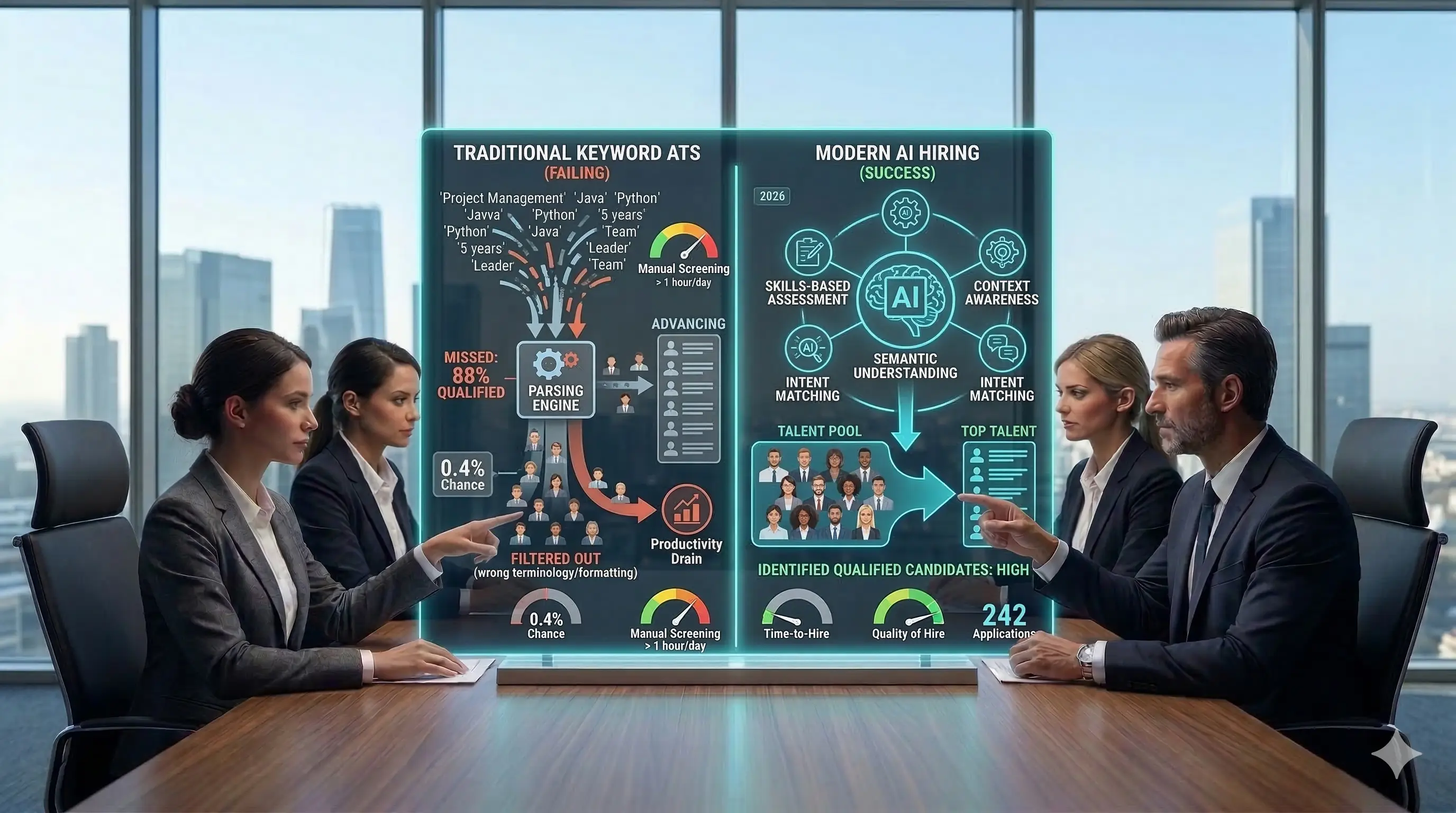
Traditional keyword-based hiring systems are failing companies in 2026. These systems miss 88% of qualified candidates while creating bottlenecks that slow down recruitment rather than streamline it.
The average job opening receives 242 applications, leaving candidates with just a 0.4% chance of landing the role. Recruiters spend more than an hour daily on manual screening and filtering, turning the ATS into a productivity drain rather than a solution. Meanwhile, strong candidates get filtered out for using different terminology or failing to format their resumes correctly.
Modern AI hiring platforms solve this problem through semantic understanding and skills-based assessment. They identify qualified candidates that keyword matching misses, while reducing time-to-hire and improving quality of hire. This guide examines why traditional systems fail, how AI hiring tools work differently, and which approach delivers better results for companies serious about competitive talent acquisition in 2026.
How Traditional ATS Systems Actually Work
The Mechanical Resume Processing Pipeline
Traditional ATS platforms function as resume databases with basic filtering capabilities. When candidates submit applications, the system strips away formatting, extracts text, and converts information into searchable fields like job titles, dates, and skills. This parsing process breaks down resumes into standardized data points that recruiters can search and filter.
The software ranks candidates by comparing resume content against job descriptions. Most systems assign numerical scores between 0 and 100 based on how closely the text matches predetermined criteria. Candidates scoring above 80% typically advance to human review.
Cloud-based platforms dominate the market, enabling remote access and global hiring workflows. The appeal is obvious: process hundreds of applications automatically rather than manually reviewing each resume.
Keyword Matching: The Core Filtering Logic
Keywords drive everything. The ATS scans for exact terms pulled directly from job descriptions—specific skills, job titles, certifications, and responsibilities. Frequency matters. Relevance matters. Context does not.
If a job posting requests "project management," the system searches for that precise phrase. Variations like "managed projects" or "project leadership" receive lower scores or get missed entirely. This literal matching approach rewards candidates who mirror job description language exactly.
Systems grade both keyword appearance and placement within sections. A skill mentioned in the summary, skills section, and work experience carries more weight than one listed only once.
Why Companies Adopted Automated Screening
The numbers explain widespread adoption. 90% of Fortune 500 companies rely on ATS technology to handle application volume. With 75% of recruiters using some form of automated tracking, these systems became standard infrastructure.
Companies needed solutions for time-consuming manual processes. Recruiters were spending hours daily on initial screening tasks that software could handle instantly. The promise was simple: reduce time-to-hire while maintaining consistency in candidate evaluation.
Where Keyword Matching Breaks Down
The rigid approach creates significant blind spots. 88% of employers acknowledge missing highly qualified candidates because resumes lack specific keywords or ATS-friendly formatting.
The filtering is aggressive. 75% of resumes never reach human reviewers due to automated screening. Up to 70% get rejected before recruiters see them. These systems eliminate candidates not because they lack skills, but because they fail to use the exact terminology the algorithm expects.
This mechanical approach treats hiring like a keyword search rather than an evaluation of human capability.
Why Keyword Matching Creates More Problems Than Solutions
Keyword-based screening fails because it rewards gaming over capability. 70% of job seekers now admit to optimizing their resumes to beat these systems. This creates an environment where algorithm manipulation matters more than actual qualifications.
Resume Manipulation Pushes Wrong Candidates Forward
Candidates respond to rigid filtering by stuffing resumes with keywords. This pushes unqualified applicants to the top while stronger candidates get overlooked.
A software engineer with eight years of Python experience gets auto-rejected for writing "Python" instead of "Python programming." Someone from a weekend bootcamp who listed every keyword variation passes screening. Modern ATS can detect hidden keywords and white text tactics, yet excessive repetition still makes resumes unreadable to human reviewers.
Different Terminology Eliminates Qualified Talent
Systems miss qualified candidates who use different terminology. A data scientist might not make the cut if the system searches for "information analysis" instead. Job titles vary substantially across industries, but ATS platforms treat them as standard elements.
This inflexible approach eliminates candidates with relevant experience expressed through alternative phrasing.
Transferable Skills Remain Invisible
Traditional keyword matching struggles with transferable skills and unconventional career paths. Marketing professionals with deep customer analytics knowledge could excel in data-driven product management roles, yet get filtered out without previous product manager titles.
Companies using AI hiring software report better identification of transferable competencies.
Critical Soft Skills Go Undetected
ATS cannot evaluate how candidates resolve conflict, make decisions, or influence others. These soft skills require human intervention to assess properly. Context around leadership potential remains invisible to keyword algorithms.
Historical Bias Gets Replicated
AI systems trained on biased historical data replicate those biases. Amazon abandoned its AI hiring tool after it showed bias against female candidates, penalizing resumes containing terms like "women's". An IBM study found white applicants received 36% more callbacks than black counterparts.
The fundamental problem is clear: keyword matching evaluates resume optimization skills, not job performance capability.
How AI Hiring Platforms Work Differently
AI hiring platforms abandon keyword matching entirely. These systems evaluate candidate capability through direct skills assessment rather than resume parsing.
Skills-Based Assessment Over Resume Parsing
Skills-based hiring evaluates how candidates handle actual work through work sample tests, skills assessments, and role simulations tied to real job responsibilities. This approach proved more predictive because it replaces superficial proxies with evidence. Companies implementing skills-based methods report that 90% made better hires when focusing on capabilities rather than degrees, with 94% observing that skills-based hires outperform those selected through traditional credentials.
This eliminates the guesswork that traditional resume screening creates. Instead of inferring skills from job titles or education credentials, AI platforms test actual competency. A candidate's ability to write clean code, analyse data, or solve complex problems becomes directly measurable.
Natural Language Processing and Semantic Understanding
NLP algorithms analyze and parse resumes by identifying relevant skills, experiences, and qualifications. Unlike keyword-based approaches, NLP understands context and semantic meaning, leading to more accurate candidate-job fit assessments. The technology extracts complex data from resumes and converts unstructured text into structured, analyzable information.
Semantic understanding means the system recognises when a "Marketing Manager" has relevant experience for a "Growth Marketing" role, even without exact title matches. Context matters more than literal word matching.
Predictive Analytics for Job Performance
Predictive systems forecast a candidate's likelihood of on-the-job success by processing vast datasets and previous placement outcomes. These predictions analyze factors like responsiveness, past performance records, and tenure at similar companies, providing recruiters with objective, data-driven scores. AI can cut time to hire by 60% or more through instant processing of repetitive tasks.
The system learns from successful placements to identify patterns that predict performance. This data-driven approach replaces gut feelings with statistical models trained on real hiring outcomes.
Anti-Cheating Technology and Assessment Integrity
Proctoring systems use multi-camera arrangements, screen monitoring, eye-gaze tracking, and speech cadence analysis to detect abnormal behavior. Platforms deploy Suspicion Score technology that combines multiple factors to assess whether submissions represent authentic candidate work. In 2025, 35% of proctored assessments were flagged, more than double the rate from the year before.
Assessment integrity ensures that skills verification reflects genuine capability. Advanced proctoring eliminates the possibility of external assistance or impersonation during testing.
Integration with Existing Recruitment Workflows
Modern AI hiring software integrates with HR systems so that candidate data moves securely and automatically between platforms without manual exports. Platforms provide dashboards displaying real-time hiring data, revealing where processes slow down and how candidates move through pipelines.
This integration eliminates the manual data entry and system switching that consumes recruiter time. Everything flows through a unified workflow that maintains data consistency across platforms.
Which System Fits Your Hiring Needs
Traditional ATS platforms serve a specific purpose, but that purpose is shrinking rapidly. The decision comes down to hiring volume, quality standards, and competitive pressure.
When Traditional ATS Still Works
Small businesses hiring fewer than 20 people annually can manage with traditional systems. Basic tracking and compliance needs don't require sophisticated AI analysis. Low application volumes make manual review feasible, and simple systems match simple requirements.
Traditional platforms remain viable when hiring stays predictable and organizational needs center on record-keeping rather than candidate evaluation. If your biggest challenge is organizing resumes rather than finding quality talent, traditional ATS suffices.
Why Growing Companies Need AI-Powered Systems
Organizations receiving 100+ applications per position cannot compete using keyword matching. The math is straightforward: manual screening becomes impossible, and traditional filtering misses too many qualified candidates.
Growing companies benefit from AI platforms that handle multiple simultaneous openings without recruiter burnout. These systems become essential when hiring quality directly impacts business growth and competitive positioning.
Firms prioritizing diversity goals and long-term retention see measurably stronger results with AI platforms that evaluate candidate potential beyond resume formatting.
The Real Cost of Each Approach
Traditional systems appear cheaper initially but hide substantial costs in recruiter time and employee turnover. AI recruitment delivers 50% cost savings with organizations reporting positive ROI within 3-6 months of implementation.
Companies using AI reduce hiring time by 50% while improving hire quality by 20%. These improvements compound over time as better hires stay longer and perform better.
The cost difference becomes stark at scale. Traditional systems require more human hours per hire, while AI systems process thousands of applications automatically.
Implementation Reality Check
AI platform deployment typically requires 2-6 months depending on organizational size and data readiness. Smaller organizations complete implementation in six to ten weeks, while larger enterprises need four to six months for complex integrations and governance reviews.
Phased rollouts starting with high-volume roles prevent support overload and improve adoption rates. Most organizations see immediate time savings in their pilot roles, building confidence for broader deployment.
The implementation timeline should align with hiring calendar peaks to maximize immediate impact.
Traditional ATS vs. AI Hiring Platforms: The Clear Choice
The performance gap between traditional ATS systems and AI hiring platforms is no longer debatable. Here's how they compare on the factors that actually matter for hiring success.
Factor
Traditional ATS
AI Hiring Platform
Screening Method
Keyword matching and resume parsing
Skills-based assessment and semantic understanding
Qualified Candidate Success Rate
88% of employers miss qualified candidates due to keyword filtering
90% of companies report better hiring decisions when focusing on actual capabilities
Cost and ROI
Lower upfront costs but hidden expenses in recruiter time and turnover
50% cost reduction with positive ROI within 3-6 months
Time to Hire
Manual screening consumes over 1 hour daily per recruiter
60% faster hiring through automated assessment
Quality of Hire
No measurable improvement in candidate success rates
20% improvement in hire quality; 94% report skills-based hires outperform credential-based selections
Best For
Small businesses with minimal hiring (under 10 roles annually)
Organizations with 100+ applications per position
Bias and Fairness
Reinforces historical biases; 75% of resumes never reach human review
Advanced anti-cheating technology; 35% of assessments flagged for integrity issues
Implementation
Basic setup and training
2-6 months depending on organization size
The data tells a clear story. Traditional ATS systems filter out qualified candidates while AI platforms identify them. The choice depends on your hiring volume and commitment to quality.
Conclusion
Traditional ATS systems miss 88% of qualified candidates through rigid keyword matching, while AI hiring platforms deliver 50% cost savings and 20% better hire quality. The choice ultimately depends on hiring volume and organizational goals. Small businesses with minimal recruitment needs can stick with traditional systems. Growing companies receiving 100+ applications per position should transition to AI platforms. Skills-based assessment consistently outperforms resume parsing, making AI the clear winner for competitive talent acquisition in 2026.
FAQs
Q1. What percentage of companies currently use AI in their recruitment process? Approximately 88% of companies worldwide have integrated AI somewhere in their recruitment process as of 2026, with 93% of recruiters planning to increase their AI usage. This represents a fundamental shift from traditional hiring methods to AI-powered screening systems.
Q2. Why do traditional ATS systems reject so many qualified candidates? Traditional ATS systems rely on rigid keyword matching that filters out candidates who use different terminology or formatting. About 88% of employers acknowledge that their automated screening systems miss highly qualified candidates, with up to 75% of resumes never reaching human reviewers due to keyword mismatches or formatting issues.
Q3. How much faster are AI-powered hiring systems compared to manual screening? AI-powered systems process resumes approximately 80% faster than manual screening methods. Companies using AI-augmented platforms report a 55-60% reduction in time-to-hire, with some organizations cutting their overall hiring time by 50% while simultaneously improving hire quality by 20%.
Q4. Should I still optimize my resume with keywords for modern ATS systems? Yes, but the approach has changed. Modern systems use natural language processing to understand context and synonyms, but exact terminology from job descriptions still carries weight. Focus on placing skills in a dedicated section near the top of your resume using industry-standard language, rather than simply stuffing keywords throughout the document.
Q5. When does it make sense to use a traditional ATS instead of an AI hiring platform? Traditional ATS systems remain suitable for small businesses with low hiring volumes (only a few hires annually) and limited budgets. If your organization receives fewer than 100 applications per position and primarily needs basic tracking and compliance features, a traditional system may be sufficient for your needs.